

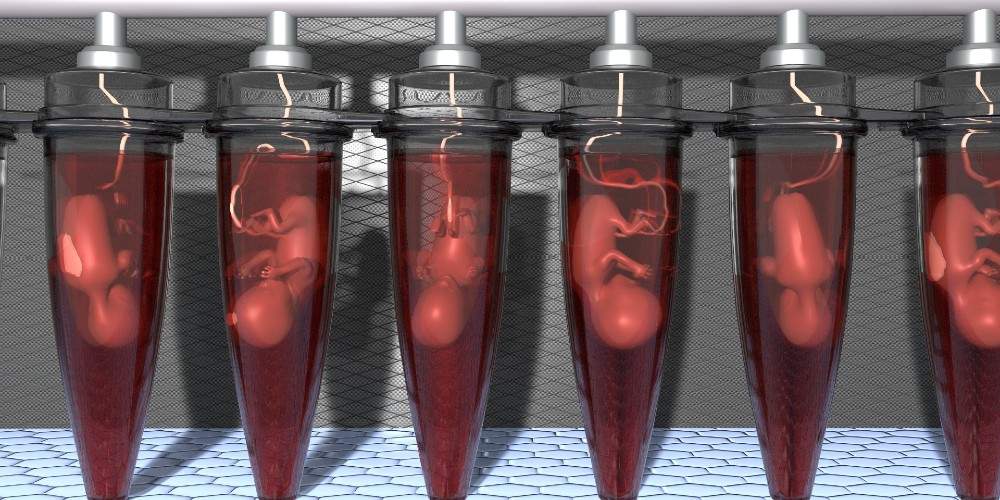

Will artificial wombs replace natural gestation? Until very recently, that notion was a far-fetched conjuring out of futuristic novels such as “Brave New World.” But research that could make this dystopian prospect a reality is fast advancing. Scientists have already gestated premature lambs in artificial wombs and brought mouse fetuses halfway through gestation in such devices—meaning that gestational vats for humans could be operational within the next few decades.
What might such a development mean for human society? A science communicator named Hashem Al-Ghaili just produced a fictional video that illustrates the disturbing potential. The video depicts the product advertisement of an artificial womb company called EctoLife that engages in the mass artificial gestation of human babies created by IVF, infants genetically engineered for eugenics purposes such as high intelligence, physical strength, and hair color.
The faux promotional for the industrialized baby farm coos, “Say goodbye to the pain of childbirth and birth-related muscle contractions. EctoLife provides a safe, pain-free alternative that helps you deliver your baby without stress. The delivery process is smooth, convenient, and can be done with just a push of a button.”
How interested are people in this dehumanizing potential? Very, it seems. Al-Ghaili’s video has already been viewed more than 1.6 million times on YouTube.
We don’t yet have artificial wombs available for human use. But the kind of experiments needed to allow industrialized baby farming are advancing at a breakneck pace. A researcher in China already genetically engineered babies for eugenics purposes. The International Society for Stem Cell Research—which establishes the voluntary ethical guidelines for experimenting on human embryos—in 2021 discarded its “14-Day Rule” that set a two-week time limit on such research, meaning that experiments on more-developed embryos and fetuses that would be required to perfect an artificial womb can proceed apace.
As to the ethics of the matter, many bioethicists swoon at the idea of bringing forth babies without the need for natural gestation.
How should we think about such a development? That’s a profound question. For now, let’s focus on how artificial wombs would denigrate the importance of natural motherhood.
Why? Gestation isn’t simply a matter of having a uterus. The gestational process itself is crucial to a baby’s healthy development and bonding with her mother. For example, a gestating baby can hear her mother’s voice and may begin the process of language development while still in the womb, which is why many experts recommend that pregnant women talk and sing to their baby. Beyond that, maternal bonding pre-birth can make for healthier post-natal development. As one recent research paper reported, “higher maternal bonding contributing to infant developmental outcomes, including higher attachment quality … lower colic rating, easier temperament, and positive infant mood.”
Little of that would happen in a “growth pod.”
“Mothers and babies don’t bond and develop attachments after birth but during the entire pregnancy,” Jennifer Lahl, president and founder of the Center for Bioethics and Culture Network, told me. “It cannot be outsourced to an unnatural environment without significant short and long-term consequences to mother and baby.”
Baby Farming Is Already Here
Many might object to EctoLife. But why? We are already desensitized to the moral values that would enable the commercial development of a mass birthing industry. Indeed, such a multibillion-dollar trade already exists. Commercial fertility companies charge want-to-be parents who cannot—or refuse to—become pregnant huge fees to grow and harvest a baby. This is often done by performing IVF and then implanting genetically tested embryos—as in the video—into the uterus of a surrogate mother who’s paid to gestate and give birth.
Surrogates receive little respect for their trouble. They aren’t even called “mothers” but are known in dehumanizing industry parlance as “gestational carriers.” These women are commonly denied any right to participate in the life of the child they carried and may have bonded with for nine months, and the baby loses contact with the mother with whom he or she bonded during the pregnancy. Surrogates may even be denied the right to simply hold the baby after birth.
Moreover, surrogacy contracts may require abortion if the baby has a perceived defect or is otherwise no longer wanted, a requirement that has led to bitter litigation. Nor is there necessarily a requirement that the baby-buying parents accept their special order. For example, a few years ago, an Australian couple paid a Thai woman to gestate two children but refused to take one home because he had Down syndrome.
A Washington Post story from a few years ago details how these technologies are commoditizing childbirth in the very ways that the fictional EctoLife commercial depicts:
“The multibillion-dollar fertility industry is booming and experimenting with business models that are changing the American family in new and unpredictable ways. Would-be parents seeking donor eggs and sperm can pick and choose from long checklists of physical and intellectual characteristics. Clinics now offer volume discounts.”
One California fertility center “is pioneering what some refer to as the ‘Costco mode of babymaking,’ creating batches of embryos using donor eggs and sperm that can be shared among several different families.”
Other than the artificial womb part and mass scale of the enterprise, how’s the commercial surrogacy industry materially different in morals and outcomes than the still-fictional high-tech baby farms?
Industrialized artificial womb baby manufacturing would undermine the essence and meaning of motherhood, which heretofore has been considered a special, and indeed, almost sacred calling. But our existing commercialized fertility business model is already transforming birthing babies into a crass gestational service industry complete with quality control and, even, the right to refuse delivery.
No wonder so many people have watched Al-Ghaili’s video. We are already inured to the dehumanized values for childbirth presented in the film. All that remains to go from inefficient surrogates to mass-producing infants is the perfection of the artificial technology.
Article cross-posted from our premium news partners at The Epoch Times.
Safeguarding Your American Dream: Discover the Power of America First Healthcare
In today’s uncertain world, where skyrocketing medical costs and bureaucratic red tape threaten the very fabric of the American way of life, protecting your family’s health and financial future has never been more critical. Medical bills remain the leading cause of bankruptcy in the U.S., with millions of hardworking Americans either uninsured, underinsured, or overburdened by premiums that don’t deliver real value. But what if there was a way to secure top-tier coverage that aligns with your conservative values, saves you money, and gives you peace of mind?
Enter America First Healthcare—a private insurance agency dedicated to empowering freedom-loving patriots like you to reclaim control over your healthcare destiny.
Founded by Jordan Sarmiento, a dynamic entrepreneur and former touring musician who knows firsthand the highs and lows of navigating America’s complex insurance landscape, America First Healthcare stands as a beacon for those who believe in small government, personal responsibility, and the enduring American Dream. Jordan’s own journey underscores the company’s mission: after a harrowing six-day hospital stay that racked up a $95,000 bill, his Conservative Care Coverage through America First Healthcare reduced his out-of-pocket expenses to just $500. This isn’t just insurance—it’s a shield against the financial pitfalls that plague so many families, ensuring you’re prepared for life’s unexpected turns without sacrificing your principles.
At its core, America First Healthcare is about more than policies; it’s about shared values. In an era where “woke” policies and liberal ideologies seem to infiltrate every corner of society, this agency prioritizes serving conservatives who value freedom and self-reliance. They offer a suite of essential services designed to fortify your life, including:
- Health Insurance: Tailored plans that keep your family healthy and ready to thrive, addressing the gaps that leave 41 million Americans vulnerable to preventable chronic diseases and inadequate coverage.
- Life Insurance: Protection that secures your loved ones’ future, ensuring your legacy endures.
- Business Insurance: Safeguards for your enterprise, preserving the income that fuels your independence.
What sets America First Healthcare apart is their commitment to personalization and savings. Start with their complimentary Free Insurance Review, where experts evaluate your current policies to uncover hidden gaps, eliminate over insurance, and potentially slash your costs by up to 20%. Whether you’re among the 27 million uninsured, the 44% underinsured on marketplace plans, or the 33% feeling squeezed by high premiums, their team crafts customized solutions that deliver better coverage at rates that respect your wallet. And with ongoing support from advisors who share your worldview, you’ll never feel alone in the fight for affordable, reliable protection.
Clients rave about the difference America First makes. Families across the nation have switched to better health insurance for less, resting easy knowing they’ve partnered with a company that puts America first. As one satisfied customer might say, it’s not just about policies—it’s about preserving the freedoms that make this country great.
Don’t let liberal overreach or financial uncertainty derail your dreams. Take the first step toward unbreakable security today by visiting for your Free Insurance Review. With America First Healthcare, you’re not just insured—you’re empowered to live the life you deserve. Act now, because your American Dream is worth protecting.

Stop the sliding advertising. It’s distracting and annoying.
I’ll be waiting to hear how God addresses the issue.
The problem is that whatever God says about this matter will be either ignored, suppressed or defamed by our corrupt marxist baby killing misleadia.
Psalm 2
1 Why do the heathen rage, and the people imagine a vain thing?
2 The kings of the earth set themselves, and the rulers take counsel together, against the Lord, and against his anointed, saying,
3 Let us break their bands asunder, and cast away their cords from us.
4 He that sitteth in the heavens shall laugh: the Lord shall have them in derision.
My comment is too obvious, so I’ll keep quiet. Don’t want to be called a rascist or something like that.
I am opposed of course, but I have to point out that the existence of such technology means viability outside the mother’s womb now begins at the moment of conception. You can’t cogently argue that a baby inside one of these things is part of its mother’s body. Abortion is murder.
An artificial womb will save lives. But of course it can also be used for evil. That’s true of every technology. We need not let that stop the good. Just do right yourself.