

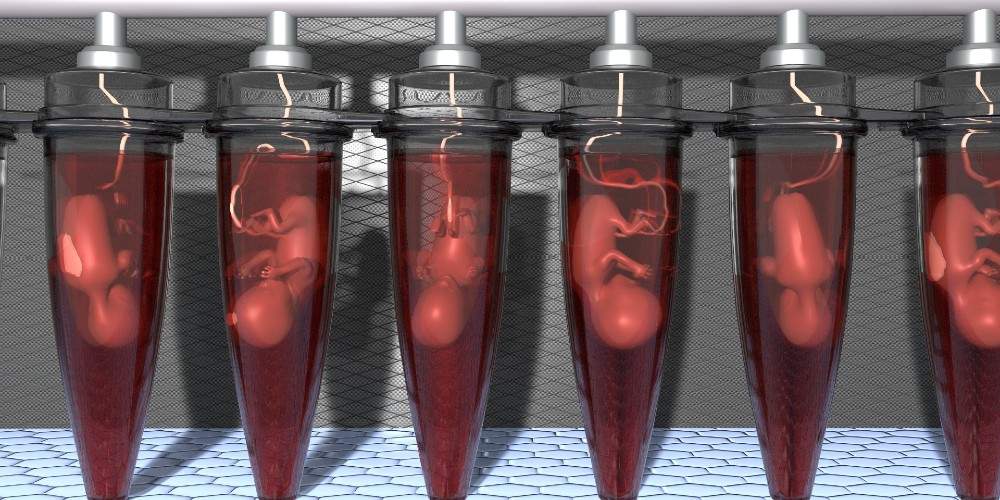

Will artificial wombs replace natural gestation? Until very recently, that notion was a far-fetched conjuring out of futuristic novels such as “Brave New World.” But research that could make this dystopian prospect a reality is fast advancing. Scientists have already gestated premature lambs in artificial wombs and brought mouse fetuses halfway through gestation in such devices—meaning that gestational vats for humans could be operational within the next few decades.
What might such a development mean for human society? A science communicator named Hashem Al-Ghaili just produced a fictional video that illustrates the disturbing potential. The video depicts the product advertisement of an artificial womb company called EctoLife that engages in the mass artificial gestation of human babies created by IVF, infants genetically engineered for eugenics purposes such as high intelligence, physical strength, and hair color.
The faux promotional for the industrialized baby farm coos, “Say goodbye to the pain of childbirth and birth-related muscle contractions. EctoLife provides a safe, pain-free alternative that helps you deliver your baby without stress. The delivery process is smooth, convenient, and can be done with just a push of a button.”
How interested are people in this dehumanizing potential? Very, it seems. Al-Ghaili’s video has already been viewed more than 1.6 million times on YouTube.
We don’t yet have artificial wombs available for human use. But the kind of experiments needed to allow industrialized baby farming are advancing at a breakneck pace. A researcher in China already genetically engineered babies for eugenics purposes. The International Society for Stem Cell Research—which establishes the voluntary ethical guidelines for experimenting on human embryos—in 2021 discarded its “14-Day Rule” that set a two-week time limit on such research, meaning that experiments on more-developed embryos and fetuses that would be required to perfect an artificial womb can proceed apace.
As to the ethics of the matter, many bioethicists swoon at the idea of bringing forth babies without the need for natural gestation.
How should we think about such a development? That’s a profound question. For now, let’s focus on how artificial wombs would denigrate the importance of natural motherhood.
Why? Gestation isn’t simply a matter of having a uterus. The gestational process itself is crucial to a baby’s healthy development and bonding with her mother. For example, a gestating baby can hear her mother’s voice and may begin the process of language development while still in the womb, which is why many experts recommend that pregnant women talk and sing to their baby. Beyond that, maternal bonding pre-birth can make for healthier post-natal development. As one recent research paper reported, “higher maternal bonding contributing to infant developmental outcomes, including higher attachment quality … lower colic rating, easier temperament, and positive infant mood.”
Little of that would happen in a “growth pod.”
“Mothers and babies don’t bond and develop attachments after birth but during the entire pregnancy,” Jennifer Lahl, president and founder of the Center for Bioethics and Culture Network, told me. “It cannot be outsourced to an unnatural environment without significant short and long-term consequences to mother and baby.”
Baby Farming Is Already Here
Many might object to EctoLife. But why? We are already desensitized to the moral values that would enable the commercial development of a mass birthing industry. Indeed, such a multibillion-dollar trade already exists. Commercial fertility companies charge want-to-be parents who cannot—or refuse to—become pregnant huge fees to grow and harvest a baby. This is often done by performing IVF and then implanting genetically tested embryos—as in the video—into the uterus of a surrogate mother who’s paid to gestate and give birth.
Surrogates receive little respect for their trouble. They aren’t even called “mothers” but are known in dehumanizing industry parlance as “gestational carriers.” These women are commonly denied any right to participate in the life of the child they carried and may have bonded with for nine months, and the baby loses contact with the mother with whom he or she bonded during the pregnancy. Surrogates may even be denied the right to simply hold the baby after birth.
Moreover, surrogacy contracts may require abortion if the baby has a perceived defect or is otherwise no longer wanted, a requirement that has led to bitter litigation. Nor is there necessarily a requirement that the baby-buying parents accept their special order. For example, a few years ago, an Australian couple paid a Thai woman to gestate two children but refused to take one home because he had Down syndrome.
A Washington Post story from a few years ago details how these technologies are commoditizing childbirth in the very ways that the fictional EctoLife commercial depicts:
“The multibillion-dollar fertility industry is booming and experimenting with business models that are changing the American family in new and unpredictable ways. Would-be parents seeking donor eggs and sperm can pick and choose from long checklists of physical and intellectual characteristics. Clinics now offer volume discounts.”
One California fertility center “is pioneering what some refer to as the ‘Costco mode of babymaking,’ creating batches of embryos using donor eggs and sperm that can be shared among several different families.”
Other than the artificial womb part and mass scale of the enterprise, how’s the commercial surrogacy industry materially different in morals and outcomes than the still-fictional high-tech baby farms?
Industrialized artificial womb baby manufacturing would undermine the essence and meaning of motherhood, which heretofore has been considered a special, and indeed, almost sacred calling. But our existing commercialized fertility business model is already transforming birthing babies into a crass gestational service industry complete with quality control and, even, the right to refuse delivery.
No wonder so many people have watched Al-Ghaili’s video. We are already inured to the dehumanized values for childbirth presented in the film. All that remains to go from inefficient surrogates to mass-producing infants is the perfection of the artificial technology.
Article cross-posted from our premium news partners at The Epoch Times.

How to Prepare for Food Emergencies if You Don’t Have a Homestead or Bunker
In an unpredictable world, where supply chain disruptions, natural disasters, or economic instability can strike without warning, having a reliable food supply is more than just smart—it’s essential for survival. Whether you’re a “prepper” or not, we all know the golden rule: self-sufficiency is key. But what if you’re living in an apartment, working long hours, or simply don’t have the land to turn into a thriving homestead? Don’t worry; there’s a practical, effective way to build your food security without needing acres of soil or a fortified bunker.
The Ideal Prep: Building Your Own Food Empire
The ultimate dream for any serious prepper is controlling your own food production. Imagine waking up to a sprawling garden bursting with fresh vegetables, fruits, and herbs—tomatoes ripening on the vine, potatoes ready to harvest, and greens that provide nutrition year-round. Add in livestock like chickens for eggs and meat, and you’ve got a self-sustaining system that keeps your family fed no matter what chaos unfolds outside.
This approach isn’t just about calories; it’s about resilience. A well-maintained garden can yield hundreds of pounds of produce annually, while a small flock of chickens might produce dozens of eggs weekly. It’s empowering, cost-effective in the long run, and teaches invaluable skills like crop rotation, animal husbandry, and preservation techniques. If you have the space, time, and resources, starting small and scaling up is the best path to true independence.
The Reality Check: Not Everyone Can Homestead
But let’s face it—not all of us are in a position to go full homesteader. Urban dwellers might be limited to a balcony or community plot that’s far from sufficient for long-term needs. Busy professionals juggling jobs, families, and daily life often lack the hours required for daily tending. And for those in apartments, condos, or regions with harsh climates, raising livestock or maintaining a large garden simply isn’t feasible. Factors like zoning laws, soil quality, water access, or even physical limitations can make this ideal out of reach.
That’s where the frustration sets in. You want to be prepared, but without a homestead or bunker, how do you ensure your pantry doesn’t run dry during a prolonged crisis? The good news is, you don’t have to sacrifice your preparedness goals. There’s a smart, accessible alternative that bridges the gap: investing in high-quality, long-term storage food.
The Smart Alternative: Long-Term Storage Food from Heaven’s Harvest
Long-term storage food is designed for exactly these scenarios—providing nutrient-dense, shelf-stable meals that last for decades without refrigeration or special conditions. It’s the perfect solution for preppers who can’t rely on fresh production but still demand reliability and variety in their emergency stockpile.
At Heaven’s Harvest, they specialize in premium survival food kits that make preparedness effortless. Their products are crafted with the prepper mindset in mind: non-GMO, made in the USA, and packed with real ingredients that taste like home-cooked meals, not bland rations. Whether you’re stocking up for a short-term blackout or a long-haul SHTF event, our kits offer:
- Extended Shelf Life: Up to 25 years of storage, so you can buy once and forget about rotation worries.
- Nutritional Balance: High-protein entrees, fruits, vegetables, and dairy alternatives to keep your energy up and health intact.
- Ease of Preparation: Just add water, and you’ve got hearty meals like beef stroganoff, chili mac, or cheesy lasagna ready in minutes—no garden weeding required.
- Customizable Options: From individual buckets to family-sized kits, scale your supply to fit your needs and budget.
- Peace of Mind: Sealed in durable, waterproof containers that protect against pests, moisture, and light.
Unlike generic store-bought cans that spoil quickly or lack variety, Heaven’s Harvest focuses on quality and sustainability. Our food is freeze-dried or dehydrated to lock in flavor and nutrients, ensuring you’re not just surviving but thriving. And for those concerned about allergens or dietary preferences, we offer gluten-free and vegetarian options to keep everyone covered.
Why Wait? Secure Your Food Supply Today
Preparing for food emergencies doesn’t require a homestead or bunker—it requires action. By choosing long-term storage food from Heaven’s Harvest, you’re taking control in a way that fits your lifestyle. Start small with a 72-hour kit to test the waters, or go all-in with a year’s supply for ultimate security.
Visit Heaven’s Harvest today and use code “PATRIOT” for an exclusive discount on your order. Don’t let limitations hold you back; build your resilient future, one meal at a time. Your family will thank you when it matters most.

Stop the sliding advertising. It’s distracting and annoying.
I’ll be waiting to hear how God addresses the issue.
The problem is that whatever God says about this matter will be either ignored, suppressed or defamed by our corrupt marxist baby killing misleadia.
Psalm 2
1 Why do the heathen rage, and the people imagine a vain thing?
2 The kings of the earth set themselves, and the rulers take counsel together, against the Lord, and against his anointed, saying,
3 Let us break their bands asunder, and cast away their cords from us.
4 He that sitteth in the heavens shall laugh: the Lord shall have them in derision.
My comment is too obvious, so I’ll keep quiet. Don’t want to be called a rascist or something like that.
I am opposed of course, but I have to point out that the existence of such technology means viability outside the mother’s womb now begins at the moment of conception. You can’t cogently argue that a baby inside one of these things is part of its mother’s body. Abortion is murder.
An artificial womb will save lives. But of course it can also be used for evil. That’s true of every technology. We need not let that stop the good. Just do right yourself.