

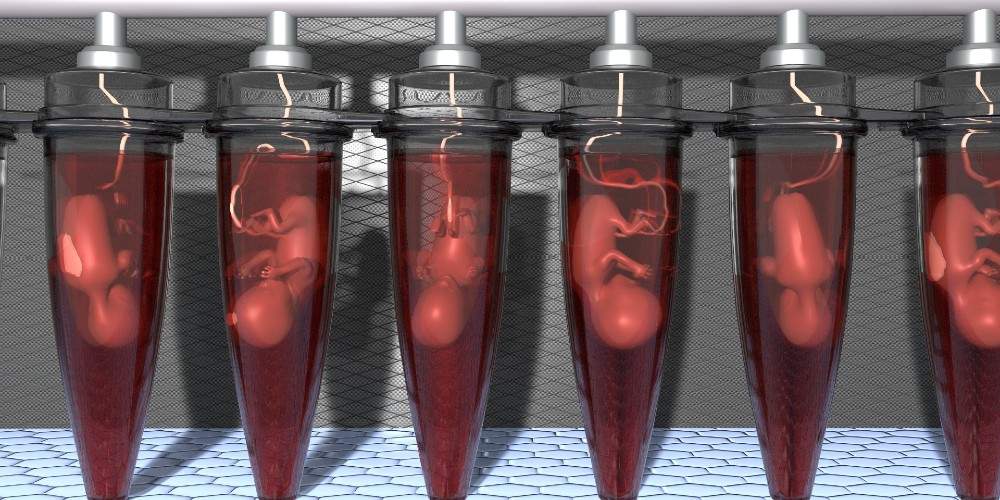
Will artificial wombs replace natural gestation? Until very recently, that notion was a far-fetched conjuring out of futuristic novels such as “Brave New World.” But research that could make this dystopian prospect a reality is fast advancing. Scientists have already gestated premature lambs in artificial wombs and brought mouse fetuses halfway through gestation in such devices—meaning that gestational vats for humans could be operational within the next few decades.
What might such a development mean for human society? A science communicator named Hashem Al-Ghaili just produced a fictional video that illustrates the disturbing potential. The video depicts the product advertisement of an artificial womb company called EctoLife that engages in the mass artificial gestation of human babies created by IVF, infants genetically engineered for eugenics purposes such as high intelligence, physical strength, and hair color.
The faux promotional for the industrialized baby farm coos, “Say goodbye to the pain of childbirth and birth-related muscle contractions. EctoLife provides a safe, pain-free alternative that helps you deliver your baby without stress. The delivery process is smooth, convenient, and can be done with just a push of a button.”
How interested are people in this dehumanizing potential? Very, it seems. Al-Ghaili’s video has already been viewed more than 1.6 million times on YouTube.
We don’t yet have artificial wombs available for human use. But the kind of experiments needed to allow industrialized baby farming are advancing at a breakneck pace. A researcher in China already genetically engineered babies for eugenics purposes. The International Society for Stem Cell Research—which establishes the voluntary ethical guidelines for experimenting on human embryos—in 2021 discarded its “14-Day Rule” that set a two-week time limit on such research, meaning that experiments on more-developed embryos and fetuses that would be required to perfect an artificial womb can proceed apace.
As to the ethics of the matter, many bioethicists swoon at the idea of bringing forth babies without the need for natural gestation.
How should we think about such a development? That’s a profound question. For now, let’s focus on how artificial wombs would denigrate the importance of natural motherhood.
Why? Gestation isn’t simply a matter of having a uterus. The gestational process itself is crucial to a baby’s healthy development and bonding with her mother. For example, a gestating baby can hear her mother’s voice and may begin the process of language development while still in the womb, which is why many experts recommend that pregnant women talk and sing to their baby. Beyond that, maternal bonding pre-birth can make for healthier post-natal development. As one recent research paper reported, “higher maternal bonding contributing to infant developmental outcomes, including higher attachment quality … lower colic rating, easier temperament, and positive infant mood.”
Little of that would happen in a “growth pod.”
“Mothers and babies don’t bond and develop attachments after birth but during the entire pregnancy,” Jennifer Lahl, president and founder of the Center for Bioethics and Culture Network, told me. “It cannot be outsourced to an unnatural environment without significant short and long-term consequences to mother and baby.”
Baby Farming Is Already Here
Many might object to EctoLife. But why? We are already desensitized to the moral values that would enable the commercial development of a mass birthing industry. Indeed, such a multibillion-dollar trade already exists. Commercial fertility companies charge want-to-be parents who cannot—or refuse to—become pregnant huge fees to grow and harvest a baby. This is often done by performing IVF and then implanting genetically tested embryos—as in the video—into the uterus of a surrogate mother who’s paid to gestate and give birth.
Surrogates receive little respect for their trouble. They aren’t even called “mothers” but are known in dehumanizing industry parlance as “gestational carriers.” These women are commonly denied any right to participate in the life of the child they carried and may have bonded with for nine months, and the baby loses contact with the mother with whom he or she bonded during the pregnancy. Surrogates may even be denied the right to simply hold the baby after birth.
Moreover, surrogacy contracts may require abortion if the baby has a perceived defect or is otherwise no longer wanted, a requirement that has led to bitter litigation. Nor is there necessarily a requirement that the baby-buying parents accept their special order. For example, a few years ago, an Australian couple paid a Thai woman to gestate two children but refused to take one home because he had Down syndrome.
A Washington Post story from a few years ago details how these technologies are commoditizing childbirth in the very ways that the fictional EctoLife commercial depicts:

“The multibillion-dollar fertility industry is booming and experimenting with business models that are changing the American family in new and unpredictable ways. Would-be parents seeking donor eggs and sperm can pick and choose from long checklists of physical and intellectual characteristics. Clinics now offer volume discounts.”
One California fertility center “is pioneering what some refer to as the ‘Costco mode of babymaking,’ creating batches of embryos using donor eggs and sperm that can be shared among several different families.”
Other than the artificial womb part and mass scale of the enterprise, how’s the commercial surrogacy industry materially different in morals and outcomes than the still-fictional high-tech baby farms?
Industrialized artificial womb baby manufacturing would undermine the essence and meaning of motherhood, which heretofore has been considered a special, and indeed, almost sacred calling. But our existing commercialized fertility business model is already transforming birthing babies into a crass gestational service industry complete with quality control and, even, the right to refuse delivery.
No wonder so many people have watched Al-Ghaili’s video. We are already inured to the dehumanized values for childbirth presented in the film. All that remains to go from inefficient surrogates to mass-producing infants is the perfection of the artificial technology.
Article cross-posted from our premium news partners at The Epoch Times.


Starting the Day With a Scripture-Inspired Roast Helps Center Your Thoughts on Eternal Truths Amid Temporal Pressures
The world can seem chaotic, especially right after we wake up. Many believers start their mornings reaching for something familiar — a hot cup of coffee — yet end up settling for mediocre brews that do little more than deliver a caffeine jolt. The daily grind of life, with its endless distractions, news cycles, and responsibilities, can leave even the most faithful feeling spiritually parched alongside their physical fatigue. What if your morning ritual could do more than wake you up? What if it could ground you in truth, nourish your body with exceptional quality, and quietly advance a kingdom purpose at the same time?
That’s the promise — and the reality — behind Promised Grounds Coffee. This Christian-founded company doesn’t just roast beans; it approaches every step as an act of worship and discipleship. By selecting only the top 10% of specialty-grade beans, ethically sourced from dedicated farmers in Central and South America, and small-batch roasting them with reverence in Austin, Texas, Promised Grounds delivers what many describe as the best coffee available — never burnt, never bland, but rich with origin stories and layered flavors that honor God’s creation.
From the vibrant Psalm 27 Roast (a light, bright medium option) to the bold yet peaceful 2 Timothy 1:7 Decaf, each bag carries a Scripture verse that turns your daily pour into a gentle reminder of faith. And through their Ounce Per Ounce Promise, every ounce of coffee you enjoy provides an equal ounce of clean water to families in need via partnership with Filter of Hope — literally brewing hope for body and soul, one cup at a time.
The challenge for today’s Christians runs deeper than finding a decent cup. In an age of convenience-driven consumerism, it’s easy to support companies that dilute values or remain silent on matters of faith. Many believers want their everyday choices — from what they drink to how they spend — to reflect discipleship rather than just convenience. Promised Grounds solves this by weaving Christian excellence into the entire process: beans nurtured with prayerful stewardship by farming families, roasted as an offering rather than a commodity, and packaged with Bible verses to encourage a mindset of gratitude and purpose from the first sip. Reviewers consistently praise the smooth, rich profiles — whether enjoyed black in a drip maker, iced on a warm day, or shared in fellowship — noting how the quality stands toe-to-toe with premium secular brands while delivering something far more meaningful.
This integration of faith and flavor addresses a real need in Christian households and ministries. Busy parents, church leaders, and remote workers alike report that starting the day with a Scripture-inspired roast helps center their thoughts on eternal truths amid temporal pressures. The coffee’s exceptional character — bright citrus notes in lighter roasts or deep chocolate undertones in bolder ones — comes from meticulous selection and careful roasting that respects the bean’s natural gifts rather than masking them. It’s the kind of coffee that elevates a simple quiet time, fuels productive workdays, or sparks meaningful conversations when shared at Bible studies or outreach events. And because it’s ethically sourced with integrity, every purchase supports sustainable livelihoods for farmers who treat their crops like family harvests.
For those leading churches or small groups, the impact multiplies. Promised Grounds offers bundles and options perfect for hospitality ministries, turning ordinary coffee service into an opportunity to point people toward the living water of Christ. Imagine greeting visitors with a warm cup whose very bag carries God’s Word — a subtle yet powerful witness that aligns with the Great Commission. The company’s Texas roots and commitment to “brewing hope” resonate especially with believers who value American enterprise paired with global compassion.
Of course, quality alone isn’t enough if the experience feels out of reach. Promised Grounds keeps it accessible with practical perks like free shipping on orders over $40, sample sets for discovering favorites, and thoughtful add-ons such as faith-themed mugs. Whether you prefer whole beans for fresh grinding, grounds for convenience, or even bulk options for larger households and ministries, the result is consistently superior coffee that makes discipleship feel integrated rather than added on.
As you consider how to align even the smallest habits with your walk with God, Promised Grounds Coffee stands out as a refreshing solution. It tackles the dual problems of subpar daily sustenance and disconnected consumption by offering a product that genuinely excels in taste while advancing a mission of clean water, farmer dignity, and scriptural encouragement. Believers who make the switch often describe it as more than a beverage upgrade — it becomes part of their rhythm of gratitude, a daily invitation to remember that every good gift comes from above.
If you’re ready to transform your mornings (and perhaps your church gatherings) with coffee that honors both exceptional craftsmanship and Christian values, I encourage you to explore what Promised Grounds has to offer. One sip at a time, you’ll be nourishing your body, refreshing your spirit, and participating in something far greater — all while enjoying what truly is among the best coffee available.

Stop the sliding advertising. It’s distracting and annoying.
I’ll be waiting to hear how God addresses the issue.
The problem is that whatever God says about this matter will be either ignored, suppressed or defamed by our corrupt marxist baby killing misleadia.
Psalm 2
1 Why do the heathen rage, and the people imagine a vain thing?
2 The kings of the earth set themselves, and the rulers take counsel together, against the Lord, and against his anointed, saying,
3 Let us break their bands asunder, and cast away their cords from us.
4 He that sitteth in the heavens shall laugh: the Lord shall have them in derision.
My comment is too obvious, so I’ll keep quiet. Don’t want to be called a rascist or something like that.
I am opposed of course, but I have to point out that the existence of such technology means viability outside the mother’s womb now begins at the moment of conception. You can’t cogently argue that a baby inside one of these things is part of its mother’s body. Abortion is murder.
An artificial womb will save lives. But of course it can also be used for evil. That’s true of every technology. We need not let that stop the good. Just do right yourself.