

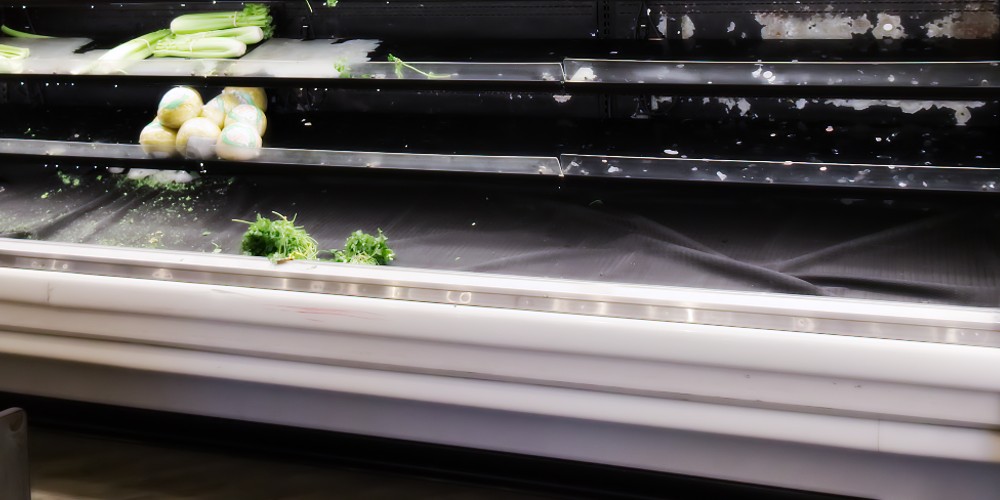
(The Organic Prepper)—In another episode of “Have We Learned Nothing from History?” two governments in the past couple of days have decided to take the high prices of food into their own hands.
Justin Trudeau, the Prime Minister of Canada, wants to heap more taxes on grocery stores to punish them for high prices. And Chicago’s mayor, Brandon Johnson, has proposed city-owned grocery stores.
Some other times the government has taken control of the food supply
Historically, it’s the beginning of the end for people when the government begins to interfere with food pricing, production, and distribution. Just look at some of the rules that were established in Venezuela that led to widespread hunger. The government took control of food production facilities. They began forcing farmers to produce food for less than the cost of growing or raising it. They rationed food to families. They even began to track people who were growing their own food. In short, every terrible decision it was possible to make, they made. And the people suffered for it.
There’s an article by a friend of mine, Scott Terry, that I always cite when talking about the collectivization of food. He wrote a concerning history of this troubling phenomenon right here in America and it’s well worth a read. His article is specifically about agriculture but the same principles hold true of other governmental controls on food.
In short, he concludes that:
There are several reasons why the collectivists want to destroy agriculture in America.
The first being that the farmer has traditionally been the great stumbling block to communism and totalitarianism. Stalin found this out the hard way and had to murder seven million ( 7,000,000) Ukrainian farmers by starvation. One cannot enslave a population of independent freeholders. They must be removed one way or another.
The second reason is that the easiest way to control people is through food. There are executive orders on the books that give the federal government the power to confiscate and nationalize the nations agricultural resources. Now, it is much easier to control a handful of farms as opposed to controlling several million farms. These plans have been on the books for many years (and always renewed by all subsequent presidents) and help explain why the USDA has always encouraged farmers to “get big or get out”. No industry in America has seen more consolidation than agriculture.
Stalin starved as many as 7 million Ukrainians during the Holomodor. China’s Great Famine was the result of governmental decisions and 30 million people died of starvation. Ethiopia has been accused of deliberately starving its own citizens. North Korea has such stringent rules around who can have food and what they can have that people starve to death in the middle of wheat fields because their harvests go to the government.
In short, it’s always ALWAYS a terrible idea.
What does Justin Trudeau want to do?
The heads of Canada’s largest grocery store chains were hastily summoned to the capitol in Ottawa to discuss plans to “stabilize food prices” after PM Trudeau issued an ultimatum:
The meeting was the result of Prime Minister Justin Trudeau declaring on Friday that he was summonsing top officials from Loblaw, Metro, Empire, Walmart and Costco to begin discussions to address what a House committee has long been studying(opens in a new tab): the escalating price of groceries in Canada.
Trudeau’s ultimatum was(opens in a new tab): Come up with a credible plan by Thanksgiving or he’ll consider “the use of tax measures in order to restore the grocery price stability that Canadians expect.”
“Such actions must not negatively impact small suppliers or the price that farmers receive for their products, nor should they impact pricing mechanisms as determined by supply-managed industries,” Champagne’s office said Monday, elaborating on the government’s expectations.
Trudeau seems to think that the stores are rolling in money.
“Trudeau said food is “too expensive for too many families,” and said given these major grocery chains are making “record profits” he plans to “hold them to account.”
Of course, putting it solely on the backs of grocery store chains without also including producers means that the stores will lose money. And what happens when a product line isn’t profitable? Oh. They stop selling those products.
What could possibly go wrong?
Meanwhile in Chicago…
In Chicago, stores like Walmart and Whole Foods have shut their doors in certain neighborhoods, creating food deserts. Mayor Brandon Johnson has a plan for that.
Spoiler: It’s not tackling the high levels of crime that may have caused the exodus in the first place. (Though it’s important to note that neither Walmart nor Whole Foods has publicly given a reason for closing the stores aside from a vague “lack of profit” statement.) But our American cities are under siege by shoplifters, as we’ve noted here recently. This article suggests that crime is very likely the cause of the closures.
One explanation could be the shoplifting epidemic taking over America, which has seen retailers struggling to cope with the consequence-less pilfering, stripping them of revenue that’s also led to the closure of a “landmark” grocery store in Baltimore that shut its doors after nearly 25 years.
Experts have blamed the surge on lax policies — including the passage of Prop 47 in California, which reduced theft from a potential felony to a misdemeanor — as well as calls to defund the police in 2020 following the murder of George Floyd, which resulted in a mass exodus of cops nationwide.
The atmosphere has made retail-laden cities like New York, San Francisco and Chicago a “shoplifter’s paradise.”
According to the Chicago Police Department, thefts are up 25% to-date year over year. Robberies are up 11%.
Illinois is also one of the states that has shifted to a state wtih crimes that don’t require cash bail for criminals to be released after they’re apprehended.
Anyway… back to the plan.
Chicago Mayor Brandon Johnson said he wants to open city-owned grocery stores to serve neighborhoods that have become “food deserts” after four Walmart stores and a Whole Foods closed.
Johnson announced last week that his administration would partner with the nonprofit advocacy group Economic Security Project to put stores in underserved areas of the city.
Local Republicans are not pleased:
Republican politicians in the Democrat-run Windy City blasted the plan as something out of “Soviet-style central planning.”
“Take all the problems private chains face in low-income areas, then add in amateur management by a bureaucracy, Chicago-style political corruption in hiring and contracting, and a limited range of products,” said Steve Boulton, the chairman of the Chicago Republican Party.
“Private chains should just pull out of all the neighborhoods, because the city stores will have better police protection and lower prices subsidized by the long-suffering Chicago taxpayer.”
“Food deserts do exist in Chicago neighborhoods, but the answer is promoting capitalist prosperity and stopping crime, not injecting more socialist dependency,” Boulton added.
Again…what could possibly go wrong?
We’re seeing a concerning trend these days.
Governments are getting way too big for their britches. They want to control every facet of our lives, up to and including how much businesses can charge for the food we eat.
Obviously, I don’t like to go to the store and find that a box of Triscuits costs $7. But I can choose not to buy the Triscuits. I can go buy other things that are more reasonably priced. Once the government begins to interfere and companies are no longer making profits, not only will products still be expensive, but they’ll become harder and harder to come by.
We saw semi-empty grocery stores for the first time that I recall in my lifetime during the Covid-induced supply chain crisis in 2020. We’ve never fully bounced back from that. The supplies that refilled the shelves were smaller, often lower quality, and far more expensive.

This, of course, leads governments to come up with “solutions” and add more restrictions and regulations. Instead of letting the free market thrash it out, they’ve made it more and more difficult for farmers and small stores to recover. I fear that we’re rapidly moving toward a world where you can only shop at Walmart, Amazon, and CVS.
Every time the government gets involved in things that should be simple – like producing, selling, and buying food – this is another way that they can control people. It’s happened time and time again throughout history but people are so desperate for solutions that they think, “It’ll be different this time.”
It won’t.
What are your thoughts?
I urge you to work on your food supplies. Please check out How to Feed Your Family No Matter What. This is a printed collection of nearly 500 pages of a decade’s worth of Organic Prepper articles on food production, acquisition, and preservation that will help you regardless of what kind of control is exerted over our food supplies.
Are we looking at more collectivization of food here in North America? Do you think we’ll see more price caps or government-owned food distribution? Do you think this is a good thing and will help? Do you think this will hinder our economy from recovering?
Share your thoughts in the comments section.
About Daisy
Daisy Luther is a coffee-swigging, adventure-seeking, globe-trotting blogger. She is the founder and publisher of three websites. 1) The Organic Prepper, which is about current events, preparedness, self-reliance, and the pursuit of liberty; 2) The Frugalite, a website with thrifty tips and solutions to help people get a handle on their personal finances without feeling deprived; and 3) PreppersDailyNews.com, an aggregate site where you can find links to all the most important news for those who wish to be prepared. Her work is widely republished across alternative media and she has appeared in many interviews.
Daisy is the best-selling author of 5 traditionally published books, 12 self-published books, and runs a small digital publishing company with PDF guides, printables, and courses at SelfRelianceand Survival.com You can find her on Facebook, Pinterest, Gab, MeWe, Parler, Instagram, and Twitter.
Two Storms, One Harvest

Every food crisis in living memory has been a one-shock event. The 2008 price spike was a commodity bubble. The 2020 shortages were a logistics failure. The 2022 grain scare was a war on one exporter’s ports. Each time, the system bent, adjusted, and recovered, and each time the experts assured us afterward that global markets are simply too big and too diversified to fail.
What nobody in Washington seems eager to discuss is that 2026 is shaping up to be something the modern food system has never actually faced. Two independent shocks, one climatic and one geopolitical, are converging on the same harvest cycle at the same time. Not sequentially. Simultaneously.
Start with the weather. The Pacific Ocean is currently building toward what forecasters now openly call a record event. NOAA’s Climate Prediction Center puts the odds of at least a strong El Niño near 88 percent, with roughly two in three odds it reaches “very strong” status, the tier reserved for perhaps three or four events in the entire satellite era. Every major global model now projects a median peak in Super El Niño territory, and most of them project it exceeding the 2015-16 event, which until now held the modern record. Sea surface anomalies were already brushing the super threshold in mid-July, months before these events normally peak. The atmosphere has already shifted into El Niño mode, and the event is forecast to crest in late fall and early winter.
This is not about “climate change.” It’s about the standard cycles of weather, and the cycle we’re currently in is one that has likely devastated societies in the past. We’re better prepared as a society today, but not all Americans are equally prepared.
Serious households have started doing the quiet math on their own. Grocery bills tell part of the story, and the forecast maps tell the rest, which is why long-term food storage has moved from fringe hobby to mainstream line item in the family budget, with established suppliers like Heaven’s Harvest seeing demand from people who five years ago would have rolled their eyes at the idea. That instinct is not paranoia. It is pattern recognition, and the pattern is worth walking through carefully.
Editor’s Note: Heaven’s Harvest IS a sponsor, but the warnings of this article are real and would be written even if we didn’t have a survival food sponsor. With that said, those who take advantage of what they offer can use promo code “Patriot” for 15% off.
The Fertilizer Clock Is Already Running
While the Pacific warms, the second shock has been unfolding in the Strait of Hormuz. The conflict with Iran turned the world’s most important energy chokepoint into a contested waterway, and the consequences reach far beyond the gas pump. Roughly a third of global fertilizer trade moves through Hormuz, and the disruption sent urea prices up 86 percent year over year by March, with a 53 percent jump in a single month.
The World Bank projects energy prices rising about 24 percent in 2026 and fertilizer about 31 percent. By its own accounting, fertilizer prices ran 35 percent higher in the first five months of this year than the same period last year.
Here is the mechanism the nightly news will not explain. Fertilizer is not a grocery item. It is a time-delayed input. The nitrogen a farmer in Iowa or Punjab could not afford to apply this spring does not show up as a problem this spring. It shows up as a thinner harvest six to twelve months later.
The World Bank’s own food security brief concedes that the effects of reduced applications earlier this season “are likely to become visible only later in harvest outcomes.” Translate that from institutional language into plain English and it means this. The damage is already done, it is already in the ground, and we are simply waiting for it to arrive on the shelf.
Now check the calendar. Six to twelve months from the spring planting season lands us squarely in late 2026 and early 2027. Which is precisely when the strongest El Niño in the instrumental record is forecast to peak, bringing its signature droughts to Southeast Asia, Australia, southern Africa, northern Brazil, and South Asia, the very regions that grow the world’s rice, sugar, and oilseeds.
The World Bank warns openly that a strong El Niño “could disrupt multiple crop belts simultaneously” on top of the conflict-driven input costs. Their baseline projection assumes the Middle East disruptions ease by autumn. What in the last two years of Middle East history suggests that assumption is safe?
The System Has No Slack Left
The comfortable answer is that global markets always adjust. But adjustment requires slack, and the slack is gone. Global cereal production is expected to decline from last year’s records even before El Niño does its work. The UN World Food Programme, hardly a den of right-wing preppers, is calling this the most significant disruption to its supply chains since Covid and the invasion of Ukraine, and its supply chain director put the stakes bluntly.
Today’s supply chain challenges are tomorrow’s hunger crisis.
There is also a political dimension that markets cannot price. When food gets scarce, governments do not behave like economists. They behave like politicians. Export bans, hoarding mandates, and panic buying at the national level turned the modest rice shortfall of 2008 into a global crisis, and analysts are already warning that import-dependent nations are the first dominoes.
The 2015-16 Super El Niño, a far weaker event than what is now forecast, threw tens of millions into food stress across Africa and Asia. This one is projected to be stronger, and it arrives with fertilizer already rationed by price and shipping lanes already contested by missiles.
What Joseph Knew
Scripture does not treat preparation for lean years as faithlessness. It treats it as wisdom delivered in advance to those willing to act on it.
Behold, there come seven years of great plenty throughout all the land of Egypt: And there shall arise after them seven years of famine; and all the plenty shall be forgotten in the land of Egypt.
Joseph did not respond to that warning with a hashtag or a committee. He stored grain during the years of abundance, and when the famine came, Egypt stood while its neighbors begged. The lesson is not that famine is certain. It is that the time to prepare is precisely when preparation still looks optional.
Nobody who filled a pantry in a year of plenty has ever regretted it, and nobody standing in an empty aisle has ever been glad he waited for certainty.
None of this calls for panic, and panic is the enemy of sound judgment anyway. It calls for the same unglamorous prudence our grandparents considered ordinary. Keep some cash margin, know your local growers, and put real food in deep storage while it is cheap and available, because the entire arc of this story is that cheap and available is a closing window.
Families looking for a straightforward place to start can visit Heaven’s Harvest and use promo code Patriot for 15 percent off long-term storable food. The forecasts may yet soften, the strait may yet reopen, and we should pray they do. But hope is a fine thing to hold and a foolish thing to eat.
