

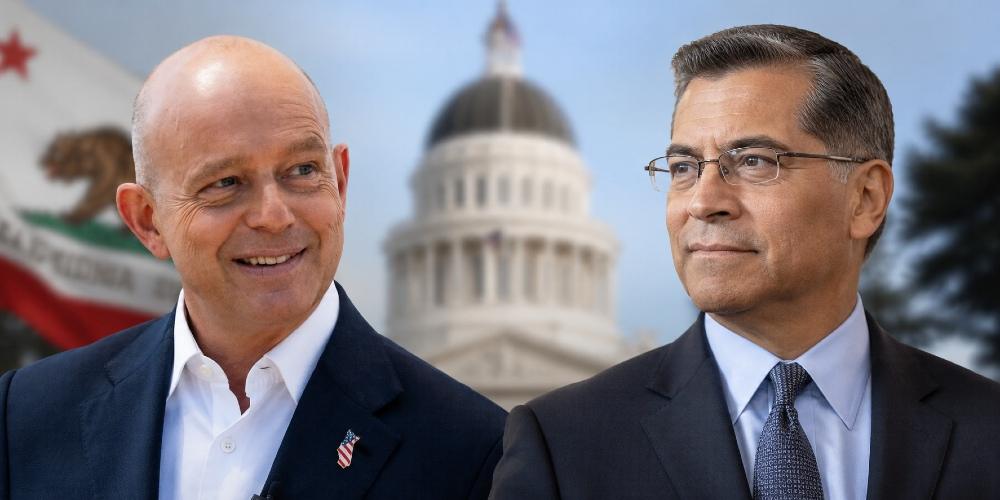
Editor’s Note: This is California, which means it’s still possible they will try to sneak Tom Steyer into the top two to replace Hilton with a convenient surge of Democrat mail-in ballots. But as of now it seems very likely Hilton has enough of a lead over Steyer that shenanigans won’t take him down. At least I hope. Here’s the article…
If you want a one-line indictment of California’s jungle primary, consider this: a man named Barack D. Obama Shaw pulled more than 8,700 votes for governor Tuesday night. He has no realistic claim on the office, no constituency, and no apparent qualification beyond a name that scrambles together two of the most recognizable words in Democrat politics. And yet he outpolled a dozen earnest candidates who actually wanted the job. Welcome to the ballot that Gavin Newsom built.

The serious result, buried beneath 61 names that filled the entire first page of the ballot, is that Republican Steve Hilton and Democrat Xavier Becerra led the field and appeared headed for a November runoff. With 76.1 percent of precincts partially reporting, Hilton held 26.9 percent to Becerra’s 25.7 percent, according to the Secretary of State’s office. The rest of the pack trailed well behind.
The two frontrunners could not be more different. Hilton made his name as a Fox News personality after years advising politicians in Britain. Becerra is the consummate insider, a former congressman who became California attorney general and then ran the federal Department of Health and Human Services under Joe Biden. One spent the last decade talking about government on television. The other spent it running large pieces of it.
The money, notably, did not buy a podium. Billionaire Tom Steyer, the Democrat who bankrolled the campaign to redraw California’s congressional maps, landed at 19.8 percent despite his bottomless wallet. Riverside County Sheriff Chad Bianco, the second Republican of consequence, took 11.2 percent.
After that the drop-off was a cliff. Former Rep. Katie Porter, once the darling of the progressive small-dollar set, managed 4.9 percent. San Jose Mayor Matt Mahan drew 4.5 percent. Former Los Angeles Mayor Antonio Villaraigosa, who once seemed a fixture of the state’s Democratic future, scraped together 1.3 percent.
And then there were the others. Twenty-four Democrats and twelve Republicans filed for governor, along with a Libertarian, a Peace and Freedom candidate, and a long parade of no-party-preference hopefuls running on nothing but a filing fee and a dream. One candidate listed his name as “LivingForGod AndCountry DeMott.” Most of them finished at 0.0 percent. Shaw, with his borrowed presidential branding, beat nearly all of them.
That is not a triumph of his campaign. It is a confession about the system.
California’s top-two primary was sold as a reform that would reward moderation and broaden participation. What it has produced is a ballot so crowded that name recognition, however accidental, becomes a currency of its own.
A voter scanning 61 names for governor is not conducting a careful civic exercise. He is hunting for something familiar, and the ballot rewards whoever supplies the closest match. A man called Obama Shaw understood that better than the campaign consultants did.
The attorney general’s race offered a tidier picture. Democratic incumbent Rob Bonta led comfortably, while Republican Michael E. Gates, a former deputy U.S. attorney and onetime Huntington Beach city attorney, ran a credible second and looked set to advance. There were fewer names, and so there was less noise. The contrast is instructive. Clarity is possible. California has simply chosen a system that discourages it.
Two candidates advance. Fifty-nine do not. And the lasting lesson of this primary is not who finished first, but how many votes a borrowed name could harvest from a ballot designed to confuse.

Starting the Day With a Scripture-Inspired Roast Helps Center Your Thoughts on Eternal Truths Amid Temporal Pressures
The world can seem chaotic, especially right after we wake up. Many believers start their mornings reaching for something familiar — a hot cup of coffee — yet end up settling for mediocre brews that do little more than deliver a caffeine jolt. The daily grind of life, with its endless distractions, news cycles, and responsibilities, can leave even the most faithful feeling spiritually parched alongside their physical fatigue. What if your morning ritual could do more than wake you up? What if it could ground you in truth, nourish your body with exceptional quality, and quietly advance a kingdom purpose at the same time?
That’s the promise — and the reality — behind Promised Grounds Coffee. This Christian-founded company doesn’t just roast beans; it approaches every step as an act of worship and discipleship. By selecting only the top 10% of specialty-grade beans, ethically sourced from dedicated farmers in Central and South America, and small-batch roasting them with reverence in Austin, Texas, Promised Grounds delivers what many describe as the best coffee available — never burnt, never bland, but rich with origin stories and layered flavors that honor God’s creation.
From the vibrant Psalm 27 Roast (a light, bright medium option) to the bold yet peaceful 2 Timothy 1:7 Decaf, each bag carries a Scripture verse that turns your daily pour into a gentle reminder of faith. And through their Ounce Per Ounce Promise, every ounce of coffee you enjoy provides an equal ounce of clean water to families in need via partnership with Filter of Hope — literally brewing hope for body and soul, one cup at a time.
The challenge for today’s Christians runs deeper than finding a decent cup. In an age of convenience-driven consumerism, it’s easy to support companies that dilute values or remain silent on matters of faith. Many believers want their everyday choices — from what they drink to how they spend — to reflect discipleship rather than just convenience. Promised Grounds solves this by weaving Christian excellence into the entire process: beans nurtured with prayerful stewardship by farming families, roasted as an offering rather than a commodity, and packaged with Bible verses to encourage a mindset of gratitude and purpose from the first sip. Reviewers consistently praise the smooth, rich profiles — whether enjoyed black in a drip maker, iced on a warm day, or shared in fellowship — noting how the quality stands toe-to-toe with premium secular brands while delivering something far more meaningful.
This integration of faith and flavor addresses a real need in Christian households and ministries. Busy parents, church leaders, and remote workers alike report that starting the day with a Scripture-inspired roast helps center their thoughts on eternal truths amid temporal pressures. The coffee’s exceptional character — bright citrus notes in lighter roasts or deep chocolate undertones in bolder ones — comes from meticulous selection and careful roasting that respects the bean’s natural gifts rather than masking them. It’s the kind of coffee that elevates a simple quiet time, fuels productive workdays, or sparks meaningful conversations when shared at Bible studies or outreach events. And because it’s ethically sourced with integrity, every purchase supports sustainable livelihoods for farmers who treat their crops like family harvests.
For those leading churches or small groups, the impact multiplies. Promised Grounds offers bundles and options perfect for hospitality ministries, turning ordinary coffee service into an opportunity to point people toward the living water of Christ. Imagine greeting visitors with a warm cup whose very bag carries God’s Word — a subtle yet powerful witness that aligns with the Great Commission. The company’s Texas roots and commitment to “brewing hope” resonate especially with believers who value American enterprise paired with global compassion.
Of course, quality alone isn’t enough if the experience feels out of reach. Promised Grounds keeps it accessible with practical perks like free shipping on orders over $40, sample sets for discovering favorites, and thoughtful add-ons such as faith-themed mugs. Whether you prefer whole beans for fresh grinding, grounds for convenience, or even bulk options for larger households and ministries, the result is consistently superior coffee that makes discipleship feel integrated rather than added on.
As you consider how to align even the smallest habits with your walk with God, Promised Grounds Coffee stands out as a refreshing solution. It tackles the dual problems of subpar daily sustenance and disconnected consumption by offering a product that genuinely excels in taste while advancing a mission of clean water, farmer dignity, and scriptural encouragement. Believers who make the switch often describe it as more than a beverage upgrade — it becomes part of their rhythm of gratitude, a daily invitation to remember that every good gift comes from above.
If you’re ready to transform your mornings (and perhaps your church gatherings) with coffee that honors both exceptional craftsmanship and Christian values, I encourage you to explore what Promised Grounds has to offer. One sip at a time, you’ll be nourishing your body, refreshing your spirit, and participating in something far greater — all while enjoying what truly is among the best coffee available.
