


(Zero Hedge)—Democrats unleashed their coordinated, NGO-driven color revolution—dubbed the ‘Tesla Takedown‘—nationwide on Saturday, though it unfolded in a notably unimpressive fashion.
The days of million-man (or woman) marches, usually bankrolled with taxpayer dollars funneled through now-defunct USAID, appear to be over, as their ability to sway national sentiment has diminished significantly. Still, these dark and corrupt NGOs receive monies from leftist billionaires, as we’ve previously reported.
I.e., angry old white liberals
OMG, looks at this Tesla protest in Charlotte NC, it’s all old white Karen’s and their miserable low testosterone cucks 😂😂😂😂 pic.twitter.com/BCuEstNEwC
— Vince Langman (@LangmanVince) March 29, 2025
As the protests wound down by late Saturday, Elon Musk took to X, quoting a Joe Rogan podcast that called out Democrats for their rent-a-protester tactics. Musk asked: “Who is funding and organizing all these paid protests?”
Who is funding and organizing all these paid protests? https://t.co/QDjD9Gao8a
— Elon Musk (@elonmusk) March 30, 2025
On Friday, the far-left revolutionaries behind Tesla Takedown began mobilizing their far-left agitators aligned with the Democratic Party. Soros-linked organizations like Indivisible have been linked to yesterday’s “Global Day of Action” against Tesla …

The Tesla Takedown website links to The Action Network—an online platform used by shady far-left NGOs to organize and fundraise—which shows that groups like Troublemakers and the Disruption Project led yesterday’s efforts to “tank Tesla’s stock” and destroy shareholder value.
“Stopping Musk will help save lives and our democracy,” Tesla Takedown wrote on its website, adding, “The stakes couldn’t be higher. No one is coming to save us—not politicians, not the media.”
Also, on Friday, Musk threw the corrupt far-left and anti-American NGOs a curve ball that renders their entire movement meaningless…
xAI & X Merger Defuses Musk’s Tesla Share Liquidation Risk https://t.co/Ohl1l81O6H
— zerohedge (@zerohedge) March 29, 2025
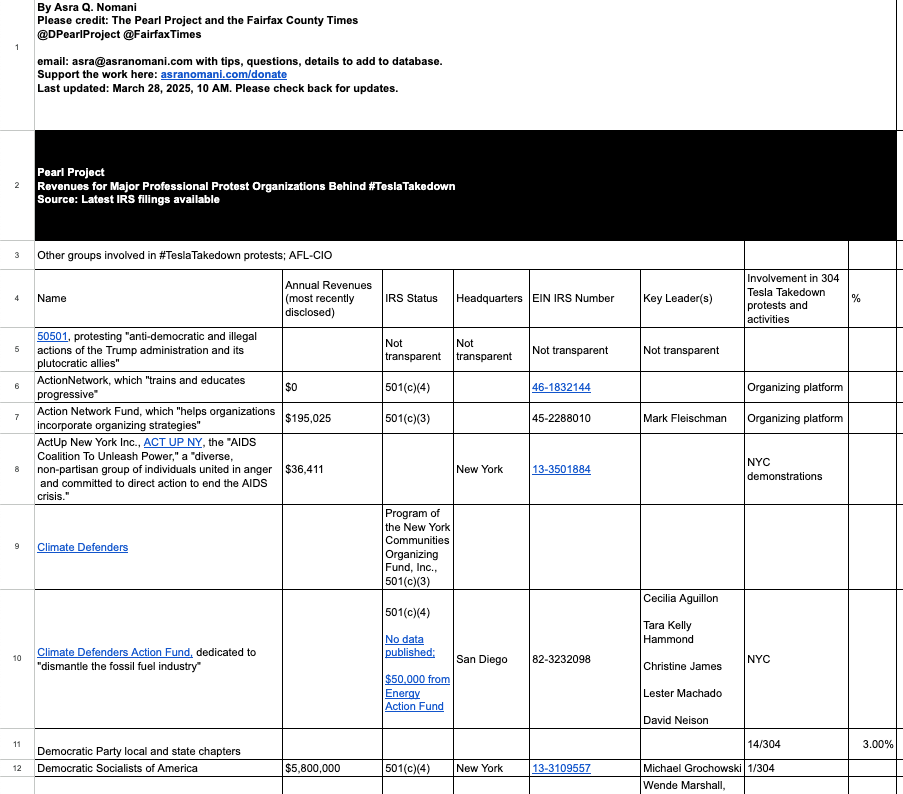
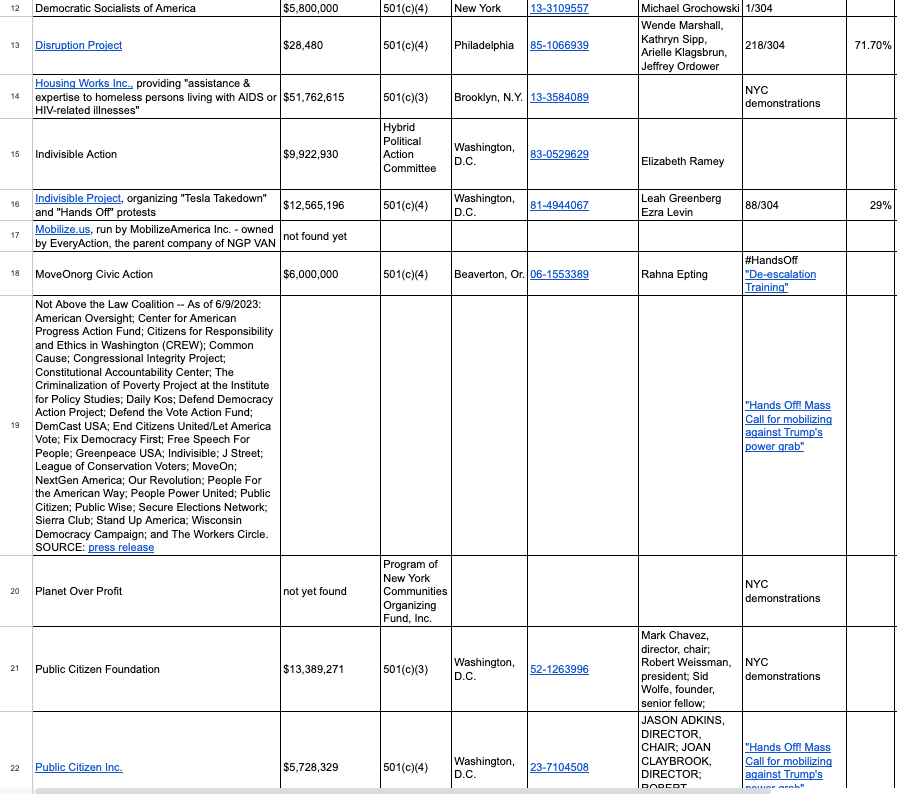
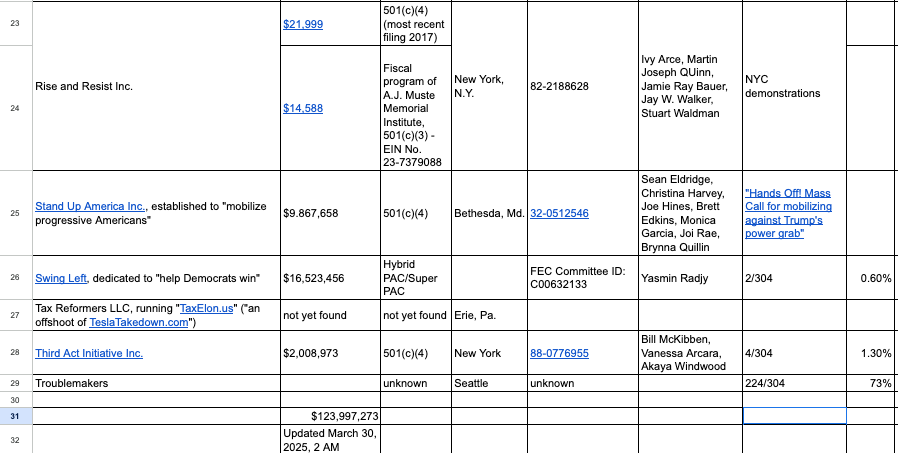
On Sunday morning, ex-Wall Street Journal journalist Asra Nomani answered Musk’s question with a detailed list of the 24 groups that led one Tesla Takedown protest in northern Virginia.
Here are the answers—sure to give Musk and DOGE investigators a quick path to uncovering the root of the chaos against Tesla vehicles, showrooms, service centers, and chargers in recent months.
You asked who is funding and organizing the #TeslaTakedown protests. I’ve got answers for you, after going onto the streets of northern Virginia for the local protests here, seeing familiar faces from the Virginia Democratic political machine and then following the money — and the data.
AstroTurf Protest Industry
To your question, at the latest count, as of 3/30, 5:30 AM:
- 24 organizations and counting are funding and organizing the #TeslaTakedown protests and leading the very partisan propaganda campaign against Tesla, Tesla drivers, Tesla employees, Donald Trump and you. See below to see all 24 groups with their revenues, involvement, tax ID numbers and other info.
- These organizations have combined annual revenues of at least $124 MILLION and counting.
- 100% of the groups are aligned with the Democratic Party. At the protest on 3/29 at Tyco Road, in Tysons, Va., a photo I took of a “Virginia Democrats” sign in front of the Tesla dealership.
- Most of these groups enjoy tax-deductible status as 501(c)(3) and 501(c)(4) organizations, claiming they are “nonpartisan.” A few have PACs. The organizations have not returned requests for comment.
Database
You can see the raw data on 306 #TeslaTakedown protests in the database here.
Back story
I’m a former Wall Street Journal reporter and a propaganda expert and editor of the @DPearlProject , a journalism nonprofit named for my WSJ colleague and friend Daniel Pearl. Since Oct. 7th, I have been reporting on the anti-Jew, anti-America, anti-Israel protests and building a database, following the money. It numbers 2,000 groups now, and I am working on a web and mobile app for parents, policymakers, university administrators, law enforcement, the public and others.
I went to the #TeslaTakedown protest a week ago Saturday on Tyco Road at the Tysons, Va., and saw familiar faces from Indivisible and the Fairfax County Democratic Party, shouting for you to be deported as they stood outside the Tesla dealership. I wondered too who is organizing and funding the protests nationwide.
I got the protest details scraped from ActionNetwork and Mobilize, the two platforms aligned with the Democratic Party promoting the #TeslaTakedown protests, and built a public database of the groups behind the Tesla protest.
AstroTurf, not “grassroots”
In an article for the @FairfaxTimes , I wrote about how the local protests in Tysons, are a window into how the protests are AstroTurf, not “grassroots.” What this case reveals is the way that a multi-million dollar professional protest industry manufactures outrage in top-down political theater, agitprop, or agitation propaganda, and now criminal offenses. Here is the article.
Next step:
I just got data on the April 5 #HandsOff protests and will be adding that data to the database. In addition, I am completing an analysis of the propaganda using the tools of natural language processing and content analysis.
Why is this important to report on? Because defending principles of free enterprise and individual liberty in the U.S. means allowing people to buy whatever make of car they wish without fear of danger or harassment and allowing companies to do business without fear of danger or harassment.
All, please let me know if you have any questions, ideas or recommendations. Asra [email protected] To support the Pearl Project: http://asranomani.com/donate
24+ Groups Leading and Funding #TeslaTakedown (and counting) (view full list here):
CC Doge Team…
Hello @ElonMusk and Friends,
You asked who is funding and organizing the #TeslaTakedown protests. I’ve got answers for you, after going onto the streets of northern Virginia for the local protests here, seeing familiar faces from the Virginia Democratic political machine and… pic.twitter.com/53MMDpOnOx
— Asra Nomani (@AsraNomani) March 30, 2025
Your dive into these NGOs became much easier because of Nomani’s reporting.
Starting the Day With a Scripture-Inspired Roast Helps Center Your Thoughts on Eternal Truths Amid Temporal Pressures
The world can seem chaotic, especially right after we wake up. Many believers start their mornings reaching for something familiar — a hot cup of coffee — yet end up settling for mediocre brews that do little more than deliver a caffeine jolt. The daily grind of life, with its endless distractions, news cycles, and responsibilities, can leave even the most faithful feeling spiritually parched alongside their physical fatigue. What if your morning ritual could do more than wake you up? What if it could ground you in truth, nourish your body with exceptional quality, and quietly advance a kingdom purpose at the same time?
That’s the promise — and the reality — behind Promised Grounds Coffee. This Christian-founded company doesn’t just roast beans; it approaches every step as an act of worship and discipleship. By selecting only the top 10% of specialty-grade beans, ethically sourced from dedicated farmers in Central and South America, and small-batch roasting them with reverence in Austin, Texas, Promised Grounds delivers what many describe as the best coffee available — never burnt, never bland, but rich with origin stories and layered flavors that honor God’s creation.
From the vibrant Psalm 27 Roast (a light, bright medium option) to the bold yet peaceful 2 Timothy 1:7 Decaf, each bag carries a Scripture verse that turns your daily pour into a gentle reminder of faith. And through their Ounce Per Ounce Promise, every ounce of coffee you enjoy provides an equal ounce of clean water to families in need via partnership with Filter of Hope — literally brewing hope for body and soul, one cup at a time.
The challenge for today’s Christians runs deeper than finding a decent cup. In an age of convenience-driven consumerism, it’s easy to support companies that dilute values or remain silent on matters of faith. Many believers want their everyday choices — from what they drink to how they spend — to reflect discipleship rather than just convenience. Promised Grounds solves this by weaving Christian excellence into the entire process: beans nurtured with prayerful stewardship by farming families, roasted as an offering rather than a commodity, and packaged with Bible verses to encourage a mindset of gratitude and purpose from the first sip. Reviewers consistently praise the smooth, rich profiles — whether enjoyed black in a drip maker, iced on a warm day, or shared in fellowship — noting how the quality stands toe-to-toe with premium secular brands while delivering something far more meaningful.
This integration of faith and flavor addresses a real need in Christian households and ministries. Busy parents, church leaders, and remote workers alike report that starting the day with a Scripture-inspired roast helps center their thoughts on eternal truths amid temporal pressures. The coffee’s exceptional character — bright citrus notes in lighter roasts or deep chocolate undertones in bolder ones — comes from meticulous selection and careful roasting that respects the bean’s natural gifts rather than masking them. It’s the kind of coffee that elevates a simple quiet time, fuels productive workdays, or sparks meaningful conversations when shared at Bible studies or outreach events. And because it’s ethically sourced with integrity, every purchase supports sustainable livelihoods for farmers who treat their crops like family harvests.
For those leading churches or small groups, the impact multiplies. Promised Grounds offers bundles and options perfect for hospitality ministries, turning ordinary coffee service into an opportunity to point people toward the living water of Christ. Imagine greeting visitors with a warm cup whose very bag carries God’s Word — a subtle yet powerful witness that aligns with the Great Commission. The company’s Texas roots and commitment to “brewing hope” resonate especially with believers who value American enterprise paired with global compassion.
Of course, quality alone isn’t enough if the experience feels out of reach. Promised Grounds keeps it accessible with practical perks like free shipping on orders over $40, sample sets for discovering favorites, and thoughtful add-ons such as faith-themed mugs. Whether you prefer whole beans for fresh grinding, grounds for convenience, or even bulk options for larger households and ministries, the result is consistently superior coffee that makes discipleship feel integrated rather than added on.
As you consider how to align even the smallest habits with your walk with God, Promised Grounds Coffee stands out as a refreshing solution. It tackles the dual problems of subpar daily sustenance and disconnected consumption by offering a product that genuinely excels in taste while advancing a mission of clean water, farmer dignity, and scriptural encouragement. Believers who make the switch often describe it as more than a beverage upgrade — it becomes part of their rhythm of gratitude, a daily invitation to remember that every good gift comes from above.
If you’re ready to transform your mornings (and perhaps your church gatherings) with coffee that honors both exceptional craftsmanship and Christian values, I encourage you to explore what Promised Grounds has to offer. One sip at a time, you’ll be nourishing your body, refreshing your spirit, and participating in something far greater — all while enjoying what truly is among the best coffee available.

It’s always the same usual suspects at all these “protest” rallies. The cause is unimportant, it’s the action that counts. Just protest something.
The people on the left are mentally Ill , to cause this kind of evil to your own backyard is perplexing, you are like a jilted women divorcing her husband because he won’t use her new pronoun.