

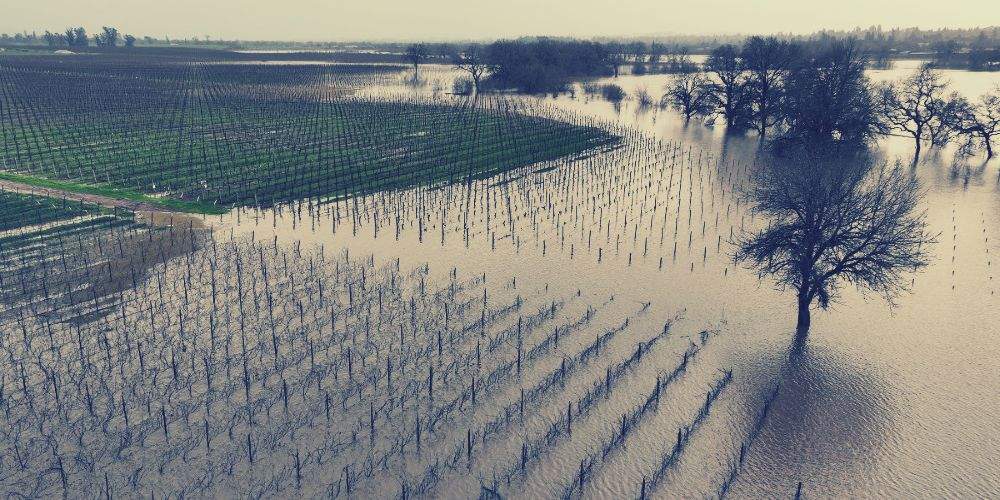

The dozen-or-so “atmospheric rivers,” also known as rain storms, that have hit California this winter so far have provided a much-needed reprieve from the persistent drought conditions that have plagued the state for many years. There is a downside, though: many of the state’s crop farms are now underwater from all this excess moisture, which is creating massive food and finance losses for the Golden State’s farmers.
Many people are unaware of this, but nearly half of all American agriculture is grown in California, generating more than $50 billion a year in revenue. The Midwest primarily grows genetically modified (GMO) corn and soybeans, along with wheat, while California grows most of the country’s fruits, vegetables, nuts, and leafy greens.
Because these atmospheric river storms have been hitting California one after another after another following many years of mostly dry conditions, a lot of that water is flowing from higher elevations to lower elevations rather than absorbing into oftentimes rock-hard soils. The result is many destroyed farms and farmers who have “lost everything.”
(Related: In the midst of covid, communist China saw similar heavy rains for a period of time that resulted in catastrophic destruction.)
The Sierra Nevada mountains are packed with record levels of snow that will eventually melt, delivering even more devastation to California farms
The worst-affected county right now is Tulare County, which is the second-largest county in the entire United States in terms of food production, generating more than $8 billion annually. One-fourth of that is dairy sales, while the rest is citrus and nuts.
Kern County, located just to the south of Tulare County, is the nation’s number-one producer of agriculture, with Fresno County, located just to the north of Tulare County, being third in terms of food production.
All three of these counties are being devastated by all this rain, as is Monterey County, located on the Central Coast of California, which is the nation’s fourth-largest food-producing county. Like the others, Monterey is experiencing devastating flooding, wiping out most of its vegetable and strawberry farms.
Brian Shilhavy, the editor of Health Impact News, put together a video with testimony from friends and family members he knows who live in these areas. Be sure to watch that video below to see for yourself their first-hand experiences with all that rain:
Even when the rains finally stop, it will not mean an end to the devastation. California’s vast Sierra Nevada mountain range is packed with record levels of snow that will eventually melt, delivering a double whammy to the farms below it.
“This is horrible and I feel so bad for these devastated people,” one commenter wrote about the horrific devastation occurring in California, as depicted in the above video. “As an animal lover, my heart broke when I saw the cats on the roof (but thank God they survived!) and the confused and panicked cattle being driven through the water by the chopper.”
Another wrote that Americans had better wake up fast and learn how to grow food the traditional way, starting in their own backyards (if possible) and around their local communities.
“As the technology crashes, more and more Americans are going to have to learn how to do actual work that produces something, rather than entertainment-based technology that produces NOTHING,” this person added.
“But the technologists haven’t figured this out yet, even as tens of thousands of jobs seem to disappear every week now. They are still throwing away money on AI and chat bots and other such useless products. But their banks are failing now, and their money will eventually run out.”
First it was not enough rain; now it is too much rain. You can keep up with the latest news about the “birth pangs,” as the Bible calls them, at Prophecy.news.
Sources for this article include:
Preparing for the Unexpected: Your Essential Partner in Health Readiness
In an increasingly unpredictable world—where supply chain disruptions, natural disasters, and global travel can leave us vulnerable to sudden health challenges—being prepared isn’t just smart; it’s essential.
That’s where Jase Medical steps in, offering innovative solutions that empower individuals and families to take control of their health with emergency medication kits designed for real-life scenarios. As someone who’s always advocated for proactive wellness, I was impressed by how Jase Medical combines expert medical guidance with convenient, customizable options to ensure you’re never caught off guard.
At the heart of their offerings is the Jase Case, a comprehensive emergency antibiotic kit priced at just $289.95. This powerhouse contains five life-saving antibiotics and five vital symptom-relief medications, capable of treating over 50 common infections—from respiratory issues and skin conditions to traveler’s diarrhea and more.
What sets it apart? It’s fully customizable with 28 add-on options, including a specialized KidCase for children ages 2-11, making it ideal for families.
Whether you’re stocking up for home emergencies or preparing for remote adventures, the Jase Case provides peace of mind with medications that boast extended shelf lives—up to five years or longer when stored properly, with studies showing 90% potency retention even after 20 years.
For those on the move, the Jase Go travel med kit at $129.95 is a game-changer. Curated by physicians, it addresses over 30 common travel ailments, from digestive upsets to minor injuries, ensuring explorers, hikers, and globetrotters can handle health hiccups without derailing their plans.
And for targeted concerns, Jase Medical offers specialized kits like the UTI Kit ($99.95), which includes test strips and treatments for urinary tract infections, vaginal candidiasis, and even jock itch, or the Parasites Kit (starting at $199.95), featuring compounded Ivermectin and Mebendazole to combat internal and external parasitic infections.
But Jase Medical isn’t just about one-off kits; their Jase Daily service provides an extended supply of your ongoing prescriptions, supporting hundreds of medications for chronic conditions like diabetes, heart health, high blood pressure, mental health, and more. This ensures long-term preparedness, safeguarding against factory shutdowns or extreme weather that could interrupt your regular supply.
The process couldn’t be simpler or more reassuring. Start by customizing your order online, then benefit from a thorough review by a team of world-class physicians who ensure safety and accuracy. In most cases, prescriptions are issued after a quick consultation—sometimes just a call to clarify allergies or needs—and your kit arrives discreetly at your door. While they don’t accept traditional health insurance, many customers use HSA cards, and refills are available for added convenience.
What truly stands out is the real-world impact. As radio host Glenn Beck puts it, “The supply lines for antibiotics already are stressed to the max. Please have some antibiotics on hand… You can do it through Jase.”
One satisfied customer shared, “It could have been a nightmare. Instead, the best trip we’ve had,” after their kit turned a potential health crisis into a minor blip during a family vacation.
In a time when health uncertainties loom larger than ever, Jase Medical isn’t just selling products—it’s delivering empowerment. Don’t wait for the next disruption; visit Patriot.TV/meds today to build your personalized emergency plan and step into a more secure tomorrow. Your health, and your family’s, deserves nothing less.

Commiefornica whines when centuries old cycles of droughts in their climate ruin their water-intensive crops. Then continue whining when erosion from ample rainfall destroys their crops. Erosion caused by overtilling and the absence of organic humus that used to bind the soil and provide natural fertility. Wouldn’t it be nice if they used the sustainable agricultural practices in areas with similar climatic conditions in the past?
Wouldn’t it be nice if industrial agriculture fully funded their crop insurance programs with some of the abundant profits they make on bumper crops during good years so that in years when they lose money, taxpayer-subsidized crop insurance doesn’t bail them out. Hmmm. Sounds like the banking industry, doesn’t it?
The story does not seem to be a mention that Tulare Lake is actually a lake. It was drained dry by irrigation projects that took the water to feed surrounding farms. In the intervening years, the lake bottom was developed into farms. Now “climate change” (aka sunspot cycle, or is it global warming?) has brought the rain and refilled the lake flooding the bottom land farms. . Those farmers should have bought flood insurance.