

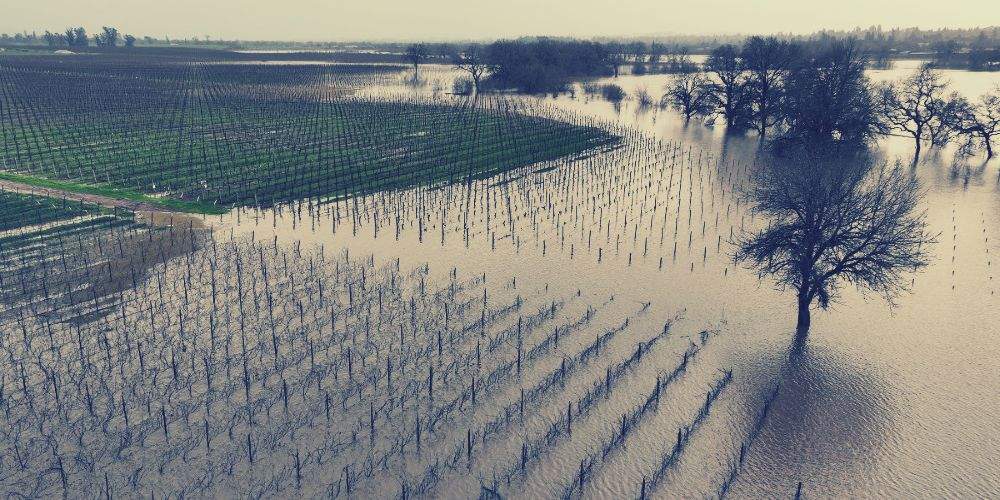
The dozen-or-so “atmospheric rivers,” also known as rain storms, that have hit California this winter so far have provided a much-needed reprieve from the persistent drought conditions that have plagued the state for many years. There is a downside, though: many of the state’s crop farms are now underwater from all this excess moisture, which is creating massive food and finance losses for the Golden State’s farmers.
Many people are unaware of this, but nearly half of all American agriculture is grown in California, generating more than $50 billion a year in revenue. The Midwest primarily grows genetically modified (GMO) corn and soybeans, along with wheat, while California grows most of the country’s fruits, vegetables, nuts, and leafy greens.
Because these atmospheric river storms have been hitting California one after another after another following many years of mostly dry conditions, a lot of that water is flowing from higher elevations to lower elevations rather than absorbing into oftentimes rock-hard soils. The result is many destroyed farms and farmers who have “lost everything.”
(Related: In the midst of covid, communist China saw similar heavy rains for a period of time that resulted in catastrophic destruction.)
The Sierra Nevada mountains are packed with record levels of snow that will eventually melt, delivering even more devastation to California farms
The worst-affected county right now is Tulare County, which is the second-largest county in the entire United States in terms of food production, generating more than $8 billion annually. One-fourth of that is dairy sales, while the rest is citrus and nuts.
Kern County, located just to the south of Tulare County, is the nation’s number-one producer of agriculture, with Fresno County, located just to the north of Tulare County, being third in terms of food production.
All three of these counties are being devastated by all this rain, as is Monterey County, located on the Central Coast of California, which is the nation’s fourth-largest food-producing county. Like the others, Monterey is experiencing devastating flooding, wiping out most of its vegetable and strawberry farms.
Brian Shilhavy, the editor of Health Impact News, put together a video with testimony from friends and family members he knows who live in these areas. Be sure to watch that video below to see for yourself their first-hand experiences with all that rain:
Even when the rains finally stop, it will not mean an end to the devastation. California’s vast Sierra Nevada mountain range is packed with record levels of snow that will eventually melt, delivering a double whammy to the farms below it.
“This is horrible and I feel so bad for these devastated people,” one commenter wrote about the horrific devastation occurring in California, as depicted in the above video. “As an animal lover, my heart broke when I saw the cats on the roof (but thank God they survived!) and the confused and panicked cattle being driven through the water by the chopper.”
Another wrote that Americans had better wake up fast and learn how to grow food the traditional way, starting in their own backyards (if possible) and around their local communities.
“As the technology crashes, more and more Americans are going to have to learn how to do actual work that produces something, rather than entertainment-based technology that produces NOTHING,” this person added.
“But the technologists haven’t figured this out yet, even as tens of thousands of jobs seem to disappear every week now. They are still throwing away money on AI and chat bots and other such useless products. But their banks are failing now, and their money will eventually run out.”
First it was not enough rain; now it is too much rain. You can keep up with the latest news about the “birth pangs,” as the Bible calls them, at Prophecy.news.

Sources for this article include:

Starting the Day With a Scripture-Inspired Roast Helps Center Your Thoughts on Eternal Truths Amid Temporal Pressures
The world can seem chaotic, especially right after we wake up. Many believers start their mornings reaching for something familiar — a hot cup of coffee — yet end up settling for mediocre brews that do little more than deliver a caffeine jolt. The daily grind of life, with its endless distractions, news cycles, and responsibilities, can leave even the most faithful feeling spiritually parched alongside their physical fatigue. What if your morning ritual could do more than wake you up? What if it could ground you in truth, nourish your body with exceptional quality, and quietly advance a kingdom purpose at the same time?
That’s the promise — and the reality — behind Promised Grounds Coffee. This Christian-founded company doesn’t just roast beans; it approaches every step as an act of worship and discipleship. By selecting only the top 10% of specialty-grade beans, ethically sourced from dedicated farmers in Central and South America, and small-batch roasting them with reverence in Austin, Texas, Promised Grounds delivers what many describe as the best coffee available — never burnt, never bland, but rich with origin stories and layered flavors that honor God’s creation.
From the vibrant Psalm 27 Roast (a light, bright medium option) to the bold yet peaceful 2 Timothy 1:7 Decaf, each bag carries a Scripture verse that turns your daily pour into a gentle reminder of faith. And through their Ounce Per Ounce Promise, every ounce of coffee you enjoy provides an equal ounce of clean water to families in need via partnership with Filter of Hope — literally brewing hope for body and soul, one cup at a time.
The challenge for today’s Christians runs deeper than finding a decent cup. In an age of convenience-driven consumerism, it’s easy to support companies that dilute values or remain silent on matters of faith. Many believers want their everyday choices — from what they drink to how they spend — to reflect discipleship rather than just convenience. Promised Grounds solves this by weaving Christian excellence into the entire process: beans nurtured with prayerful stewardship by farming families, roasted as an offering rather than a commodity, and packaged with Bible verses to encourage a mindset of gratitude and purpose from the first sip. Reviewers consistently praise the smooth, rich profiles — whether enjoyed black in a drip maker, iced on a warm day, or shared in fellowship — noting how the quality stands toe-to-toe with premium secular brands while delivering something far more meaningful.
This integration of faith and flavor addresses a real need in Christian households and ministries. Busy parents, church leaders, and remote workers alike report that starting the day with a Scripture-inspired roast helps center their thoughts on eternal truths amid temporal pressures. The coffee’s exceptional character — bright citrus notes in lighter roasts or deep chocolate undertones in bolder ones — comes from meticulous selection and careful roasting that respects the bean’s natural gifts rather than masking them. It’s the kind of coffee that elevates a simple quiet time, fuels productive workdays, or sparks meaningful conversations when shared at Bible studies or outreach events. And because it’s ethically sourced with integrity, every purchase supports sustainable livelihoods for farmers who treat their crops like family harvests.
For those leading churches or small groups, the impact multiplies. Promised Grounds offers bundles and options perfect for hospitality ministries, turning ordinary coffee service into an opportunity to point people toward the living water of Christ. Imagine greeting visitors with a warm cup whose very bag carries God’s Word — a subtle yet powerful witness that aligns with the Great Commission. The company’s Texas roots and commitment to “brewing hope” resonate especially with believers who value American enterprise paired with global compassion.
Of course, quality alone isn’t enough if the experience feels out of reach. Promised Grounds keeps it accessible with practical perks like free shipping on orders over $40, sample sets for discovering favorites, and thoughtful add-ons such as faith-themed mugs. Whether you prefer whole beans for fresh grinding, grounds for convenience, or even bulk options for larger households and ministries, the result is consistently superior coffee that makes discipleship feel integrated rather than added on.
As you consider how to align even the smallest habits with your walk with God, Promised Grounds Coffee stands out as a refreshing solution. It tackles the dual problems of subpar daily sustenance and disconnected consumption by offering a product that genuinely excels in taste while advancing a mission of clean water, farmer dignity, and scriptural encouragement. Believers who make the switch often describe it as more than a beverage upgrade — it becomes part of their rhythm of gratitude, a daily invitation to remember that every good gift comes from above.
If you’re ready to transform your mornings (and perhaps your church gatherings) with coffee that honors both exceptional craftsmanship and Christian values, I encourage you to explore what Promised Grounds has to offer. One sip at a time, you’ll be nourishing your body, refreshing your spirit, and participating in something far greater — all while enjoying what truly is among the best coffee available.

Commiefornica whines when centuries old cycles of droughts in their climate ruin their water-intensive crops. Then continue whining when erosion from ample rainfall destroys their crops. Erosion caused by overtilling and the absence of organic humus that used to bind the soil and provide natural fertility. Wouldn’t it be nice if they used the sustainable agricultural practices in areas with similar climatic conditions in the past?
Wouldn’t it be nice if industrial agriculture fully funded their crop insurance programs with some of the abundant profits they make on bumper crops during good years so that in years when they lose money, taxpayer-subsidized crop insurance doesn’t bail them out. Hmmm. Sounds like the banking industry, doesn’t it?
The story does not seem to be a mention that Tulare Lake is actually a lake. It was drained dry by irrigation projects that took the water to feed surrounding farms. In the intervening years, the lake bottom was developed into farms. Now “climate change” (aka sunspot cycle, or is it global warming?) has brought the rain and refilled the lake flooding the bottom land farms. . Those farmers should have bought flood insurance.