

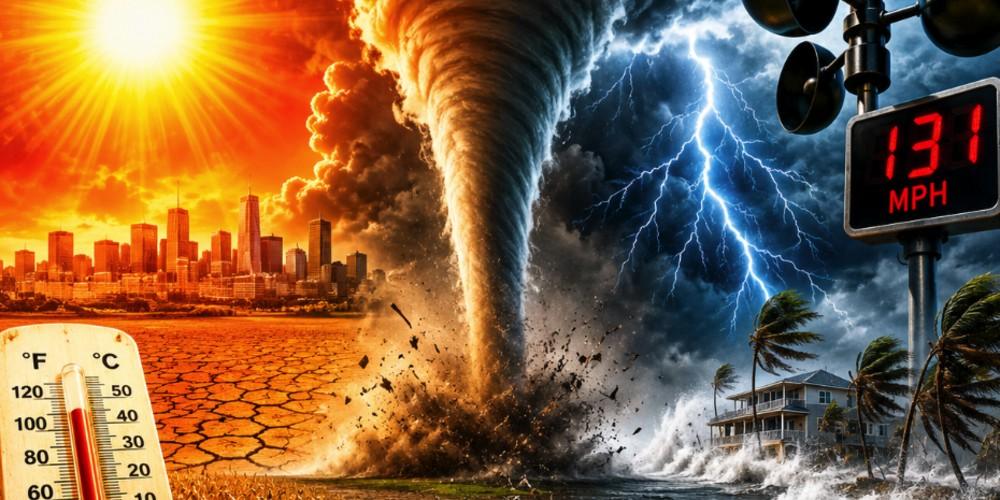
(End of the American Dream)—We have witnessed crazy summer weather in the United States before, but this year has been just bonkers. There was snow at the end of June, high winds just shredded a wind farm in South Dakota, there have never been more tornadoes in Illinois, the western half of the country is being plagued by severe drought, wildfires are erupting at a blistering pace, and now the eastern half of the country is going to experience a “4th of July furnace” caused by an absolutely colossal heat dome…
Half of all Americans are facing prolonged, dangerously hot temperatures from an intense heat dome as they head outdoors to celebrate the country’s 250th Independence Day.
The temperatures in some spots in the eastern US, like New York City and Washington, DC, could be the hottest in over a decade, and numerous high temperature records are likely to fall in the coming days.
The oppressive heat and humidity are already gripping the Midwest and South and it will expand to the Mid-Atlantic and Northeast on Wednesday. The sprawling heat dome will then park over the East, particularly the Interstate 95 corridor, and peak by Friday.
I repeatedly warned my readers that things would get really hot once the “Super El Niño” officially arrived, and that is precisely what has happened.
Throughout the rest of this week, high temperatures will be way above normal from the Mississippi River to the Atlantic Ocean…
Actual high temperatures are forecast to range from 90 to 105 F in most areas from the Plains to the western slopes of the Appalachians early this week and from the Plains to the Atlantic and Gulf coasts from Wednesday to Independence Day. Temperatures this week will be 10-20 degrees above the 30-year historical average in nearly three dozen states in late June and early July.
“The extreme heat and humidity are expected to bring near-record, or possibly record, energy usage to the mid-Atlantic power providers,” AccuWeather Senior Meteorologist Alan Reppert said.
This is truly going to be an epic heat wave.
According to the Washington Post, a whopping 73 million Americans are expected to experience high temperatures in the triple digits…
- 73 million. That’s the number of Americans that are expected to experience triple-digit heat through Sunday.
- 190 million. Humidity will build to extreme levels for that many Americans by the end of the weekend.
- 205 million. For that many Americans, the risk for heat-related impacts will reach major or extreme levels through Monday, according to NOAA’s HeatRisk. At the rare extreme level, heat can be deadly to people without access to effective cooling.
The mid-Atlantic region will be hit particularly hard.
If you can believe it, in certain parts of the mid-Atlantic it could actually feel like it is 115 degrees outside once you account for the oppressive humidity.
One meteorologist is warning that it will be so hot in some areas that it “will melt your face off”.
If you live in an area that will be affected by this heat dome, please take proper precautions.
Sadly, there are still many people that do not take the heat seriously. In one very tragic case, an 18-month-old child ended up dead as a result…
An 18-month-old child died Monday after being found in a hot car outside an early education center in Plantation, Florida, on a day when temperatures climbed into the 90s.
Plantation police and firefighters responded at 5:39 p.m. Monday to a report of a deceased child inside a vehicle at A World of Discovery Academy, according to the Plantation Police Department.
The Plantation Fire Department confirmed the child was deceased, police said. Detectives responded to the scene, and an investigation into the child’s death is underway.
We need to educate our young parents better so that this sort of thing will stop happening.
When it gets extremely hot, we also see very large thunderstorms.
Throughout the rest of the week, the forecast calls for thunderstorms to develop all along the edges of the heat dome…
Rounds of thunderstorms will track along the edge of a massive heat dome through the days leading up to the Fourth of July. As the heat dome begins to weaken over the Independence Day weekend, severe thunderstorms are forecast to surge southward into areas that have remained largely storm-free this week.
During a heat wave like this week’s, sinking air beneath most of the heat dome suppresses thunderstorm development. Storms that do form typically develop along the weaker outer edge of the dome, where the flow around the high-pressure system helps steer them.
Thunderstorms will vary in size and intensity. Most will develop during the afternoon and evening, but some may organize into large complexes that persist overnight and continue into the next morning. In extreme cases, these complexes can evolve into derechos, while isolated storms may strengthen into supercells that may travel hundreds of miles. Both can be extremely dangerous and destructive.
Some of the storms that we have already seen have been absolutely frightening.

In South Dakota, a storm that actually occurred early in the morning produced a 131 mph wind gust that literally destroyed a bunch of wind turbines…
An early morning storm ripped through Highmore, South Dakota, about 220 miles east of Rapid City, producing a reported 131 mph wind gust that, if sustained, would fall within Category 4 hurricane strength on the Saffir-Simpson scale.
Local KELOLAND meteorologists Scot Mundt and Brian Karstens were absolutely stunned by the wind speed, which reached 131 mph.
The violent straight-line winds toppled grain silos, damaged infrastructure, and knocked over large wind turbines.
Wind turbines are normally placed in areas that typically get high winds.
But they were never designed to handle a wind gust of this magnitude…

High temperatures also typically mean lots of tornadoes, and this year has been no exception.
In fact, the state of Illinois has already experienced more tornadoes in 2026 than in any other full year on record…
Illinois has had a record-setting year of tornadoes that no state wants to experience.
As of late June, Illinois already has experienced 205 preliminary tornado reports, which is more than any other full year since records were first taken.
Notably, Illinois has had more than double the number of tornadoes of any other state thus far in 2026. Mississippi and Indiana are a distant second with 84 apiece.
This is insane.

At this stage, Illinois has “almost tripled the 30-year average number of tornadoes per year”…
Illinois state climatologist Trent Ford told Newsweek in an email that the number of tornadoes in the state has skyrocketed over the last four years, but even by those standards, this year has been extreme.
“2026 is by a wide margin the most severe weather active year we have since consistent records were taken in the late 1950s,” Ford said.
“We have smashed our previous tornado record by mid-June and almost tripled the 30-year average number of tornadoes per year in Illinois.”
I told you that this summer has been bonkers.
And the scary thing is that it has just started.
In the western half of the nation, drought is the biggest issue.
Right now, the entire state of Colorado is experiencing at least some level of drought…
A number of states are suffering from record drought, but none has suffered as much recently as Colorado. Drought at various levels covers the entire state, according to the U.S. Drought Monitor. The worst levels of drought, called “exceptional drought” and “extreme drought,” cover 37%. According to Drought Monitor experts, exceptional drought is “the most severe classification of drought, indicating critical, widespread water shortages, massive agricultural and pasture losses, and the frequent implementation of emergency water restrictions.”
Large wildfires have started along the Colorado border with Utah. This has strained the state’s firefighting resources. This has become a larger problem across the country. There have been over 35,000 wildfires in the US this year, the National Interagency Fire Center reports. These have burned 3.1 million acres so far this year. Last year, at the same time, the acres burned totaled 1.8 million.
The “Super El Niño” is likely to make things even hotter and even drier in many of the areas that are already dealing with drought.
The founder of AccuWeather is warning that we could soon see a “mini-Dust Bowl” in our western states…
And even though El Niño could transition back to neutral later this year, some experts are increasingly focused on what could follow, warning that drought conditions in the Plains could persist for years after the pattern breaks down — and the possibility of a “mini Dust Bowl” scenario.
“If the long-term drought is as bad as it could be, and you are starting off already with severe drought, this raises the real possibility of a ‘mini-Dust Bowl,” said AccuWeather Founder and Executive Chair Joel N. Myers. “Soybeans will be stressed further in the months and years ahead, and yields on some of these crops will be reduced in parts of the country. If that happens, it will have a negative impact on food production, leading to price inflation. Furthermore, water supplies will be harmed, as well.”
Drought is afflicting other key agricultural areas all over the globe, and that is setting the stage for widespread famines.
Everything that I have shared in this article is really happening.
But a lot of people out there are just sticking their heads in the sand and pretending that everything is going to be okay somehow.
It is time to wake up and face reality, but much of the population simply won’t do that.
Michael’s new book entitled “10 Prophetic Events That Are Coming Next” is available in paperback and for the Kindle on Amazon.com, and you can subscribe to his Substack newsletter at michaeltsnyder.substack.com.

Starting the Day With a Scripture-Inspired Roast Helps Center Your Thoughts on Eternal Truths Amid Temporal Pressures
The world can seem chaotic, especially right after we wake up. Many believers start their mornings reaching for something familiar — a hot cup of coffee — yet end up settling for mediocre brews that do little more than deliver a caffeine jolt. The daily grind of life, with its endless distractions, news cycles, and responsibilities, can leave even the most faithful feeling spiritually parched alongside their physical fatigue. What if your morning ritual could do more than wake you up? What if it could ground you in truth, nourish your body with exceptional quality, and quietly advance a kingdom purpose at the same time?
That’s the promise — and the reality — behind Promised Grounds Coffee. This Christian-founded company doesn’t just roast beans; it approaches every step as an act of worship and discipleship. By selecting only the top 10% of specialty-grade beans, ethically sourced from dedicated farmers in Central and South America, and small-batch roasting them with reverence in Austin, Texas, Promised Grounds delivers what many describe as the best coffee available — never burnt, never bland, but rich with origin stories and layered flavors that honor God’s creation.
From the vibrant Psalm 27 Roast (a light, bright medium option) to the bold yet peaceful 2 Timothy 1:7 Decaf, each bag carries a Scripture verse that turns your daily pour into a gentle reminder of faith. And through their Ounce Per Ounce Promise, every ounce of coffee you enjoy provides an equal ounce of clean water to families in need via partnership with Filter of Hope — literally brewing hope for body and soul, one cup at a time.
The challenge for today’s Christians runs deeper than finding a decent cup. In an age of convenience-driven consumerism, it’s easy to support companies that dilute values or remain silent on matters of faith. Many believers want their everyday choices — from what they drink to how they spend — to reflect discipleship rather than just convenience. Promised Grounds solves this by weaving Christian excellence into the entire process: beans nurtured with prayerful stewardship by farming families, roasted as an offering rather than a commodity, and packaged with Bible verses to encourage a mindset of gratitude and purpose from the first sip. Reviewers consistently praise the smooth, rich profiles — whether enjoyed black in a drip maker, iced on a warm day, or shared in fellowship — noting how the quality stands toe-to-toe with premium secular brands while delivering something far more meaningful.
This integration of faith and flavor addresses a real need in Christian households and ministries. Busy parents, church leaders, and remote workers alike report that starting the day with a Scripture-inspired roast helps center their thoughts on eternal truths amid temporal pressures. The coffee’s exceptional character — bright citrus notes in lighter roasts or deep chocolate undertones in bolder ones — comes from meticulous selection and careful roasting that respects the bean’s natural gifts rather than masking them. It’s the kind of coffee that elevates a simple quiet time, fuels productive workdays, or sparks meaningful conversations when shared at Bible studies or outreach events. And because it’s ethically sourced with integrity, every purchase supports sustainable livelihoods for farmers who treat their crops like family harvests.
For those leading churches or small groups, the impact multiplies. Promised Grounds offers bundles and options perfect for hospitality ministries, turning ordinary coffee service into an opportunity to point people toward the living water of Christ. Imagine greeting visitors with a warm cup whose very bag carries God’s Word — a subtle yet powerful witness that aligns with the Great Commission. The company’s Texas roots and commitment to “brewing hope” resonate especially with believers who value American enterprise paired with global compassion.
Of course, quality alone isn’t enough if the experience feels out of reach. Promised Grounds keeps it accessible with practical perks like free shipping on orders over $40, sample sets for discovering favorites, and thoughtful add-ons such as faith-themed mugs. Whether you prefer whole beans for fresh grinding, grounds for convenience, or even bulk options for larger households and ministries, the result is consistently superior coffee that makes discipleship feel integrated rather than added on.
As you consider how to align even the smallest habits with your walk with God, Promised Grounds Coffee stands out as a refreshing solution. It tackles the dual problems of subpar daily sustenance and disconnected consumption by offering a product that genuinely excels in taste while advancing a mission of clean water, farmer dignity, and scriptural encouragement. Believers who make the switch often describe it as more than a beverage upgrade — it becomes part of their rhythm of gratitude, a daily invitation to remember that every good gift comes from above.
If you’re ready to transform your mornings (and perhaps your church gatherings) with coffee that honors both exceptional craftsmanship and Christian values, I encourage you to explore what Promised Grounds has to offer. One sip at a time, you’ll be nourishing your body, refreshing your spirit, and participating in something far greater — all while enjoying what truly is among the best coffee available.
