

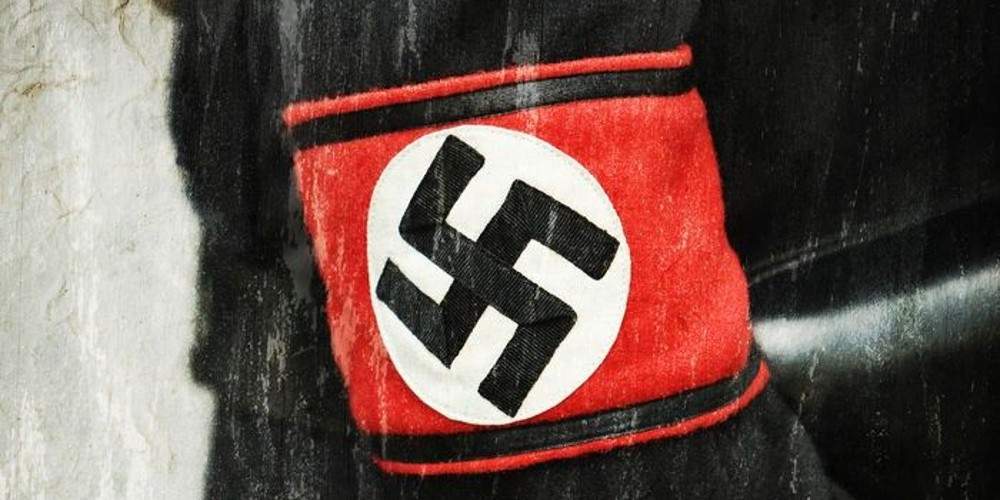
When the average person thinks of the Nazis, what often comes to mind is World War II, the Holocaust, and rousing speeches of hate. However, the National Socialists also had economic and political policies, policies many just assume were either free market or New Deal–style public works projects like the Autobahn. But Nazi policy was not so cut-and-dried.
The Nazis were socialists, and it showed in many of the policies they implemented after coming to power in 1933. First, like the Soviets, the Nazis initiated a war on private property. Not surprisingly, property rights were severely curbed by National Socialism in the name of public welfare.
How did the National Socialists combat private property in Germany? The first step came shortly after the Nazis took control, when they abolished private property. Article 153 of the Weimar constitution guaranteed private property, with expropriation only to occur within the due process of the law, but this article was nullified by a decree on February 28, 1933.
With this, the new National Socialist government had complete control of private property in Germany. While they did not take complete control of the lands like the Bolsheviks did in Russia in 1917, the Nazis issued quotas for industries and farms, and later they reorganized all industry into corporations run by members of the Nazi Party.
The War on Business
Peter Temin wrote about this in Soviet and Nazi Economic Planning, stating:
Both governments reorganized industry into larger units, ostensibly to increase state control over economic activity. The Nazis reorganized industry into 13 administrative groups with a larger number of subgroups to create a private hierarchy for state control. The state could therefore direct a firm’s activities without acquiring direct ownership of enterprises. The pre-existing tendency to form cartels was encouraged to eliminate competition that would destabilize prices.
The Nazis, ironically, called this reorganization “privatization,” although the owners of these corporations were either removed from board positions and replaced by Nazi Party members or sold out and became Nazi Party members. They included IG Farben and the Junkers airplane factory. IG Farben was a chemical company founded in 1925 by Carl Bosch and Carl Duisberg, who were both Jewish, and had a capitalization of around a billion marks by 1926. By 1938, all of the company’s Jewish workers had been purged and the supervisory board replaced by Nazis (see Joseph Borkin’s book The Crime and Punishment of I.G. Farben).
IG Farben was a clear example of the reorganization of industry the Nazis undertook for their benefit. Sybille Steinbacher, a professor of Holocaust studies, wrote about the public-private partnership in her book Auschwitz, stating:
Otto Ambros and IG Farben director Fritz ter Meer held a board meeting in Berlin with Carl Krauch who was not only a member of the board of directors of IG Farben, but also a member of the circle of industrialists around Reichsfurhrer-SS known as Himmler’s “Circle of Friends.”
After the Nazis took power, this kind of cooperation was common. Private businesses became merely public entities, and industrialists who resisted the Nazi commissars and their policies were removed from their positions and their businesses seized.
Junkers airplane factory did not fare much better, according to Temin, who wrote:
Prof. Junkers of the Junkers airplane factory refused to follow the government’s bidding in 1934. The Nazis thereupon took over the plant, compensating Junkers for his loss. This was the context in which other contracts were negotiated.
This Nazi war on business left industrialists and other businessmen worried that they would have their livelihoods stolen from them, as Günter Reimann explains in The Vampire Economy.
Reimann quotes a letter from a German businessman to an American businessman:
The difference between this and the Russian system is much less than you think, despite the fact that officially we are still independent businessmen.
The letter continues:
Some businessmen have even started studying Marxist theories, so that they will have a better understanding of the present economic system.
This German businessman also complained of “arbitrary government decisions concerning quantity, quality, and prices of foreign raw materials.” But businessmen were not the only members of the private sector who faced mass amounts of bureaucracy and control. The farmers faced it as well.
The War on Agriculture
When the Nazis came to power in 1933, a major interest for them was Lebensbraum (living space) for the “pure” German citizen. Professor Adam Tooze talks about the “hereditary farm” in his book Wages of Destruction:

For the purpose of protecting the peasantry as the “Blood Source of the German People,” the law proposed to create a new category of farm, the Erbhof (hereditary farm), protected against all debt insulated from market forces.
These farms were to be passed down from generation to generation to keep the soil “pure,” and Reich officials even thought that “Erbhof farmers should assume collective responsibility for each other’s debts.” This policy was introduced and supported by the Reich central bank and Reichsnährstand (RNS, State Food Society) officials.
Farming price subsidies were also common in the Nazi Reich even before World War II broke out. The RNS was created to fix prices and create production controls in agriculture. In his book Hitler’s Beneficiaries, German historian Götz Aly describes the measures the German government took in the farming sector.
Götz states, “The prices producers were paid for milk and potatoes were raised by 25 to 35 percent in the course of the war.” These subsidies would cause shortages as early as August 1939, when meat and eggs rationing was imposed to keep the industry focused on grain production.
Life in Prewar Germany
In high school history textbooks, very few pages are dedicated to prewar Germany (1933–39). However, two details are always covered: the Night of Broken Glass (Kristallnacht), which saw thousands of Jewish businesses vandalized and destroyed, and the Autobahn, a massive public works program that improved many lives and made travel easy.
Because of this, people may reach the conclusion that prewar life was bad for the Jews, but beneficial for non-Jewish citizens. It is true that Jews suffered immensely, not only socially but also economically. At the start of 1933, there were an estimated hundred thousand Jewish businesses; by 1938, only 39,552 remained. In the same year, a capital levy was put on Jews; they needed to register all their assets with the local tax office, which placed a 20 percent and later a 25 percent capital levy on them.
But for ordinary non-Jewish citizens, life was also hard. Private sale negotiations were subject to official rules, these rules being set selling prices for whatever good someone had. If a dealer wanted to increase his prices, he must get a special permit from a price commissar, who needed a detailed statement of necessity and other data such as production and distribution costs.

R.J. Overy’s War and Economy in the Third Reich and Richard Evans’s Third Reich in Power talks about the shortages that came out of the industries at these times. In 1936, Germany steel producers were only producing 26 percent of Germany’s domestic output requirement. The German government in 1937 would encourage citizens to hand in their scrap metal, and in the same year, authorities including the Hitler Youth would search people’s homes for old metal keys.
Metal was strictly rationed, and fines were handed out to building contractors who installed metal central heating pipes. Iron lamp posts and railings were replaced with wooden ones, but this was halted when there was a wood shortage, which also led to a paper shortage.
All of this happened in 1937, two years before the war. Building projects had to cut back on wood and people were encouraged to burn peat instead of wood. Even coal was rationed. All industries under price controls were in the same situation, such as agriculture, where egg and dairy shortages led to the distribution of ration coupons.
Conclusion
The Nazi government took control of the economy, which is what one expects from socialism.
Unfortunately, the US economy today has similarities to the Nazi economy, from vast subsidies to price controls, and “stakeholder” advocates making even wilder demands. History tells us where these policies lead: the road to serfdom.
About the Author
John Kennedy is a recent graduate of Hartford Magnet Trinity College Academy. Economists such as Murray Rothbard, Hans-Hermann Hoppe, and Ludwig von Mises have captured his interest in Austrian economics and inspired him to start writing.
Article cross-posted from Mises.

Two Storms, One Harvest

Every food crisis in living memory has been a one-shock event. The 2008 price spike was a commodity bubble. The 2020 shortages were a logistics failure. The 2022 grain scare was a war on one exporter’s ports. Each time, the system bent, adjusted, and recovered, and each time the experts assured us afterward that global markets are simply too big and too diversified to fail.
What nobody in Washington seems eager to discuss is that 2026 is shaping up to be something the modern food system has never actually faced. Two independent shocks, one climatic and one geopolitical, are converging on the same harvest cycle at the same time. Not sequentially. Simultaneously.
Start with the weather. The Pacific Ocean is currently building toward what forecasters now openly call a record event. NOAA’s Climate Prediction Center puts the odds of at least a strong El Niño near 88 percent, with roughly two in three odds it reaches “very strong” status, the tier reserved for perhaps three or four events in the entire satellite era. Every major global model now projects a median peak in Super El Niño territory, and most of them project it exceeding the 2015-16 event, which until now held the modern record. Sea surface anomalies were already brushing the super threshold in mid-July, months before these events normally peak. The atmosphere has already shifted into El Niño mode, and the event is forecast to crest in late fall and early winter.
This is not about “climate change.” It’s about the standard cycles of weather, and the cycle we’re currently in is one that has likely devastated societies in the past. We’re better prepared as a society today, but not all Americans are equally prepared.
Serious households have started doing the quiet math on their own. Grocery bills tell part of the story, and the forecast maps tell the rest, which is why long-term food storage has moved from fringe hobby to mainstream line item in the family budget, with established suppliers like Heaven’s Harvest seeing demand from people who five years ago would have rolled their eyes at the idea. That instinct is not paranoia. It is pattern recognition, and the pattern is worth walking through carefully.
Editor’s Note: Heaven’s Harvest IS a sponsor, but the warnings of this article are real and would be written even if we didn’t have a survival food sponsor. With that said, those who take advantage of what they offer can use promo code “Patriot” for 15% off.
The Fertilizer Clock Is Already Running
While the Pacific warms, the second shock has been unfolding in the Strait of Hormuz. The conflict with Iran turned the world’s most important energy chokepoint into a contested waterway, and the consequences reach far beyond the gas pump. Roughly a third of global fertilizer trade moves through Hormuz, and the disruption sent urea prices up 86 percent year over year by March, with a 53 percent jump in a single month.
The World Bank projects energy prices rising about 24 percent in 2026 and fertilizer about 31 percent. By its own accounting, fertilizer prices ran 35 percent higher in the first five months of this year than the same period last year.
Here is the mechanism the nightly news will not explain. Fertilizer is not a grocery item. It is a time-delayed input. The nitrogen a farmer in Iowa or Punjab could not afford to apply this spring does not show up as a problem this spring. It shows up as a thinner harvest six to twelve months later.
The World Bank’s own food security brief concedes that the effects of reduced applications earlier this season “are likely to become visible only later in harvest outcomes.” Translate that from institutional language into plain English and it means this. The damage is already done, it is already in the ground, and we are simply waiting for it to arrive on the shelf.
Now check the calendar. Six to twelve months from the spring planting season lands us squarely in late 2026 and early 2027. Which is precisely when the strongest El Niño in the instrumental record is forecast to peak, bringing its signature droughts to Southeast Asia, Australia, southern Africa, northern Brazil, and South Asia, the very regions that grow the world’s rice, sugar, and oilseeds.
The World Bank warns openly that a strong El Niño “could disrupt multiple crop belts simultaneously” on top of the conflict-driven input costs. Their baseline projection assumes the Middle East disruptions ease by autumn. What in the last two years of Middle East history suggests that assumption is safe?
The System Has No Slack Left
The comfortable answer is that global markets always adjust. But adjustment requires slack, and the slack is gone. Global cereal production is expected to decline from last year’s records even before El Niño does its work. The UN World Food Programme, hardly a den of right-wing preppers, is calling this the most significant disruption to its supply chains since Covid and the invasion of Ukraine, and its supply chain director put the stakes bluntly.
Today’s supply chain challenges are tomorrow’s hunger crisis.
There is also a political dimension that markets cannot price. When food gets scarce, governments do not behave like economists. They behave like politicians. Export bans, hoarding mandates, and panic buying at the national level turned the modest rice shortfall of 2008 into a global crisis, and analysts are already warning that import-dependent nations are the first dominoes.
The 2015-16 Super El Niño, a far weaker event than what is now forecast, threw tens of millions into food stress across Africa and Asia. This one is projected to be stronger, and it arrives with fertilizer already rationed by price and shipping lanes already contested by missiles.
What Joseph Knew
Scripture does not treat preparation for lean years as faithlessness. It treats it as wisdom delivered in advance to those willing to act on it.
Behold, there come seven years of great plenty throughout all the land of Egypt: And there shall arise after them seven years of famine; and all the plenty shall be forgotten in the land of Egypt.
Joseph did not respond to that warning with a hashtag or a committee. He stored grain during the years of abundance, and when the famine came, Egypt stood while its neighbors begged. The lesson is not that famine is certain. It is that the time to prepare is precisely when preparation still looks optional.
Nobody who filled a pantry in a year of plenty has ever regretted it, and nobody standing in an empty aisle has ever been glad he waited for certainty.
None of this calls for panic, and panic is the enemy of sound judgment anyway. It calls for the same unglamorous prudence our grandparents considered ordinary. Keep some cash margin, know your local growers, and put real food in deep storage while it is cheap and available, because the entire arc of this story is that cheap and available is a closing window.
Families looking for a straightforward place to start can visit Heaven’s Harvest and use promo code Patriot for 15 percent off long-term storable food. The forecasts may yet soften, the strait may yet reopen, and we should pray they do. But hope is a fine thing to hold and a foolish thing to eat.
