

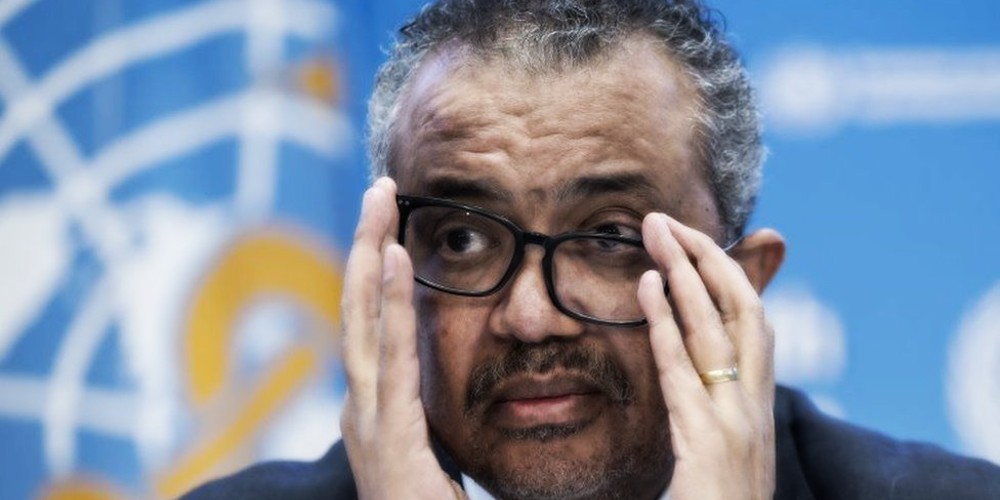
In December 2021, members of the World Health Assembly agreed to draft an agreement under the Constitution of the World Health Organization (WHO) to strengthen the world’s pandemic prevention, preparedness, and response. The plan has been to develop a draft, accept comments and amendments during 2023, and sign it into law in 2024. For the record, The OP posted our grave concerns about this back in 2021.
An Intergovernmental Governing Body (IGB) has been drafting this document, and they will be accepting feedback from “relevant stakeholders” regarding the final draft, as well as the addition of amendments. There are about 220 relevant stakeholders participating in this. Not surprisingly, they include civil society, academic, and health groups; the pharmaceutical industry is also well-represented, along with agribusiness groups. Some of these negotiations have been open to the media. Many have not.
President Biden has supported this effort from the beginning, and American groups represent some of the relevant stakeholders.
Much ado has been made over this the past few weeks, with voices on the right saying it’s going to kill Americans and voices on the fact-checking left scoffing at all those conspiracy theorists who think the U.S. would sign over sovereignty to an international body.
Here’s what you need to know straight from the treaty draft itself.
So, what’s in this thing?
Let’s start off with the Zero Draft. This is public information readily available on WHO’s website. It’s about 30 pages long, so it’s readable. I’ll share some highlights.
Article 4, Section 3 states:
States have. . . the sovereign right to determine and manage their approach to public health, notably pandemic prevention, preparedness, response and recovery of health systems, pursuant to their own policies and legislation, provided that activities within their jurisdiction or control do not cause damage to their peoples and other countries. (emphasis mine)
Who determines the damage threshold for when a nation loses its sovereignty? They don’t address that.
Article 10, Section 3h gets a lot of conservatives worked up.
It states that the WHO will receive 20% of pandemic related materials (vaccines, diagnostic tools, PPE, therapeutics) from wealthier countries for “equitable distribution” among poorer ones. And it involves “real-time” access, which means that the WHO will take their 20% when they want it, not when richer countries are ready to donate extra supplies.
Article 11, Section 4c addresses the need to strengthen and reinforce public health functions for surveillance using the One Health approach. One Health is a concept that gets addressed more thoroughly in Article 18.
Article 11 Section 4h addresses the need to create and maintain digital health and data science capacities. This translates to keeping everyone’s medical records online and readily available to health professionals. There are practical applications for this (like making sure people aren’t prescribed contra-indicated medications), but the privacy concerns are legitimate, too.
Article 15, Section 2 recognizes the WHO as the central authority, and gives the director general authority to declare pandemics. This means a director general in Europe could theoretically declare a pandemic in Southeast Asia without ever having set foot on the ground there. Incidentally, Southeast Asians see this potential, even though Americans may not. They’re concerned about it.
Article 17 is titled “Strengthening Pandemic and Public Health Literacy.” It discusses the need to tackle disinformation, particularly vaccine hesitancy. It also discusses the need to improve trust in science and government institutions. What this really means is cracking down on dissenting voices.

Article 18 goes into a little more detail about the One Health approach. For the purposes of this draft, it means focusing on zoonotic (animal-to-human) disease transmission and strengthening surveillance systems that include animals as well as humans.
One Health refers to the notion that everything on earth is interconnected, and that the health of humans, plants, animals, fungi, bacteria all affect each other. This is true, but the practical application of One Health means giving public health bodies like the WHO oversight into animal husbandry practices. This is why agribusiness groups are listed as “relevant stakeholders” and have been part of the draft process.
Even though most mainstream sources now agree Covid originated in a laboratory, power-hungry types are still clinging to the threat of zoonotic diseases to justify reaching into ever more sectors of the worldwide economy. One Health is a way of using human health concerns as a pretext for world government bodies like the WHO to exercise control over livestock operations.
In Article 19, Section 1c, parties are expected to commit not less than 5% of current health expenditure to pandemic prevention.
This is another one that has conservatives up in arms. The U.S. spends far more on health than any country in the world; our public health expenditures in 2022 were over $4 trillion. American taxpayers would essentially be footing the bill for this new pandemic authority.
The money alone, I think, is reason enough for Americans to pay attention to this. Conservative lawmakers have been pitching an absolute fit about the financial obligations, along with the references scattered throughout the document about waiving patent protection for pharmaceutical companies.
Waiving patent protection means that Big Pharma won’t retain patents on any new treatments they develop; they will have to foot the bill for development, and then hand their research materials to other nations so that they can make their own pharmaceutical products. Big Pharma is furious about this part of the proposed treaty. Considering how many of their products get mandated by governments, though, I think they’ll survive.
And speaking of mandates, Article 22, Section 1 says that the first meeting of the WHO’s governing body will determine how to deal with noncompliance.
What does this mean for the average person?
Right now, there is a lot of finger-pointing at the tin-foil hat-wearers who think that this treaty will undermine American sovereignty. But look at the documents yourselves. This is in the process of turning into a legally binding agreement. On the WHO’s own webpage, they state that members will get to define “compliance mechanisms” for parties failing to meet their obligations.
In the widely-quoted AP article fact-checking the claim that the U.S. would be ceding sovereignty to the WHO if this passes, the author quotes the same piece from Article 4, Section 3 that I did above and uses it to say, “See? Everyone still has sovereignty!” They do not address the clause regarding damage at all.
The fact-checkers also claim that while the treaty will be “legally binding,” there will be no consequences for noncompliant states. There are no consequences for noncomplying states right now. The WHO hasn’t gotten to “compliance mechanisms” yet, but again, if you read their own website, they intend to.
This is a classic “You have to pass it to see what’s in it” ploy. They’re leaving things vague at the moment so they can reprimand who they want in the future.
And the Zero Draft referenced by the fact-checkers doesn’t include any of the proposed amendments. Obviously only some are available to the public right now, but we can view the ones proposed by the U.S. government here. They give the WHO much more power to simply show up in nations that are even suspected of harboring a pandemic. Language about taking individual states’ views into consideration is being removed (Article 10, Section 4).
The proposed amendments also shorten the review time for member states to accept amendments from 18 months to six. They force member states to make a decision within 48 hours of a potential emergency about collaborating with the WHO. The best decisions are not necessarily made under time crunches.
The WHO can make big decisions..and may soon be able to enforce them.
Fact-checking articles state that the Zero Draft says nothing about lockdowns, and so we have nothing to worry about. However, Article 21 of the WHO Constitution states that the Assembly can adopt resolutions on member states unless they expressly opt-out.
Their areas of enforcement include 1) sanitary and quarantine requirements for preventing the international spread of disease; 2) nomenclatures of diseases, causes of death, and public health practices; 3) standards for diagnostic procedures aimed at an international use; 4) standards ascertaining the safety, purity, and potency of biological, pharmaceutical and similar products in international trade; and 5) advertising and labeling of biological, pharmaceutical and similar products in international trade.
Number one sounds an awful lot like lockdowns to me.
Researchers are already complaining that the WHO needs regulatory teeth to enforce the treaty’s provisions. I think that, shortly after this passes in 2024, the WHO will get them.
Between the huge additional funding sources and the new powers granted to the WHO, we’re watching the birth of what the Brownstone Institute referred to as a “self-perpetuating pandemic industry.”
What does this mean for everyday Americans?
So, back to what this means for the average American.
First of all, with a minimum of 5% of our annual health expenditure going to a brand new bureaucracy, either our healthcare costs will go up, or our quality will go down. Or, most likely, we’ll see some combination thereof.
I also have a sneaking suspicion that we may see more pandemics after 2024. I hope I’m wrong about this one. But with the amount of money getting dumped into this, I think it’s only a matter of time. And with the increased crackdown on misinformation, as specified in Article 17 of the Zero Draft, I think it’s going to become increasingly difficult to figure out what is actually happening.
Unfortunately, this is way beyond our control. And it’s just another step in a process that’s been going on for a long time. Power has been getting centralized over the last few decades. Gone are the days of personal relationships with a trusted family physician; the Affordable Care Act pushed private physicians into hospital systems, where they have far less freedom to treat each patient individually. Without access to trusted experts, it’s much harder for the average, not particularly scientifically-literate person to get good information.
Wading through legal documents might seem tedious, but it’s important to know what’s going on. Life’s definitely changed a lot post-Covid, but churches and schools have been open, and I’ve enjoyed the return to semi-normalcy. However, it’s important to understand that this may not last. It probably will not. Again, multi-billion dollar bureaucracies don’t get set up for nothing.
Republican politicians have legitimate complaints about the money Americans will be pouring into this, especially considering how unhealthy our own population is. However, I think it’s wrong to focus anger on other countries. A lot of low-income countries don’t necessarily want our pharmaceutical products or our boots on their ground. I think they’d like to be able to come to First World countries for advice without having to make binding commitments, but unfortunately, this is what the proposed treaty may stick them with.
Low-income nations are not the winners here. Nor are average Americans. The only winners will be the army of bureaucrats, as well as Big Pharma and PPE manufacturers. And, of course, the globalists at the center of it all.
What do you think about all this?
Are you for or against the WHO having so much control over American healthcare and policies? How do you think we’ll be affected by this? Is there any way for us to maintain our personal independence from such a system?
Let’s discuss it in the comments section.
About Marie Hawthorne
A lover of novels and cultivator of superb apple pie recipes, Marie spends her free time writing about the world around her. Article cross-posted from The Organic Prepper.
Two Storms, One Harvest

Every food crisis in living memory has been a one-shock event. The 2008 price spike was a commodity bubble. The 2020 shortages were a logistics failure. The 2022 grain scare was a war on one exporter’s ports. Each time, the system bent, adjusted, and recovered, and each time the experts assured us afterward that global markets are simply too big and too diversified to fail.
What nobody in Washington seems eager to discuss is that 2026 is shaping up to be something the modern food system has never actually faced. Two independent shocks, one climatic and one geopolitical, are converging on the same harvest cycle at the same time. Not sequentially. Simultaneously.
Start with the weather. The Pacific Ocean is currently building toward what forecasters now openly call a record event. NOAA’s Climate Prediction Center puts the odds of at least a strong El Niño near 88 percent, with roughly two in three odds it reaches “very strong” status, the tier reserved for perhaps three or four events in the entire satellite era. Every major global model now projects a median peak in Super El Niño territory, and most of them project it exceeding the 2015-16 event, which until now held the modern record. Sea surface anomalies were already brushing the super threshold in mid-July, months before these events normally peak. The atmosphere has already shifted into El Niño mode, and the event is forecast to crest in late fall and early winter.
This is not about “climate change.” It’s about the standard cycles of weather, and the cycle we’re currently in is one that has likely devastated societies in the past. We’re better prepared as a society today, but not all Americans are equally prepared.
Serious households have started doing the quiet math on their own. Grocery bills tell part of the story, and the forecast maps tell the rest, which is why long-term food storage has moved from fringe hobby to mainstream line item in the family budget, with established suppliers like Heaven’s Harvest seeing demand from people who five years ago would have rolled their eyes at the idea. That instinct is not paranoia. It is pattern recognition, and the pattern is worth walking through carefully.
Editor’s Note: Heaven’s Harvest IS a sponsor, but the warnings of this article are real and would be written even if we didn’t have a survival food sponsor. With that said, those who take advantage of what they offer can use promo code “Patriot” for 15% off.
The Fertilizer Clock Is Already Running
While the Pacific warms, the second shock has been unfolding in the Strait of Hormuz. The conflict with Iran turned the world’s most important energy chokepoint into a contested waterway, and the consequences reach far beyond the gas pump. Roughly a third of global fertilizer trade moves through Hormuz, and the disruption sent urea prices up 86 percent year over year by March, with a 53 percent jump in a single month.
The World Bank projects energy prices rising about 24 percent in 2026 and fertilizer about 31 percent. By its own accounting, fertilizer prices ran 35 percent higher in the first five months of this year than the same period last year.
Here is the mechanism the nightly news will not explain. Fertilizer is not a grocery item. It is a time-delayed input. The nitrogen a farmer in Iowa or Punjab could not afford to apply this spring does not show up as a problem this spring. It shows up as a thinner harvest six to twelve months later.
The World Bank’s own food security brief concedes that the effects of reduced applications earlier this season “are likely to become visible only later in harvest outcomes.” Translate that from institutional language into plain English and it means this. The damage is already done, it is already in the ground, and we are simply waiting for it to arrive on the shelf.
Now check the calendar. Six to twelve months from the spring planting season lands us squarely in late 2026 and early 2027. Which is precisely when the strongest El Niño in the instrumental record is forecast to peak, bringing its signature droughts to Southeast Asia, Australia, southern Africa, northern Brazil, and South Asia, the very regions that grow the world’s rice, sugar, and oilseeds.
The World Bank warns openly that a strong El Niño “could disrupt multiple crop belts simultaneously” on top of the conflict-driven input costs. Their baseline projection assumes the Middle East disruptions ease by autumn. What in the last two years of Middle East history suggests that assumption is safe?
The System Has No Slack Left
The comfortable answer is that global markets always adjust. But adjustment requires slack, and the slack is gone. Global cereal production is expected to decline from last year’s records even before El Niño does its work. The UN World Food Programme, hardly a den of right-wing preppers, is calling this the most significant disruption to its supply chains since Covid and the invasion of Ukraine, and its supply chain director put the stakes bluntly.
Today’s supply chain challenges are tomorrow’s hunger crisis.
There is also a political dimension that markets cannot price. When food gets scarce, governments do not behave like economists. They behave like politicians. Export bans, hoarding mandates, and panic buying at the national level turned the modest rice shortfall of 2008 into a global crisis, and analysts are already warning that import-dependent nations are the first dominoes.
The 2015-16 Super El Niño, a far weaker event than what is now forecast, threw tens of millions into food stress across Africa and Asia. This one is projected to be stronger, and it arrives with fertilizer already rationed by price and shipping lanes already contested by missiles.
What Joseph Knew
Scripture does not treat preparation for lean years as faithlessness. It treats it as wisdom delivered in advance to those willing to act on it.
Behold, there come seven years of great plenty throughout all the land of Egypt: And there shall arise after them seven years of famine; and all the plenty shall be forgotten in the land of Egypt.
Joseph did not respond to that warning with a hashtag or a committee. He stored grain during the years of abundance, and when the famine came, Egypt stood while its neighbors begged. The lesson is not that famine is certain. It is that the time to prepare is precisely when preparation still looks optional.
Nobody who filled a pantry in a year of plenty has ever regretted it, and nobody standing in an empty aisle has ever been glad he waited for certainty.
None of this calls for panic, and panic is the enemy of sound judgment anyway. It calls for the same unglamorous prudence our grandparents considered ordinary. Keep some cash margin, know your local growers, and put real food in deep storage while it is cheap and available, because the entire arc of this story is that cheap and available is a closing window.
Families looking for a straightforward place to start can visit Heaven’s Harvest and use promo code Patriot for 15 percent off long-term storable food. The forecasts may yet soften, the strait may yet reopen, and we should pray they do. But hope is a fine thing to hold and a foolish thing to eat.
