

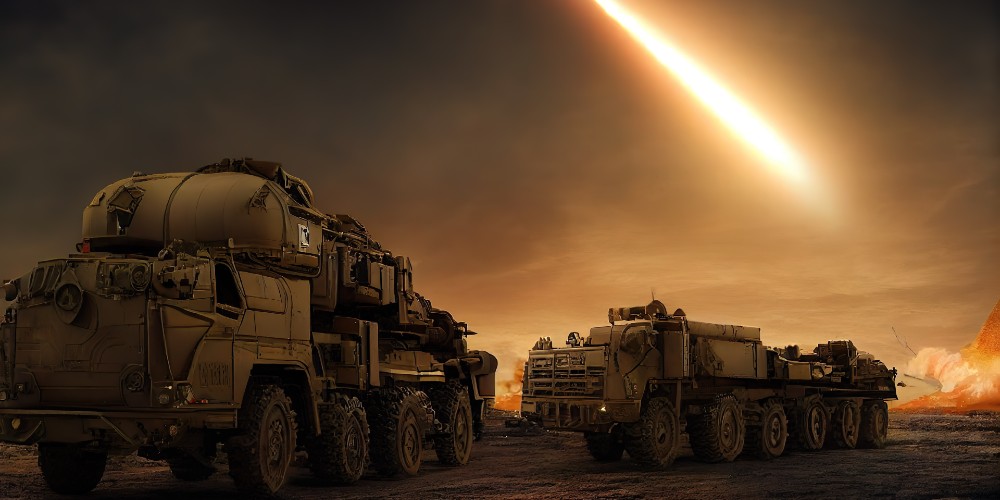
(Alt-Market)—If you’re getting the feeling like the globalists are really pushing hard for WWIII these days, you’re not alone. In the past few months there has been multiple instances of European and US officials hinting at the possibility of a new military draft, the EU has talked openly about boots on the ground in Ukraine, NATO officials have stated unequivocally that they WILL NOT accept a loss in Ukraine to the Russians and the Kremlin has warned once again that nuclear weapons are on the table if western troops enter the war. The US government has recently asserted that Ukraine will be joining NATO, a red line in the sand for Russia.
Then there’s Israel and Gaza. I warned months ago in my article ‘It’s A Trap! The Wave Of Repercussions As The Middle East Fights “The Last War”’ that the war in Gaza would expand into a multi-front conflict that would probably include Iran. I also warned that it would be to Israel’s benefit if Iran entered the war because this would force the US to become directly involved. To be sure, Iran has already been engaging in proxy attacks on Israel through Lebanon, but Israel’s attack on the Iranian “embassy” or diplomatic station in Syria basically ensures that Iran will now directly commit to strikes on Israeli targets.
In other words, much like WWI, the situation is being escalated by the political elites despite the fact that the general public in the west is increasingly opposed to participating in the conflict. The globalists want to send us to war whether we like it or not. Every decision they have made so far makes peaceful resolution impossible.
One saving grace that is perhaps new in the entire history of geopolitics is that the public is far more awake and aware of the fact that it’s not necessarily their “duty” to blindly go fight when their government calls on them to do so. Social media has also given a platform for people to widely voice their concerns about war, whereas in the past objectors felt isolated.
Obviously, some of this is based purely on fear – A large percentage of Gen Z is unequipped mentally or physically to go to war, which is why more than 70% of potential military recruits today are rejected before they even get to boot camp. These are many of the same young people who post Ukrainian flags to their social media profiles and jump headfirst into anti-Russian rhetoric, but now that they are faced with the possibility of having to sacrifice themselves for Ukraine they are angry and terrified.
However, there is also a large contingent of capable (and mostly conservative) men with the background and the aptitude for combat that still want nothing to do with Ukraine. The reason is simple: They believe that far-left western governments and globalists want to use them as cannon fodder to get rid of them. Once they are used up in war, there will be no one left to appose the leftist takeover at home.
For most of us in America, Ukraine is irrelevant and we grow tired of wars in the Middle East. Whether left or right, we have no interest in fighting for them. But that’s not going to matter much, at least in terms of preventing a global war.
European Fear Mongering
War with Russia will depend more on European involvement than US involvement. While the US has been the largest provider of armaments to Ukraine by far, the ultimate goal I believe is to integrate European troops into the Ukrainian front, which would be an automatic declaration of global war.
The basis for mobilization of troops from Europe is “domino theory” propaganda. We’ve heard some of it here in America but nowhere near the same level as the EU populace. Governments assert that Russia’s goal is to clear Ukraine as a pathway to invade the rest of Europe. This is the same claim used as justification for the US war in Vietnam: “If we let one country fall to the enemy, all the surrounding countries will fall also.”
Both Ukrainian and NATO leadership suggests that war must continue in Ukraine in order to contain it. There has been no serious discussion of diplomacy, which is utterly bizarre considering the stakes involved. A peace proposal should have been broached the moment the war kicked off and there should have been ongoing efforts to come to an agreement. Instead, even limited peace talks have been thwarted before they truly begin.
A military draft in Europe is far more likely to succeed, given the socialist nature of the population and the fact that only a tiny percentage of civilians are armed to defend themselves. Even with a public protest movement I have little doubt EU governments will be able to secure a large enough force to send into Ukraine and escalate the war.
According to the evidence, it’s clear that some NATO troops have already been deployed to Ukraine and have been there for some time. As I’ve noted in past articles, the strategies used during the first Ukrainian counter-attack were far too advanced for Ukrainian troops and leadership to pull off without help. Anti-armor tactics in particular were very familiar; similar in execution to tactics used by US and British special forces. Not surprisingly, as soon as foreign mercenary recruit rates dropped off, Ukraine’s momentum fizzled.
The Russians are likely well aware of this situation, but as long as smaller groups of soldiers can be sent under the guise of mercenary forces, there’s not much they can do about it. It’s the open deployment of NATO battalions that is cause for greater worry.
There is zero basis for the domino narrative. Not once has Russia indicated since the start of the conflict that they intend to invade the EU. In fact, Putin has long stated that the war in Ukraine is about protecting the separatists of the Donbas region from Ukrainian reprisal, and about the continued escalation of NATO armament.

My suspicions about Putin’s connections to the globalists aside, if we look at the war from a basic cost/benefit analysis there is really nothing for Russia to gain by threatening Europe.
Then there’s the problem of logistics. If Russia is supposedly struggling in Ukraine, how could they have the means to fight on an expanded front against the combined military might of Europe and the US? The only end result would be nuclear war, which both sides would lose. But if you look at the situation objectively, there is a group of people out there that have a lot to gain…
Attacks On Russian Interior Accelerate
Smaller attacks on Russian supplies as well as civilians have been escalating in the past month. The terror attack in Moscow (which US intel blames on ISIS) resulted in the deaths of at least 130 people and drone attacks are threatening oil depots along with other resources. In the grand scheme of the war these attacks are inconsequential, but they will undoubtedly lead to extensive bombardment of Ukrainian cities and the further disablement of Ukrainian infrastructure. Power, water and other utilities will be destroyed and a resource crisis will ensue.
Compared to the US invasion of Iraq, Russia has managed to keep civilian casualties in Ukraine very low. But, each new attack on Russian soil instigates a larger Russian retaliation. And maybe this is the goal – To get the Russians to crater a larger Ukrainian population center thereby giving NATO an excuse to send troops to the region.
Iran And The Oil Imperative
In the Middle East the primary driver for international involvement is oil. We all know this. But oil access is not the end goal to the war in Gaza, just a mechanism for getting the US involved.
I’ll reiterate here that I don’t care which side started the fight or how far back the conflict supposedly goes in history. This is irrelevant. What I do know is that Hamas started this particular war by killing civilians in Israel and you should not start a war unless you’re willing to accept the consequences. That said, I do find it suspicious that Israel’s defensive measures were so useless that they were completely unaware of the Hamas incursion until it was too late.

In any case the conflagration is guaranteed to bring in other larger military elements. Iran is going to enter the fray now, there’s no way around it. This might happen first in the form of economic warfare, and the Strait of Hormuz is the most likely target. Shutting down 30% of the world’s oil traffic would be disastrous for the west. So, America’s entry is thus also guaranteed.
The Inflation Factor, US Elections And How Globalists Benefit
Joe Biden has been struggling for the past three years to manipulate oil prices down by dumping strategic reserves on the market. By artificially keeping oil prices down he keeps energy prices down, and by keeping energy prices down he reduces the growth of CPI.
The Ukrainian attacks on Russian oil depots have helped to spike gas prices in the past month exactly because Russian oil is still being purchased by western countries through back channels. You can’t just cut off one of the largest energy suppliers in the world without huge effects on prices at the pump. And these attacks are revealing how sensitive the oil market is to the slightest threat to supply.
Any major conflict in the Middle East will seal the deal and gas prices will explode. Inflation is not just going to be the death knell of Biden’s presidency (assuming presidential elections still matter), it’s going to be the death knell of the leftists and globalists overall UNLESS they can delay a larger economic calamity until they have a scapegoat, or, until they can start a massive war.
That scapegoat will either be Trump and conservatives, or, Russia and the BRICS (or both). If Trump replaces Biden in 2025 then a crash will be fast and assured and it will be blamed on conservative movements. If Biden stays in a crash will be slower but will still hit hard after it can be blamed on the widening wars.
Then there’s the scenario of globalists securing a war BEFORE elections take place. Perhaps with the intention of preventing or delaying the vote. Perhaps with the intention of creating enough chaos that the vote can be rigged, or giving the impression that it was rigged, triggering civil unrest. Perhaps with the intention of declaring martial law.
Obviously, this is where the globalists benefit; either by preventing conservatives from taking power or by embroiling conservatives in a global calamity that they eventually get blamed for. Keep in mind that any conservative/independent opposition to the globalist establishment can now be accused of “Russian collusion.”
What’s the value of this? Well, it’s an age-old strategy for demonizing freedom fighters – If they are seen by the public as fellow citizens fighting for their rights, then they might be treated as heroes. But, if they’re painted as foreign assests and terrorists seeking to destabilize society, then the public sees them as villains. It’s just another advantage that explains why globalists seem so intent on creating a world war.
I believe that the reason the establishment is pressing so hard for WWIII is partly because of the upcoming elections and also because their covid agenda failed. Covid lockdowns and the vaccine passport system were their big play to create a permanent authoritarian environment with the ability to crush conservative groups that refused to submit. And no matter how you slice it they didn’t get what they wanted. World war is the natural Plan B.
It’s important to understand that every crisis created by globalists is meant to destroy the freedom minded. The true target is not Russia or Iran; they are peripheral. These events are designed to create an environment conducive to tyranny, they act as cover for engineered economic collapse, and they act as cover for the REAL war against those people that still defend liberty.
You could say that WWIII has already started, at least in economic terms. I also highly doubt that the end game for the globalists is a worldwide nuclear exchange; why spend decades building a massive control grid only to vaporize it all in seconds? I do think the danger of kinetic warfare is skyrocketing and that US and European citizens will be directly affected. It will take a sizable resistance movement to change the path we are being forced to follow, and things will get much worse before they get better.
If you would like to support the work that Alt-Market does while also receiving content on advanced tactics for defeating the globalist agenda, subscribe to our exclusive newsletter The Wild Bunch Dispatch. Learn more about it HERE.
Two Storms, One Harvest

Every food crisis in living memory has been a one-shock event. The 2008 price spike was a commodity bubble. The 2020 shortages were a logistics failure. The 2022 grain scare was a war on one exporter’s ports. Each time, the system bent, adjusted, and recovered, and each time the experts assured us afterward that global markets are simply too big and too diversified to fail.
What nobody in Washington seems eager to discuss is that 2026 is shaping up to be something the modern food system has never actually faced. Two independent shocks, one climatic and one geopolitical, are converging on the same harvest cycle at the same time. Not sequentially. Simultaneously.
Start with the weather. The Pacific Ocean is currently building toward what forecasters now openly call a record event. NOAA’s Climate Prediction Center puts the odds of at least a strong El Niño near 88 percent, with roughly two in three odds it reaches “very strong” status, the tier reserved for perhaps three or four events in the entire satellite era. Every major global model now projects a median peak in Super El Niño territory, and most of them project it exceeding the 2015-16 event, which until now held the modern record. Sea surface anomalies were already brushing the super threshold in mid-July, months before these events normally peak. The atmosphere has already shifted into El Niño mode, and the event is forecast to crest in late fall and early winter.
This is not about “climate change.” It’s about the standard cycles of weather, and the cycle we’re currently in is one that has likely devastated societies in the past. We’re better prepared as a society today, but not all Americans are equally prepared.
Serious households have started doing the quiet math on their own. Grocery bills tell part of the story, and the forecast maps tell the rest, which is why long-term food storage has moved from fringe hobby to mainstream line item in the family budget, with established suppliers like Heaven’s Harvest seeing demand from people who five years ago would have rolled their eyes at the idea. That instinct is not paranoia. It is pattern recognition, and the pattern is worth walking through carefully.
Editor’s Note: Heaven’s Harvest IS a sponsor, but the warnings of this article are real and would be written even if we didn’t have a survival food sponsor. With that said, those who take advantage of what they offer can use promo code “Patriot” for 15% off.
The Fertilizer Clock Is Already Running
While the Pacific warms, the second shock has been unfolding in the Strait of Hormuz. The conflict with Iran turned the world’s most important energy chokepoint into a contested waterway, and the consequences reach far beyond the gas pump. Roughly a third of global fertilizer trade moves through Hormuz, and the disruption sent urea prices up 86 percent year over year by March, with a 53 percent jump in a single month.
The World Bank projects energy prices rising about 24 percent in 2026 and fertilizer about 31 percent. By its own accounting, fertilizer prices ran 35 percent higher in the first five months of this year than the same period last year.
Here is the mechanism the nightly news will not explain. Fertilizer is not a grocery item. It is a time-delayed input. The nitrogen a farmer in Iowa or Punjab could not afford to apply this spring does not show up as a problem this spring. It shows up as a thinner harvest six to twelve months later.
The World Bank’s own food security brief concedes that the effects of reduced applications earlier this season “are likely to become visible only later in harvest outcomes.” Translate that from institutional language into plain English and it means this. The damage is already done, it is already in the ground, and we are simply waiting for it to arrive on the shelf.
Now check the calendar. Six to twelve months from the spring planting season lands us squarely in late 2026 and early 2027. Which is precisely when the strongest El Niño in the instrumental record is forecast to peak, bringing its signature droughts to Southeast Asia, Australia, southern Africa, northern Brazil, and South Asia, the very regions that grow the world’s rice, sugar, and oilseeds.
The World Bank warns openly that a strong El Niño “could disrupt multiple crop belts simultaneously” on top of the conflict-driven input costs. Their baseline projection assumes the Middle East disruptions ease by autumn. What in the last two years of Middle East history suggests that assumption is safe?
The System Has No Slack Left
The comfortable answer is that global markets always adjust. But adjustment requires slack, and the slack is gone. Global cereal production is expected to decline from last year’s records even before El Niño does its work. The UN World Food Programme, hardly a den of right-wing preppers, is calling this the most significant disruption to its supply chains since Covid and the invasion of Ukraine, and its supply chain director put the stakes bluntly.
Today’s supply chain challenges are tomorrow’s hunger crisis.
There is also a political dimension that markets cannot price. When food gets scarce, governments do not behave like economists. They behave like politicians. Export bans, hoarding mandates, and panic buying at the national level turned the modest rice shortfall of 2008 into a global crisis, and analysts are already warning that import-dependent nations are the first dominoes.
The 2015-16 Super El Niño, a far weaker event than what is now forecast, threw tens of millions into food stress across Africa and Asia. This one is projected to be stronger, and it arrives with fertilizer already rationed by price and shipping lanes already contested by missiles.
What Joseph Knew
Scripture does not treat preparation for lean years as faithlessness. It treats it as wisdom delivered in advance to those willing to act on it.
Behold, there come seven years of great plenty throughout all the land of Egypt: And there shall arise after them seven years of famine; and all the plenty shall be forgotten in the land of Egypt.
Joseph did not respond to that warning with a hashtag or a committee. He stored grain during the years of abundance, and when the famine came, Egypt stood while its neighbors begged. The lesson is not that famine is certain. It is that the time to prepare is precisely when preparation still looks optional.
Nobody who filled a pantry in a year of plenty has ever regretted it, and nobody standing in an empty aisle has ever been glad he waited for certainty.
None of this calls for panic, and panic is the enemy of sound judgment anyway. It calls for the same unglamorous prudence our grandparents considered ordinary. Keep some cash margin, know your local growers, and put real food in deep storage while it is cheap and available, because the entire arc of this story is that cheap and available is a closing window.
Families looking for a straightforward place to start can visit Heaven’s Harvest and use promo code Patriot for 15 percent off long-term storable food. The forecasts may yet soften, the strait may yet reopen, and we should pray they do. But hope is a fine thing to hold and a foolish thing to eat.
