

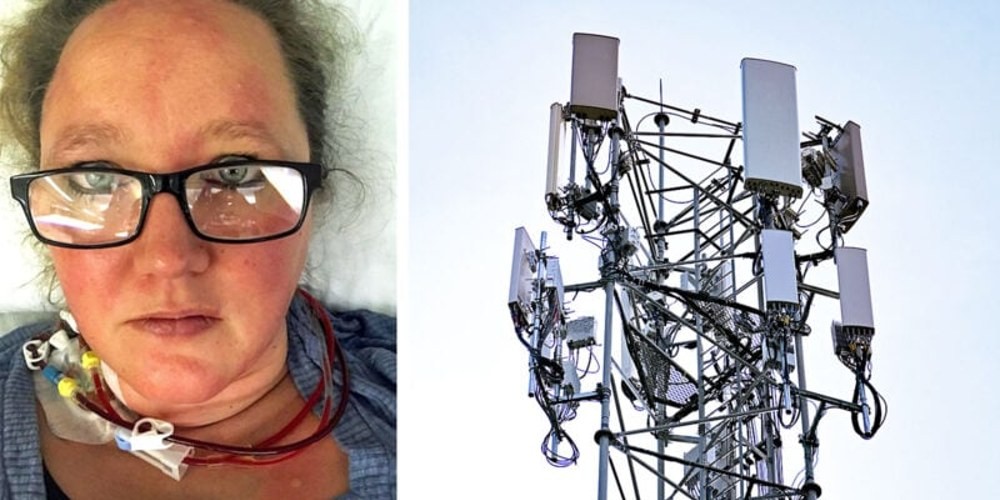
(The Defender)—In 2007, Marcia and Jason Haller — high school sweethearts who met in Duluth, Minnesota — bought their dream property north of Duluth to peacefully live close to nature and Marcia’s family.
Little did they know then that American Towers, AT&T and T-Mobile would soon build a cell tower just 900 feet from their home — a tower that would later forever change Marcia’s life as she knew it.
Nearly immediately after the cell tower was “upgraded” in 2019, Marcia became disabled from the intense levels of radiofrequency (RF) radiation emitted by the tower.
Since then, she has suffered 51 strokes, vision loss, hearing loss, headaches, sleep disruption, chronic fatigue and cognitive impairment. She experiences ongoing issues with balance, orientation and mobility.
Now, backed by the legal team in Children’s Health Defense’s (CHD) Electromagnetic Radiation (EMR) & Wireless program, Marcia plans to sue the companies operating the tower, under the Americans with Disability Act.
Marcia alleges that the companies must provide her with a “reasonable accommodation” and/or “modify their policies, practices or procedures” to comply with federal disability law.
Hers is the second in CHD’s strategic line of cases trying out new legal avenues for individuals suffering from RF radiation exposure.
The cases also draw attention to the need for better federal regulation of RF radiation and outline the scientific evidence that debunks the “RF radiation is safe” narrative.
W. Scott McCollough, lead litigator for the cases, told The Defender that Marcia’s legal team in January sent the telecom companies a demand letter and plans to file the initial complaint in her lawsuit later this month.
Marcia and Jay — who also have an 18-year-old son whose health they say has been impaired by the tower’s radiation — spoke to The Defender about Marcia’s illness and the importance of her legal battle in raising awareness that RF radiation can hurt people’s health.
‘Something’s wrong in my head’
In late September 2019, Marica and Jay noticed workmen doing a “major upgrade” on the 300-foot cell tower on the property adjacent to theirs.
Marcia, who at the time was in her third year of nursing school and worked as a certified nursing assistant at a hospital, said the work lasted about 10 days.
“They put a big crane up there,” said Jay, who runs a trucking business. “We had seen them go up there without a crane multiple times, but this was the first time where it was a major overhaul type thing.”
What exactly did the workers do?

“We’re thinking [they upgraded the tower for deploying] 5G,” Marcia said. “They [the companies] won’t admit to what they did. They say they don’t have to tell us.”
On the weekend after the workers completed the upgrade, Marcia was at home and began feeling dizzy and as if something “just didn’t feel right.”
She called Jay, telling him, “Something’s wrong in my head … I don’t know how to explain it. I just feel like crap.”
Did she need him to come home? No, she told him. “I’ll be fine.”
The physical sensation was “awful,” Marcia said. In addition to dizziness, she had headaches and nausea. “I couldn’t pick my head up off the pillow without the room spinning and feeling very sick.“
‘We think you’re having a stroke’
The symptoms continued. On Monday, she went to urgent care and was diagnosed with vertigo.

She returned home. A few days later, she had blind spots in her vision and tingling in her arm with “almost a numb feeling.”
Marcia called the on-call nurse center. They told her, “You need to come down to the emergency room. We think you’re having a stroke.”
An MRI of Marcia’s brain showed numerous damaged areas called lesions. She was admitted to the hospital on Oct. 10, 2019, and diagnosed with strokes, vision loss and balance difficulties.
After three days in the hospital, the strokes stopped happening — meaning MRIs of her brain no longer showed lesions — and Marcia returned home.
But before the end of the month, Marcia “started feeling the same thing again” and went back to the emergency room.
Jay recalled, “We were home — the kid and I — and she was cooking dinner … She turned around and her face had actually drooped on this one. It was like ‘uh-oh.’”
Marcia went back to the hospital, where she was diagnosed with more brain lesions. A neurologist told Marcia the MRI scan of her brain looked like a “starry night” because of how many white spots, or lesions, appeared.
The doctors still did not know what was causing them, she said.
Marcia goes to Mayo Clinic
Over the following weeks, Marcia went “back and forth a few times” between her home and her local hospital.
After a night or two at the hospital, she would begin feeling better. But after returning home, her symptoms reemerged and she’d have to return to the hospital. “Each time, more strokes,” she said.
According to Jay, “A week or 10 days later, there’d be seven or 10 new ones [lesions appearing in the MRI scans]. This was going on for about a month. I think we rounded up to about 51 complete strokes.”
Still, her local hospital doctors couldn’t explain why this was happening.
In early November 2019, Marcia was referred to the Mayo Clinic where doctors found her symptoms consistent with Susac syndrome, a rare autoimmune disease.
She stayed at the Mayo Clinic until Nov. 22, 2019. She received plasmapheresis to put new plasma in her blood, steroids and a medication called CellCept.
Treatment just wasn’t working
The treatment didn’t work, and when Marcia returned home, she had more strokes. So she went back to the Mayo Clinic for her second two-week round of the same treatment.
But after the second round of treatment, Marcia had more strokes — including one that temporarily impaired her hearing — and she continued to experience extreme fatigue.
Both Marcia and Jay looked back on these months of Marcia’s sickness as a time of emotional stress and pain.
Jay had to withdraw Marcia from school and convince her employer that she needed an indefinite leave of absence because of her health condition.
Meanwhile, because one of Marcia’s symptoms was cognitive impairment, she “thought she was fine” and was upset at Jay for doing so.
Marcia had also been a volunteer firefighter and emergency medical responder. “I was so mad at my husband because he — behind my back — told the fire department … ‘You can’t send her pages anymore because she wants to go on these calls and she cannot go on these calls.’”
Time to live in a different location
During one of Marcia’s stays at the Mayo Clinic, Jay “just woke up” with a strong sense that the cell tower radiation was causing Marcia’s symptoms. “Then he started doing research and that’s when we started piecing things together,” Marcia explained.
Based on what Jay was discovering, he and Marcia decided to try living elsewhere.
On March 3, 2020, they and their son moved into Marcia’s parents’ house a mile further away from the tower. Marcia “got a lot better,” she said. The strokes stopped.
By June, she was talking about returning to school, Jay said. “We’d go fishing every night and she just had a lot more energy.”
Around the same time, Marcia’s doctors at the Mayo Clinic had Marcia taking pill chemotherapy. “So they’re patting themselves on the back for the chemo,” Jay said, “I think it was moving that made it stop.”
But in October 2020, Marcia’s parents returned so Jay, Marcia and their son moved back to their house close to the tower.
In just a week, Marcia started experiencing the same symptoms again.
Building the ‘penalty box’
Jay and Marcia became more convinced that the RF radiation from the tower was making Marcia sick.
Oct. 16, 2020, they hired Frank DiCristina — a certified building biologist and certified EMR specialist — to measure the wireless radiation levels throughout their home.
DiCristina’s report showed peaks of up to 18 milliwatts per squared meter (mW/m2) — which is 18 times higher than what the Standard of Building Biology considers the “extreme limit,” noted DiCristina in the report.
Marcia and Jay loved the location of their home and didn’t want to move. So they set about making their property more livable for Marcia.
In late October 2020, Jay constructed a Faraday cage — an enclosure with metal lining that blocks out all RF radiation — to give Marcia a place of relief from the radiation.

Having a space free of RF radiation has made a big difference in Marcia’s well-being.
She said she can feel her head relax when she’s in the Faraday cage. But anywhere else in the house or yard, her head feels “loud” and “full … like a motor’s running.”
Despite the relief provided by the cage, Marcia made it clear it’s not fun having to go into a small enclosed space to feel OK.
She and Jay call the Faraday cage “the penalty box.” It’s a tiny room with no power and no windows — just a “complete black box with two beds,” Marcia said.
She and Jay sleep there. “I would be nervous to sleep in my house because I don’t want to get sick again,” Marcia said.
Sleeping out there isn’t convenient, though. “There’s no bathroom in the garage,” she said. “So if I get up in the middle of the night to go to the bathroom, I have to leave the garage, go outside, come in the house.”
Marcia also now wears a metal-lined baseball cap when in her home to mitigate her symptoms.
With these measures, she slowly was able to complete her nursing program and return to work.
‘We’re not crazy’
Marcia hopes her lawsuit will force the telecom companies to relocate their tower so she can move freely on her property without risking her health.
She also wants her case to raise public awareness that people experience physical symptoms from RF radiation. “We’re not crazy,” she said. “This really is happening.”

For instance, she and Jay think living so close to the tower may have been a factor in Jay’s development of rheumatoid arthritis.
Their son, too, has had negative health episodes — including a major blood clot in his left arm — that Marcia and Jay suspect may have been linked to the radiation. In 2022, their then-16-year-old son, Clay, called Marcia from work and asked, “Is it normal that my arm is blue and tight?”
The two shared a quick video call. “No, that’s not normal,” Marcia said when she saw Clay’s arm. She immediately picked him up and took him to the hospital.
CT scans showed Clay had a blood clot starting from his elbow that extended into his neck and two more clots in his lungs.

Clay’s bloodwork showed that, while he tested negative for COVID-19, he at some point in the past had had an asymptomatic case of COVID-19 — which the doctors said could have caused the clots.
But Marcia found this explanation unlikely and confirmed with an integrative medicine doctor — who was knowledgeable of the possible health impacts of wireless radiation — that the blood clots could have been caused by Clay’s ongoing exposure to RF radiation.
Marcia and Jay also said they’ve witnessed animals affected by the tower’s radiation. Their dog, Daisy, developed fatty tumors throughout her body that limited her mobility and quality of life to the point that Marcia and Jay had to put her down.

“The deer definitely have these tumors like the dog did,” Jay said. “Not every deer, but some of the deer.”
When Marcia and Jay tell others about their experiences, people tend to “just kind of brush it off” and say, “That’s not going to happen to me or to anybody I know besides you guys.”
But “we’re not the only ones out there that this is happening to,” Marcia said.
Although estimates vary, a 2019 analysis suggested that 1.5% of the population experience severe symptoms from exposure to RF radiation, 5% have moderate symptoms and 30% have mild symptoms.
That means roughly 2.16-99.7 million Americans are likely affected.
Marcia and Jay recently shared their story on CHD.TV.

Two Storms, One Harvest

Every food crisis in living memory has been a one-shock event. The 2008 price spike was a commodity bubble. The 2020 shortages were a logistics failure. The 2022 grain scare was a war on one exporter’s ports. Each time, the system bent, adjusted, and recovered, and each time the experts assured us afterward that global markets are simply too big and too diversified to fail.
What nobody in Washington seems eager to discuss is that 2026 is shaping up to be something the modern food system has never actually faced. Two independent shocks, one climatic and one geopolitical, are converging on the same harvest cycle at the same time. Not sequentially. Simultaneously.
Start with the weather. The Pacific Ocean is currently building toward what forecasters now openly call a record event. NOAA’s Climate Prediction Center puts the odds of at least a strong El Niño near 88 percent, with roughly two in three odds it reaches “very strong” status, the tier reserved for perhaps three or four events in the entire satellite era. Every major global model now projects a median peak in Super El Niño territory, and most of them project it exceeding the 2015-16 event, which until now held the modern record. Sea surface anomalies were already brushing the super threshold in mid-July, months before these events normally peak. The atmosphere has already shifted into El Niño mode, and the event is forecast to crest in late fall and early winter.
This is not about “climate change.” It’s about the standard cycles of weather, and the cycle we’re currently in is one that has likely devastated societies in the past. We’re better prepared as a society today, but not all Americans are equally prepared.
Serious households have started doing the quiet math on their own. Grocery bills tell part of the story, and the forecast maps tell the rest, which is why long-term food storage has moved from fringe hobby to mainstream line item in the family budget, with established suppliers like Heaven’s Harvest seeing demand from people who five years ago would have rolled their eyes at the idea. That instinct is not paranoia. It is pattern recognition, and the pattern is worth walking through carefully.
Editor’s Note: Heaven’s Harvest IS a sponsor, but the warnings of this article are real and would be written even if we didn’t have a survival food sponsor. With that said, those who take advantage of what they offer can use promo code “Patriot” for 15% off.
The Fertilizer Clock Is Already Running
While the Pacific warms, the second shock has been unfolding in the Strait of Hormuz. The conflict with Iran turned the world’s most important energy chokepoint into a contested waterway, and the consequences reach far beyond the gas pump. Roughly a third of global fertilizer trade moves through Hormuz, and the disruption sent urea prices up 86 percent year over year by March, with a 53 percent jump in a single month.
The World Bank projects energy prices rising about 24 percent in 2026 and fertilizer about 31 percent. By its own accounting, fertilizer prices ran 35 percent higher in the first five months of this year than the same period last year.
Here is the mechanism the nightly news will not explain. Fertilizer is not a grocery item. It is a time-delayed input. The nitrogen a farmer in Iowa or Punjab could not afford to apply this spring does not show up as a problem this spring. It shows up as a thinner harvest six to twelve months later.
The World Bank’s own food security brief concedes that the effects of reduced applications earlier this season “are likely to become visible only later in harvest outcomes.” Translate that from institutional language into plain English and it means this. The damage is already done, it is already in the ground, and we are simply waiting for it to arrive on the shelf.
Now check the calendar. Six to twelve months from the spring planting season lands us squarely in late 2026 and early 2027. Which is precisely when the strongest El Niño in the instrumental record is forecast to peak, bringing its signature droughts to Southeast Asia, Australia, southern Africa, northern Brazil, and South Asia, the very regions that grow the world’s rice, sugar, and oilseeds.
The World Bank warns openly that a strong El Niño “could disrupt multiple crop belts simultaneously” on top of the conflict-driven input costs. Their baseline projection assumes the Middle East disruptions ease by autumn. What in the last two years of Middle East history suggests that assumption is safe?
The System Has No Slack Left
The comfortable answer is that global markets always adjust. But adjustment requires slack, and the slack is gone. Global cereal production is expected to decline from last year’s records even before El Niño does its work. The UN World Food Programme, hardly a den of right-wing preppers, is calling this the most significant disruption to its supply chains since Covid and the invasion of Ukraine, and its supply chain director put the stakes bluntly.
Today’s supply chain challenges are tomorrow’s hunger crisis.
There is also a political dimension that markets cannot price. When food gets scarce, governments do not behave like economists. They behave like politicians. Export bans, hoarding mandates, and panic buying at the national level turned the modest rice shortfall of 2008 into a global crisis, and analysts are already warning that import-dependent nations are the first dominoes.
The 2015-16 Super El Niño, a far weaker event than what is now forecast, threw tens of millions into food stress across Africa and Asia. This one is projected to be stronger, and it arrives with fertilizer already rationed by price and shipping lanes already contested by missiles.
What Joseph Knew
Scripture does not treat preparation for lean years as faithlessness. It treats it as wisdom delivered in advance to those willing to act on it.
Behold, there come seven years of great plenty throughout all the land of Egypt: And there shall arise after them seven years of famine; and all the plenty shall be forgotten in the land of Egypt.
Joseph did not respond to that warning with a hashtag or a committee. He stored grain during the years of abundance, and when the famine came, Egypt stood while its neighbors begged. The lesson is not that famine is certain. It is that the time to prepare is precisely when preparation still looks optional.
Nobody who filled a pantry in a year of plenty has ever regretted it, and nobody standing in an empty aisle has ever been glad he waited for certainty.
None of this calls for panic, and panic is the enemy of sound judgment anyway. It calls for the same unglamorous prudence our grandparents considered ordinary. Keep some cash margin, know your local growers, and put real food in deep storage while it is cheap and available, because the entire arc of this story is that cheap and available is a closing window.
Families looking for a straightforward place to start can visit Heaven’s Harvest and use promo code Patriot for 15 percent off long-term storable food. The forecasts may yet soften, the strait may yet reopen, and we should pray they do. But hope is a fine thing to hold and a foolish thing to eat.
