

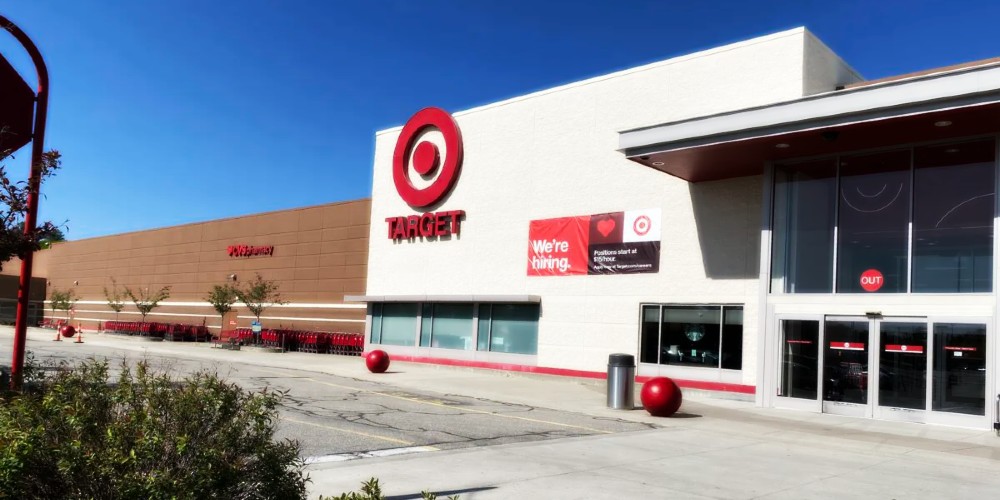
Back in March, people shopping at Target began noticing a new line of clothing on full display on mannequins at the front of the store—LGBT clothes, clothes from a Satanic brand, and merchandise with Satanic messaging. These included clothes for small children and onesies for babies. Also included were “tuck-friendly” clothing for males who identify as females and want to have women’s swimsuits that will hide their private parts.
As more and more Americans found out about this merchandise, a boycott of Target began. Twitter joined the boycott and helped spread the message. It was also spread by rap singers Forgiato Blow and Jimmy Levy, whose song “Boycott Target” rose to the number-one spot in the iTunes hip hop chart. The opening line states: “Attention all shoppers, there’s a cleanup on every aisle. Target is targeting your kids.”
The boycott worked. Starting in March, the stock began plummeting. Target’s stock price hit its lowest level since the 2020 pandemic lockdowns. Shares hit a low of $133.42 on May 31 in early trading and dropped for eight consecutive sessions, its longest losing streak since November 2018, according to the New York Post. As of June 2, according to Newsmax, the stock showed a $12.7 billion loss.
Then there’s Bud Light. Anheuser-Busch chose to go woke last March for the NCAA March Madness tournament, using a picture of transgender Dylan Mulvaney, an actress and pro-Biden social media influencer, to help sell its fourth big-selling beer, Bud Light. They chose Mr. Mulvaney, who identifies as female, to celebrate that he had just passed a year, a personal milestone, in his transition to becoming a female; a transition that he had shared almost every day on social media.
However, this woke decision led to an amazing backlash and boycott against the brewer, which it appears they will not be able to overcome. Anheuser-Busch’s share price fell $13.63 from when the market closed at $66.57 on March 31, just a day before Mulvaney appeared on Twitter to brag about the personalized Bud Light cans and partnership.
The New York Post reported on May 13 that Bud Light sales had fallen for the sixth consecutive week and retailers had slashed prices. One store charged $3.49 for a 24-pack, it reported.
By June 2, Anheuser-Busch had lost a whopping $27 billion in market value in the wake of its partnership with Mr. Mulvaney.
Here are some of the statements sent out on Twitter about the boycott—of not just Bud Light, but all of Anheuser-Busch’s beers, including Budweiser:
- “Maybe Anheuser-Busch will get the picture…. that some people are not on board with their decisions! Why can’t beer makers…JUST MAKE BEER!”
- “I want to know how stupid you have to be to not realize who your customers are. Trying to appease maybe 1% of the populace they gave the middle finger to everyone else.”
- “As we have seen with each and every company/industry that panders to the woke brigade. The woke mob does not support or buy the products that you promote to them. All you are doing is turning away your existing supporters. Movies, music, comics, sports, food, drinks, clothing…”
According to Investor Business Daily, by May 23, the boycott had boosted the sales of the other major publicly traded global beer brands, which added $3.2 billion in market value during the same time. The biggest winner from the Bud Light situation is Molson Coors Beverage (TAP). Shares are up more than 20 percent from April 1. That’s added more than $2.2 billion in market value to the stock.
By mid-July, Costco gave Bud Light the death star. According to the Washington Examiner, Costco, the third largest wholesale retail warehouse store in the world, announced on July 13 that it will no longer be carrying Bud Light. Once all the beer is sold, it will no longer restock its shelves with the brand.
On Newsmax on May 29, stockbroker Thomas Philipson, referring to the big loss in stocks of both Target and Anheuser-Busch, stated: “This is a good lesson that companies should focus on their profits, not on politics. Whether those politics are conservative or liberal, they should stay away from them.”
ESG May Be Behind Companies’ Wokeness
In case the reader is not familiar with “Environmental, Social, and Governance” (ESG), it has become much more influential over the past few years, exercising more control over businesses and even banks—coercing them to go along with the progressive woke agenda to be able to stay in business.
ESG means that a company or business or even a bank will be judged according to how well it is adhering to woke standards of environmental guidelines concerning climate change, energy use, and other “sustainable” policies; how well the business goes along with “Diversity, Equity, and Inclusion” (DEI) and whether their employees meet certain quotas for race, gender, ethnic backgrounds, disabilities, etc. (that’s the “social” part); and how politically involved it is in supporting the right kind of politics—progressive and liberal, of course (that’s the “governance” part).
In March 2021, Justin Haskins, editor-in-chief of the Heartland Institute, said on the Glenn Beck show that ESG has a metrics system, a numerical score, for evaluating a company based on how “green” and “socially just” it is.
There is a large amount of money—trillions of dollars—set aside to use to reward the “woke” high-ESG-scoring companies. Thus, companies that don’t make a lot of money selling their products (because they may have been boycotted by their upset customers like Target and Anheuser-Busch) but are very woke with a high ESG score, can still stay in business due to the awards coming to them.
Those awarding the money also state that they will only invest in certain types of businesses. So if you want that money, you must jump through the political correctness hoops to get it.
Glenn Beck asked who makes the judgment calls. Mr. Haskins told him it is the World Economic Forum (WEF) International Business Council, led by the CEO of Bank of America, Brian Monihan. They created a report in September 2020 with an elaborate ESG system that they think all the major companies in the world should adopt.
The list includes things such as percentage of employees by gender as well as how many ethnic groups are included. For example, if you don’t have the right ratio of Asians to Hispanics, you get a lower score. It also helps to have a certain percentage of employees who belong to a labor union.
Mr. Haskins gave the example of Coke: It actually lists its ESG score in its annual report. It has an ESG auditor who gives it its ratings.
ESG was started by the United Nations in 2006 when the U.N. was promoting its Agenda 21 Sustainable Development Goals, now called Agenda 2030. Those U.N. schemers were saying, how can we get businesses to go along with our agenda when we can’t get government to impose it?

Their agenda is really a communist one of total control of every aspect of our lives—“how man interacts with the environment.” They wanted to somehow get that idea into the bloodstream of the corporate universe. The way they figured out how to do that was to get investors, central banks, the IMF, the WEF, and the U.N. behind this and say, we will only support you if you agree to adopt and live by these ESG standards. If you do, then we will take care of you and make sure the money keeps flowing in your direction.
They have been building this whole ESG infrastructure for almost 15 years. No one really noticed it or knew what was happening until now. All of the major corporations that we can think of already have this system in place.
They also call it “Stakeholder Capitalism.” Glenn Beck gave examples of how it is affecting our private lives: GoFundMe yanked a fundraiser that parents were holding against critical race theory, and Home Depot cosponsored a website citing the Southern Poverty Law Center and the 1619 Project. So Home Depot is helping to fund what Beck calls the “poison” coming from the distorted American history of the 1619 Project.
Beck stated: “The insidious part of ESG is that it doesn’t just affect the company. It affects everyone in the chain of that company. So every company that drives a truck for that company, who makes a widget for that company, etc., will be adopting the EU’s ESG policy.”
And every company in the chain of command has to have a good ESG “social credit” score, just like in communist China, or they could be blacklisted and not be allowed to be part of the supply chain.
Banks and PayPal are included in the supply chain. According to the website esgagainstus.com, banks and PayPal are already using ESG to punish conservatives, as shown in the following six examples:
- The largest U.S. bank cut ties to a conservative group, canceling a Donald Trump Jr. event.
- In 2019, JP Morgan Chase closed bank accounts associated with several political activists and commentators.
- Wells Fargo suspiciously closed a bank account belonging to Lauren Witske, a 2020 Republican candidate for the Delaware Senate.
- Citibank and other large banks rolled out restrictions for gun manufacturers and retailers.
- PayPal admitted to closing accounts flagged by the Southern Poverty Law Center.
- Tina Descovich, cofounder of the conservative group Moms for Liberty, said her organization and some members have had accounts frozen by PayPal in Florida.
Europe is adopting ESG standards and making them mandatory. Even the potato farmer who supplies potatoes to McDonalds for French fries has to go along with ESG. They are already adopting it throughout the EU and adopting it through the entire chain of command, including the banks.
What Can We Do?
Glenn Beck suggests that we get our state legislators to write bills against ESG in our own local states. He was instrumental in getting one passed in Utah. Five other states have passed similar laws: Kentucky, West Virginia, Arkansas, Montana, and Florida.
According to the Daily Signal, for the year 2023, there are 12 other states that have similar bills going through their state legislators. Beck believes we need to return the power to the hands of the people. He suggests bills with the following provisions:
- No state contracts awarded to businesses for ESG
- Prohibit state pension funds being used under ESG
- Pass a fair access to financial services act that gives protection for you—the individual
- Local banks will be required to tell you about your ESG score when you are applying for a loan (right now they don’t have to tell you anything)
Beck tells us to do our part to try to turn the tide against ESG in our own states. Remember, for many companies, “going woke means going broke” and “ESG means you are no longer free!”
Views expressed in this article are the opinions of the author and do not necessarily reflect the views of The Epoch Times. Article cross-posted from our premium news partners at The Epoch Times.
Starting the Day With a Scripture-Inspired Roast Helps Center Your Thoughts on Eternal Truths Amid Temporal Pressures
The world can seem chaotic, especially right after we wake up. Many believers start their mornings reaching for something familiar — a hot cup of coffee — yet end up settling for mediocre brews that do little more than deliver a caffeine jolt. The daily grind of life, with its endless distractions, news cycles, and responsibilities, can leave even the most faithful feeling spiritually parched alongside their physical fatigue. What if your morning ritual could do more than wake you up? What if it could ground you in truth, nourish your body with exceptional quality, and quietly advance a kingdom purpose at the same time?
That’s the promise — and the reality — behind Promised Grounds Coffee. This Christian-founded company doesn’t just roast beans; it approaches every step as an act of worship and discipleship. By selecting only the top 10% of specialty-grade beans, ethically sourced from dedicated farmers in Central and South America, and small-batch roasting them with reverence in Austin, Texas, Promised Grounds delivers what many describe as the best coffee available — never burnt, never bland, but rich with origin stories and layered flavors that honor God’s creation.
From the vibrant Psalm 27 Roast (a light, bright medium option) to the bold yet peaceful 2 Timothy 1:7 Decaf, each bag carries a Scripture verse that turns your daily pour into a gentle reminder of faith. And through their Ounce Per Ounce Promise, every ounce of coffee you enjoy provides an equal ounce of clean water to families in need via partnership with Filter of Hope — literally brewing hope for body and soul, one cup at a time.
The challenge for today’s Christians runs deeper than finding a decent cup. In an age of convenience-driven consumerism, it’s easy to support companies that dilute values or remain silent on matters of faith. Many believers want their everyday choices — from what they drink to how they spend — to reflect discipleship rather than just convenience. Promised Grounds solves this by weaving Christian excellence into the entire process: beans nurtured with prayerful stewardship by farming families, roasted as an offering rather than a commodity, and packaged with Bible verses to encourage a mindset of gratitude and purpose from the first sip. Reviewers consistently praise the smooth, rich profiles — whether enjoyed black in a drip maker, iced on a warm day, or shared in fellowship — noting how the quality stands toe-to-toe with premium secular brands while delivering something far more meaningful.
This integration of faith and flavor addresses a real need in Christian households and ministries. Busy parents, church leaders, and remote workers alike report that starting the day with a Scripture-inspired roast helps center their thoughts on eternal truths amid temporal pressures. The coffee’s exceptional character — bright citrus notes in lighter roasts or deep chocolate undertones in bolder ones — comes from meticulous selection and careful roasting that respects the bean’s natural gifts rather than masking them. It’s the kind of coffee that elevates a simple quiet time, fuels productive workdays, or sparks meaningful conversations when shared at Bible studies or outreach events. And because it’s ethically sourced with integrity, every purchase supports sustainable livelihoods for farmers who treat their crops like family harvests.
For those leading churches or small groups, the impact multiplies. Promised Grounds offers bundles and options perfect for hospitality ministries, turning ordinary coffee service into an opportunity to point people toward the living water of Christ. Imagine greeting visitors with a warm cup whose very bag carries God’s Word — a subtle yet powerful witness that aligns with the Great Commission. The company’s Texas roots and commitment to “brewing hope” resonate especially with believers who value American enterprise paired with global compassion.
Of course, quality alone isn’t enough if the experience feels out of reach. Promised Grounds keeps it accessible with practical perks like free shipping on orders over $40, sample sets for discovering favorites, and thoughtful add-ons such as faith-themed mugs. Whether you prefer whole beans for fresh grinding, grounds for convenience, or even bulk options for larger households and ministries, the result is consistently superior coffee that makes discipleship feel integrated rather than added on.
As you consider how to align even the smallest habits with your walk with God, Promised Grounds Coffee stands out as a refreshing solution. It tackles the dual problems of subpar daily sustenance and disconnected consumption by offering a product that genuinely excels in taste while advancing a mission of clean water, farmer dignity, and scriptural encouragement. Believers who make the switch often describe it as more than a beverage upgrade — it becomes part of their rhythm of gratitude, a daily invitation to remember that every good gift comes from above.
If you’re ready to transform your mornings (and perhaps your church gatherings) with coffee that honors both exceptional craftsmanship and Christian values, I encourage you to explore what Promised Grounds has to offer. One sip at a time, you’ll be nourishing your body, refreshing your spirit, and participating in something far greater — all while enjoying what truly is among the best coffee available.
