

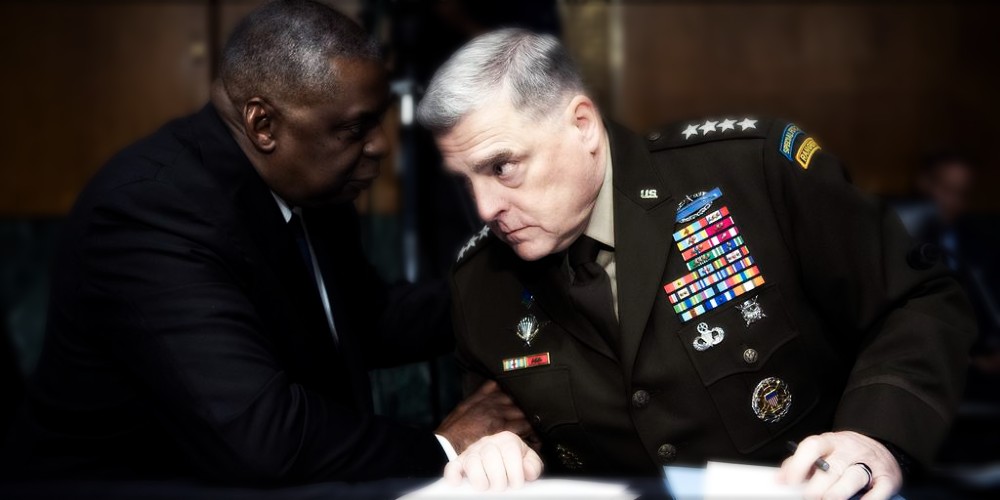
 Military academies will likely face legal challenges for their use of affirmative action following Thursday’s landmark Supreme Court ruling that barred universities from considering an applicant’s race in admission decisions, experts told the Daily Caller News Foundation.
A 6-3 majority of Supreme Court justices in the Harvard and University of North Carolina vs. Students for Fair Admissions found that the way they prioritized applicants of certain racial categories in admissions violated the Equal Protection Clause of the 14th Amendment, overruling a prior decision that allowed universities to consider race. Justices deferred weighing in on the ruling’s significance for military academies, opening the door for likely successful Equal Protection lawsuits against the academies as the Department of Defense (DOD) seeks to increase racial diversity among commissioning officers, legal and military experts told the DCNF.
“Any DOD spin claiming that the Court has decided not to apply the ruling to the service academies, and therefore discriminatory practices at the service academies may continue, would be disingenuous at best and without credible support,” Elaine Donnelly, founder and president of the Center for Military Readiness, told the DCNF.
But the court did not consider any cases involving the military, opting instead to leave out the question of racial preference in service academies’ admissions decisions due to the “potentially distinct interests” they might hold, according to the opinion.
“No military academy is a party to these cases, however, and none of the courts below addressed the propriety of race-based admissions systems in that context,” Chief Justice John Roberts wrote in a footnote to the majority opinion. “This opinion also does not address the issue,” he added, “in light of the potentially distinct interests that military academies may present.”
Importantly, the Supreme Court did not affirm service academies’ race-preferential admissions policies or say that the Equal Protection Clause does not apply to the military, experts told the DCNF. Rather, because the DOD was not included in the litigation, the court could not decide whether the military actually has distinct interests that meet the strict requirements for an exemption.
“The question is not whether the Equal Protection Clause applies to admissions policies at the SAs (service academies), but how do the uniquely military interests involved influence the application of the [Equal Protection] Clause in that setting?” retired law professor and Army Col. William Woodruff explained to the DCNF. “Constitutional rights apply in the military.”
Thirty-five former Pentagon officers, including four former chairmen of the Joint Chiefs of Staff, submitted a brief in support of the respondents, Harvard and UNC, anticipating the affect the case might have on military academies. They argued that taking race out of the admissions equation would “impede our military’s ability to acquire essential entry level leadership attributes and training essential to cohesion.”
Oral arguments also touched on the possibility national security interests might affect how the Equal Protection Clause should apply to service academies.
“If what you’re asking me is whether we think the military has distinctive interests in this context, I would say yes,” Solicitor General Elizabeth Prelogar told the court in October, a transcript shows. “And I think it’s critically important for the Court in its decision in these cases to make clear that those interests are, I think, truly compelling with respect to the military.”
The U.S. Military Academy at West Point explored alternatives to race-based affirmative action, such as preferencing socioeconomic status, but found that would increase the number of white men at the academy, Prelogar explained. Other race-neutral alternatives failed to improve the racial diversity rate of admitted students.
Roberts asked whether Prelogar sought to link the military academies to Harvard and UNC; “In other words, you rise and fall with their case?” he said.
Prelogar did not give a definitive answer.
Justice Roberts’ footnote, then, acknowledges the military could have distinct national security interests — but that was not a question before the court, and no body of evidence was developed in the case to prove either way the existence of unique national security interests, experts explained to the DCNF. The question will have to be answered at some other time.

“The Court did not hint, or imply, approval of DOD’s claim or of DOD’s race-based practices,” Scott McQuarrie, a West Point graduate and attorney, whose organization Veterans for Fairness and Merit wrote in support of the plaintiffs, told the DCNF.
In other words, the ruling does not, as Justice Sotomayor claims in her dissent, create a “carveout” for the service academies.
The Future Of Race-Based Admissions At Military Academies
Pentagon officials have long said they seek a total force that reflects the demographics of the American public. Efforts to increase diversity have highlighted the officer corps, where the relative proportion of racial and ethnic minorities tends to be smaller than among the enlisted ranks.
Over 75% of active duty officers are white, according to the latest DOD demographic data. “Black and African American” individuals make up 19% of the enlisted active duty force, compared with 9% of officers.
To meet those goals, the military academies have practiced affirmative action in admissions for decades, according to The New York Times.
“The U.S. Naval Academy uses race and ethnicity as one of a multitude of factors to assess applications for admission,” Cmdr. Alana Garas, a spokesperson for the academy, previously told Military Times in October. It does not assign points for race or seek to fill quotas, Garas added.

Col. Arthur W. Primas Jr., director of admissions for the U.S. Air Force Academy, told the outlet the academy also considers race in a “holistic evaluation” of candidates. “Race, along with gender and ethnicity, is not used solely as the basis for appointment consideration,” he said.
West Point’s website confirms the institution is “committed to affirmative action.”
Service academies may try to modify or reframe their existing guidance to prove their version of affirmative action is “as bad” as the practices of Harvard and UNC, Woodruff explained to the DCNF.
“In the current political climate, my guess is the SAs will continue to march under their current policies with, perhaps, a little tweaking to better shore up their chances in resisting efforts by Congress to impose merit-based admissions policies and to prepare for the inevitable lawsuits that will come challenging the use of racial preferences in the SAs,” Woodruff told the DCNF.
DOD is “aware of the Supreme Court decision concerning affirmative action in college admissions,” a Naval Academy spokesperson told the DCNF. “We are currently assessing the decision and its potential impacts on our practices.”
The Pentagon would have to prove that to achieving greater officer diversity constitutes a national security imperative with sufficient weight to justify continued employment of race-based admissions, experts said. However, winning an exception in the court would be extremely difficult.
“Racial preferences are subject to strict scrutiny and it is very difficult to sustain racial discrimination when the policy is subjected to strict scrutiny,” Woodruff said.
“The government has dug itself into a bit of a hole,” Mike Berry, director of military affairs and senior counsel for First Liberty Institute, told the DCNF, because it often tries to achieve contradictory objectives in the name of national security.
“On the one hand, it claims that diversity is a compelling national security (governmental) interest, thus race-based admissions are necessary to maintain diversity in the military. But on the other hand, it often argues in religious liberty cases that it cannot allow individual religious expression, such as the wearing of Sikh, Jewish, or Muslim articles of faith, because uniformity in the military is a compelling national security interest,” he said.
In addition, the court applied the ruling to universities that host Reserve Officer Training Corps (ROTC) programs, which routinely commission officers into the military.
“That is an implicit rejection of DOD’s claim,” McQuarrie told the DCNF.
“The fact that [the court] did not even blink at the military justification for racial preferences in the ROTC context, which is the largest source of officers, is pretty telling that the Court will not just roll over in a future lawsuit challenging the SA racial preferences,” Woodruff said.
Instead, service academies could look for ways to hone in recruitment to target underrepresented groups, so more minorities apply to the academy, according to Military Times.
The best way to prevent service academies from discriminating on the basis of race when deciding who to admit is for Congress to step in, Donnelly told the DCNF.
“Officials will try to maintain racial preferences as usual, until Congress intervenes or an affected plaintiff with standing files suit,” she said.
“Generations of recent military experience have shown that warfighter teams have been successfully built on the selfless, colorblind culture (and mutual trust) that the Court’s decision reminds us is a national imperative. … There’s simply no excuse for compromising military leader quality, at any level, by diluting merit with identity-based preferences,” McQuarrie said.
All content created by the Daily Caller News Foundation, an independent and nonpartisan newswire service, is available without charge to any legitimate news publisher that can provide a large audience. All republished articles must include our logo, our reporter’s byline and their DCNF affiliation. For any questions about our guidelines or partnering with us, please contact [email protected].
Two Storms, One Harvest

Every food crisis in living memory has been a one-shock event. The 2008 price spike was a commodity bubble. The 2020 shortages were a logistics failure. The 2022 grain scare was a war on one exporter’s ports. Each time, the system bent, adjusted, and recovered, and each time the experts assured us afterward that global markets are simply too big and too diversified to fail.
What nobody in Washington seems eager to discuss is that 2026 is shaping up to be something the modern food system has never actually faced. Two independent shocks, one climatic and one geopolitical, are converging on the same harvest cycle at the same time. Not sequentially. Simultaneously.
Start with the weather. The Pacific Ocean is currently building toward what forecasters now openly call a record event. NOAA’s Climate Prediction Center puts the odds of at least a strong El Niño near 88 percent, with roughly two in three odds it reaches “very strong” status, the tier reserved for perhaps three or four events in the entire satellite era. Every major global model now projects a median peak in Super El Niño territory, and most of them project it exceeding the 2015-16 event, which until now held the modern record. Sea surface anomalies were already brushing the super threshold in mid-July, months before these events normally peak. The atmosphere has already shifted into El Niño mode, and the event is forecast to crest in late fall and early winter.
This is not about “climate change.” It’s about the standard cycles of weather, and the cycle we’re currently in is one that has likely devastated societies in the past. We’re better prepared as a society today, but not all Americans are equally prepared.
Serious households have started doing the quiet math on their own. Grocery bills tell part of the story, and the forecast maps tell the rest, which is why long-term food storage has moved from fringe hobby to mainstream line item in the family budget, with established suppliers like Heaven’s Harvest seeing demand from people who five years ago would have rolled their eyes at the idea. That instinct is not paranoia. It is pattern recognition, and the pattern is worth walking through carefully.
Editor’s Note: Heaven’s Harvest IS a sponsor, but the warnings of this article are real and would be written even if we didn’t have a survival food sponsor. With that said, those who take advantage of what they offer can use promo code “Patriot” for 15% off.
The Fertilizer Clock Is Already Running
While the Pacific warms, the second shock has been unfolding in the Strait of Hormuz. The conflict with Iran turned the world’s most important energy chokepoint into a contested waterway, and the consequences reach far beyond the gas pump. Roughly a third of global fertilizer trade moves through Hormuz, and the disruption sent urea prices up 86 percent year over year by March, with a 53 percent jump in a single month.
The World Bank projects energy prices rising about 24 percent in 2026 and fertilizer about 31 percent. By its own accounting, fertilizer prices ran 35 percent higher in the first five months of this year than the same period last year.
Here is the mechanism the nightly news will not explain. Fertilizer is not a grocery item. It is a time-delayed input. The nitrogen a farmer in Iowa or Punjab could not afford to apply this spring does not show up as a problem this spring. It shows up as a thinner harvest six to twelve months later.
The World Bank’s own food security brief concedes that the effects of reduced applications earlier this season “are likely to become visible only later in harvest outcomes.” Translate that from institutional language into plain English and it means this. The damage is already done, it is already in the ground, and we are simply waiting for it to arrive on the shelf.
Now check the calendar. Six to twelve months from the spring planting season lands us squarely in late 2026 and early 2027. Which is precisely when the strongest El Niño in the instrumental record is forecast to peak, bringing its signature droughts to Southeast Asia, Australia, southern Africa, northern Brazil, and South Asia, the very regions that grow the world’s rice, sugar, and oilseeds.
The World Bank warns openly that a strong El Niño “could disrupt multiple crop belts simultaneously” on top of the conflict-driven input costs. Their baseline projection assumes the Middle East disruptions ease by autumn. What in the last two years of Middle East history suggests that assumption is safe?
The System Has No Slack Left
The comfortable answer is that global markets always adjust. But adjustment requires slack, and the slack is gone. Global cereal production is expected to decline from last year’s records even before El Niño does its work. The UN World Food Programme, hardly a den of right-wing preppers, is calling this the most significant disruption to its supply chains since Covid and the invasion of Ukraine, and its supply chain director put the stakes bluntly.
Today’s supply chain challenges are tomorrow’s hunger crisis.
There is also a political dimension that markets cannot price. When food gets scarce, governments do not behave like economists. They behave like politicians. Export bans, hoarding mandates, and panic buying at the national level turned the modest rice shortfall of 2008 into a global crisis, and analysts are already warning that import-dependent nations are the first dominoes.
The 2015-16 Super El Niño, a far weaker event than what is now forecast, threw tens of millions into food stress across Africa and Asia. This one is projected to be stronger, and it arrives with fertilizer already rationed by price and shipping lanes already contested by missiles.
What Joseph Knew
Scripture does not treat preparation for lean years as faithlessness. It treats it as wisdom delivered in advance to those willing to act on it.
Behold, there come seven years of great plenty throughout all the land of Egypt: And there shall arise after them seven years of famine; and all the plenty shall be forgotten in the land of Egypt.
Joseph did not respond to that warning with a hashtag or a committee. He stored grain during the years of abundance, and when the famine came, Egypt stood while its neighbors begged. The lesson is not that famine is certain. It is that the time to prepare is precisely when preparation still looks optional.
Nobody who filled a pantry in a year of plenty has ever regretted it, and nobody standing in an empty aisle has ever been glad he waited for certainty.
None of this calls for panic, and panic is the enemy of sound judgment anyway. It calls for the same unglamorous prudence our grandparents considered ordinary. Keep some cash margin, know your local growers, and put real food in deep storage while it is cheap and available, because the entire arc of this story is that cheap and available is a closing window.
Families looking for a straightforward place to start can visit Heaven’s Harvest and use promo code Patriot for 15 percent off long-term storable food. The forecasts may yet soften, the strait may yet reopen, and we should pray they do. But hope is a fine thing to hold and a foolish thing to eat.

Sorry, but this article is simply so much goobleydegook —– when communist political minder systems are in place at the military academies and Pentagon/DoD, and only Maoist jargon is allowed at the service academies —- usage of “mother” and “father” etc., forbidden —- this article is simple the semi–specious response to an entirely false narrative!
The Milleytary has been completely subverted —– did not help that covert globalist, MARK ESPER, inserted those DEI political minder systems in the Pentagon via the NDAA during the Trump Administration —- proving once again the nation requires a president who can recognize Deep Staters and not grow the frigging swamp!!!
Back in the 1990s, when I was a contractor at Micro$oft tech support with the rollout of Win95, I noticed a strange pattern of superior former military officers there who had been hired as general managers or in–line supervisors —- across the spectrum: White, Black, Asian, female —- all capable people RIF’d from military careers by the Clinton Administration —– the ONE prevailing trait they shared in common? All political conservatives?!
At the time I thought this odd —- why are TPTB RIF’ing the most superior ones?! And what of “diversity”?!
Now we know . . .
Reagan left the nation with a highly improved military, but Bush #1, the Clintons, Bush #2 and Obama destroyed it!