

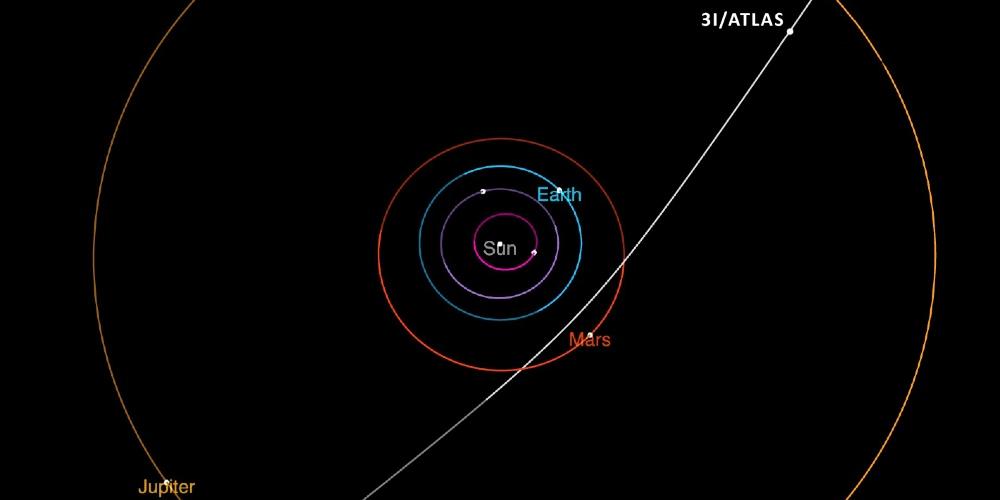
(End of the American Dream)—A colossal interstellar space rock that was originally known as “A11pl3Z” but has since been given the designation “3I/ATLAS” will be making a very alarming run through our solar system in September and October. Based on their initial observations, scientists estimated that 3I/ATLAS has a diameter of approximately 20 kilometers, and that would make it larger than Manhattan. But now scientists are telling us that it is probably at most 5.6 kilometers wide. Even if it is only about 5 kilometers wide, we are still talking about an extinction-level event if it were to hit us. Over the next couple of months, 3I/ATLAS will be zipping through our solar system at a speed of about 130,000 miles per hour, and scientists assure us that the gravity of the sun cannot significantly alter the trajectory of anything moving that fast. But what if they are wrong?
As you will see below, 3I/ATLAS is supposed to fly past Mars at a distance of just 0.19 AU on October 3rd.
That is even closer than astronomers were originally projecting, and that is making some people nervous.
Hopefully the experts are correct and there is no threat of collision, because if this thing actually hit Mars it would be a cataclysm unlike anything that any of us have ever seen.
According to Harvard astrophysicist Avi Loeb, it appears that 3I/ATLAS may actually be emitting its own light…
Interstellar object 3I/ATLAS — which is zooming through our inner solar system — appears to be emitting its own light, according to Harvard astrophysicist Avi Loeb.
The observation by Loeb, if verified, would contradict NASA’s classification of the Manhattan-size object as a comet, the scientist argues in a new blog post.
Obviously, more observations will have to be done in order to confirm this.
But there are essentially two options.
If this theory is not true and 3I/ATLAS is not emitting its own light, Loeb says that this giant space rock is probably about 12 miles long…
If 3I/ATLAS were reflecting light, it would mean the object was 12 miles long, which is improbable, according to the astrophysicist.
I cannot even imagine an object that is 12 miles long and that is traveling at 130,000 miles per hour.
Can you?
The second option is that 3I/ATLAS is emitting its own light, and that would be even more ominous, because Loeb believes that 3I/ATLAS could potentially be “a spacecraft powered by nuclear energy”…
Loeb speculated that the nucleus of the object could in fact be nuclear — and possibly an engine crafted by an alien people.
“A natural nuclear source could be a rare fragment from the core of a nearby supernova that is rich in radioactive material. This possibility is highly unlikely, given the scarce reservoir of radioactive elements in interstellar space,” Loeb wrote.
“Alternatively, 3I/ATLAS could be a spacecraft powered by nuclear energy, and the dust emitted from its frontal surface might be from dirt that accumulated on its surface during its interstellar travel,” Loeb conjectured, adding, “This cannot be ruled out, but requires better evidence to be viable.”
And Loeb has pointed out that the fact that the trajectory of 3I/ATLAS will take it so close to Mars, Venus and Jupiter is more evidence for the theory that it could be an alien spacecraft…
Loeb has also raised questions about its unusual trajectory.
“If you imagine objects entering the solar system from random directions, just one in 500 of them would be aligned so well with the orbits of the planets,” Loeb told Fox News Digital earlier this month.
The interstellar object, which comes from the center of the Milky Way, is also expected to pass near Mars, Venus and Jupiter, another improbable coincidence, he said.
“It also comes close to each of them, with a probability of one in 20,000,” he said.
For the record, I think that Loeb is way out in left field on this.
I do not believe that 3I/ATLAS is an alien spacecraft.

But I do believe that it is a very dangerous space rock.
And it does appear that it will travel alarmingly close to Mars, Venus and Jupiter…
It follows a retrograde orbit aligned within 5 degrees of the ecliptic plane, passing close to Venus at 0.65 astronomical units, Mars at 0.19 AU, and Jupiter at 0.36 AU. Loeb calculates the probability of such alignments at 0.005 percent for random arrivals.
When I originally wrote about this giant space rock, we were being told that it would pass Mars at a distance of approximately 0.4 AU.
But now we are being told that it will pass Mars at a distance of just 0.19 AU on October 3rd.
I know that is still a relatively safe distance, but it is a little too close for comfort in my book.
And could it be possible that our astronomers will modify their projections again as we get closer to October 3rd?

They have already more than halved the projected distance between 3I/ATLAS and Mars.
This is a story that we will want to watch very closely.
Following the close encounter with Mars, 3I/ATLAS is expected to be closest to the Sun on October 30th.
Subsequently, 3I/ATLAS is supposed to come closest to Earth on December 19th at a distance of approximately 1.8 astronomical units.
That is very good news, because as I pointed out in a previous article, it has been estimated that if a giant space rock that is just 11 or 12 kilometers wide hit us it would “wipe out most everything on Earth”…
For an asteroid to wipe out most everything on Earth, it would have to be massive. Scientists estimate it would take an asteroid about 7 to 8 miles (11 to 12 kilometers) wide crashing into the Earth. Once it made impact, it would create a tremendous dust plume that would envelope the entire planet, block out the sun and raise temperatures where the asteroid made impact. Billions would die, and much of life on the planet would be destroyed. But, scientists believe some would survive.
Thankfully, 3I/ATLAS is not going to hit us, but the clock is certainly ticking for humanity.
In fact, even mainstream scientists are now warning that humanity is living on borrowed time…
In a game of Russian roulette with a standard Colt revolver, the chances of instant death are one-in-six.
Terrifyingly, that’s the same as the odds of humanity being wiped out within 75 years – everyone dead in a cataclysmic and total breakdown of civilisation, according to Oxford University futurologist Toby Ord, an expert on the threat of artificial intelligence.
Does it sound impossibly bleak? His colleague Nick Bostrom is more pessimistic still. He rates the possibility of human extinction by the next century as one in four.
Pulitzer prize-winning writer Jared Diamond is even less hopeful, predicting our species’ chances of survival beyond 2050 – just 25 years away – are no better than evens, or 50/50.
Our self-destructive behaviors are slowly but surely killing our civilization in thousands of different ways.
So even if we are extremely fortunate and a giant space rock does not hit our planet in any of our lifetimes, the truth is that our civilization would still be facing one existential crisis after another.
Michael’s new book entitled “10 Prophetic Events That Are Coming Next” is available in paperback and for the Kindle on Amazon.com, and you can subscribe to his Substack newsletter at michaeltsnyder.substack.com.

Two Storms, One Harvest

Every food crisis in living memory has been a one-shock event. The 2008 price spike was a commodity bubble. The 2020 shortages were a logistics failure. The 2022 grain scare was a war on one exporter’s ports. Each time, the system bent, adjusted, and recovered, and each time the experts assured us afterward that global markets are simply too big and too diversified to fail.
What nobody in Washington seems eager to discuss is that 2026 is shaping up to be something the modern food system has never actually faced. Two independent shocks, one climatic and one geopolitical, are converging on the same harvest cycle at the same time. Not sequentially. Simultaneously.
Start with the weather. The Pacific Ocean is currently building toward what forecasters now openly call a record event. NOAA’s Climate Prediction Center puts the odds of at least a strong El Niño near 88 percent, with roughly two in three odds it reaches “very strong” status, the tier reserved for perhaps three or four events in the entire satellite era. Every major global model now projects a median peak in Super El Niño territory, and most of them project it exceeding the 2015-16 event, which until now held the modern record. Sea surface anomalies were already brushing the super threshold in mid-July, months before these events normally peak. The atmosphere has already shifted into El Niño mode, and the event is forecast to crest in late fall and early winter.
This is not about “climate change.” It’s about the standard cycles of weather, and the cycle we’re currently in is one that has likely devastated societies in the past. We’re better prepared as a society today, but not all Americans are equally prepared.
Serious households have started doing the quiet math on their own. Grocery bills tell part of the story, and the forecast maps tell the rest, which is why long-term food storage has moved from fringe hobby to mainstream line item in the family budget, with established suppliers like Heaven’s Harvest seeing demand from people who five years ago would have rolled their eyes at the idea. That instinct is not paranoia. It is pattern recognition, and the pattern is worth walking through carefully.
Editor’s Note: Heaven’s Harvest IS a sponsor, but the warnings of this article are real and would be written even if we didn’t have a survival food sponsor. With that said, those who take advantage of what they offer can use promo code “Patriot” for 15% off.
The Fertilizer Clock Is Already Running
While the Pacific warms, the second shock has been unfolding in the Strait of Hormuz. The conflict with Iran turned the world’s most important energy chokepoint into a contested waterway, and the consequences reach far beyond the gas pump. Roughly a third of global fertilizer trade moves through Hormuz, and the disruption sent urea prices up 86 percent year over year by March, with a 53 percent jump in a single month.
The World Bank projects energy prices rising about 24 percent in 2026 and fertilizer about 31 percent. By its own accounting, fertilizer prices ran 35 percent higher in the first five months of this year than the same period last year.
Here is the mechanism the nightly news will not explain. Fertilizer is not a grocery item. It is a time-delayed input. The nitrogen a farmer in Iowa or Punjab could not afford to apply this spring does not show up as a problem this spring. It shows up as a thinner harvest six to twelve months later.
The World Bank’s own food security brief concedes that the effects of reduced applications earlier this season “are likely to become visible only later in harvest outcomes.” Translate that from institutional language into plain English and it means this. The damage is already done, it is already in the ground, and we are simply waiting for it to arrive on the shelf.
Now check the calendar. Six to twelve months from the spring planting season lands us squarely in late 2026 and early 2027. Which is precisely when the strongest El Niño in the instrumental record is forecast to peak, bringing its signature droughts to Southeast Asia, Australia, southern Africa, northern Brazil, and South Asia, the very regions that grow the world’s rice, sugar, and oilseeds.
The World Bank warns openly that a strong El Niño “could disrupt multiple crop belts simultaneously” on top of the conflict-driven input costs. Their baseline projection assumes the Middle East disruptions ease by autumn. What in the last two years of Middle East history suggests that assumption is safe?
The System Has No Slack Left
The comfortable answer is that global markets always adjust. But adjustment requires slack, and the slack is gone. Global cereal production is expected to decline from last year’s records even before El Niño does its work. The UN World Food Programme, hardly a den of right-wing preppers, is calling this the most significant disruption to its supply chains since Covid and the invasion of Ukraine, and its supply chain director put the stakes bluntly.
Today’s supply chain challenges are tomorrow’s hunger crisis.
There is also a political dimension that markets cannot price. When food gets scarce, governments do not behave like economists. They behave like politicians. Export bans, hoarding mandates, and panic buying at the national level turned the modest rice shortfall of 2008 into a global crisis, and analysts are already warning that import-dependent nations are the first dominoes.
The 2015-16 Super El Niño, a far weaker event than what is now forecast, threw tens of millions into food stress across Africa and Asia. This one is projected to be stronger, and it arrives with fertilizer already rationed by price and shipping lanes already contested by missiles.
What Joseph Knew
Scripture does not treat preparation for lean years as faithlessness. It treats it as wisdom delivered in advance to those willing to act on it.
Behold, there come seven years of great plenty throughout all the land of Egypt: And there shall arise after them seven years of famine; and all the plenty shall be forgotten in the land of Egypt.
Joseph did not respond to that warning with a hashtag or a committee. He stored grain during the years of abundance, and when the famine came, Egypt stood while its neighbors begged. The lesson is not that famine is certain. It is that the time to prepare is precisely when preparation still looks optional.
Nobody who filled a pantry in a year of plenty has ever regretted it, and nobody standing in an empty aisle has ever been glad he waited for certainty.
None of this calls for panic, and panic is the enemy of sound judgment anyway. It calls for the same unglamorous prudence our grandparents considered ordinary. Keep some cash margin, know your local growers, and put real food in deep storage while it is cheap and available, because the entire arc of this story is that cheap and available is a closing window.
Families looking for a straightforward place to start can visit Heaven’s Harvest and use promo code Patriot for 15 percent off long-term storable food. The forecasts may yet soften, the strait may yet reopen, and we should pray they do. But hope is a fine thing to hold and a foolish thing to eat.

A Christian doesn’t worry with a big rock ending things. We know how things end 🙂
In Revelation, one of the tribulations is a giant “mountain” falling from space and hitting earth, killing a major fraction of fauna.
Con matter what happens, Jesus will return and save his people.
Excerpt from the article above: “Thankfully, 3I/ATLAS is not going to hit us, but the clock is certainly ticking for humanity.”
Okay … so, and what?
The CLOCK on humanity has been ticking SINCE DAY ONE, and will continue to tick until our planetary demise — however and whenever such may manifest itself — after which, for us, the ticking will be no more.
Please stop with the pointless melodrama.
Even more improbable is that this is the 3rd object in a few years to enter our solar system from its edge and in its planetary plane. Our system is inclined from the galactic plane by 62 degrees, so 3I/Atlas cannot have come from the direction of the galactic center. If it did, it would punch through the planetary plane from underneath like a bullet through paper. Also, if it did come from galactic center, its trajectory is well controlled. Well controlled trajectories 3 times? Why are there no images of #I/Atlas from Webb or Hubble? Why were there no images of Omuramura? It has the shape of cylinder, but that shape is not natural. Why are no sensors available to scientists to get the size of the object right?
Alien probe, really? The NEAREST star system to us is the Centauri system, and at this space rock’s speed of 130,000 miles per hour, it would take 30,000 years to cover the distance. One way.
About the extraterrestrial angle: not saying what is what, but what did Jesus actually mean in John 14:2 when he says “In my Father’s house are many mansions, I go to prepare a place for you…”. This says two things most people overlook. 1) There are undisputably many already existing mansions in the total family of lifeforms under the Father (whoever that is, because Jesus never once mentions of Yahweh or Elohim). 2) our mansion wasn’t yet a part of that. What does that say about us? We are one race of many? Was this a veiled reference to other races in the stars? Give it some thought, all you Christians out there!
What’s with the hysteria? It’s going to be 17,670 000 miles from Mars. That’s not exactly in the neighborhood. It’s going to be 167,400 000 miles from Earth. That’s almost twice the distance from the Earth to the Sun. Does anyone have any common sense? These crap articles are a waste of time.
“I cannot even imagine an object that is 12 miles long and that is traveling at 130,000 miles per hour. Can you?”
Well, let’s play with some numbers:
– The earth is roughly 93 million (9.3 x 10^7) miles from the sun. Call that the radius.
– The diameter is therefore 1.86 x 10^8
– So the circumference (orbit) is pi times diameter, or 5.8 x 10^8 miles. That’s the distance the earth travels in a year.
– There are 8760 hours in a year (or 8766. if you want to factor in leap years)
That amounts to 66,164 miles per hour. Half your targeted speed of 130,000, but a darn sight bigger than 12 miles, too.
Class dismissed.
(Or see this youtube video: https://www.youtube.com/watch?v=48cKCKnJ7jA)
Loeb… Sounds like typical BS.
So what if it hits Mars.