

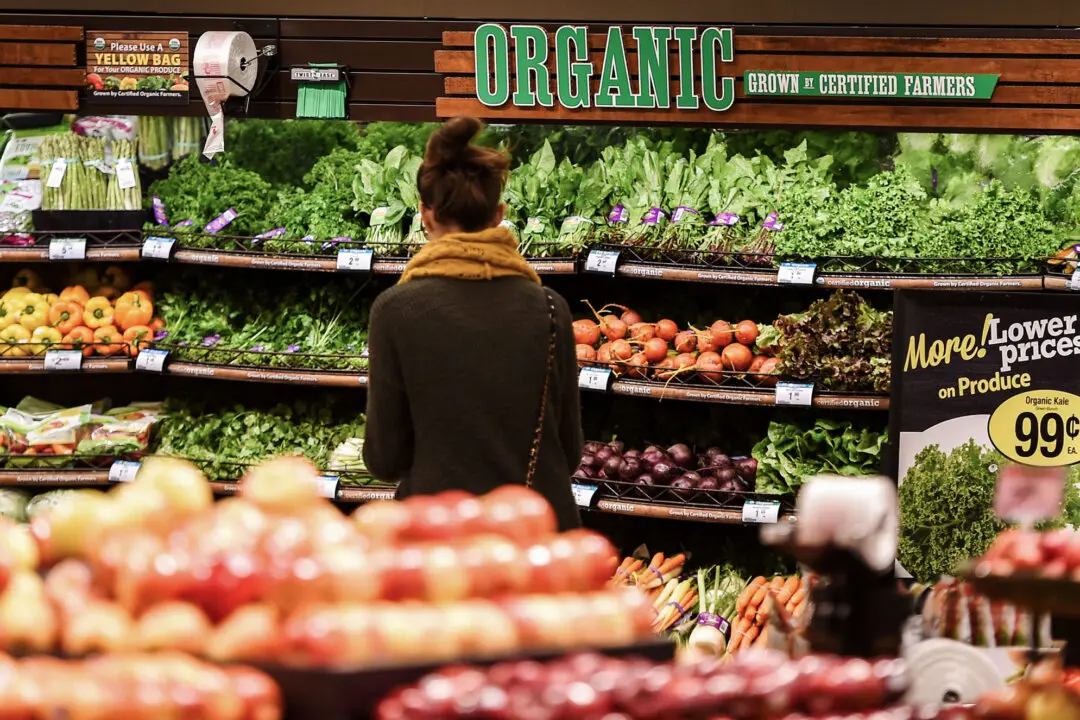

(The Epoch Times)—Grocery shoppers in the United States have an abundance of options to choose from, and a wide range of prices accompanying varying selections.
Items labeled as organic typically sell for a premium over non-organic counterparts, but many consumers are unaware of the market forces that factor into the pricing.
Premiums, once as high as 170 percent for some items—such as spinach in 2015—are on the decline and are currently about 20 percent higher than conventionally grown produce, according to data from the U.S. Department of Agriculture (USDA).
While all farms face certain regulatory hurdles at the federal, state, and local levels, organic producers are saddled with more comprehensive rules to abide by.
Organic food production is heavily regulated—forbidding genetically modified organisms as well as approximately 700 chemicals that are used in non-organic agriculture—and certification is required.
To achieve organic certification, farmers spend hundreds of hours and thousands of dollars annually to comply with record keeping requirements and prepare for regular document and facility inspections.
Non-organic farms do not have such overhead costs and thus have fewer expenses priced into the cost of goods sold.
Throughout the growing seasons, organic farms cost more to operate for a variety of reasons, and subsidies that disproportionately benefit chemically intensive agriculture exacerbate the price discrepancies, according to advocates for the organic industry.
Approximately 2 percent of the money allocated for research by the federal government since 2018 was focused on organic food production, according to data collected by the Organic Trade Association.
“We would really like to see more of a balance for the research money, especially because funds used for organic studies tend to benefit the entire Ag industry,” a spokesperson for the trade group told The Epoch Times.
Past research related to integrated pest management—where beneficial insects are used to manage invasive pests—for example, was initiated by organic producers, but the subsequent findings are now widely used.
One study from the U.S. National Institute of Health found a 95 percent reduction in insecticide use when pests are managed using natural methods.
With the bulk of federal dollars going to study non-organic practices such as how to use pesticides and herbicides banned in organic production, critics of the current system suggest the playing field is tilted toward farmers who use a wide range of chemicals.
It has resulted in significantly lower prices for some non-organic foods, including heavily processed fast foods, compared with organic, natural ingredients.
Advocates are currently lobbying federal lawmakers to boost investment in organic agriculture research.
More Expensive Inputs
Fertilizers used in organic production—including manure, alfalfa meal, and composted material, among other things—are more costly than synthetic versions like urea and ammonium nitrate, with estimates ranging from 20 to 50 percent higher for organic nutrients.
Conventional farms rely on synthetic materials developed since the 1950s with the invention of chemically intensive agriculture.
Organic farmers utilize crop rotation and cover crops to fix nitrogen in the soil, a method that builds soil health, improves water retention, outcompetes weeds, and reduces insect populations.
Spreading natural fertilizers and planting and plowing under clover, winter rye, and other cover crops requires the use of heavy equipment or laborers, depending on the size of the operation, which further adds to the cost of production.
Labor Intensive
Removing weeds is one of the costliest aspects of organic agriculture, as mechanical removal using weed eaters or flamethrowers is the preferred method and requires many hours of labor to eradicate nuisance plants.
“During part of the year, we spend more hours removing weeds than doing anything else,” Juan Guzman, a managing farmhand for organic vineyards in Northern California, told The Epoch Times.
“It’s the most important job because the weeds will steal food from the vines and reduce the yields if we don’t get rid of them.”
Non-organic farmers typically use glyphosate, sold under the brand name Roundup, to manage weeds. The cost of the chemical is offset by the ease of application, which helps lower production costs.
Supply and Demand
Also impacting pricing are the perennial forces of supply and demand, with health-conscious consumers seeking high-quality foods at increasing levels, while production has plateaued in recent years, and organic yields are slightly lower than conventional crops.
A thin market, with fewer producers than in the conventional sector, creates a situation where more dollars are chasing fewer goods, thus leading to higher pricing strategies at retail levels.
Imports of organic produce are increasing to meet the demand, with more than $4 billion of goods imported in 2023, according to the USDA.
However, margins for organic farms are slightly below the national average for non-organic farms, ranging from negative 3 percent to slightly higher than 20 percent, the National Center for Appropriate Technology concluded in a 2019 report.
Consumers Want Healthy, Affordable Food
Demand for organic food is at an all-time high, with approximately $64 billion worth of certified organic food sold in the United States last year, up from about $11 billion in 2000, according to the Agriculture Department’s 2025 situation report.
Families of all backgrounds across the United States are prioritizing healthy living, and a growing movement is popularizing a return to traditional farming methods that avoid synthetic chemicals.
“I don’t want that going into my child’s body,” Megan Armstrong, a resident of Huntsville, Texas, and mother of a 3-year-old, told The Epoch Times.
“It’s worth the extra bucks to keep my child safe.”
Another mother from Texas, Kelsey Facundo, said she prioritizes organic food for her children, while she and her husband oftentimes have to make do with what they can afford.
A homesteading mother said the difference in quality of organic and conventional meats is stark.
Animals raised for organic production are fed certified organic hay and grains, allowed to graze in pastures, and are strictly forbidden from eating genetically modified grains, which is the standard fare for conventional livestock production.
“I started finding local butchers to buy all my meat from,” Shanna Dixon told The Epoch Times.
“It’s worth the price because the taste is on another level, which really goes to show you what they are doing to the meat between the slaughter and the table to change the taste.”
Newly appointed Health and Human Services Secretary Robert F. Kennedy, Jr. has long championed organic agriculture as part of his Make America Healthy Again agenda, and many advocates are anxiously watching his actions to see how new policies could impact the industry.
Regarding prospective reviews of the U.S. food supply, he said, “Nothing is going to be off limits,” during introductory remarks to his department on Feb. 18.
Three Reasons a Coffee Gift Set From This Christian Company Is Perfect for Christmas

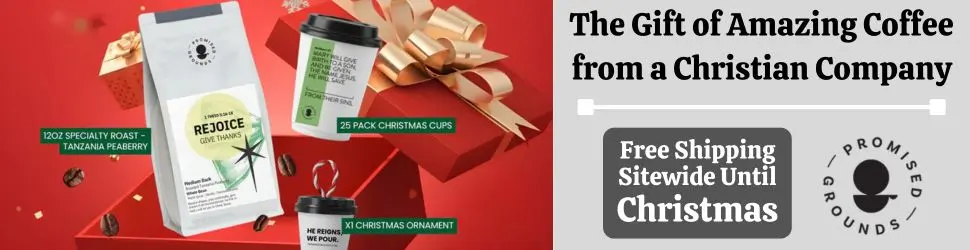
When you’re searching for a Christmas gift that’s meaningful, useful, and rooted in faith, you don’t want to settle for anything generic. This season is filled with noise — mass-produced products, last-minute picks, and trends that fade as quickly as they appear. But one gift stands apart because it blends genuine quality with a message that matters: a coffee gift set from Promised Grounds Coffee.
This small Christian-owned company has become a favorite among believers who want to support faith-driven businesses while giving friends and family something they’ll actually enjoy. Here are three reasons a Promised Grounds Coffee gift set may be the most thoughtful and impactful present you give this year.
1. It’s Truly Delicious Coffee
Too many “gift-worthy” coffees look beautiful in the package but disappoint when the cup is poured. Promised Grounds takes the opposite approach — exceptional taste first, thoughtful presentation second.
Their beans are sourced with care, roasted in small batches, and crafted to bring out a rich, smooth flavor profile that appeals to both casual drinkers and true coffee lovers. Whether someone enjoys bold, dark roasts or lighter, more delicate blends, every sip reflects quality that stands shoulder-to-shoulder with the biggest specialty brands.
Simply put: this coffee is good. Really good. Some say it’s absolutely fantastic. If you want a gift that won’t be re-gifted, ignored, or shoved in a cabinet, this is it.
2. It Spreads the Word While Serving a Real Purpose
There are many Christian gifts that are meaningful… but not exactly practical. There are also useful gifts that have nothing to do with faith. Promised Grounds Coffee bridges both worlds beautifully.
Each gift set delivers an encouraging, faith-centered message through its packaging and presentation — a simple but powerful reminder of God’s goodness during the Christmas season. The cups are especially popular and serve as a daily reminder of the blessings from our Lord. At the same time, the product itself is something people will actually use and appreciate every single day.
It’s a gift that uplifts the spirit and fills the mug. A gift that points loved ones toward Scripture while still being part of the normal rhythm of life. And in a culture that increasingly pushes faith to the margins, giving a gift that quietly but confidently honors Christ can make a deeper impact than you might expect.
3. It’s Affordable, Valuable, and Elegantly Presented
Many people want to give something meaningful without breaking their Christmas budget. Promised Grounds Coffee strikes that perfect balance — the sets look and feel premium, but the price remains accessible.
The packaging is classy, clean, and gift-ready, making it ideal for:
- Family members of all ages
- Co-workers or employees
- Church friends or small-group leaders
- Hosts, neighbors, and last-minute gift needs
It’s the kind of gift that feels more expensive than it is — and more thoughtful than most of what you’ll find on store shelves.
The Perfect Blend of Faith, Flavor, and Christmas Cheer
A coffee gift set from Promised Grounds Coffee checks every box: a gift that tastes amazing, conveys your faith, supports a Christian business, and brings daily enjoyment to the person who receives it. In a season when so many gifts are forgotten, this one stands out for all the right reasons.
If you want a Christmas present that reflects your values and delivers genuine joy, Promised Grounds Coffee is the perfect place to start.

Most of this article is bullshit. Supply and demand are the key to any commodity. If you think organic food is too high priced, Price out Cancer. The best solution is grow as much of your own food as possible.