

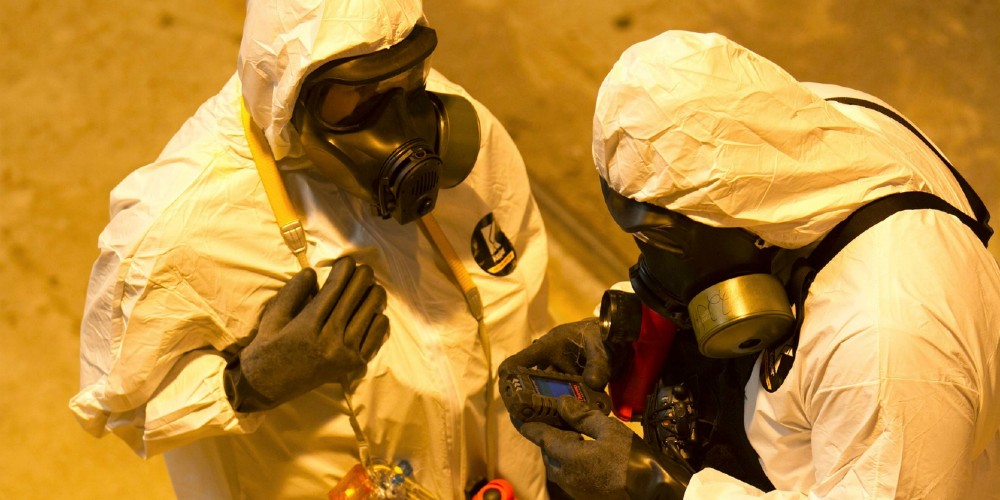
On August 12, the FBI and Department of Homeland Security released a joint bulletin to law enforcement agencies about increased threats following the raid on Donald Trump’s Mar-A-Lago residence. While the bulletin is supposed to be for official use only, Project Veritas found a copy of it, and you can view the bulletin here. FBI and DHS released the joint bulletin after a man entered the FBI building in Cincinnati and started firing at people with a nail gun on August 11. The FBI/DHS bulletin also states that a variety of threats have been made online, including the threat to place a dirty bomb in front of FBI headquarters.
What should you know about a dirty bomb?
Most of us don’t work for the FBI, but how concerned should we be about “dirty bombs”? How easy are they to make? How destructive are they?
The Nuclear Regulatory Commission defines dirty bombs as “a type of ‘radiological dispersal device’ that combines a conventional explosive, such as dynamite, with radioactive material.” Dirty bombs do not have the same ability to spread radiation for thousands of square miles that nuclear bombs do; in the event of a dirty bomb exploding, most people would likely be injured by the explosive device itself, not the actual radiation.
The NRC also says that the dirty bomb is not a “weapon of mass destruction” but a “weapon of mass disruption.” This has to do with the public fear factor regarding radiation and the very expensive cleanup involved.
For example, back in 2019, radioactive Cesium 137 leaked at Seattle’s Harborview Research and Training Building. This leak was due to actions on the part of contractors who were not obeying standard safety procedures. The contractor started sawing through pipes containing the Cesium and did not notice when it started to leak. He was not wearing any of the radiation detecting equipment (rings and/or badges) that have been standard in that field of work for quite a while, and that would have alerted him that something was wrong.
And while no one suffered long-term injuries from this incident, the cleanup took two years and cost $156 million. This $156 million price tag was just for a leak; radioactive material sprayed by an explosive device would be that much more expensive to clean up. Even if no injuries were involved, cleaning up after a dirty bomb would be a logistical and financial nightmare.
And as bad as the financial aftermath of a dirty bomb would be, the psychological impact on the community would probably be worse. The public is terrified of radiation. We’ve all heard horror stories about Hiroshima and Nagasaki, Chernobyl, and Three Mile Island. Photos of animals near Chernobyl with grotesque mutations are all over the internet.
If you’re into fear porn, boy, does radiation have a lot to offer!
But what if you want a sober assessment of what might happen if you, say, worked next to a building in which a dirty bomb went off?
Well, according to the NRC, it would depend on the amount of radiation absorbed by the body, the type of radiation, the distance of the source of radiation to your body, type of exposure (absorbed by skin, inhaled, or ingested,) and the length of time of exposure. And, of course, the strength of the explosive device.
If you don’t remember the different types of radiation and genuinely want a better understanding of possible scenarios, you can always revisit your favorite middle-school science book. My personal favorite is The Usborne Science Encyclopedia, but I’m sure there are plenty of other good ones out there.
There are three types of radiation: alpha, beta, and gamma. Alpha particles are absorbed by thick pieces of paper and travel less than 4 inches through air. While they are heavy and very harmful if swallowed or inhaled, they are too big to be absorbed through skin unless it is cut.
Beta particles can travel up to three feet in the air and are absorbed by thin sheets of copper. Your clothes will protect you from beta particles, though some types of beta particles can cause radiation burns on bare skin. Like alpha particles, they do the most damage if swallowed or inhaled.
Gamma rays are the most penetrating. They have no mass; they are pure energy. X-rays are not identical to gamma rays, though both are commonly used in medicine.
X-rays are lower in intensity and so are not as damaging. Gamma rays are more high energy; it takes several inches of lead to completely stop gamma rays. They can pass through not only clothes but your entire body, causing damaging ionization on the way.

But don’t panic.
This sounds scary, but people are exposed to all kinds of radiation in everyday activities. Many smoke detectors contain alpha particles. Beta particles have a variety of medical applications, like in positron emission tomography (PET). Do you only eat organic home grown, home processed food? Including all your spices? No?
Then you probably have irradiated food in your regular diet. Almost all spices on the market have been exposed to gamma rays to kill pathogens, and it’s permissible in other foods, too. Gamma rays are also used to sterilize medical equipment.
And radioactive substances are ubiquitous in the environment. We’re all exposed to some forms of radiation. Do you like bananas? They’re radioactive. Do you like traveling by plane? You’re being exposed to cosmic radiation, then, too. Humans have evolved to deal with certain amounts of radioactive substances in the environment.
Yes, in the past hundred years, we have been working with larger quantities of synthetically produced radioactive material than ever before. This absolutely warrants additional safety protocols. But today, people have been working in various industries, handling radioactive substances on a daily basis for decades. We should be cautious and attentive toward radioactive substances; people that work in those industries need to be attentive to their own physical well-being to make sure they are not being negatively affected.
(Looking for information on emergency evacuations? Check out our free QUICKSTART Guide.)
The public should not be stupidly terrified about the possibility of a dirty bomb.
And it is worth repeating that most of the actual damage done by a dirty bomb would be done by the explosive itself. And the more powerful the explosion was, the less damage would be done by the radioactive material because it would be more widely dispersed. The dose makes the poison we’ve known for a long time; a powerful blast that dispersed radioactive material over a wide radius would also highly dilute the radioactive material, rendering it far less dangerous.

Radioactive material is widely used in medicine and industry, but purchasing is highly regulated.
Each state has its own rules regarding purchasing radioactive materials, but in none of them can anyone off the street just call a distributor and buy whatever they want. However, other countries also use radioactive material, and many don’t regulate it as well as we do in the States. It’s theoretically possible that a bad actor could get hold of radioactive material in a country like Mexico and then sneak it across the border into the U.S. Also, there have been cases of cars transporting radioactive material being stolen.
Having said that, a dirty bomb is something to be aware of, not something to lose sleep over.
Journalists love making people terrified of radiation, but the truth is that 36 years after Chernobyl, we know now much more about the long-term effects of radiation exposure, and they are not as bad as we feared 50 years ago. Yes, Chernobyl was horrible, wasteful, and tragic. Many people lost their lives, and many more lost quality of life. However, fears that mutations observed as a result of the blast would be passed down from generation to generation turned out to be misplaced. People who suffered as a result of the Chernobyl blast were able to have healthy children.
The fear-mongering surrounding dirty bombs may do more damage, and I can’t help but wonder a little bit at some of the timing. About a month ago, NBC did a news report on how easy it is to get radioactive material.
The whole 2 minutes were basically fear porn about radioactive substances we’ve been using in medicine for years. Their reporters were able to order some radioactive substances using a fake license and used this as a pretext for pushing stricter controls on the part of medical physicists and sellers.
They also use the incident to incite fear; they say that a dirty bomb made with the improperly purchased amount of radioactive material stolen could “cause hundreds of deaths from evacuations and billions of dollars of socioeconomic effects.” (Go to 1:10 in this video to see.)
This report did not offer many specific details. NBC didn’t say what kind of radioactive materials were improperly purchased; they didn’t say what kind of explosive device it would take to spread the materials around that would cause hundreds of people to die in an evacuation.
Notice that the reporter did not say that hundreds of people would die from radiation poisoning because that would be a blatant lie. But saying that hundreds could possibly die in an evacuation scenario is much vaguer and, therefore, much harder to dispute definitively.
This report was designed to spread fear regarding dirty bombs.
But why? Why do mainstream media and government officials want to keep us in a permanent state of being terrified of something, whether it’s Covid, or the Russians, or monkeypox, or now dirty bombs?
Without going into a huge amount of detail, I think it has to do with Mattias Desmet’s idea of mass formation. There are a variety of reasons that powerful people want the public terrified right now.
Dirty bombs are just another layer on the fear cake.
If the thought of a dirty bomb genuinely scares you, I would recommend taking a look at the OP’s very reasonable, not-fear-mongering article on How to Prepare for a Nuclear Attack. And then bear in mind that dirty bombs are far, far less damaging. For even more information, check out The Organic Prepper Nuclear Survival Anthology. As always, I think the best antidote to fear is knowledge and then preparedness. Don’t let the thought of a dirty bomb terrify you. Learn about what you’re most likely to encounter in your particular environment, prepare accordingly, and then go about your life.
Are you concerned about the possibility of a dirty bomb? How likely do you think it is that someone would get these materials and create a terrorist disaster? Do you have any particular knowledge about dirty bombs that you’d like to share with us? Let us know your thoughts in the comments.
About the Author
A lover of novels and cultivator of superb apple pie recipes, Marie spends her free time writing about the world around her.
Article cross-posted from The Organic Prepper.

Two Storms, One Harvest

Every food crisis in living memory has been a one-shock event. The 2008 price spike was a commodity bubble. The 2020 shortages were a logistics failure. The 2022 grain scare was a war on one exporter’s ports. Each time, the system bent, adjusted, and recovered, and each time the experts assured us afterward that global markets are simply too big and too diversified to fail.
What nobody in Washington seems eager to discuss is that 2026 is shaping up to be something the modern food system has never actually faced. Two independent shocks, one climatic and one geopolitical, are converging on the same harvest cycle at the same time. Not sequentially. Simultaneously.
Start with the weather. The Pacific Ocean is currently building toward what forecasters now openly call a record event. NOAA’s Climate Prediction Center puts the odds of at least a strong El Niño near 88 percent, with roughly two in three odds it reaches “very strong” status, the tier reserved for perhaps three or four events in the entire satellite era. Every major global model now projects a median peak in Super El Niño territory, and most of them project it exceeding the 2015-16 event, which until now held the modern record. Sea surface anomalies were already brushing the super threshold in mid-July, months before these events normally peak. The atmosphere has already shifted into El Niño mode, and the event is forecast to crest in late fall and early winter.
This is not about “climate change.” It’s about the standard cycles of weather, and the cycle we’re currently in is one that has likely devastated societies in the past. We’re better prepared as a society today, but not all Americans are equally prepared.
Serious households have started doing the quiet math on their own. Grocery bills tell part of the story, and the forecast maps tell the rest, which is why long-term food storage has moved from fringe hobby to mainstream line item in the family budget, with established suppliers like Heaven’s Harvest seeing demand from people who five years ago would have rolled their eyes at the idea. That instinct is not paranoia. It is pattern recognition, and the pattern is worth walking through carefully.
Editor’s Note: Heaven’s Harvest IS a sponsor, but the warnings of this article are real and would be written even if we didn’t have a survival food sponsor. With that said, those who take advantage of what they offer can use promo code “Patriot” for 15% off.
The Fertilizer Clock Is Already Running
While the Pacific warms, the second shock has been unfolding in the Strait of Hormuz. The conflict with Iran turned the world’s most important energy chokepoint into a contested waterway, and the consequences reach far beyond the gas pump. Roughly a third of global fertilizer trade moves through Hormuz, and the disruption sent urea prices up 86 percent year over year by March, with a 53 percent jump in a single month.
The World Bank projects energy prices rising about 24 percent in 2026 and fertilizer about 31 percent. By its own accounting, fertilizer prices ran 35 percent higher in the first five months of this year than the same period last year.
Here is the mechanism the nightly news will not explain. Fertilizer is not a grocery item. It is a time-delayed input. The nitrogen a farmer in Iowa or Punjab could not afford to apply this spring does not show up as a problem this spring. It shows up as a thinner harvest six to twelve months later.
The World Bank’s own food security brief concedes that the effects of reduced applications earlier this season “are likely to become visible only later in harvest outcomes.” Translate that from institutional language into plain English and it means this. The damage is already done, it is already in the ground, and we are simply waiting for it to arrive on the shelf.
Now check the calendar. Six to twelve months from the spring planting season lands us squarely in late 2026 and early 2027. Which is precisely when the strongest El Niño in the instrumental record is forecast to peak, bringing its signature droughts to Southeast Asia, Australia, southern Africa, northern Brazil, and South Asia, the very regions that grow the world’s rice, sugar, and oilseeds.
The World Bank warns openly that a strong El Niño “could disrupt multiple crop belts simultaneously” on top of the conflict-driven input costs. Their baseline projection assumes the Middle East disruptions ease by autumn. What in the last two years of Middle East history suggests that assumption is safe?
The System Has No Slack Left
The comfortable answer is that global markets always adjust. But adjustment requires slack, and the slack is gone. Global cereal production is expected to decline from last year’s records even before El Niño does its work. The UN World Food Programme, hardly a den of right-wing preppers, is calling this the most significant disruption to its supply chains since Covid and the invasion of Ukraine, and its supply chain director put the stakes bluntly.
Today’s supply chain challenges are tomorrow’s hunger crisis.
There is also a political dimension that markets cannot price. When food gets scarce, governments do not behave like economists. They behave like politicians. Export bans, hoarding mandates, and panic buying at the national level turned the modest rice shortfall of 2008 into a global crisis, and analysts are already warning that import-dependent nations are the first dominoes.
The 2015-16 Super El Niño, a far weaker event than what is now forecast, threw tens of millions into food stress across Africa and Asia. This one is projected to be stronger, and it arrives with fertilizer already rationed by price and shipping lanes already contested by missiles.
What Joseph Knew
Scripture does not treat preparation for lean years as faithlessness. It treats it as wisdom delivered in advance to those willing to act on it.
Behold, there come seven years of great plenty throughout all the land of Egypt: And there shall arise after them seven years of famine; and all the plenty shall be forgotten in the land of Egypt.
Joseph did not respond to that warning with a hashtag or a committee. He stored grain during the years of abundance, and when the famine came, Egypt stood while its neighbors begged. The lesson is not that famine is certain. It is that the time to prepare is precisely when preparation still looks optional.
Nobody who filled a pantry in a year of plenty has ever regretted it, and nobody standing in an empty aisle has ever been glad he waited for certainty.
None of this calls for panic, and panic is the enemy of sound judgment anyway. It calls for the same unglamorous prudence our grandparents considered ordinary. Keep some cash margin, know your local growers, and put real food in deep storage while it is cheap and available, because the entire arc of this story is that cheap and available is a closing window.
Families looking for a straightforward place to start can visit Heaven’s Harvest and use promo code Patriot for 15 percent off long-term storable food. The forecasts may yet soften, the strait may yet reopen, and we should pray they do. But hope is a fine thing to hold and a foolish thing to eat.
