

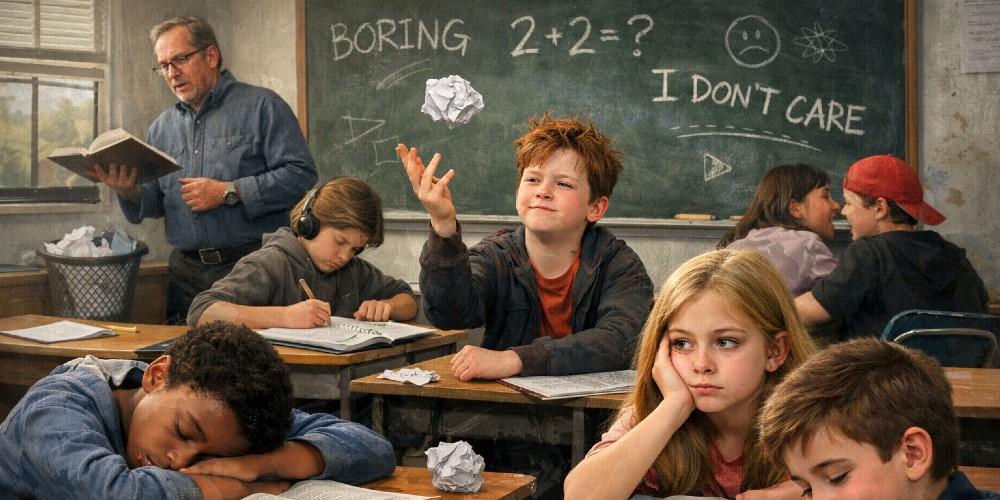
(End of the American Dream)—The quality of the education that our children are receiving in America’s public schools just continues to go down. At one time, the concern was that not enough students were taking advanced courses. But now we have reached a point where a very large portion of our high school graduates cannot read effectively, cannot write effectively and cannot do basic math effectively.
If you think that I am exaggerating, please keep reading. We have never faced an education crisis of this magnitude in the entire history of our nation, and that has enormous implications for our future.
Dr. Kent Ingle is the president of Southeastern University, and he recently authored an excellent piece in which he warned that reading levels among incoming college students are so bad that many are struggling “to understand basic text on a page”…
A stunning report revealed that many university professors now find themselves teaching students who struggle to read, not just to interpret literature or write essays, but to understand basic text on a page. According to Fortune, a growing number of Gen Z students enter college unable to “read effectively,” forcing professors to break down even simple passages line by line.
That trend should alarm every parent, employer and policymaker in this country. It is not just an academic concern. It is a cultural crisis.
This is not some random guy that is making these claims.
This is the president of a major university.
I don’t understand how it is possible for millions upon millions of students to enter college without even being able to read on a basic level, but it is happening.
Sadly, the same thing is true for math skills.
Large numbers of students that are entering our colleges must take remedial math courses that teach concepts that should have been taught in elementary and middle school…
Five years ago, about 30 incoming freshmen at UC San Diego arrived with math skills below high-school level. Now, according to a recent report from UC San Diego faculty and administrators, that number is more than 900—and most of those students don’t fully meet middle-school math standards. Many students struggle with fractions and simple algebra problems. Last year, the university, which admits fewer than 30 percent of undergraduate applicants, launched a remedial-math course that focuses entirely on concepts taught in elementary and middle school. (According to the report, more than 60 percent of students who took the previous version of the course couldn’t divide a fraction by two.) One of the course’s tutors noted that students faced more issues with “logical thinking” than with math facts per se. They didn’t know how to begin solving word problems.
The university’s problems are extreme, but they are not unique. Over the past five years, all of the other University of California campuses, including UC Berkeley and UCLA, have seen the number of first-years who are unprepared for precalculus double or triple. George Mason University, in Virginia, revamped its remedial-math summer program in 2023 after students began arriving at their calculus course unable to do algebra, the math-department chair, Maria Emelianenko, told me.
If students in our public schools are not being taught basic reading skills and basic math skills, what are they being taught?
That is a very good question.
In many states, there always seems to be plenty of classroom time to discuss gender, the latest politically-correct pronouns and social justice issues.
But that isn’t why we send our kids to school.
We send them to school so that they will learn the basic skills that will enable them to successfully function as adults.
And in so many cases, that just isn’t happening.

We have millions upon millions of high school kids that are unable to read a contract or multiply three digit numbers without a calculator, but virtually all of them know about the “6-7” meme…
“6-7,” pronounced “six-seveeeeen,” is haunting school halls across the country (including South Park Elementary), making it the Gen Alpha nonsense phrase of the moment. Kids are shouting it in classrooms when a teacher turns to page 67, when lunchtime is 6 to 7 minutes away or for no reason at all. It’s become so ubiquitous that Dictionary.com named it the word of the year.
“It’s like a plague — a virus that has taken over these kids’ minds,” said Gabe Dannenbring, a seventh-grade science teacher in Sioux Falls, South Dakota. “You can’t say any iteration of the numbers 6 or 7 without having at least 15 kids yell, ‘6-7!’”
It’s a joke without a punchline (or a setup, for that matter). 6-7 means nothing, but using it can make a student feel like a member of a bigger, cooler group of their peers.
We have failed our young people.
It takes an extraordinary amount of self-discipline to be successful in our society today, but millions upon millions of them are being allowed to slide through grade level after grade level without being forced to put in the hard work that will enable them to develop that self-discipline.
When I was growing up, I had a number of teachers that made sure that I worked hard.
But these days, many school officials are far more interested in preying on their students.
In Indiana, a high school secretary has just been charged with having sex with two different students…

An Indiana high school secretary has been accused of having sex with two students after her husband caught her with one of them and allegedly ‘battered’ her.
Alicia Hughes was arrested Saturday after an investigation unveiled her alleged sexual relationship with two teenagers.
The 31-year-old was caught by her husband while she was with an 18-year-old Randolph Eastern School Corporation student on Friday night, Union City police said.
And in Florida, a band teacher has been arrested for having sex with “multiple students”…
A North Miami Beach band teacher has been arrested after he was accused of inappropriate relationships with multiple students.
Jose Francisco Montes-Guedez, 40, was arrested Friday on two counts of offenses against students by authority figures, two counts of battery – touch or strike, and three counts of contributing to the delinquency of a child, Miami-Dade jail records showed.
According to an arrest report, Montes is a band teacher at Alonzo and Tracy Mourning Senior High Biscayne Bay School in North Miami Beach.
There are stories like this in the news every single day.
But because none of the teachers is named “Epstein”, those stories don’t get much notice.
Our system of public education needs to be rebuilt from the ground up.
If we don’t prepare our young people for the real world, they will fail.
At this stage, many of our young people are so unprepared for the real world that they actually need their parents to go to job interviews with them…
Over 50% of college-age job seekers had their parents sit with them at an in-person interview, a January survey by Resume Templates found. What’s more, over 35% of surveyed individuals reported parents either writing a cover letter or performing a test assignment for them.
Julia Toothacre, a career coach and chief career strategist at the survey group, said she had never seen parents this involved in their child’s job searches in the past.
“When I was doing career development at the college level, we would see parents come in to talk about majors and sometimes career choices, but they weren’t sitting in on interviews or communicating with managers,” Toothacre told The College Fix in a recent interview via email.
A couple of decades ago, it would have been unthinkable for a parent to accompany a college graduate to a job interview.
Now it happens all the time.
But at least our young people are happy, right?
Well, actually that is not the case at all.
In fact, suicide rates among Gen Z adults have been absolutely soaring…
Suicide rates among Gen Z adults have unnaturally increased in the U.S. over the past ten years according to new figures.
Axios Notes that there has been a 16.4 percent increase in suicides among the demographic between 2014-2024.
The locations where the rise is most prominent, the report notes are in the South and the Midwest, with black and Hispanic men, accounting for a huge 85 percent of the increase.
A Stateline analysis of data also shows that Georgia experienced the largest increase in suicide rates over the past decade, among 18 to 27-year-olds, with the state’s suicide rate in the age group increasing by a massive 64.9 percent.
Reading those statistics should break your heart.
The system has failed an entire generation of Americans.
If we don’t get it fixed, things will only get worse.
Michael’s new book entitled “10 Prophetic Events That Are Coming Next” is available in paperback and for the Kindle on Amazon.com, and you can subscribe to his Substack newsletter at michaeltsnyder.substack.com.

Two Storms, One Harvest

Every food crisis in living memory has been a one-shock event. The 2008 price spike was a commodity bubble. The 2020 shortages were a logistics failure. The 2022 grain scare was a war on one exporter’s ports. Each time, the system bent, adjusted, and recovered, and each time the experts assured us afterward that global markets are simply too big and too diversified to fail.
What nobody in Washington seems eager to discuss is that 2026 is shaping up to be something the modern food system has never actually faced. Two independent shocks, one climatic and one geopolitical, are converging on the same harvest cycle at the same time. Not sequentially. Simultaneously.
Start with the weather. The Pacific Ocean is currently building toward what forecasters now openly call a record event. NOAA’s Climate Prediction Center puts the odds of at least a strong El Niño near 88 percent, with roughly two in three odds it reaches “very strong” status, the tier reserved for perhaps three or four events in the entire satellite era. Every major global model now projects a median peak in Super El Niño territory, and most of them project it exceeding the 2015-16 event, which until now held the modern record. Sea surface anomalies were already brushing the super threshold in mid-July, months before these events normally peak. The atmosphere has already shifted into El Niño mode, and the event is forecast to crest in late fall and early winter.
This is not about “climate change.” It’s about the standard cycles of weather, and the cycle we’re currently in is one that has likely devastated societies in the past. We’re better prepared as a society today, but not all Americans are equally prepared.
Serious households have started doing the quiet math on their own. Grocery bills tell part of the story, and the forecast maps tell the rest, which is why long-term food storage has moved from fringe hobby to mainstream line item in the family budget, with established suppliers like Heaven’s Harvest seeing demand from people who five years ago would have rolled their eyes at the idea. That instinct is not paranoia. It is pattern recognition, and the pattern is worth walking through carefully.
Editor’s Note: Heaven’s Harvest IS a sponsor, but the warnings of this article are real and would be written even if we didn’t have a survival food sponsor. With that said, those who take advantage of what they offer can use promo code “Patriot” for 15% off.
The Fertilizer Clock Is Already Running
While the Pacific warms, the second shock has been unfolding in the Strait of Hormuz. The conflict with Iran turned the world’s most important energy chokepoint into a contested waterway, and the consequences reach far beyond the gas pump. Roughly a third of global fertilizer trade moves through Hormuz, and the disruption sent urea prices up 86 percent year over year by March, with a 53 percent jump in a single month.
The World Bank projects energy prices rising about 24 percent in 2026 and fertilizer about 31 percent. By its own accounting, fertilizer prices ran 35 percent higher in the first five months of this year than the same period last year.
Here is the mechanism the nightly news will not explain. Fertilizer is not a grocery item. It is a time-delayed input. The nitrogen a farmer in Iowa or Punjab could not afford to apply this spring does not show up as a problem this spring. It shows up as a thinner harvest six to twelve months later.
The World Bank’s own food security brief concedes that the effects of reduced applications earlier this season “are likely to become visible only later in harvest outcomes.” Translate that from institutional language into plain English and it means this. The damage is already done, it is already in the ground, and we are simply waiting for it to arrive on the shelf.
Now check the calendar. Six to twelve months from the spring planting season lands us squarely in late 2026 and early 2027. Which is precisely when the strongest El Niño in the instrumental record is forecast to peak, bringing its signature droughts to Southeast Asia, Australia, southern Africa, northern Brazil, and South Asia, the very regions that grow the world’s rice, sugar, and oilseeds.
The World Bank warns openly that a strong El Niño “could disrupt multiple crop belts simultaneously” on top of the conflict-driven input costs. Their baseline projection assumes the Middle East disruptions ease by autumn. What in the last two years of Middle East history suggests that assumption is safe?
The System Has No Slack Left
The comfortable answer is that global markets always adjust. But adjustment requires slack, and the slack is gone. Global cereal production is expected to decline from last year’s records even before El Niño does its work. The UN World Food Programme, hardly a den of right-wing preppers, is calling this the most significant disruption to its supply chains since Covid and the invasion of Ukraine, and its supply chain director put the stakes bluntly.
Today’s supply chain challenges are tomorrow’s hunger crisis.
There is also a political dimension that markets cannot price. When food gets scarce, governments do not behave like economists. They behave like politicians. Export bans, hoarding mandates, and panic buying at the national level turned the modest rice shortfall of 2008 into a global crisis, and analysts are already warning that import-dependent nations are the first dominoes.
The 2015-16 Super El Niño, a far weaker event than what is now forecast, threw tens of millions into food stress across Africa and Asia. This one is projected to be stronger, and it arrives with fertilizer already rationed by price and shipping lanes already contested by missiles.
What Joseph Knew
Scripture does not treat preparation for lean years as faithlessness. It treats it as wisdom delivered in advance to those willing to act on it.
Behold, there come seven years of great plenty throughout all the land of Egypt: And there shall arise after them seven years of famine; and all the plenty shall be forgotten in the land of Egypt.
Joseph did not respond to that warning with a hashtag or a committee. He stored grain during the years of abundance, and when the famine came, Egypt stood while its neighbors begged. The lesson is not that famine is certain. It is that the time to prepare is precisely when preparation still looks optional.
Nobody who filled a pantry in a year of plenty has ever regretted it, and nobody standing in an empty aisle has ever been glad he waited for certainty.
None of this calls for panic, and panic is the enemy of sound judgment anyway. It calls for the same unglamorous prudence our grandparents considered ordinary. Keep some cash margin, know your local growers, and put real food in deep storage while it is cheap and available, because the entire arc of this story is that cheap and available is a closing window.
Families looking for a straightforward place to start can visit Heaven’s Harvest and use promo code Patriot for 15 percent off long-term storable food. The forecasts may yet soften, the strait may yet reopen, and we should pray they do. But hope is a fine thing to hold and a foolish thing to eat.
