

Editor’s Commentary: It is incumbent on us all to discern what’s happening in the world and determine if it’s important enough for us to change how we’re living. The article below by Michael Snyder declares that we’re in the end times and the weather we’re seeing is a sign of that. I am always skeptical of any claims that “this is it,” having lived through dozens of supposedly prophetic events. I heard Obama is definitely the Antichrist. I heard 2012 was the end because the Mayans said so. I heard the blood moons of 2015 meant we were toast. There is never a shortage of signs that can be interpreted as “this is it.”
With that said, Snyder makes some solid points, and while I will never declare world events are definitely signs of Jesus Christ’s imminent return, I won’t dismiss them, either. It’s possible that the crazy weather we’re seeing is just random, cyclical. It’s possible that we’re experiencing weather manipulation for the sake of selling the climate change hoax. It’s possible that God is waking people up. And none of these are mutually exclusive; it wouldn’t surprise me if we learn in the afterlife that God had globalists use weather manipulation to serve His purposes of warning us. The point is this: Read Snyder’s words below with an open mind but always be discerning as well. Crazy things are happening. How we let those things determine our course is a matter of proper discernment. Here’s Michael Snyder…
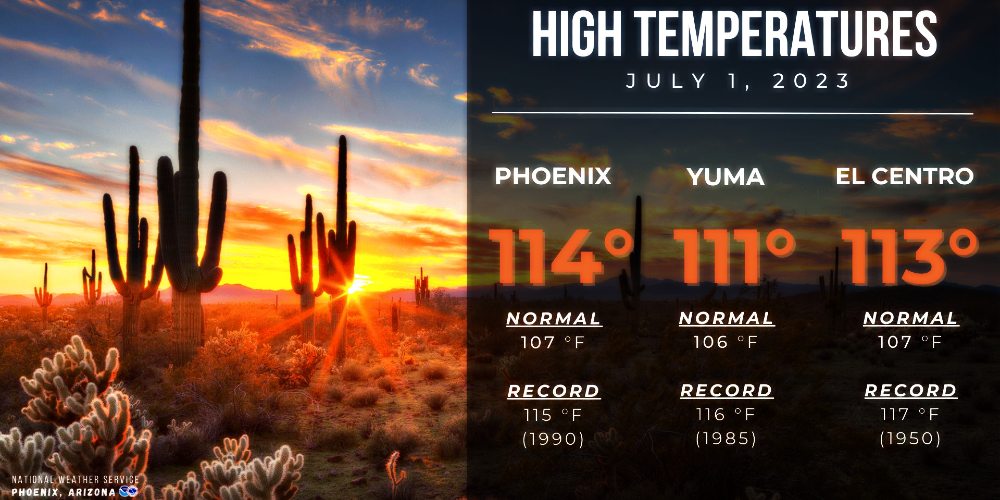
Have you noticed that we are being hit by an endless series of weather emergencies? Here in the middle of 2023, farms in the Midwest are being devastated by a seemingly endless drought, massive dust storms are happening as far north as Illinois, residents of Vermont just experienced the worst flooding that they have seen in nearly 100 years, and the Southwest is being baked by unprecedented heat. I realize that this is a very sensitive topic.
A large portion of the population insists that what we are witnessing is “normal”, while another large portion of the population believes that we can fix the weather by changing our behavior. Unfortunately, both groups are wrong. What we are beginning to experience is the apocalyptic weather of the end times, and things are only going to get crazier during the months and years that are in front of us.
Right now, the horrifying heat wave that is frying the Southwest is making headlines all over the nation…
Across a wide swath of the U.S. from Texas to Nevada, a major heat wave that is threatening to break temperature records continued to bake parts of the South and Southwest on Wednesday, sending people scrambling for relief and adding to what has become a series of weather extremes that researchers say fit the pattern of a warming environment.
Temperatures well into the triple digits are expected this weekend from California to Texas to Florida, with parts of Nevada forecast to reach 116 degrees Fahrenheit and cities in Arizona expected to hit a staggering 118 F.
Temperatures this high are life-threatening, and it is likely that quite a few people will die from the heat in the days ahead.
In Phoenix, there is a possibility that the city could actually see the 120 degree mark for only the fourth time ever…
‘While the 120-degree mark is not a certainty for Phoenix, it is possible late this week and this upcoming weekend,’ AccuWeather Senior Meteorologist Alex Sosnowski warned this week of forecast temperatures for the famously arid city, known as Arizona’s Valley of the Sun.
The city has seen 13 consecutive 110F-plus days – and now weather experts warn the city may soon challenge its all-time record of 18 days.
The all-time record high in Phoenix is 122 degrees. There is a chance that record could get broken.
But even now, the heat is so intense that it is actually melting tar on the roofs of some homes…
‘How bad is the Phoenix heat wave? The tar is melting off the newish roof on our house,’ Astrid Galvan shared in a post.
On TikTok, one hilarious resident shared a video of himself frying an egg on a grill that was not plugged in but heated up by the sun.
‘Gotta love Az summers,’ the creator captioned the video.
That is hot! Unfortunately, conditions are going to be like this for a while.
These oppressive temperatures are being caused by a “heat dome” that is “now set to persist through much of the month”…
A sprawling area of high pressure currently positioned directly over the Four Corners is responsible for the scorching temperatures, which are unusual even for the notoriously hot expanse.
Known as a ‘heat dome’ to meteorologists, the phenomenon is now set to persist through much of the month – scorching metros in Arizona, Nevada, and California in the process.
And of course this is happening in the context of a historic global heat wave.
In fact, we are being told that last month was the warmest June “since at least 1850”…
Last month was the warmest June globally since at least 1850, when record-keeping began, according to a new report by Berkeley Earth, a nonprofit research organization that focuses on climate data analysis. The report found that June 2023 broke the previous record, set last year, by a “large margin,” putting the planet on track for one of the warmest years on record — if not the warmest.
Meanwhile, ocean temperatures also continue to rise.

If you can believe it, some areas off the coast of Florida are actually experiencing “hot tub-like water temperatures”…
Buoys off the coast of Florida measured hot tub-like water temperatures near 97 degrees Fahrenheit on Monday in the shallow, heat-prone Florida Bay between the southern tip of Florida and the Keys. The more ecologically vital and expansive coral reefs are located east and south of the Florida Keys, but the buoy measurements indicate just how extreme the heat in Florida has been so unusually early in the summer.
Ocean temperatures around Florida usually get hotter as the summer progresses and don’t reach their peak until late August into September, Manzello said, meaning ocean temperatures could rise further.
If ocean temperatures stay this high, it will significantly intensify any major storms that come along later this year.
Perhaps this explains why Farmers Insurance has suddenly decided to completely pull out of the state of Florida…
Farmers Insurance will stop offering its policies in Florida, including home, auto and umbrella policies, in a change that will force thousands of people to change their insurance provider.
The company said in a statement that its decision to get out of Florida was a business decision necessary to manage its risk exposure in the hurricane-prone state. Farmers serves 100,000 customers in Florida but said there will be no impact to customers who use Farmers’ owned subsidiaries like Foremost Signature and Bristol West.
So why is all of this happening?
Well, whenever there is a lot of solar activity temperatures tend to rise, and right now sunspot activity has spiked to very alarming levels.
SUNSPOT NUMBER SOARS TO OVER 200 AGAIN! Over the last 20 years a sunspot number >200 has only happened a couple of times. Now it seems to be occurring several times per month. We are about to lose some spot regions over the W limb, so it will soon drop back to more normal values. pic.twitter.com/wkmPSsRxJW
— Keith Strong (@drkstrong) July 11, 2023
So we are being cooked from above, and we are also being cooked from beneath.
In a previous article, I discussed some of the very unusual things that are happening on our ocean floors. For example, scientists recently discovered “a sprawling field of hydrothermal vents” on the floor of the Atlantic Ocean that are releasing material “hot enough to melt lead”…
On March 12, a team of scientists gathered in the control room of the RV Falkor (too), an oceanographic research vessel operated by the Schmidt Ocean Institute. They watched the monitor of a camera-wielding underwater drone, or ROV, as it explored the deep sea 2,000 meters (6,600 feet) below the ship. When the screen showed a plume of black smoke, the scientists cheered.
The video showed a sprawling field of hydrothermal vents — fissures in the seabed where seawater mixes with magma — on the Puy des Folles Volcano on the Mid-Atlantic Ridge. Some of the vents, known as “black smokers,” had formed tall “chimneys” of iron sulfide deposits that gushed out dark, sulfurous plumes with temperatures up to about 340° Celsius (644° Fahrenheit), hot enough to melt lead.
During the months and years to come, our planet will get even more unstable, and that is because we really are living in the end times.
Sadly, most people don’t want to hear the truth.
Most people just assume that the politicians have everything under control.
But they don’t.
What is happening to us is outside of our control, and the “birth pains” that we are experiencing will only become more intense in the days ahead.
Michael’s new book entitled “End Times” is now available in paperback and for the Kindle on Amazon.com, and you can check out his new Substack newsletter right here.
Articles cross-posted from End of the American Dream.

Two Storms, One Harvest

Every food crisis in living memory has been a one-shock event. The 2008 price spike was a commodity bubble. The 2020 shortages were a logistics failure. The 2022 grain scare was a war on one exporter’s ports. Each time, the system bent, adjusted, and recovered, and each time the experts assured us afterward that global markets are simply too big and too diversified to fail.
What nobody in Washington seems eager to discuss is that 2026 is shaping up to be something the modern food system has never actually faced. Two independent shocks, one climatic and one geopolitical, are converging on the same harvest cycle at the same time. Not sequentially. Simultaneously.
Start with the weather. The Pacific Ocean is currently building toward what forecasters now openly call a record event. NOAA’s Climate Prediction Center puts the odds of at least a strong El Niño near 88 percent, with roughly two in three odds it reaches “very strong” status, the tier reserved for perhaps three or four events in the entire satellite era. Every major global model now projects a median peak in Super El Niño territory, and most of them project it exceeding the 2015-16 event, which until now held the modern record. Sea surface anomalies were already brushing the super threshold in mid-July, months before these events normally peak. The atmosphere has already shifted into El Niño mode, and the event is forecast to crest in late fall and early winter.
This is not about “climate change.” It’s about the standard cycles of weather, and the cycle we’re currently in is one that has likely devastated societies in the past. We’re better prepared as a society today, but not all Americans are equally prepared.
Serious households have started doing the quiet math on their own. Grocery bills tell part of the story, and the forecast maps tell the rest, which is why long-term food storage has moved from fringe hobby to mainstream line item in the family budget, with established suppliers like Heaven’s Harvest seeing demand from people who five years ago would have rolled their eyes at the idea. That instinct is not paranoia. It is pattern recognition, and the pattern is worth walking through carefully.
Editor’s Note: Heaven’s Harvest IS a sponsor, but the warnings of this article are real and would be written even if we didn’t have a survival food sponsor. With that said, those who take advantage of what they offer can use promo code “Patriot” for 15% off.
The Fertilizer Clock Is Already Running
While the Pacific warms, the second shock has been unfolding in the Strait of Hormuz. The conflict with Iran turned the world’s most important energy chokepoint into a contested waterway, and the consequences reach far beyond the gas pump. Roughly a third of global fertilizer trade moves through Hormuz, and the disruption sent urea prices up 86 percent year over year by March, with a 53 percent jump in a single month.
The World Bank projects energy prices rising about 24 percent in 2026 and fertilizer about 31 percent. By its own accounting, fertilizer prices ran 35 percent higher in the first five months of this year than the same period last year.
Here is the mechanism the nightly news will not explain. Fertilizer is not a grocery item. It is a time-delayed input. The nitrogen a farmer in Iowa or Punjab could not afford to apply this spring does not show up as a problem this spring. It shows up as a thinner harvest six to twelve months later.
The World Bank’s own food security brief concedes that the effects of reduced applications earlier this season “are likely to become visible only later in harvest outcomes.” Translate that from institutional language into plain English and it means this. The damage is already done, it is already in the ground, and we are simply waiting for it to arrive on the shelf.
Now check the calendar. Six to twelve months from the spring planting season lands us squarely in late 2026 and early 2027. Which is precisely when the strongest El Niño in the instrumental record is forecast to peak, bringing its signature droughts to Southeast Asia, Australia, southern Africa, northern Brazil, and South Asia, the very regions that grow the world’s rice, sugar, and oilseeds.
The World Bank warns openly that a strong El Niño “could disrupt multiple crop belts simultaneously” on top of the conflict-driven input costs. Their baseline projection assumes the Middle East disruptions ease by autumn. What in the last two years of Middle East history suggests that assumption is safe?
The System Has No Slack Left
The comfortable answer is that global markets always adjust. But adjustment requires slack, and the slack is gone. Global cereal production is expected to decline from last year’s records even before El Niño does its work. The UN World Food Programme, hardly a den of right-wing preppers, is calling this the most significant disruption to its supply chains since Covid and the invasion of Ukraine, and its supply chain director put the stakes bluntly.
Today’s supply chain challenges are tomorrow’s hunger crisis.
There is also a political dimension that markets cannot price. When food gets scarce, governments do not behave like economists. They behave like politicians. Export bans, hoarding mandates, and panic buying at the national level turned the modest rice shortfall of 2008 into a global crisis, and analysts are already warning that import-dependent nations are the first dominoes.
The 2015-16 Super El Niño, a far weaker event than what is now forecast, threw tens of millions into food stress across Africa and Asia. This one is projected to be stronger, and it arrives with fertilizer already rationed by price and shipping lanes already contested by missiles.
What Joseph Knew
Scripture does not treat preparation for lean years as faithlessness. It treats it as wisdom delivered in advance to those willing to act on it.
Behold, there come seven years of great plenty throughout all the land of Egypt: And there shall arise after them seven years of famine; and all the plenty shall be forgotten in the land of Egypt.
Joseph did not respond to that warning with a hashtag or a committee. He stored grain during the years of abundance, and when the famine came, Egypt stood while its neighbors begged. The lesson is not that famine is certain. It is that the time to prepare is precisely when preparation still looks optional.
Nobody who filled a pantry in a year of plenty has ever regretted it, and nobody standing in an empty aisle has ever been glad he waited for certainty.
None of this calls for panic, and panic is the enemy of sound judgment anyway. It calls for the same unglamorous prudence our grandparents considered ordinary. Keep some cash margin, know your local growers, and put real food in deep storage while it is cheap and available, because the entire arc of this story is that cheap and available is a closing window.
Families looking for a straightforward place to start can visit Heaven’s Harvest and use promo code Patriot for 15 percent off long-term storable food. The forecasts may yet soften, the strait may yet reopen, and we should pray they do. But hope is a fine thing to hold and a foolish thing to eat.
