

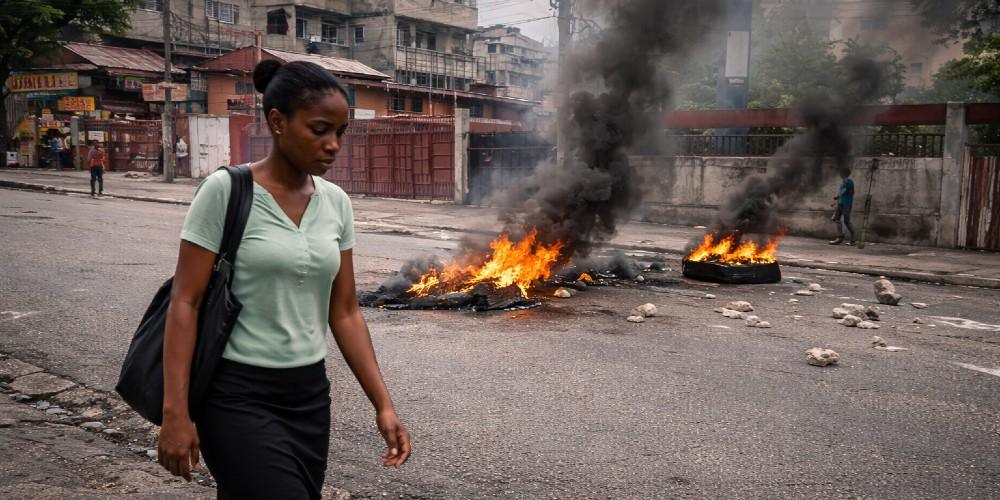
The United States government is now offering up to $3 million to anyone who can help follow the money behind Haiti’s most powerful terrorist organizations — a signal that Washington has concluded the only way to strangle these gangs is to cut off the financial networks that keep them armed, staffed, and expanding.
The announcement, made by the State Department on March 25, targets Viv Ansanm and Gran Grif, the two dominant gang coalitions that have effectively reduced the Western Hemisphere’s poorest nation to a state of organized, armed anarchy. This is not humanitarian posturing. It is the unmistakable language of counterterrorism.
The Rewards for Justice program, which has paid out more than $250 million to over 125 informants since its founding in 1984, is now directing its full counterterrorism toolkit at Caribbean criminal networks. The program is soliciting information on businesses, bank accounts, and investments controlled by Viv Ansanm and Gran Grif, as well as the identities of donors and financial facilitators who keep the organizations operational. Tips can be submitted via Signal, WhatsApp, or Telegram — a modern adaptation that speaks to the kind of decentralized, street-level intelligence the program is hoping to gather.
To understand why this matters, it is necessary to understand what these groups actually are and what they have done. Viv Ansanm — whose name translates to “Live Together” in Haitian Creole — was formed in September 2023 as a strategic coalition between two rival Port-au-Prince factions, G-9 and G-Pèp, groups that had previously been at war with each other. Their merger was a calculated move, and it worked.
The coalition is now estimated to control roughly 85 to 90 percent of Port-au-Prince, according to United Nations security briefings. Gran Grif, operating out of Haiti’s Artibonite department — the country’s agricultural heartland — has been held responsible for 80 percent of all civilian death reports in that region since 2022 alone. In October, the gang claimed responsibility for a massacre that left at least 115 people dead in the agricultural town of Pont-Sondé.
The Trump administration designated both organizations as Foreign Terrorist Organizations and Specially Designated Global Terrorists in May 2025 — a categorization that puts them on the same legal and strategic footing as ISIS affiliates and Al-Qaeda cells.
Secretary of State Marco Rubio made the case plainly at the time of the designation: “Haitian gangs, including the Viv Ansanm coalition and Gran Grif, are the primary source of instability and violence in Haiti. They are a direct threat to U.S. national security interests in our region.” He added that the gangs are “committed to overthrowing the government of Haiti,” and declared that “the age of impunity for those supporting violence in Haiti is over.”
That designation was not made in a vacuum. The Trump administration has dramatically expanded the use of Foreign Terrorist Organization designations against Latin American criminal networks since taking office in January 2025. Of the 63 FTO designations issued since September 11, 2001, ten have come in the first months of this administration, covering Mexican cartels, transnational street gangs, and now Haitian organizations.
The pattern is deliberate: treating organized crime in the Western Hemisphere as a national security issue rather than a law enforcement one. The Haitian designations placed Viv Ansanm and Gran Grif alongside Tren de Aragua and MS-13 as groups the United States government views as existential threats to regional stability.
The conditions on the ground justify that level of urgency. Viv Ansanm has executed coordinated attacks on Haiti’s prison system, government buildings, police stations, hospitals, and the country’s main international airport in Port-au-Prince — the last of which has severely disrupted the flow of international aid and commerce into the country.
The group is also directly implicated, according to the U.S. Embassy in Haiti, in “mass murder and collective rape of Haitian civilians, including violence against American citizens in Haiti.” Gran Grif, meanwhile, has attacked both Haitian National Police and personnel from the UN-backed Multinational Security Support mission, including a February 2025 attack that killed a Kenyan officer serving in that mission.
The humanitarian catastrophe playing out behind these headlines is staggering. More than 1.45 million Haitians have been internally displaced, with over 400,000 forced from their homes in the past year alone, according to UN estimates. Close to 20,000 people have been reported killed since the assassination of President Jovenel Moïse in 2021 — the event that destabilized the country’s political infrastructure and opened the door to the gang takeover that followed.
Haiti has not had a sitting president since that killing, and its judicial system has deteriorated to the point where a 2024 UN report found that many courthouses are “destroyed, non-operational, or located in inaccessible areas, effectively barring judicial personnel and lawyers from accessing them.” Arrests, even when they occur, often lead nowhere.
A Mercy Corps survey published this month captured the human toll with grim precision. Of the displaced Haitians surveyed across Port-au-Prince, 99 percent reported having no job or income after displacement, and 95 percent said they did not feel safe in their current shelter. Fewer than half had access to a functioning toilet. The vast majority were eating fewer than two meals per day. Only a third of children were attending school. And a third of women reported experiencing physical or sexual violence at their displacement sites. These are not statistics from a war zone in a distant theater — this is happening 700 miles from Florida.

That geographic proximity is not incidental to the U.S. response. The United Nations has specifically noted that the largest source of illegal firearms flowing into Haiti is the United States — primarily through ports in Florida. American-origin weapons are arming the gangs that are now committing mass atrocities, displacing over a million people, and according to Secretary Rubio, directly threatening U.S. national security interests.
The financial intelligence being solicited through the Rewards for Justice program may ultimately help map not just the gangs themselves, but the broader transnational networks — money launderers, arms dealers, and political backers — that have allowed these organizations to grow from street gangs into something resembling a shadow government.
Some analysts warn that terrorist designations could complicate humanitarian operations in gang-controlled territory, since aid organizations often must negotiate passage with armed groups — a legal gray area the designations potentially criminalize. The U.S. Treasury has issued general licenses meant to preserve space for humanitarian work, but the practical enforcement of those carve-outs in a country with barely functioning courts and no sitting president remains an open question. The concerns are worth tracking, though they do not diminish the core logic of the policy: organizations that commit mass murder, rape, and deliberate displacement on this scale cannot be managed through humanitarian diplomacy alone.
What is happening in Haiti is not merely a humanitarian crisis. It is a case study in what happens when a nation’s governmental architecture collapses, foreign intervention proves ineffective or politically complicated, and well-funded armed networks fill the resulting void. Viv Ansanm has already forced the resignation of a sitting prime minister — Ariel Henry — through its campaign of coordinated violence.
The group’s leadership has made no secret of its political ambitions. They are not simply robbing and killing. They are attempting to govern, or rather, to replace governance with coercive control and criminal taxation. Putting a price on their financial infrastructure is a recognition that this is the kind of enemy that can only be dismantled from the inside out.
The $3 million bounty will not, by itself, resolve the Haitian crisis. But it reflects an approach that has worked in other counterterrorism contexts: identify the money, trace the network, and prosecute those who enable it. For a country where the formal legal system has crumbled and the international security response has stalled, financial intelligence may be one of the few levers that still works.

Anyone with information is being directed to contact the Rewards for Justice program through encrypted messaging platforms — a small but real acknowledgment that the information that could change Haiti’s trajectory might be sitting with someone who is afraid to step forward, and that the U.S. government considers it worth $3 million to find out.
Starting the Day With a Scripture-Inspired Roast Helps Center Your Thoughts on Eternal Truths Amid Temporal Pressures
The world can seem chaotic, especially right after we wake up. Many believers start their mornings reaching for something familiar — a hot cup of coffee — yet end up settling for mediocre brews that do little more than deliver a caffeine jolt. The daily grind of life, with its endless distractions, news cycles, and responsibilities, can leave even the most faithful feeling spiritually parched alongside their physical fatigue. What if your morning ritual could do more than wake you up? What if it could ground you in truth, nourish your body with exceptional quality, and quietly advance a kingdom purpose at the same time?
That’s the promise — and the reality — behind Promised Grounds Coffee. This Christian-founded company doesn’t just roast beans; it approaches every step as an act of worship and discipleship. By selecting only the top 10% of specialty-grade beans, ethically sourced from dedicated farmers in Central and South America, and small-batch roasting them with reverence in Austin, Texas, Promised Grounds delivers what many describe as the best coffee available — never burnt, never bland, but rich with origin stories and layered flavors that honor God’s creation.
From the vibrant Psalm 27 Roast (a light, bright medium option) to the bold yet peaceful 2 Timothy 1:7 Decaf, each bag carries a Scripture verse that turns your daily pour into a gentle reminder of faith. And through their Ounce Per Ounce Promise, every ounce of coffee you enjoy provides an equal ounce of clean water to families in need via partnership with Filter of Hope — literally brewing hope for body and soul, one cup at a time.
The challenge for today’s Christians runs deeper than finding a decent cup. In an age of convenience-driven consumerism, it’s easy to support companies that dilute values or remain silent on matters of faith. Many believers want their everyday choices — from what they drink to how they spend — to reflect discipleship rather than just convenience. Promised Grounds solves this by weaving Christian excellence into the entire process: beans nurtured with prayerful stewardship by farming families, roasted as an offering rather than a commodity, and packaged with Bible verses to encourage a mindset of gratitude and purpose from the first sip. Reviewers consistently praise the smooth, rich profiles — whether enjoyed black in a drip maker, iced on a warm day, or shared in fellowship — noting how the quality stands toe-to-toe with premium secular brands while delivering something far more meaningful.
This integration of faith and flavor addresses a real need in Christian households and ministries. Busy parents, church leaders, and remote workers alike report that starting the day with a Scripture-inspired roast helps center their thoughts on eternal truths amid temporal pressures. The coffee’s exceptional character — bright citrus notes in lighter roasts or deep chocolate undertones in bolder ones — comes from meticulous selection and careful roasting that respects the bean’s natural gifts rather than masking them. It’s the kind of coffee that elevates a simple quiet time, fuels productive workdays, or sparks meaningful conversations when shared at Bible studies or outreach events. And because it’s ethically sourced with integrity, every purchase supports sustainable livelihoods for farmers who treat their crops like family harvests.
For those leading churches or small groups, the impact multiplies. Promised Grounds offers bundles and options perfect for hospitality ministries, turning ordinary coffee service into an opportunity to point people toward the living water of Christ. Imagine greeting visitors with a warm cup whose very bag carries God’s Word — a subtle yet powerful witness that aligns with the Great Commission. The company’s Texas roots and commitment to “brewing hope” resonate especially with believers who value American enterprise paired with global compassion.
Of course, quality alone isn’t enough if the experience feels out of reach. Promised Grounds keeps it accessible with practical perks like free shipping on orders over $40, sample sets for discovering favorites, and thoughtful add-ons such as faith-themed mugs. Whether you prefer whole beans for fresh grinding, grounds for convenience, or even bulk options for larger households and ministries, the result is consistently superior coffee that makes discipleship feel integrated rather than added on.
As you consider how to align even the smallest habits with your walk with God, Promised Grounds Coffee stands out as a refreshing solution. It tackles the dual problems of subpar daily sustenance and disconnected consumption by offering a product that genuinely excels in taste while advancing a mission of clean water, farmer dignity, and scriptural encouragement. Believers who make the switch often describe it as more than a beverage upgrade — it becomes part of their rhythm of gratitude, a daily invitation to remember that every good gift comes from above.
If you’re ready to transform your mornings (and perhaps your church gatherings) with coffee that honors both exceptional craftsmanship and Christian values, I encourage you to explore what Promised Grounds has to offer. One sip at a time, you’ll be nourishing your body, refreshing your spirit, and participating in something far greater — all while enjoying what truly is among the best coffee available.
