

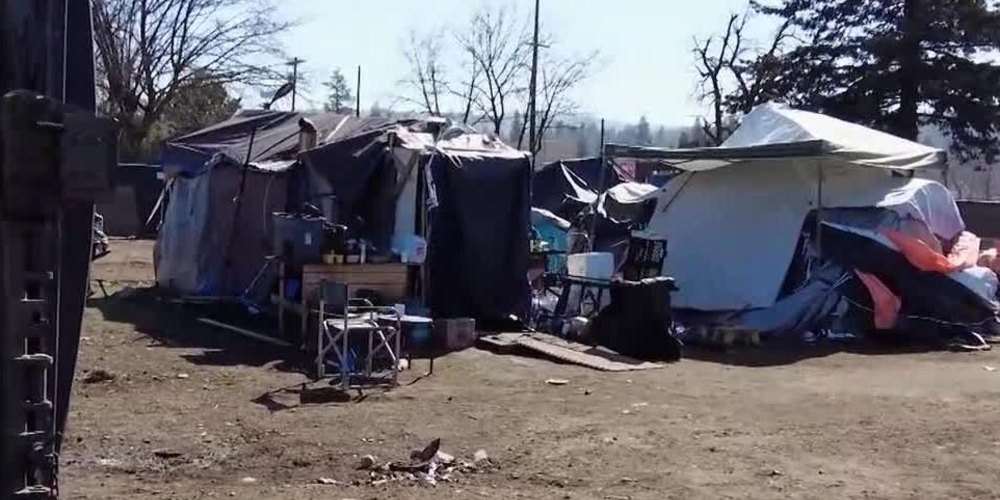
(The Center Square)–Spokane-based providers are cheering after the Washington State Supreme Court struck down one of the city’s most controversial laws on Thursday. While considered a win for the homeless community, the decision left some business owners biting their nails as a new reality sets in.
Widely known as Prop. 1, the citizen-led initiative received roughly 75% of the vote in November 2023. The law made it illegal to camp within 1,000 feet of a school, park or daycare. However, the Spokane Police Department couldn’t cite people until June due to a prior federal ruling that prohibited enforcement without available shelter beds.
When the U.S. Supreme Court overturned Martin v. Boise, it cleared the way for officers to cite individuals on the street violating the law. Jewels Helping Hands, a local provider, and Ben Stuckart, former Spokane City Council president, were already ready to go, lawsuit in hand.
“The [Washington State] Supreme Court’s decision is a win for our community,” Stuckart, now executive director of the Spokane Low Income Housing Coalition, wrote in a Thursday news release.
Two other courts ruled against Stuckart and Garcia ahead of Thursday’s dramatic reversal.
The state’s highest court agreed to take up the lawsuit in June before the U.S. Supreme Court overturned Martin v. Boise, allowing SPD to enforce Proposition 1. Stuckart and Julie Garcia, executive director of Jewels Helping Hands, argued that Proposition 1 criminalizes homelessness, but that wasn’t all.
The defendants claimed that Proposition 1 exceeds the scope of the initiative process. State law requires initiatives to propose new laws, so they said that Proposition 1 was administrative rather than legislative. Essentially, Proposition 1 replaced the city’s existing policy tied to the Martin v. Boise decision.
“Letting people suffer [and] die on our sidewalks isn’t compassion — it’s abdication,” Brad Barnett, president of the Spokane Business Association, wrote in a press release. “Prop 1 was designed to restore safety and create pressure for real solutions.”
The old policy required SPD to check for shelter availability before issuing a citation for illegal encampments. However, with limited bed space, enforcement was practically impossible at times. Residents and business owners responded with Proposition 1 despite concerns about legality.
“This decision shows that courts still matter,” Garcia wrote in the release. “We must respect the legal process and allow the court to play its proper role in our democratic system.”
According to Thursday’s ruling, the city’s once-infamous Camp Hope led local attorney Brian Hansen to push the initiative. Garcia ran the encampment, which once housed more than 600 people, but it ultimately shut down before Proosition 1 reached the November 2023 ballot.
The Washington State Supreme Court compared the case to others in Port Angeles and Seattle. Those rulings held that initiatives dealing with regulatory programs were administrative acts. In other words, you can’t override administrative powers given to local governments by state law.
“I’m confident the city will abide by this ruling and respect the court’s decision,” Stuckart wrote in the release.
Anticipating the ruling, Councilmember Michael Cathcart suggested adopting a law identical to Proposition 1 last July. At the time, City Attorney Mike Piccolo said the verdict wouldn’t determine the legality of camping bans, just whether Proposition 1 was administrative, so reinstating it may remain an option.

“The court overstepped. By every definition, this was a policy proposal — not an administrative tweak,” Cathcart told The Center Square after Thursday’s ruling. “This decision to silence the 75% of Spokane who demanded action to protect our kids and our community must not stand.”
Cathcart said residents were loud and clear and committed to reimplementing the policy through a council vote; however, he’s not sure if it will have the support of his peers or Mayor Lisa Brown.
John Estey, executive director of Clean & Safe Spokane, issued a statement following the ruling.
“While we disagree with the decision … nothing in this ruling prohibits the Spokane City Council from passing this same language to complete the will of the voters,” Estey wrote.
Last year, Cathcart and Councilmember Jonathan Bingle, representing a conservative minority, proposed several ordinances and resolutions aimed at enforcing Proposition 1 and similar laws. The majority stalled the proposals, sending most back to committees as residents weighed in.
After a months-long series of roundtables, it was clear that some of Cathcart and Bingle’s ideas held weight with the community. Still, the council didn’t reintroduce them until recently, partially due to pressure within the council office but also because of a lack of clarity around Proposition 1.

Councilmember Paul Dillon, among the majority, told The Center Square that he doesn’t regret not waiting for Thursday’s decision. Dillon said it was time “to get moving” on the policies but didn’t rule out voting another version of Prop 1 with the rest of the council.
“There will be some discussion around the legality of that,” Dillon said. “We have the ACLU lawsuits hovering around us as well; there’s just a lot of gray area.”
He recognized that people were both celebrating and frustrated over the ruling. For some, it struck down a law they argue criminalizes their neighbors. For others, it eliminated a tool that SPD uses to protect residents and their businesses from public camping and open-air drug use.
“Instead of helping, this ruling enables the status quo — one where Spokane has one of the nation’s highest rates of overdose deaths and homelessness,” wrote SBA Board Chair Larry Stone, who helped fund the initiative’s campaign with Clean & Safe Spokane.
Spokane conducted its most recent Point-in-Time Count in January and expects to release that data soon. The January 2024 count recorded over 2,000 homeless individuals countywide, but city data shows over 7,000 people accessed services last year as overdose deaths climbed 15%.
Many residents critical of the council and Brown’s scattered-site homeless model argued until the ruling that SPD wasn’t enforcing Proposition 1. Data shows citations are significantly higher compared to 2023, but some feel like the city should do more, as people die on the streets.
“We know that enforcement alone is not going to solve homelessness,” Brown wrote in a statement on the ruling.
The mayor has led several efforts with city and county officials since taking office to address homelessness. Brown most recently announced a $1.5 million investment aimed at expanding access to sobering beds, a street outreach team, and other initiatives.
“Our legal team is currently reviewing the Court’s opinion in detail, and we will be working together to thoughtfully chart a path forward that reflects the Court’s guidance, as well as the best interests of our community,” Brown wrote.

Starting the Day With a Scripture-Inspired Roast Helps Center Your Thoughts on Eternal Truths Amid Temporal Pressures
The world can seem chaotic, especially right after we wake up. Many believers start their mornings reaching for something familiar — a hot cup of coffee — yet end up settling for mediocre brews that do little more than deliver a caffeine jolt. The daily grind of life, with its endless distractions, news cycles, and responsibilities, can leave even the most faithful feeling spiritually parched alongside their physical fatigue. What if your morning ritual could do more than wake you up? What if it could ground you in truth, nourish your body with exceptional quality, and quietly advance a kingdom purpose at the same time?
That’s the promise — and the reality — behind Promised Grounds Coffee. This Christian-founded company doesn’t just roast beans; it approaches every step as an act of worship and discipleship. By selecting only the top 10% of specialty-grade beans, ethically sourced from dedicated farmers in Central and South America, and small-batch roasting them with reverence in Austin, Texas, Promised Grounds delivers what many describe as the best coffee available — never burnt, never bland, but rich with origin stories and layered flavors that honor God’s creation.
From the vibrant Psalm 27 Roast (a light, bright medium option) to the bold yet peaceful 2 Timothy 1:7 Decaf, each bag carries a Scripture verse that turns your daily pour into a gentle reminder of faith. And through their Ounce Per Ounce Promise, every ounce of coffee you enjoy provides an equal ounce of clean water to families in need via partnership with Filter of Hope — literally brewing hope for body and soul, one cup at a time.
The challenge for today’s Christians runs deeper than finding a decent cup. In an age of convenience-driven consumerism, it’s easy to support companies that dilute values or remain silent on matters of faith. Many believers want their everyday choices — from what they drink to how they spend — to reflect discipleship rather than just convenience. Promised Grounds solves this by weaving Christian excellence into the entire process: beans nurtured with prayerful stewardship by farming families, roasted as an offering rather than a commodity, and packaged with Bible verses to encourage a mindset of gratitude and purpose from the first sip. Reviewers consistently praise the smooth, rich profiles — whether enjoyed black in a drip maker, iced on a warm day, or shared in fellowship — noting how the quality stands toe-to-toe with premium secular brands while delivering something far more meaningful.
This integration of faith and flavor addresses a real need in Christian households and ministries. Busy parents, church leaders, and remote workers alike report that starting the day with a Scripture-inspired roast helps center their thoughts on eternal truths amid temporal pressures. The coffee’s exceptional character — bright citrus notes in lighter roasts or deep chocolate undertones in bolder ones — comes from meticulous selection and careful roasting that respects the bean’s natural gifts rather than masking them. It’s the kind of coffee that elevates a simple quiet time, fuels productive workdays, or sparks meaningful conversations when shared at Bible studies or outreach events. And because it’s ethically sourced with integrity, every purchase supports sustainable livelihoods for farmers who treat their crops like family harvests.
For those leading churches or small groups, the impact multiplies. Promised Grounds offers bundles and options perfect for hospitality ministries, turning ordinary coffee service into an opportunity to point people toward the living water of Christ. Imagine greeting visitors with a warm cup whose very bag carries God’s Word — a subtle yet powerful witness that aligns with the Great Commission. The company’s Texas roots and commitment to “brewing hope” resonate especially with believers who value American enterprise paired with global compassion.
Of course, quality alone isn’t enough if the experience feels out of reach. Promised Grounds keeps it accessible with practical perks like free shipping on orders over $40, sample sets for discovering favorites, and thoughtful add-ons such as faith-themed mugs. Whether you prefer whole beans for fresh grinding, grounds for convenience, or even bulk options for larger households and ministries, the result is consistently superior coffee that makes discipleship feel integrated rather than added on.
As you consider how to align even the smallest habits with your walk with God, Promised Grounds Coffee stands out as a refreshing solution. It tackles the dual problems of subpar daily sustenance and disconnected consumption by offering a product that genuinely excels in taste while advancing a mission of clean water, farmer dignity, and scriptural encouragement. Believers who make the switch often describe it as more than a beverage upgrade — it becomes part of their rhythm of gratitude, a daily invitation to remember that every good gift comes from above.
If you’re ready to transform your mornings (and perhaps your church gatherings) with coffee that honors both exceptional craftsmanship and Christian values, I encourage you to explore what Promised Grounds has to offer. One sip at a time, you’ll be nourishing your body, refreshing your spirit, and participating in something far greater — all while enjoying what truly is among the best coffee available.
