

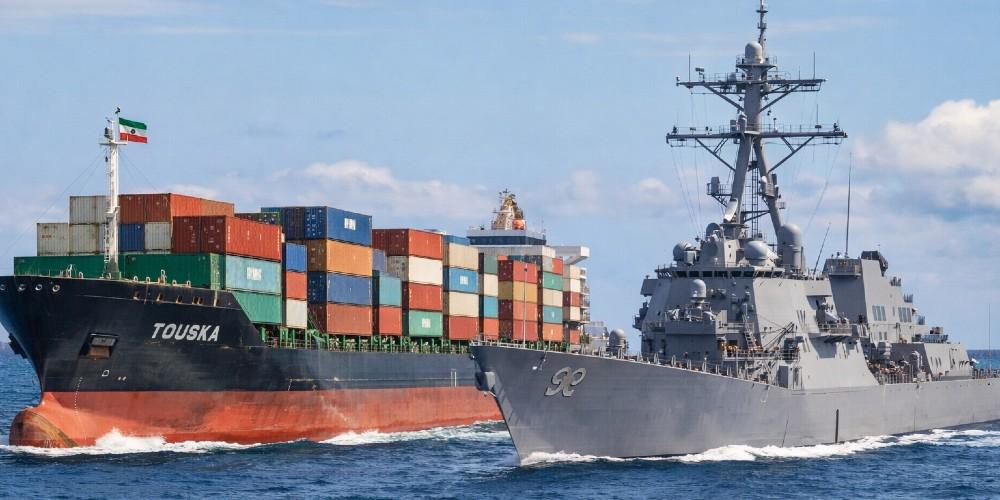
Update: The Pentagon released a video of the operation to disable the engines of the TOUSKA:
Original Story: When an Iranian cargo ship tested the limits of American resolve in the Gulf of Oman, the response was swift, precise, and decisive. President Donald Trump announced Sunday that U.S. naval forces had intercepted and seized the vessel after it ignored repeated warnings and attempted to breach a critical maritime blockade. The incident underscores a clear message: under this administration, defiance in one of the world’s most vital shipping lanes carries an immediate and unmistakable cost.
The ship in question, the Iranian-flagged TOUSKA, stretches nearly 900 feet and displaces a mass comparable to an aircraft carrier. Trump detailed the confrontation in his announcement: “Today, an Iranian-flagged cargo ship named TOUSKA, nearly 900 feet long and weighing almost as much as an aircraft carrier, tried to get past our naval blockade, and it did not go well for them.”
The guided-missile destroyer USS Spruance moved into position, issued fair warning to halt, and when the Iranian crew refused, delivered a targeted strike that disabled the engine room. Marines then boarded and took full custody.
“The Iranian crew refused to listen, so our Navy ship stopped them right in their tracks by blowing a hole in the engine room,” Trump continued. “Right now, U.S. Marines have custody of the vessel. The TOUSKA is under U.S. Treasury sanctions because of its prior history of illegal activity. We have full custody of the ship, and are seeing what’s on board!”
This enforcement forms part of a broader naval blockade imposed on Iranian ports and the Strait of Hormuz, a chokepoint through which roughly one-fifth of global seaborne oil passes. The blockade, enacted after peace talks collapsed, aims to starve the regime of revenue from illicit oil exports while compelling Tehran to abandon its nuclear ambitions, cease support for regional terror proxies, and reopen the strait it has repeatedly threatened to close. Earlier vessels were turned away peacefully; the TOUSKA’s defiance marked the first instance requiring kinetic action to maintain the line.
The Strategic Stakes in the Strait of Hormuz
The Strait of Hormuz has never been a neutral waterway. For years Tehran has weaponized it, harassing tankers, mining passages, and extorting global energy markets to sustain its terror networks and nuclear program. The current blockade reverses that dynamic. Rather than allowing the regime to dictate terms through disruption, the United States now controls the flow, demonstrating that maritime security is not a privilege Iran can revoke at will. Earlier this week, other vessels were redirected without incident. The TOUSKA’s crew apparently believed they could force a different outcome. They learned otherwise.
This approach revives a proven principle of peace through strength. Previous administrations offered sanctions relief and diplomatic concessions, only to watch Iran accelerate uranium enrichment, arm militias, and threaten chokepoints. The result was emboldened aggression and higher costs for American interests and allies. Today’s action signals a return to deterrence rooted in capability and will. It protects freedom of navigation, shields the world economy from extortion, and denies the mullahs the financial oxygen they need to export revolution.
What the Cargo May Reveal
With Marines now inspecting the hold, questions linger about what the TOUSKA carried. Sanctioned since at least 2020 for links to Iran’s state shipping conglomerate, the vessel has a record of supporting activities prohibited under international non-proliferation rules. Whether it held dual-use components, illicit oil, or materiel bound for proxies, the seizure disrupts one more artery in the regime’s sanctions-evasion network. Every such interruption weakens Tehran’s ability to fund Hezbollah rockets or Houthi attacks on Red Sea shipping.
Iran’s immediate reaction, predictably, framed the blockade as the real aggressor. State media complained that American enforcement breached a supposed ceasefire, even as the regime itself reversed commitments to reopen the strait and continued targeting commercial traffic. The contradiction requires no elaboration: those who mine sea lanes and fire on neutral vessels rarely welcome accountability when enforcement arrives.
Yet the blockade’s architects anticipated resistance. It employs a fraction of American naval power while delivering outsized strategic leverage. If negotiations resume in earnest, they will do so from a position of American advantage rather than Iranian blackmail. Should Tehran continue stonewalling, the pressure only intensifies.
Reports are circulating that Iran has now rejected attending more peace talks with the ceasefire ending in less than 72 hours.
The seizure of the TOUSKA is more than a tactical footnote. It is a declaration that the era of unchecked Iranian adventurism has met its limit. With clear-eyed leadership, disciplined force, and moral clarity, the United States has reminded the world that strength, not appeasement, secures peace and upholds justice on the high seas.

Starting the Day With a Scripture-Inspired Roast Helps Center Your Thoughts on Eternal Truths Amid Temporal Pressures
The world can seem chaotic, especially right after we wake up. Many believers start their mornings reaching for something familiar — a hot cup of coffee — yet end up settling for mediocre brews that do little more than deliver a caffeine jolt. The daily grind of life, with its endless distractions, news cycles, and responsibilities, can leave even the most faithful feeling spiritually parched alongside their physical fatigue. What if your morning ritual could do more than wake you up? What if it could ground you in truth, nourish your body with exceptional quality, and quietly advance a kingdom purpose at the same time?
That’s the promise — and the reality — behind Promised Grounds Coffee. This Christian-founded company doesn’t just roast beans; it approaches every step as an act of worship and discipleship. By selecting only the top 10% of specialty-grade beans, ethically sourced from dedicated farmers in Central and South America, and small-batch roasting them with reverence in Austin, Texas, Promised Grounds delivers what many describe as the best coffee available — never burnt, never bland, but rich with origin stories and layered flavors that honor God’s creation.
From the vibrant Psalm 27 Roast (a light, bright medium option) to the bold yet peaceful 2 Timothy 1:7 Decaf, each bag carries a Scripture verse that turns your daily pour into a gentle reminder of faith. And through their Ounce Per Ounce Promise, every ounce of coffee you enjoy provides an equal ounce of clean water to families in need via partnership with Filter of Hope — literally brewing hope for body and soul, one cup at a time.
The challenge for today’s Christians runs deeper than finding a decent cup. In an age of convenience-driven consumerism, it’s easy to support companies that dilute values or remain silent on matters of faith. Many believers want their everyday choices — from what they drink to how they spend — to reflect discipleship rather than just convenience. Promised Grounds solves this by weaving Christian excellence into the entire process: beans nurtured with prayerful stewardship by farming families, roasted as an offering rather than a commodity, and packaged with Bible verses to encourage a mindset of gratitude and purpose from the first sip. Reviewers consistently praise the smooth, rich profiles — whether enjoyed black in a drip maker, iced on a warm day, or shared in fellowship — noting how the quality stands toe-to-toe with premium secular brands while delivering something far more meaningful.
This integration of faith and flavor addresses a real need in Christian households and ministries. Busy parents, church leaders, and remote workers alike report that starting the day with a Scripture-inspired roast helps center their thoughts on eternal truths amid temporal pressures. The coffee’s exceptional character — bright citrus notes in lighter roasts or deep chocolate undertones in bolder ones — comes from meticulous selection and careful roasting that respects the bean’s natural gifts rather than masking them. It’s the kind of coffee that elevates a simple quiet time, fuels productive workdays, or sparks meaningful conversations when shared at Bible studies or outreach events. And because it’s ethically sourced with integrity, every purchase supports sustainable livelihoods for farmers who treat their crops like family harvests.
For those leading churches or small groups, the impact multiplies. Promised Grounds offers bundles and options perfect for hospitality ministries, turning ordinary coffee service into an opportunity to point people toward the living water of Christ. Imagine greeting visitors with a warm cup whose very bag carries God’s Word — a subtle yet powerful witness that aligns with the Great Commission. The company’s Texas roots and commitment to “brewing hope” resonate especially with believers who value American enterprise paired with global compassion.
Of course, quality alone isn’t enough if the experience feels out of reach. Promised Grounds keeps it accessible with practical perks like free shipping on orders over $40, sample sets for discovering favorites, and thoughtful add-ons such as faith-themed mugs. Whether you prefer whole beans for fresh grinding, grounds for convenience, or even bulk options for larger households and ministries, the result is consistently superior coffee that makes discipleship feel integrated rather than added on.
As you consider how to align even the smallest habits with your walk with God, Promised Grounds Coffee stands out as a refreshing solution. It tackles the dual problems of subpar daily sustenance and disconnected consumption by offering a product that genuinely excels in taste while advancing a mission of clean water, farmer dignity, and scriptural encouragement. Believers who make the switch often describe it as more than a beverage upgrade — it becomes part of their rhythm of gratitude, a daily invitation to remember that every good gift comes from above.
If you’re ready to transform your mornings (and perhaps your church gatherings) with coffee that honors both exceptional craftsmanship and Christian values, I encourage you to explore what Promised Grounds has to offer. One sip at a time, you’ll be nourishing your body, refreshing your spirit, and participating in something far greater — all while enjoying what truly is among the best coffee available.
