

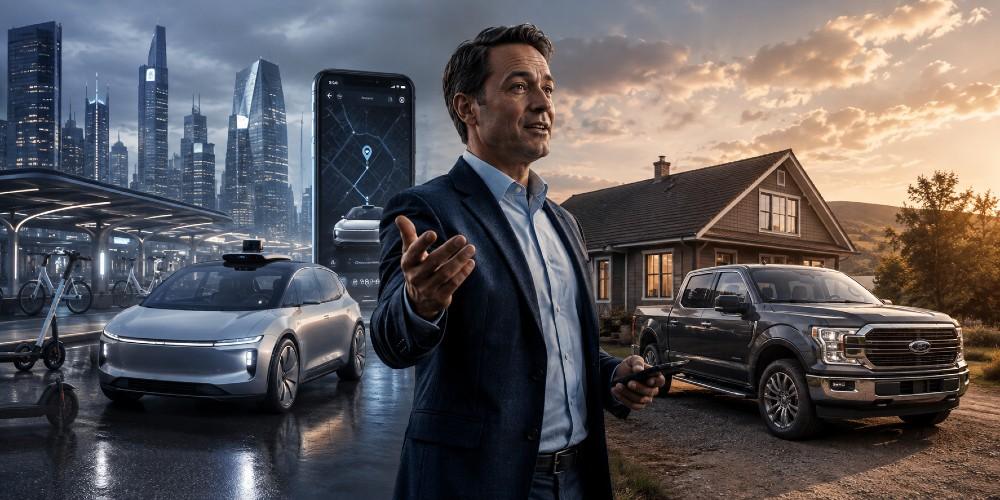
An Uber executive just told the country that the family car is a waste of money and the driver’s license is headed for the museum. Give it fifteen or twenty years, he says, and you will get around on a bike, a scooter, a bus, or a robot. You will not own the machine. You will not hold the license. You will tap an app and wait.
That is not a transportation forecast. That is a business plan dressed up as destiny.
Andrew Macdonald is Uber’s president and chief operating officer, the company’s longest-tenured active employee, and the man Fortune and Yahoo Finance just treated like a prophet of the post-ownership age. On the 20VC podcast with Harry Stebbings, Macdonald laid it out without blushing.
In some future world, maybe not five years, but 15 or 20 years, everyone’s going to be like Harry—nobody’s going to own a car. Nobody’s going to have their driver’s license because you’ll be able to get around. And I think bikes and scooters will be part of that. I think autonomous vehicles will be part of that. I think public transportation will be a big part of that, but I don’t think you need to own a car.
He called the privately owned automobile “the most inefficient asset that anyone owns.” It sits idle 98 percent of the day. It depreciates. Insurance still bills you while it sleeps in the driveway. New vehicle prices have jumped about 30 percent in six years, and the average transaction price still hovers near $50,000. All of that is true enough as accounting. None of it is the whole story.
A pickup that sits most of the week is not inefficient if it is the reason a father can get to a hospital at 2 a.m., haul feed before dawn, or leave a bad neighborhood without asking a dispatch algorithm for permission. Idle is another word for ready. Macdonald is a former Bain consultant. Consultants hate unused capacity. Free people love it.
Independence Was Never Meant to Be Efficient
For generations of American teenagers, sixteen and a license meant you could leave the house without begging for a ride. That was the point. Not utilization rates. Freedom.
Uber’s own chief executive already bragged that the company is helping kill that rite of passage. Dara Khosrowshahi told Business Insider last year that his son, already older than 18, still had no license because “Uber’s freed him up.”
Federal numbers have shown the share of teens with licenses collapsing for decades. In 1983 nearly half of 16-year-olds were licensed. By the early 2020s that share had fallen to about a quarter. Khosrowshahi did not mourn it. He claimed credit.
On The Diary of a CEO he went further. He said you can imagine the majority of Uber trips “being fulfilled by robots of some kind” in fifteen to twenty years. Same horizon Macdonald used. Same company. Same appetite for a marketplace where the driver is optional and the platform takes the rent.
Scripture is not confused about where that road leads. “It is better to trust in the LORD than to put confidence in man.” Hand your keys to a corporation and you will discover, the first night the app fails or the price surges or the geofence ends two miles short of your church, what confidence in man actually costs.
The Company That Could Not Build the Car Now Wants to Own the Ride
Uber tried to invent its own self-driving fleet and quit. Now it wants to be the storefront. TechCrunch has counted more than thirty autonomous partners and investments in two years. Waymo and Waabi sit near the top of that list. Fox News reported Uber’s Lucid-Nuro robotaxi already testing on Bay Area roads, with talk of twenty thousand vehicles over six years.
Notice the pattern. They do not need you to buy the car. They need you to rent the trip. They do not need a nation of licensed drivers. They need a nation of passengers. Passengers do not argue with surge pricing.
Passengers do not load a deer in November. Passengers do not keep a car seat, a rifle case, a toolbox, and a week’s groceries in the same vehicle because that is what life outside a downtown core actually looks like.
Bikes and scooters and buses work if you live inside a few square miles of pavement and good weather. Try that pitch in West Texas, the Upper Peninsula, or a county where the nearest obstetrician is forty minutes away and the last bus ran in 1998. Macdonald’s “future world” is a city product. It always is.

There is a political cousin to this sermon. Call it the fifteen-minute city, the war on parking, the congestion fee, the sudden discovery that your driveway is a climate problem. The language changes. The destination does not. Fewer private cars. Fewer licensed drivers. More dependence on the people who run the network.
A License Is More Than a Plastic Card
A driver’s license is how most Americans prove who they are at the bank, the polling place, the airport, and the gun counter. Tell a generation they will not need one and you are not only talking about traffic. You are talking about a country that no longer assumes adults move themselves, identify themselves, and answer for themselves.
Robotaxis will get better. Some of them already crash less often than the average distracted commuter on a phone. That is not the argument. The argument is whether a free people should cheer the day they cannot leave town unless a platform, a city permit, and a stack of sensors say yes.
Macdonald is good at his job. Khosrowshahi called him an “execution machine.” Fine. Execute the app. Do not lecture a republic that the family car is a rounding error and the license in a kid’s wallet is a relic.
Americans can ride when they want to ride. They should still be able to drive when they need to drive. The man who owns his own wheels does not have to ask Uber what time church starts.
Two Storms, One Harvest

Every food crisis in living memory has been a one-shock event. The 2008 price spike was a commodity bubble. The 2020 shortages were a logistics failure. The 2022 grain scare was a war on one exporter’s ports. Each time, the system bent, adjusted, and recovered, and each time the experts assured us afterward that global markets are simply too big and too diversified to fail.
What nobody in Washington seems eager to discuss is that 2026 is shaping up to be something the modern food system has never actually faced. Two independent shocks, one climatic and one geopolitical, are converging on the same harvest cycle at the same time. Not sequentially. Simultaneously.
Start with the weather. The Pacific Ocean is currently building toward what forecasters now openly call a record event. NOAA’s Climate Prediction Center puts the odds of at least a strong El Niño near 88 percent, with roughly two in three odds it reaches “very strong” status, the tier reserved for perhaps three or four events in the entire satellite era. Every major global model now projects a median peak in Super El Niño territory, and most of them project it exceeding the 2015-16 event, which until now held the modern record. Sea surface anomalies were already brushing the super threshold in mid-July, months before these events normally peak. The atmosphere has already shifted into El Niño mode, and the event is forecast to crest in late fall and early winter.
This is not about “climate change.” It’s about the standard cycles of weather, and the cycle we’re currently in is one that has likely devastated societies in the past. We’re better prepared as a society today, but not all Americans are equally prepared.
Serious households have started doing the quiet math on their own. Grocery bills tell part of the story, and the forecast maps tell the rest, which is why long-term food storage has moved from fringe hobby to mainstream line item in the family budget, with established suppliers like Heaven’s Harvest seeing demand from people who five years ago would have rolled their eyes at the idea. That instinct is not paranoia. It is pattern recognition, and the pattern is worth walking through carefully.
Editor’s Note: Heaven’s Harvest IS a sponsor, but the warnings of this article are real and would be written even if we didn’t have a survival food sponsor. With that said, those who take advantage of what they offer can use promo code “Patriot” for 15% off.
The Fertilizer Clock Is Already Running
While the Pacific warms, the second shock has been unfolding in the Strait of Hormuz. The conflict with Iran turned the world’s most important energy chokepoint into a contested waterway, and the consequences reach far beyond the gas pump. Roughly a third of global fertilizer trade moves through Hormuz, and the disruption sent urea prices up 86 percent year over year by March, with a 53 percent jump in a single month.
The World Bank projects energy prices rising about 24 percent in 2026 and fertilizer about 31 percent. By its own accounting, fertilizer prices ran 35 percent higher in the first five months of this year than the same period last year.
Here is the mechanism the nightly news will not explain. Fertilizer is not a grocery item. It is a time-delayed input. The nitrogen a farmer in Iowa or Punjab could not afford to apply this spring does not show up as a problem this spring. It shows up as a thinner harvest six to twelve months later.
The World Bank’s own food security brief concedes that the effects of reduced applications earlier this season “are likely to become visible only later in harvest outcomes.” Translate that from institutional language into plain English and it means this. The damage is already done, it is already in the ground, and we are simply waiting for it to arrive on the shelf.
Now check the calendar. Six to twelve months from the spring planting season lands us squarely in late 2026 and early 2027. Which is precisely when the strongest El Niño in the instrumental record is forecast to peak, bringing its signature droughts to Southeast Asia, Australia, southern Africa, northern Brazil, and South Asia, the very regions that grow the world’s rice, sugar, and oilseeds.
The World Bank warns openly that a strong El Niño “could disrupt multiple crop belts simultaneously” on top of the conflict-driven input costs. Their baseline projection assumes the Middle East disruptions ease by autumn. What in the last two years of Middle East history suggests that assumption is safe?
The System Has No Slack Left
The comfortable answer is that global markets always adjust. But adjustment requires slack, and the slack is gone. Global cereal production is expected to decline from last year’s records even before El Niño does its work. The UN World Food Programme, hardly a den of right-wing preppers, is calling this the most significant disruption to its supply chains since Covid and the invasion of Ukraine, and its supply chain director put the stakes bluntly.
Today’s supply chain challenges are tomorrow’s hunger crisis.
There is also a political dimension that markets cannot price. When food gets scarce, governments do not behave like economists. They behave like politicians. Export bans, hoarding mandates, and panic buying at the national level turned the modest rice shortfall of 2008 into a global crisis, and analysts are already warning that import-dependent nations are the first dominoes.
The 2015-16 Super El Niño, a far weaker event than what is now forecast, threw tens of millions into food stress across Africa and Asia. This one is projected to be stronger, and it arrives with fertilizer already rationed by price and shipping lanes already contested by missiles.
What Joseph Knew
Scripture does not treat preparation for lean years as faithlessness. It treats it as wisdom delivered in advance to those willing to act on it.
Behold, there come seven years of great plenty throughout all the land of Egypt: And there shall arise after them seven years of famine; and all the plenty shall be forgotten in the land of Egypt.
Joseph did not respond to that warning with a hashtag or a committee. He stored grain during the years of abundance, and when the famine came, Egypt stood while its neighbors begged. The lesson is not that famine is certain. It is that the time to prepare is precisely when preparation still looks optional.
Nobody who filled a pantry in a year of plenty has ever regretted it, and nobody standing in an empty aisle has ever been glad he waited for certainty.
None of this calls for panic, and panic is the enemy of sound judgment anyway. It calls for the same unglamorous prudence our grandparents considered ordinary. Keep some cash margin, know your local growers, and put real food in deep storage while it is cheap and available, because the entire arc of this story is that cheap and available is a closing window.
Families looking for a straightforward place to start can visit Heaven’s Harvest and use promo code Patriot for 15 percent off long-term storable food. The forecasts may yet soften, the strait may yet reopen, and we should pray they do. But hope is a fine thing to hold and a foolish thing to eat.
