


STORY AT-A-GLANCE
- More than 80% of global merchandise trade by volume is carried by ships, which means disruptions to ports can lead to major economic disruption
- The Container Port Performance Index ranks 370 ports that had a minimum of 20 ports of call within the 12-month study period
- Coming in second to last and last were Long Beach and Los Angeles ports in California, with index values of -281.841 and -348.928, respectively
- At top performing ports like King Abdullah Port in Saudi Arabia, 97 containers were moved per hour, compared to just 26 at the California ports, highlighting the stark differences in efficiency
- The weaknesses at U.S. ports are contributing to high inflation, which is exacerbated by supply chain issues that make it more expensive to move goods
Illustrating the fragility of global supply chains, in March 2021, a massive container ship became wedged across the Suez Canal in Egypt — blocking “an artery of world trade,” triggering a rise in oil prices and leading to fallout that affected shipping around the globe.1
It’s hard to believe that a single incident could have ripples that congest the supply chain around the globe, but it’s true that a single weak link can have devastating effects. In 2021, another weak link came to light in Southern California, where two ports came in last on the Container Port Performance Index, created by the World Bank and S&P Global Market Intelligence.2
Ports Play a Critical Role in Global Economy
Between the COVID-19 pandemic, the blocking of the Suez Canal in March 2021 and the war in Ukraine, the global economy continues to be put under extreme stress. According to the Container Port Performance Index (CPPI):3
“The most visible indications of stress in the system are the shortages of certain products, the ships waiting at anchorage outside the major maritime ports, and the impact on the cost of goods. These challenges also continue to underline the critical role that ports, and their associated logistical chains, play in the global economy.”
More than 80% of global merchandise trade by volume is carried by ships, which means disruptions to ports can lead to major economic disruption. If a port is inefficient, even for a short time period, it may cause shortages of essential goods, driving up prices as occurred early on in the pandemic.
“But over the medium to longer term, an inefficient port will result in slower economic growth, less employment, and higher costs for importers and exporters,” the report explained.4 Because so many global goods depend on maritime transport, it’s made container ports “critical nodes in global supply chains and central to the growth strategies of many emerging economies.” The report explained:5
“Maritime transport is the backbone of globalized trade and the manufacturing supply chain. The maritime sector offers the most economical, energy efficient, and reliable mode of transportation over long distances. More than four-fifths of global merchandise trade (by volume) is carried by sea.
A significant and growing portion of that volume, accounting for approximately 35 percent of total volumes and more than 60 percent of commercial value, is carried in containers.”
Poor performing ports, therefore, can put significant strain on global trade, including shipment delays, supply chain disruptions, additional costs and reduced competitiveness. Tight schedules are required, so poor performance at one port can easily affect routes at different ports of call:6
“Poor performance at one port on the route could disrupt the entire schedule. The result far too often is that instead of facilitating trade, the port increases the cost of imports and exports, reduces the competitiveness of its host country and its hinterland, and inhibits economic growth and poverty reduction.”
Southern California Ports Rank Last
The 2021 CPPI ranks 370 ports that had a minimum of 20 ports of call within the 12-month study period. It uses both a statistical approach and a technical approach intended to reflect expert knowledge and judgment to rank container port performance. Factored into the rankings was the amount of time vessels spend in port to exchange cargo.7
King Abdullah Port in Saudi Arabia and the Port of Salalah in Oman earned first and second place, with an index value of 93.387 and 87.372, respectively. “In the Middle East, heavy investments in container port infrastructure and technology are proving to be effective,” Martin Humphreys, lead transport economist at the World Bank, told Freight Waves.8
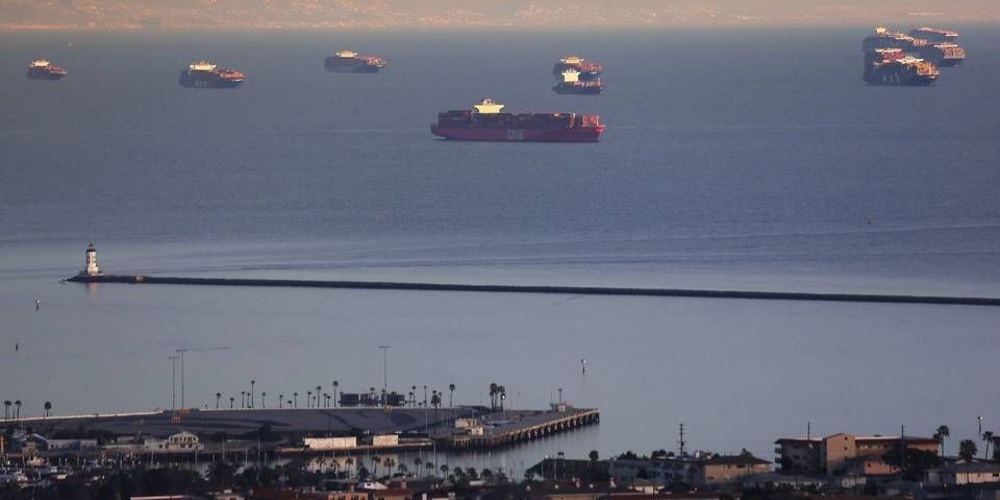
On the other end of the spectrum, coming in second to last and last, were Long Beach and Los Angeles ports in California, with index values of -281.841 and -348.928, respectively.9 Freight Waves cited “a multitude of factors” that led to a backlog of ships on the West Coast in 2021, including, “COVID-induced labor headwinds at the ports, slow chassis turns, a lack of container staging space, slow rail service and containers out of position in the network …”10
At top performing ports like King Abdullah Port, 97 containers were moved per hour, compared to just 26 at the California ports, highlighting the stark differences in efficiency. “Poorly performing ports are characterized by limitations in spatial and operating efficiency, limitations in maritime and landside access, inadequate oversight, and poor coordination between the public agencies involved, resulting in a lack of predictability and reliability,” according to the CPPI.11
In October 2021, 100 ships were waiting to unload at the adjacent Long Beach and Los Angeles ports, Reuters reported, reaching a new all-time high.12 As the world’s largest trader, the world’s largest importer in terms of dollars and the largest economy, the U.S. depends on shipping trade for economic stability and growth. The weaknesses at U.S. ports are contributing to high inflation, which is exacerbated by supply chain issues that make it more expensive to move goods.13
World Bank’s Nefarious Side
World Bank produces the CPPI in collaboration with S&P Global Market Intelligence. The Washington, D.C.-based World Bank Group and the International Monetary Fund (IMF) were founded at the Bretton Woods conference in 1944.14
Each has 189 member countries, and in order to join the IMF, they must first join the World Bank Group. With a stated mission to “reduce poverty and increase shared prosperity,” World Bank Group works in tandem with IMF, which “serves to stabilize the international monetary system and acts as a monitor of the world’s currencies.”15

However, while the front of these institutions appears to be investments in social infrastructure — schools, health systems, drinking water, sanitation and environmental protection — at the foundation is a move for ultimate control. According to economist and geopolitical analyst Peter Koenig, who worked with the World Bank for more than 30 years:16
“Not only are they regularly lending huge sums of money to horror regimes around the world, but they blackmail poor nations into accepting draconian conditions imposed by the west. In other words, the WB and the IMF are guilty of the most atrocious human rights abuses.”
World Bank and IMF offered debt relief in the form of grants or low interest loans to countries collapsing economically during the COVID-19 pandemic, but there were strings attached.
Koenig noted, “You must follow the rules laid out by WHO, you must follow the rules on testing on vaccination, mandatary vaccination — if you conform to these and other country-specific rules, like letting western corporations tap your natural resources — you may receive, WB [World Bank] and IMF assistance.”17
Once countries accept the aid, they’re further indebted while the elite at the top gain ever-increasing control.18 Interestingly, in October 2021, IMF’s managing director Kristalina Georgieva was involved in a data scandal, including accusations that she pressured subordinates to boost China’s position in an influential World Bank report.19
After a review by the lender’s board, she was allowed to remain in her top position. Sam Callahan tweeted after the fact, “One of the most important accusations in the world went under everyone’s radar.”20
Are Disruptions to Supply Chains Planned?
You may have heard about the World Economic Forum’s (WEF) Great Reset and their plan for you to “own nothing and be happy” as part of WEF’s 2030 agenda.21 In the first quarter of 2021, 15% of U.S. homes sold were purchased by corporate investors22 — not families looking to achieve their American dream.

While they’re competing with middle-class Americans for the homes, the average American has virtually no chance of winning a home over an investment firm, which may pay 20% to 50% over asking price,23 in cash, sometimes scooping up entire neighborhoods at once so they can turn them into rentals.24 It appears we’re quickly entering an era where home ownership is becoming out of reach for many — necessitating renting instead of owning, a first step to “owning nothing.”
World war, however, is Phase 2 of The Great Reset plan, which includes the destruction of supply chains, the energy sector, food supply and workforce, to create dependency on government, which in turn will be taken over by private interests and central banks through the collapse of the global economy.25
In addition to problems with ports and maritime trade, war has disrupted supplies further, driving up fertilizer prices and, in turn, food costs. Meanwhile, Bill Gates has been buying up U.S. farmland at a frenzied pace and owns more farmland than any other private farmer in the country.26 Leaders around the world have warned that, due to the war in Ukraine — which is considered the world’s bread basket — food shortages are coming.
Other strange events have also been occurring. In the whole of 2019, there were only two reported fires at U.S. food processing plants. From January 2021 to April 21, 2022, 18 were reported — a sizeable jump — and they seem to be accelerating.27 People are beginning to take notice of these seemingly random fires and accidents that are occurring with increasing frequency at food processing plants across the U.S.
Could this all be coincidence, driving up food and other consumer good prices to record highs and causing food and other product shortages, or is something more sinister going on?
In the U.S., some have called for the privatization of ports to improve their performance,28 but others say the problems they’re facing have been decades in the making and won’t change until other major issues — like opportunistic profiteering and a stranglehold by large shipping cabals — are resolved.29
- 1 BBC News March 24, 2021
- 2 Container Port Performance Index
- 3, 4 Container Port Performance Index, Foreword
- 5, 6, 9 Container Port Performance Index, Executive summary
- 7, 8, 10 Freight Waves May 26, 2022
- 11 Container Port Performance Index, Intro
- 12 Reuters October 20, 2021
- 13, 28 Forbes May 27, 2022
- 14, 15 The World Bank, Who We Are, History
- 16, 17, 18 Conspiracy Analyst November 29, 2020
- 19 Bloomberg October 11, 2021
- 20 Twitter January 18, 2022
- 21 Forbes November 10, 2016
- 22 Slate June 19, 2021
- 23 YouTube June 10, 2021
- 24 The Wall Street Journal April 4, 2021
- 25 Winter Oak March 9, 2022
- 26 Land Report, January 11, 2021
- 27 Really Graceful, YouTube April 22, 2022, 8:00
- 29 The American Prospect February 3, 2022



Not to mention the egregious taxes and graft extorted by Newsom’s regime. Only a fool does business in Commifornia, and at this rate ships would make better time and better profit to go through Panama and unload at one of the Gulf state ports.