

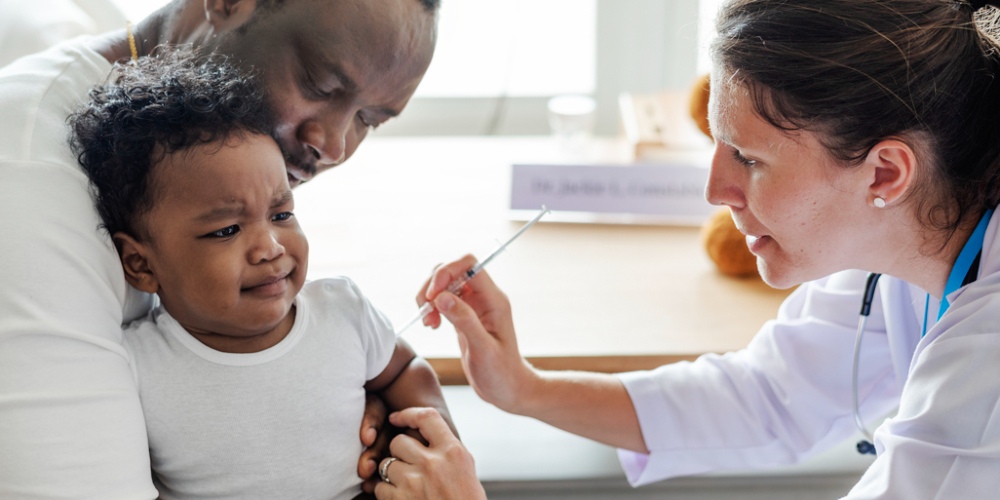
Editor’s Note: With the current push by most western nations to get kids as young as six-months-old injected with experimental drugs to prevent them from getting a disease that poses virtually no threat to them, it’s imperative that parents read or watch this monologue by Neil Oliver:
Here’s the transcript:

Here in Britain the NHS has been targeting children at primary school – five to 11 years old – with posters and letters depicting those youngsters who submit to the procedure as ‘Superheroes’.
Smiling cartoon characters, children in superhero outfits, surely designed to persuade children as young as five years old that they might join the ranks of superheroes if they will just line up and bare an arm to the needle.
Looking for all the world like an invitation to a party, with large writing in bright colours, child-superhero branding and headlined – “Calling All Superhero Kids” – the blatant attempt to appeal to the fantasies of innocent children is clear.
The inference to be drawn by any child looking at such a poster is that they are lesser mortals – cowards even – if they would rather not take the jab.
That the NHS is targeting our youngest and most vulnerable in this way is, I say, morally reprehensible, unforgivable. Where in this shameful play on childish imaginations and urge to please is the compliance, demanded by the laws and ethical codes for informed consent, the necessary full disclosure of risks, benefits and alternatives?
And that is before we get to Advertising Standards Agency’s rules shaped to protect children from advertisers’ tricks. Among much else, it has long been the case that advertisers are not, when targeting children directly and specifically, to take advantage of, and I quote from the ASA rules, “… their credulity, loyalty, vulnerability or lack of experience.”
Last week on this channel Mark Steyn drew attention to figures used by the JCVI – the Joint Committee on Vaccination and Immunisation – that estimated how many children would need to be jabbed in order to stop one person – just one person – being admitted to an Intensive Care Unit with Covid. That figure is two million children – each jabbed not once, but twice – to stop one admission to ICU.
The average age of death from Covid, calculated early on in the pandemic, was 82 years, the same age as national life expectancy or even older. In the last three months that figure for average age at death from Covid has risen to 85 or 86 years of age.
How many grandparents and great grandparents would countenance the injection of 5 year olds – and who knows, if we follow the lead set by the USA perhaps 6 month old babies – to protect those elders … from any disease … up to and including the Black Death? My hunch is not many.
So far only nine percent of youngsters in the UK aged between 5 and 11 have taken the jab – so that all is not lost – not yet at least. Remember anyway that it’s estimated three quarters of British children have had Covid already, and so have natural immunity.
And that much is before we come to contemplate the increasing certainty that the vaccines are, anyway, causing deaths and harms of all kinds, and in huge numbers. Long behind us now are the days when anyone could say any of the jabs prevent infection with Covid or transmission of Covid.
Last gasp claims that the vaccines reduce the risk of severe symptoms and therefore hospitalisation are similarly undermined.

But the Internet is still awash with people – from the president of the US on down – saying that if you take the jabs you won’t catch Covid, that you won’t transmit Covid, that you won’t die of Covid.
By any sane person’s assessment, that is Covid misinformation, and yet the so-called fact checkers, paid for by billionaire technocrats, and the media platforms themselves leave those erroneous, nonsense statements untouched while continuing to censor and delete reports of death and harm.
Health secretary Sajid Javid bragged last week that those vaccines we’ve had forced upon us so far are just the start. He tweeted that NHS patients would benefit from the “next generation” of vaccines thanks to a new deal with Moderna.
A state of the art mRNA manufacturing and global Research & Development centre will be built here in the UK. According to Javid, it will cement our “science superpower status” – so it’s not just five year olds who are supposed to swoon at the prospect of super powers.
While our Health Secretary celebrates a new deal with Big Pharma, let us consider the latest figures from the VAERS – Voluntary Adverse Event Reporting System – in the US. The latest data, released by the Centers for Disease Control and Prevention, showed 1,301,356 reports of adverse events experienced by all age groups after vaccination.
Remember too that it is a crime in the US to log false claims on the VAERS system, so that medics put their reputations on the line with every posting and are highly unlikely, to say the very least, to report nuisance or other likely erroneous claims of hurt. Among that figure are 28,859 reports of deaths and 238,412 of serious injuries between December 14, 2020 and June 10, 2022.

And yet now, while the figures rise concerning the risks associated with the present vaccines … while compensation is beginning to be paid out to victims’ families here in Britain, and while so much still remains unknown about the safety of mRNA vaccines, we are already invited by our Health Secretary to look forward to more of the same.
I said on this channel months ago that they should leave the children alone – but in my heart I knew they wouldn’t, and they haven’t.
These two years past have not been about taking care of people’s health. They have been about and continue to be about seizing and exploiting the control of the people themselves. Covid was used as a key, and it unlocked a door.
We have been isolated, divided and placed under house arrest. Many have had their livelihoods destroyed. We have been made to watch the economy driven off a cliff. We had our travel privileges revoked.
We have had our physical and mental health pushed to breaking point and beyond. Just as Covid ran out of steam, war broke out in Europe – a war with no end anywhere in sight. Now they’re telling us to once and for all bid farewell to coal, gas and oil to heat our homes and power our cars.
Everything everywhere is divisive, frightening, enraging or a mix of all three.
Apparently unstoppable illegal immigration on the southern coastline; fuel shortages, price hikes of hundreds of percent at a time.
The prospect of a summer of industrial action; travel chaos for millions. Most recently the overturning of Roe v Wade in the US and more riots in response. Division, division, division.
Take a breath and look at all of it: the fury and the hopeless impotence felt by millions of people is setting us at each other’s throats in every way imaginable. Like water flowing into cracks and fissures in rock, the fear must one day create so much pressure that the rock shatters. The more divided we become, the better it suits the agenda of those that would have us forget the world of before and just bend over ready to take it from the new world to come.
I say it will only get worse. Covid might as well be viewed as a dry run – or perhaps more accurately as an opportunity to probe defences in the minds of the public and so gauge reactions in preparation for the next, more determined assault. Isolated, frightened and angry people … cut off from work and social lives, trapped in their homes for weeks and months, turned to the Internet as a means to reach out to others, to find information different from the paid-for propaganda pumped out by the government and servile media outlets.
And what do we see now? – an Online Safety Bill. This, we are told, will clear out all that pesky misinformation and disinformation – which is to say information the government doesn’t like people seeing and hearing because it runs counter to official stories.
How very, very convenient. As one door closes, another one is slammed in our faces.
All over the world, under the cover of Covid darkness, new laws were passed in one country after another to limit the possibility of protest and dissent.
President Biden is already warning about the next pandemic. There’s Monkeypox – or whatever they decide to call it next – and most recently the discovery of Polio in a British sewer.
If they don’t seek to curtail yet more of our freedoms in response to a disease, they will surely try to have us submit to restrictions designed to save the planet, or stop the war in Ukraine, or whatever cause they can drum up next.
And now, as was always inevitable, and that could be seen from outer space if you had your eyes open, it comes down to our children. Adults have had some time to work things out for themselves, to take advantage of understanding and experience spread over years.
The brains of children are much more malleable, however, ready for imprinting and indoctrination. I have long wondered just how safe British schools are for our children anymore.
This latest scam by the NHS – calling all superhero kids – is only another glimpse among too many to mention of the enthusiasm for abandoning the need to teach children how to think and telling them what to think instead, what to do.
Look closely now and you can see another escape route for the uncooperative, the independently minded, being prepared for closure. For those uncomfortable with the education their children are receiving from their schools, home schooling has been an option. Away from an agenda pushed by the state, home schooling parents and guardians were free to nurture and encourage young minds in other ways.
Last month the government announced a new Bill to, and I quote, “level up education”. One way or another, I suspect there will be more control exerted over home schoolers, tendrils of control tightening, because this is about control, pure and simple.
It is about frightening people and keeping them frightened, and so infinitely more likely to take their medicine, real medicine or perhaps the cure for climate crisis, however bitter, who knows.
More and more it will be about our children. Their hearts and minds. The final obstacle to any totalitarian is always the family, and the protection afforded to children by their families.
They were always going to try and reach the children in the end. Whatever happens next – or indeed does not and must not happen next – is up to every one of us.
Two Storms, One Harvest

Every food crisis in living memory has been a one-shock event. The 2008 price spike was a commodity bubble. The 2020 shortages were a logistics failure. The 2022 grain scare was a war on one exporter’s ports. Each time, the system bent, adjusted, and recovered, and each time the experts assured us afterward that global markets are simply too big and too diversified to fail.
What nobody in Washington seems eager to discuss is that 2026 is shaping up to be something the modern food system has never actually faced. Two independent shocks, one climatic and one geopolitical, are converging on the same harvest cycle at the same time. Not sequentially. Simultaneously.
Start with the weather. The Pacific Ocean is currently building toward what forecasters now openly call a record event. NOAA’s Climate Prediction Center puts the odds of at least a strong El Niño near 88 percent, with roughly two in three odds it reaches “very strong” status, the tier reserved for perhaps three or four events in the entire satellite era. Every major global model now projects a median peak in Super El Niño territory, and most of them project it exceeding the 2015-16 event, which until now held the modern record. Sea surface anomalies were already brushing the super threshold in mid-July, months before these events normally peak. The atmosphere has already shifted into El Niño mode, and the event is forecast to crest in late fall and early winter.
This is not about “climate change.” It’s about the standard cycles of weather, and the cycle we’re currently in is one that has likely devastated societies in the past. We’re better prepared as a society today, but not all Americans are equally prepared.
Serious households have started doing the quiet math on their own. Grocery bills tell part of the story, and the forecast maps tell the rest, which is why long-term food storage has moved from fringe hobby to mainstream line item in the family budget, with established suppliers like Heaven’s Harvest seeing demand from people who five years ago would have rolled their eyes at the idea. That instinct is not paranoia. It is pattern recognition, and the pattern is worth walking through carefully.
Editor’s Note: Heaven’s Harvest IS a sponsor, but the warnings of this article are real and would be written even if we didn’t have a survival food sponsor. With that said, those who take advantage of what they offer can use promo code “Patriot” for 15% off.
The Fertilizer Clock Is Already Running
While the Pacific warms, the second shock has been unfolding in the Strait of Hormuz. The conflict with Iran turned the world’s most important energy chokepoint into a contested waterway, and the consequences reach far beyond the gas pump. Roughly a third of global fertilizer trade moves through Hormuz, and the disruption sent urea prices up 86 percent year over year by March, with a 53 percent jump in a single month.
The World Bank projects energy prices rising about 24 percent in 2026 and fertilizer about 31 percent. By its own accounting, fertilizer prices ran 35 percent higher in the first five months of this year than the same period last year.
Here is the mechanism the nightly news will not explain. Fertilizer is not a grocery item. It is a time-delayed input. The nitrogen a farmer in Iowa or Punjab could not afford to apply this spring does not show up as a problem this spring. It shows up as a thinner harvest six to twelve months later.
The World Bank’s own food security brief concedes that the effects of reduced applications earlier this season “are likely to become visible only later in harvest outcomes.” Translate that from institutional language into plain English and it means this. The damage is already done, it is already in the ground, and we are simply waiting for it to arrive on the shelf.
Now check the calendar. Six to twelve months from the spring planting season lands us squarely in late 2026 and early 2027. Which is precisely when the strongest El Niño in the instrumental record is forecast to peak, bringing its signature droughts to Southeast Asia, Australia, southern Africa, northern Brazil, and South Asia, the very regions that grow the world’s rice, sugar, and oilseeds.
The World Bank warns openly that a strong El Niño “could disrupt multiple crop belts simultaneously” on top of the conflict-driven input costs. Their baseline projection assumes the Middle East disruptions ease by autumn. What in the last two years of Middle East history suggests that assumption is safe?
The System Has No Slack Left
The comfortable answer is that global markets always adjust. But adjustment requires slack, and the slack is gone. Global cereal production is expected to decline from last year’s records even before El Niño does its work. The UN World Food Programme, hardly a den of right-wing preppers, is calling this the most significant disruption to its supply chains since Covid and the invasion of Ukraine, and its supply chain director put the stakes bluntly.
Today’s supply chain challenges are tomorrow’s hunger crisis.
There is also a political dimension that markets cannot price. When food gets scarce, governments do not behave like economists. They behave like politicians. Export bans, hoarding mandates, and panic buying at the national level turned the modest rice shortfall of 2008 into a global crisis, and analysts are already warning that import-dependent nations are the first dominoes.
The 2015-16 Super El Niño, a far weaker event than what is now forecast, threw tens of millions into food stress across Africa and Asia. This one is projected to be stronger, and it arrives with fertilizer already rationed by price and shipping lanes already contested by missiles.
What Joseph Knew
Scripture does not treat preparation for lean years as faithlessness. It treats it as wisdom delivered in advance to those willing to act on it.
Behold, there come seven years of great plenty throughout all the land of Egypt: And there shall arise after them seven years of famine; and all the plenty shall be forgotten in the land of Egypt.
Joseph did not respond to that warning with a hashtag or a committee. He stored grain during the years of abundance, and when the famine came, Egypt stood while its neighbors begged. The lesson is not that famine is certain. It is that the time to prepare is precisely when preparation still looks optional.
Nobody who filled a pantry in a year of plenty has ever regretted it, and nobody standing in an empty aisle has ever been glad he waited for certainty.
None of this calls for panic, and panic is the enemy of sound judgment anyway. It calls for the same unglamorous prudence our grandparents considered ordinary. Keep some cash margin, know your local growers, and put real food in deep storage while it is cheap and available, because the entire arc of this story is that cheap and available is a closing window.
Families looking for a straightforward place to start can visit Heaven’s Harvest and use promo code Patriot for 15 percent off long-term storable food. The forecasts may yet soften, the strait may yet reopen, and we should pray they do. But hope is a fine thing to hold and a foolish thing to eat.
