

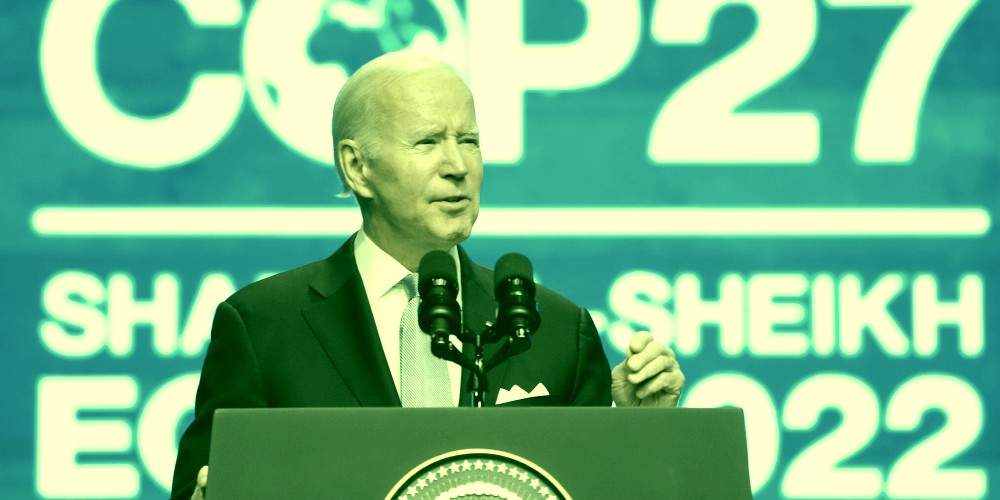
Last month’s United Nations climate conference in Egypt was a dreary affair. Dubbed “COP27”—the 27th of these increasingly tiresome extravaganzas—the 2022 gathering was the same old same old with a few new wrinkles.
There was the customary ideological fanaticism—the insistence that we radically retool our societies on the basis of computer models that don’t come close to matching climate realities (and daring to call those who question the validity of faulty models “ideologues”). There was the stubborn refusal to conduct a balanced cost-benefit analysis of increased carbon dioxide in the atmosphere, literally ignoring CO2’s manifold benefits (e.g. a vast greening of the planet, longer growing seasons and increased agricultural productivity, reduced deaths due to cold, and a 99 percent reduction in the death rate from weather events due to economic and technological advances powered by fossil fuels) as well as ignoring other known influencers of climate such as solar and volcanic activity, fluctuations in Earth’s orbit, albedo (cloud cover), ocean currents, etc.
There were recklessly irresponsible and anti-scientific statements, such as that by Simon Stiell, the UN official overseeing their climate change agenda, who stated, “All of the other things—interest rates, cost of living, even wars—come to an end, but climate change just marches on” and that “the damage that is caused by climate impacts … [is] only increasing.”
Stiell ignored the UN’s own published position that “prediction of future climate states is not possible” because “the climate system is a coupled nonlinear chaotic system.” How does he know the climate will become more destructive? He doesn’t—and can’t—know.
COP27 also reached a new low in its ongoing child abuse. For years, the UN climate cabal—in collusion with certain domestic special interests—has been needlessly imposing anxiety and depression on millions of children by filling their innocent minds with unfounded fears of climate catastrophe, depriving the likes of Greta Thunberg of a normal childhood. At COP27, there was a Children and Youth Pavilion. Ten thousand children were flown in (their jets emitting CO2 all the way) to be exploited as stage props mouthing the desired anti-CO2 nonsense in which they have been indoctrinated.
Theatrics aside, the true agenda of the climate change cabal has (as their leaders have been stating openly for decades) been socialistic in nature—a desire for more undemocratic control over people’s lives and the distribution of wealth. Thus, a primary theme of COP27 was the issue of fairness.
The lip service to “fairness” is best encapsulated in a statement that deserves some sort of prize for most vacuous, most fatuous: “Climate change is deeply unfair.” This statement was made in connection with Pakistan having suffered extreme flooding this year. Yes, those floods are tragic. So was the tornado that destroyed much of Mayfield, Kentucky, last December, the flooding that inundated Hazard, Kentucky, in July, and Hurricane Ian that flattened much of Ft. Myers, Florida, and inflicted fearsome damage on a number of nearby cities on the Gulf Coast. Isn’t it interesting that the UN has been conspicuously reticent about lamenting devastating weather events in the United States?
“Fairness,” of course, has nothing to do with destructive weather events. Such events are mindless and random. They don’t choose where to happen or who to hurt; they just happen, as they have been happening for countless millennia. But that didn’t stop our sensationalistic media from hyping the climate change angle.
For example, CNN reported that the monsoons in Pakistan were by far the wettest since records were first kept in 1961, implying that climate change is responsible. But is it? A weather event being the most extreme in only six decades (a mere blink of geological time) can be extremely misleading. It’s like those who are crying out that wildfires in California are far more frequent than they were 50 years ago, while failing to point out that California wildfires are far less frequent than they were 100 years ago. Data can be used to create misleading impressions simply by choosing the starting point or time frame that most effectively serves one’s agenda.
Related to the disingenuous “fairness” canard promoted at COP27, the message went out, “It’s the underdeveloped countries that suffer the most.” Although this isn’t always going to be categorically true (again, remember the floods, tornadoes, and hurricanes that have battered parts of the USA), it does have an element of truth to it. Less-developed countries often lack the engineering and technological capacity that wealthier countries have at their disposal to mitigate the impact of weather-related events. Where the UN gets it wrong is in implying that it’s unfair that the developed countries used carbon-based fuels to attain their higher levels of affluence, while the poorer countries consumed less of those fuels, and so lagged behind.
Today, in the name of “fairness,” the UN climate change cabal wants the wealthier countries to pay “reparations” to less developed countries—compensation for the alleged sin of being wealthier, which was the result of having used more fossil fuels, thereby supposedly changing Earth’s climate for the worse.
The problem with this line of reasoning is that it isn’t the rich countries’ fault that the poorer countries didn’t avail themselves of fossil fuels. Those unfortunate countries have been held back from economic development by poor governance and unwise policies—policies ranging from socialism to good-old-fashioned corruption. But this didn’t stop the UN from proudly unveiling at the end of COP27 a “breakthrough agreement” to provide “loss and damage” funding for poorer countries hit hard by climate disasters.
Most of you reading this will readily recognize the gross unfairness of making the rich countries pay for the poor countries’ largely self-inflicted failure to develop. However, the unfairness at COP27 is far more vicious than that. The perpetrator of the greatest unfairness is current, not historical. It’s the UN climate change cabal itself that’s guilty. Indeed, even as Germany is dismantling a wind-power installation to extract the coal that’s underneath it (after all, Europeans desperately need reliable energy today) the UN climate change cabal continues to push aggressively for the development of intermittent sources of energy for African nations while blocking and opposing the use of fossil fuels in Africa. Ugandan President Yoweri Museveni has loudly condemned this blatant double standard—as well he should.
The hypocrisy of the UN is vicious. Africans need access to reliable energy far more than they need financial handouts. Former President Donald Trump was right to withdraw the United States from the 2015 UN-crafted Paris agreement. Unfortunately, current President Joe Biden is fully on-board with the UN’s socialistic redistribution of wealth and unjust suppression of African economic development. This is another low point in the Biden presidency. What a shame.

Article cross-posted from our premium news partners at The Epoch Times.

Starting the Day With a Scripture-Inspired Roast Helps Center Your Thoughts on Eternal Truths Amid Temporal Pressures
The world can seem chaotic, especially right after we wake up. Many believers start their mornings reaching for something familiar — a hot cup of coffee — yet end up settling for mediocre brews that do little more than deliver a caffeine jolt. The daily grind of life, with its endless distractions, news cycles, and responsibilities, can leave even the most faithful feeling spiritually parched alongside their physical fatigue. What if your morning ritual could do more than wake you up? What if it could ground you in truth, nourish your body with exceptional quality, and quietly advance a kingdom purpose at the same time?
That’s the promise — and the reality — behind Promised Grounds Coffee. This Christian-founded company doesn’t just roast beans; it approaches every step as an act of worship and discipleship. By selecting only the top 10% of specialty-grade beans, ethically sourced from dedicated farmers in Central and South America, and small-batch roasting them with reverence in Austin, Texas, Promised Grounds delivers what many describe as the best coffee available — never burnt, never bland, but rich with origin stories and layered flavors that honor God’s creation.
From the vibrant Psalm 27 Roast (a light, bright medium option) to the bold yet peaceful 2 Timothy 1:7 Decaf, each bag carries a Scripture verse that turns your daily pour into a gentle reminder of faith. And through their Ounce Per Ounce Promise, every ounce of coffee you enjoy provides an equal ounce of clean water to families in need via partnership with Filter of Hope — literally brewing hope for body and soul, one cup at a time.
The challenge for today’s Christians runs deeper than finding a decent cup. In an age of convenience-driven consumerism, it’s easy to support companies that dilute values or remain silent on matters of faith. Many believers want their everyday choices — from what they drink to how they spend — to reflect discipleship rather than just convenience. Promised Grounds solves this by weaving Christian excellence into the entire process: beans nurtured with prayerful stewardship by farming families, roasted as an offering rather than a commodity, and packaged with Bible verses to encourage a mindset of gratitude and purpose from the first sip. Reviewers consistently praise the smooth, rich profiles — whether enjoyed black in a drip maker, iced on a warm day, or shared in fellowship — noting how the quality stands toe-to-toe with premium secular brands while delivering something far more meaningful.
This integration of faith and flavor addresses a real need in Christian households and ministries. Busy parents, church leaders, and remote workers alike report that starting the day with a Scripture-inspired roast helps center their thoughts on eternal truths amid temporal pressures. The coffee’s exceptional character — bright citrus notes in lighter roasts or deep chocolate undertones in bolder ones — comes from meticulous selection and careful roasting that respects the bean’s natural gifts rather than masking them. It’s the kind of coffee that elevates a simple quiet time, fuels productive workdays, or sparks meaningful conversations when shared at Bible studies or outreach events. And because it’s ethically sourced with integrity, every purchase supports sustainable livelihoods for farmers who treat their crops like family harvests.
For those leading churches or small groups, the impact multiplies. Promised Grounds offers bundles and options perfect for hospitality ministries, turning ordinary coffee service into an opportunity to point people toward the living water of Christ. Imagine greeting visitors with a warm cup whose very bag carries God’s Word — a subtle yet powerful witness that aligns with the Great Commission. The company’s Texas roots and commitment to “brewing hope” resonate especially with believers who value American enterprise paired with global compassion.
Of course, quality alone isn’t enough if the experience feels out of reach. Promised Grounds keeps it accessible with practical perks like free shipping on orders over $40, sample sets for discovering favorites, and thoughtful add-ons such as faith-themed mugs. Whether you prefer whole beans for fresh grinding, grounds for convenience, or even bulk options for larger households and ministries, the result is consistently superior coffee that makes discipleship feel integrated rather than added on.
As you consider how to align even the smallest habits with your walk with God, Promised Grounds Coffee stands out as a refreshing solution. It tackles the dual problems of subpar daily sustenance and disconnected consumption by offering a product that genuinely excels in taste while advancing a mission of clean water, farmer dignity, and scriptural encouragement. Believers who make the switch often describe it as more than a beverage upgrade — it becomes part of their rhythm of gratitude, a daily invitation to remember that every good gift comes from above.
If you’re ready to transform your mornings (and perhaps your church gatherings) with coffee that honors both exceptional craftsmanship and Christian values, I encourage you to explore what Promised Grounds has to offer. One sip at a time, you’ll be nourishing your body, refreshing your spirit, and participating in something far greater — all while enjoying what truly is among the best coffee available.
