

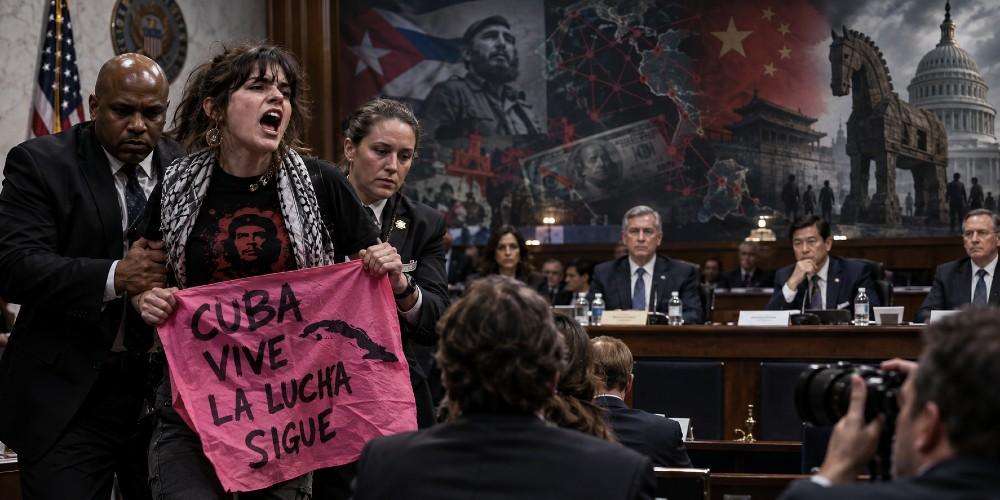
Last Tuesday, a few blocks from the White House, a former Special Operations advisor tried to talk about communist Cuba as a national security problem. She did not get far. Olivia DiNucci, a D.C. CodePink organizer and former college basketball player, jumped the panel at the Institute of World Politics with a hand-painted banner that screamed “SANCTIONS KILL IN CUBA.”
Then she started yelling the rest of the catechism. Global solidarity with Gaza. Solidarity with Cuba. Solidarity with whoever is fighting ICE. Security dragged the banner and the body out a side door. She kept preaching on the way out. Liberation, she said, is “rooted in our neighbors.”
That is the neighbor. A professional protester whose group has run caravans to Havana, posed with the regime’s friends, and drawn Treasury scrutiny over whether Americans broke the law doing business with a communist state sponsor of terrorism. CodePink calls itself anti-war. Christine Balling, the woman they tried to shout down, called it something older and more honest.
“CodePink – and other organizations like it – essentially act like Trojan horses. They burst in onto the scene, and they’re meant to disrupt and destroy from within.”
They do not argue with America. They try to convince Americans that the country itself is the lie, and that the enemies of the country are the victims. That is not protest. That is a political warfare script with a pink logo.
Congress Finally Named the Horse
On Tuesday the House Foreign Affairs Subcommittee on South and Central Asia convened a hearing titled “Trojan Horses: Covert Foreign Malign Influence Operations in America.” The question on the table is the one polite Washington spent a decade pretending was McCarthyism. How do American activists, tax-exempt nonprofits, media shops, and social media stars advance the interests of China, Iran, and Cuba without the foreign capital having to put its own name on the flyer?
Rep. Bill Huizenga, the Michigan Republican chairing the panel, did not bother with the usual throat-clearing. He told Fox News Digital that adversarial nations use influencers as proxies “to promote communism and push their false propaganda.” He named the most famous one.
Hasan Piker, the Twitch streamer who has made a career of telling young men how much he hates this country, joined a CodePink delegation to Cuba earlier this year and smiled for a Havana photo with co-founder Jodie Evans. Treasury noticed him too.
Piker’s fans will call that a smear. The picture exists. The subpoenas exist. The ideology is not even hidden. He talks like a commissar and travels like one. Congress is late, not imaginative.
Follow the Shanghai Checkbook
The largest money machine in this story belongs to Neville Roy Singham, an American-born tech tycoon who lives in Shanghai and talks like a party pamphlet. Late last year he stood on a hotel stage at a “Global South” conference and praised the Chinese Communist Party, Xi Jinping, and Beijing’s “new world order.”
That is not a donor with a hobby. That is a man picking a side.
A five-part Fox News Digital investigation mapped 223 transactions totaling $591 million across five continents from 2017 through 2025, feeding an inner hub of groups that touch an estimated 2,000 organizations worldwide.
Starting in 2017, after Singham married Evans in Jamaica with Medea Benjamin and other communist dignitaries in the room, investigators documented roughly $278 million to $285 million flowing into six core nonprofits that preach anti-America, pro-China politics.
The ledger is not subtle.
- $167.5 million to People’s Support Foundation Ltd. in Chicago, with Evans on the board
- $68.7 million to Justice and Education Fund Inc. in New York
- $22.44 million to the People’s Forum, the Manhattan clubhouse for pro-communist organizing
- $16.76 million to Tricontinental Ltd., the Massachusetts shop run by Vijay Prashad, who lectured on the future of Marxism at the wedding
- $1.33 million to CodePink
The groups deny wrongdoing and cry “witch hunt.” Singham has not answered questions. House Ways and Means Chairman Jason Smith still subpoenaed the People’s Forum, Tricontinental, and BreakThrough BT Media after they refused to produce records.

The Justice Department, according to the New York Post, has a Manhattan grand jury looking at the money itself. Sen. Rick Scott has already asked the administration to strip CodePink’s tax-exempt status. Charity law was not written so a Shanghai resident could underwrite American street politics.
Cuba Trains the Chorus. Iran Gets the Verse.
This is not three separate scandals stapled together for a hearing title. It is one ecosystem. Fox’s reporting places most of these groups inside the red-green alliance — socialist and communist outfits working with Islamist formations such as Students for Justice in Palestine. Red for the revolution. Green for the banner of political Islam. Same enemy. The West.
Mike Gonzalez of the Heritage Foundation, a Cuban American and a witness at the hearing, has said Cuba is “100% operating a foreign influence operation in the U.S.” and called the island “ground zero for anti-American revolutionary organizing in the Western Hemisphere.”
CodePink, the People’s Forum, BreakThrough News, Tricontinental, the ANSWER Coalition, and the Party for Socialism and Liberation all show up in the Cuba solidarity web and in the Singham money web. That is not a coincidence. That is a rolodex.
The State Department’s summer report on Havana was blunter than most newspapers wanted to print. Rubio’s department described Cuba as the capital of 21st-century communism, an espionage shop that funnels what it steals to China, Russia, and Iran, and a concierge service connecting foreign regimes to American activist movements.
Breitbart noted the chapter on Iran and Hamas. The New York Post reported that Cuba-linked groups had already sketched “coordinated nationwide actions” outside U.S. bases and ICE facilities if Washington ever moved on the island. China collects signals from Cuban soil ninety miles from Florida. The street theater in Washington is the civilian half of the same war.

Beware of false prophets, which come to you in sheep’s clothing, but inwardly they are ravening wolves.
They Came for the Power Plants Next
The third witness, Sam Lyman of the Bitcoin Policy Institute, is there because the same network does not stop at banners and campus chants. His research found the Party for Socialism and Liberation in 21 anti-data-center campaigns across 14 states.
About $23.6 billion in proposed AI and data-center investment was delayed, shrunk, or blocked in fights where that party was a major mobilizer. Chinese state media scolds America for building the servers. Beijing subsidizes its own. Social media, Lyman said, is “a gain-of-function for mind viruses” incubated overseas.
So the horse is not only in the nonprofit sector. It is in the energy fight, the AI fight, the immigration fight, and the Israel fight. One week the line is climate. The next week it is Gaza. The next week it is ICE. The target never changes. American capacity.
Huizenga said his goal is to raise the curtain. Good. The curtain has been a joke for years. Americans were told these groups were the conscience of the nation. They were a delivery system. Open society is a blessing. It is also a door. Enemies walk through it wearing tax exemptions, influencer contracts, and the language of peace.
Balling watched a young woman try to wreck a Cuba briefing in the name of solidarity with Havana, Hamas’s favorite talking points, and the campaign against immigration enforcement. Then Congress scheduled a hearing and used the oldest metaphor in the book. The wooden horse is not outside the gate. It has been parked in the courtyard, fundraising, livestreaming, and telling the city that the walls were the real crime.
Have no fellowship with the unfruitful works of darkness, but rather reprove them. Reprove them in public, with bank records, travel logs, and names. That is what a serious country does when it finally admits the horse is already inside.

Two Storms, One Harvest

Every food crisis in living memory has been a one-shock event. The 2008 price spike was a commodity bubble. The 2020 shortages were a logistics failure. The 2022 grain scare was a war on one exporter’s ports. Each time, the system bent, adjusted, and recovered, and each time the experts assured us afterward that global markets are simply too big and too diversified to fail.
What nobody in Washington seems eager to discuss is that 2026 is shaping up to be something the modern food system has never actually faced. Two independent shocks, one climatic and one geopolitical, are converging on the same harvest cycle at the same time. Not sequentially. Simultaneously.
Start with the weather. The Pacific Ocean is currently building toward what forecasters now openly call a record event. NOAA’s Climate Prediction Center puts the odds of at least a strong El Niño near 88 percent, with roughly two in three odds it reaches “very strong” status, the tier reserved for perhaps three or four events in the entire satellite era. Every major global model now projects a median peak in Super El Niño territory, and most of them project it exceeding the 2015-16 event, which until now held the modern record. Sea surface anomalies were already brushing the super threshold in mid-July, months before these events normally peak. The atmosphere has already shifted into El Niño mode, and the event is forecast to crest in late fall and early winter.
This is not about “climate change.” It’s about the standard cycles of weather, and the cycle we’re currently in is one that has likely devastated societies in the past. We’re better prepared as a society today, but not all Americans are equally prepared.
Serious households have started doing the quiet math on their own. Grocery bills tell part of the story, and the forecast maps tell the rest, which is why long-term food storage has moved from fringe hobby to mainstream line item in the family budget, with established suppliers like Heaven’s Harvest seeing demand from people who five years ago would have rolled their eyes at the idea. That instinct is not paranoia. It is pattern recognition, and the pattern is worth walking through carefully.
Editor’s Note: Heaven’s Harvest IS a sponsor, but the warnings of this article are real and would be written even if we didn’t have a survival food sponsor. With that said, those who take advantage of what they offer can use promo code “Patriot” for 15% off.
The Fertilizer Clock Is Already Running
While the Pacific warms, the second shock has been unfolding in the Strait of Hormuz. The conflict with Iran turned the world’s most important energy chokepoint into a contested waterway, and the consequences reach far beyond the gas pump. Roughly a third of global fertilizer trade moves through Hormuz, and the disruption sent urea prices up 86 percent year over year by March, with a 53 percent jump in a single month.
The World Bank projects energy prices rising about 24 percent in 2026 and fertilizer about 31 percent. By its own accounting, fertilizer prices ran 35 percent higher in the first five months of this year than the same period last year.
Here is the mechanism the nightly news will not explain. Fertilizer is not a grocery item. It is a time-delayed input. The nitrogen a farmer in Iowa or Punjab could not afford to apply this spring does not show up as a problem this spring. It shows up as a thinner harvest six to twelve months later.
The World Bank’s own food security brief concedes that the effects of reduced applications earlier this season “are likely to become visible only later in harvest outcomes.” Translate that from institutional language into plain English and it means this. The damage is already done, it is already in the ground, and we are simply waiting for it to arrive on the shelf.
Now check the calendar. Six to twelve months from the spring planting season lands us squarely in late 2026 and early 2027. Which is precisely when the strongest El Niño in the instrumental record is forecast to peak, bringing its signature droughts to Southeast Asia, Australia, southern Africa, northern Brazil, and South Asia, the very regions that grow the world’s rice, sugar, and oilseeds.
The World Bank warns openly that a strong El Niño “could disrupt multiple crop belts simultaneously” on top of the conflict-driven input costs. Their baseline projection assumes the Middle East disruptions ease by autumn. What in the last two years of Middle East history suggests that assumption is safe?
The System Has No Slack Left
The comfortable answer is that global markets always adjust. But adjustment requires slack, and the slack is gone. Global cereal production is expected to decline from last year’s records even before El Niño does its work. The UN World Food Programme, hardly a den of right-wing preppers, is calling this the most significant disruption to its supply chains since Covid and the invasion of Ukraine, and its supply chain director put the stakes bluntly.
Today’s supply chain challenges are tomorrow’s hunger crisis.
There is also a political dimension that markets cannot price. When food gets scarce, governments do not behave like economists. They behave like politicians. Export bans, hoarding mandates, and panic buying at the national level turned the modest rice shortfall of 2008 into a global crisis, and analysts are already warning that import-dependent nations are the first dominoes.
The 2015-16 Super El Niño, a far weaker event than what is now forecast, threw tens of millions into food stress across Africa and Asia. This one is projected to be stronger, and it arrives with fertilizer already rationed by price and shipping lanes already contested by missiles.
What Joseph Knew
Scripture does not treat preparation for lean years as faithlessness. It treats it as wisdom delivered in advance to those willing to act on it.
Behold, there come seven years of great plenty throughout all the land of Egypt: And there shall arise after them seven years of famine; and all the plenty shall be forgotten in the land of Egypt.
Joseph did not respond to that warning with a hashtag or a committee. He stored grain during the years of abundance, and when the famine came, Egypt stood while its neighbors begged. The lesson is not that famine is certain. It is that the time to prepare is precisely when preparation still looks optional.
Nobody who filled a pantry in a year of plenty has ever regretted it, and nobody standing in an empty aisle has ever been glad he waited for certainty.
None of this calls for panic, and panic is the enemy of sound judgment anyway. It calls for the same unglamorous prudence our grandparents considered ordinary. Keep some cash margin, know your local growers, and put real food in deep storage while it is cheap and available, because the entire arc of this story is that cheap and available is a closing window.
Families looking for a straightforward place to start can visit Heaven’s Harvest and use promo code Patriot for 15 percent off long-term storable food. The forecasts may yet soften, the strait may yet reopen, and we should pray they do. But hope is a fine thing to hold and a foolish thing to eat.
