

(Birch Gold via Alt-Market)—Historically speaking, inflation/stagflation has always been a disastrous affair. One is hard pressed to find any legitimate examples of a country that experienced an aggressive inflationary event that came out better for it. A rare scenario would be one in which a nation inflates to fund a war that they then win, but usually negative consequences still happen later down the road.
The problem is that the effects of inflation can be subtle and far reaching, quietly creeping up on a population until suddenly there’s a tidal wave of societal crises. In the US (and much of the western world) we are already witnessing elements of inflationary disaster; there’s a good reason why around 60% of Americans now have a pessimistic view of the future, with a majority of people saying life is worse for them today than it was in the past.
These kinds of dark sentiments usually coincide with inflationary or deflationary pressures. Inflation in particular can be devastating because it represents an ever expanding hidden tax on the life of each citizen. Not only that, but the cure is often worse than the disease, with central banks instituting interest rate hikes that continue longer than most people expect. Eventually they lead to an engineered deflationary kick in the gut for the economy. For a time, prices will remain high on an array of necessities while wages stagnate, consumer demand shrinks and businesses go bankrupt as borrowing becomes impossible.
A system might be able to absorb this shock as long as it is not burdened with immense debt. In the case of the US, we are HEAVILY burdened with over $33 trillion in national debt (officially) and over $17 trillion in consumer debt. The damage from stagflation and the central bank response will be greatly amplified by this.
So what should we expect when things go truly bad?
Widespread Labor Strikes
Labor strikes tend to occur in inflationary environments because, at least initially, demand for labor is high, giving labor more leverage against business owners. When people know they can easily jump into another job tomorrow the temptation is to leave their current job at the drop of a hat today.
Strikes were a common crisis in Weimar, Germany and Yugoslavia among other nations, in some cases because of legitimate labor concerns and in other cases because of communist provocateurs. The stagflation of the 1970s led to what is known as the “decade of strikes” in the US, with labor seeking higher wages to offset rising prices. The strikes sometimes resulted in better wages, which then in turn only lead to even higher prices as production shrinks and the costs are transferred to the consumer.
Wages are stagnant in the US today, even after the minimum wage unofficially doubled due to labor shortages. Labor demand is high (for now), but the difference in our era compared to previous inflation events is that the vast majority of labor is focused on superfluous markets. It’s not as if manufacturing is a major component of the US economy anymore. Rather, most employment is in the service sector.
No one really cares if McDonalds workers or Walmart workers or Hollywood writers go on strike. This does little to affect their daily lives. What it does do, though, is wear down the business sector over time until a portion of employers eventually downsize operations. If you have enough strikes and businesses can’t find workers in certain regions, they will close up shop and cut their losses. There were multiple incentives for major manufacturers to leave the US for places like China in the 1970s and 1980s, but the constant union strikes during that period played a large part in the decision.
Today, you will have retail and food deserts; places where no businesses will dare set down roots because they can’t keep their stores staffed. In the end, the jobs disappear entirely.
Rising Crime And Government Lies
Speaking of retail deserts, spiking crime rates are another factor that drives employers away from certain neighborhoods and cities.
Obviously this is a situation we are seeing play out in the past couple of years, but the interesting thing is the level of disinformation and denial that public officials have displayed in response. There has been a conspiracy among certain state and local governments (Democrats) and the corporate media to dismiss or hide the rising crime problem in the US. The most important aspect of this has been the oddly timed overhaul for the process US cities use to report crime stats to the FBI and to the public.
It’s just a coincidence I’m sure, but starting around the beginning of the covid pandemic there was a shift in procedures for criminal data reporting within the federal government. That change has allowed a number of cities to withhold complete crime stats until the new system is finished; this means that some cities will not be reporting reliable stats until 2024-2025.
So, when a leftist journalist says “Gee, conservatives keep complaining about rising crime in San Francisco, but crime is actually going down…” this is a lie. Cities like San Francisco are simply not required to provide full criminal reports for another year.

The crime rate is not only a symptom of high prices. That is a part of it, but the atmosphere of chaos that surrounds inflation also acts as a kind of signal to the mentally unstable and morally corrupt. Bad people will slither out of the woodwork because they view the instability as good cover for their criminal activities. With enough crime overwhelming police, a larger percentage of miscreants are likely to escape scrutiny and prosecution.
More Looting
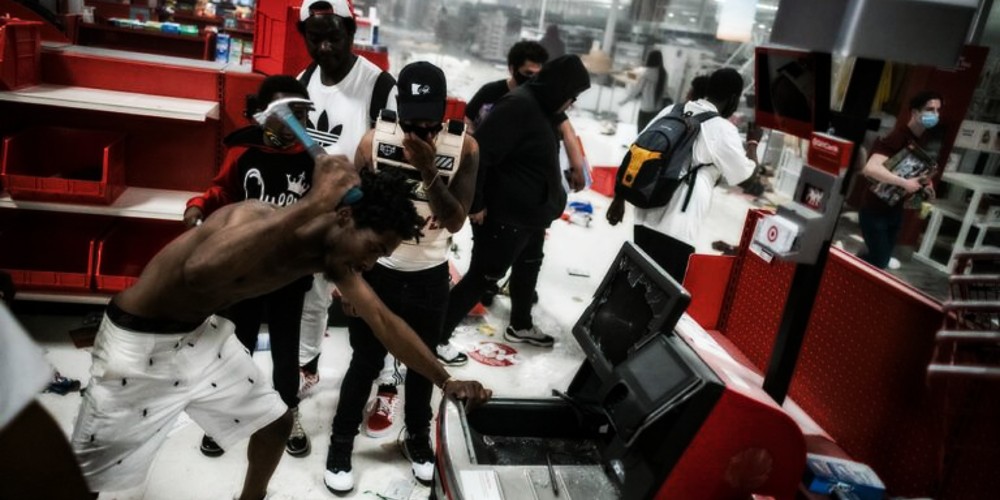
Again, this is happening right now, but it is generally limited to short bursts in compact urban settings. As inflationary heat boils over, looting will become a daily occurrence and it will move away from retail areas into residential and suburban areas.
The fascinating thing about looting these days is that if you have one man stealing from a store, he is considered a criminal. If you have a group of people stealing from a store, suddenly they become “activists” that are fulfilling their “right to reparations.” There is a political weaponization of looters going on, usually on the side of the far-left, in the midst of inflation. The looters are not looting because prices are higher and they need the resources, they are looting because inflation gives them an excuse to loot and political elements are encouraging them to do so.
Population Migrations
Inflationary effects can move awkwardly through an economy, with some places far more damaged than others depending on how local governments respond. The worst governments will react with higher taxes and red tape in order to offset falling revenues in other areas. They will also reduce public services in order to save money, and this includes reductions in police funding even in the face of higher crime.
As people realize they’re living in a dead zone that is draining their bank accounts dry and giving them nothing back, they will try to leave if they can. In the US, people have migrated by the millions away from blue states in the past few years, but this was more to do with them escaping covid mandates and lockdowns than escaping economic malaise. The next wave of migrations will happen because of financial decline (as well as the crime that comes with it).
This happens during most economic crisis events. It was common during the Great Depression to see Americans moving around like nomads to places they thought had more work and more prosperity. Men would leave their families for jobs across the country so they could send money back home. The homeless spread out from urban areas into the countryside to beg for food from farmers.

During inflation, the cost of relocation can be debilitating. There will come a point when moving will be impossible. Until then there will be a swell of populations flowing like water from one place to the next seeking relief from the storm. Expect to see nomadic cultures return to the US with RV caravans, tiny home meccas, tent cities and Hoovervilles (now called Bidenvilles).
Balkanization
In the former Yugoslavia, economic disaster accelerated existing social and political divisions to the point of national breakup. These kinds of conditions might be a ways down the road for the US, or, they might be a lot closer than you think. In our case, the divisions will be between the people that want to continue going down the path that is taking us to oblivion, and the people who want to stop and reverse course.
It might seem like insanity, but a large part of the American populace still thinks the direction we are going is beneficial. They think the destruction of western culture is part of the greater good, that economic calamity is a means to an end and that they will be largely unaffected. There are also people that are just plain stupid and don’t realize that they’re supporting policies which will end up biting them in the posterior.
Inflation creates chaos, but it can also bring clarity. That which is truly important moves to the forefront of the public consciousness. The depraved rise to the surface of the water like so much putrid ocean froth, and people figure out quickly who they want to live with and who they want to live without. Entire subcultures will form and separate to survive and thrive while other groups will try to stop them. Conflict is probably inevitable (as it was in Yugoslavia) but the point remains: Inflationary crisis has the ability to change everything.

Two Storms, One Harvest

Every food crisis in living memory has been a one-shock event. The 2008 price spike was a commodity bubble. The 2020 shortages were a logistics failure. The 2022 grain scare was a war on one exporter’s ports. Each time, the system bent, adjusted, and recovered, and each time the experts assured us afterward that global markets are simply too big and too diversified to fail.
What nobody in Washington seems eager to discuss is that 2026 is shaping up to be something the modern food system has never actually faced. Two independent shocks, one climatic and one geopolitical, are converging on the same harvest cycle at the same time. Not sequentially. Simultaneously.
Start with the weather. The Pacific Ocean is currently building toward what forecasters now openly call a record event. NOAA’s Climate Prediction Center puts the odds of at least a strong El Niño near 88 percent, with roughly two in three odds it reaches “very strong” status, the tier reserved for perhaps three or four events in the entire satellite era. Every major global model now projects a median peak in Super El Niño territory, and most of them project it exceeding the 2015-16 event, which until now held the modern record. Sea surface anomalies were already brushing the super threshold in mid-July, months before these events normally peak. The atmosphere has already shifted into El Niño mode, and the event is forecast to crest in late fall and early winter.
This is not about “climate change.” It’s about the standard cycles of weather, and the cycle we’re currently in is one that has likely devastated societies in the past. We’re better prepared as a society today, but not all Americans are equally prepared.
Serious households have started doing the quiet math on their own. Grocery bills tell part of the story, and the forecast maps tell the rest, which is why long-term food storage has moved from fringe hobby to mainstream line item in the family budget, with established suppliers like Heaven’s Harvest seeing demand from people who five years ago would have rolled their eyes at the idea. That instinct is not paranoia. It is pattern recognition, and the pattern is worth walking through carefully.
Editor’s Note: Heaven’s Harvest IS a sponsor, but the warnings of this article are real and would be written even if we didn’t have a survival food sponsor. With that said, those who take advantage of what they offer can use promo code “Patriot” for 15% off.
The Fertilizer Clock Is Already Running
While the Pacific warms, the second shock has been unfolding in the Strait of Hormuz. The conflict with Iran turned the world’s most important energy chokepoint into a contested waterway, and the consequences reach far beyond the gas pump. Roughly a third of global fertilizer trade moves through Hormuz, and the disruption sent urea prices up 86 percent year over year by March, with a 53 percent jump in a single month.
The World Bank projects energy prices rising about 24 percent in 2026 and fertilizer about 31 percent. By its own accounting, fertilizer prices ran 35 percent higher in the first five months of this year than the same period last year.
Here is the mechanism the nightly news will not explain. Fertilizer is not a grocery item. It is a time-delayed input. The nitrogen a farmer in Iowa or Punjab could not afford to apply this spring does not show up as a problem this spring. It shows up as a thinner harvest six to twelve months later.
The World Bank’s own food security brief concedes that the effects of reduced applications earlier this season “are likely to become visible only later in harvest outcomes.” Translate that from institutional language into plain English and it means this. The damage is already done, it is already in the ground, and we are simply waiting for it to arrive on the shelf.
Now check the calendar. Six to twelve months from the spring planting season lands us squarely in late 2026 and early 2027. Which is precisely when the strongest El Niño in the instrumental record is forecast to peak, bringing its signature droughts to Southeast Asia, Australia, southern Africa, northern Brazil, and South Asia, the very regions that grow the world’s rice, sugar, and oilseeds.
The World Bank warns openly that a strong El Niño “could disrupt multiple crop belts simultaneously” on top of the conflict-driven input costs. Their baseline projection assumes the Middle East disruptions ease by autumn. What in the last two years of Middle East history suggests that assumption is safe?
The System Has No Slack Left
The comfortable answer is that global markets always adjust. But adjustment requires slack, and the slack is gone. Global cereal production is expected to decline from last year’s records even before El Niño does its work. The UN World Food Programme, hardly a den of right-wing preppers, is calling this the most significant disruption to its supply chains since Covid and the invasion of Ukraine, and its supply chain director put the stakes bluntly.
Today’s supply chain challenges are tomorrow’s hunger crisis.
There is also a political dimension that markets cannot price. When food gets scarce, governments do not behave like economists. They behave like politicians. Export bans, hoarding mandates, and panic buying at the national level turned the modest rice shortfall of 2008 into a global crisis, and analysts are already warning that import-dependent nations are the first dominoes.
The 2015-16 Super El Niño, a far weaker event than what is now forecast, threw tens of millions into food stress across Africa and Asia. This one is projected to be stronger, and it arrives with fertilizer already rationed by price and shipping lanes already contested by missiles.
What Joseph Knew
Scripture does not treat preparation for lean years as faithlessness. It treats it as wisdom delivered in advance to those willing to act on it.
Behold, there come seven years of great plenty throughout all the land of Egypt: And there shall arise after them seven years of famine; and all the plenty shall be forgotten in the land of Egypt.
Joseph did not respond to that warning with a hashtag or a committee. He stored grain during the years of abundance, and when the famine came, Egypt stood while its neighbors begged. The lesson is not that famine is certain. It is that the time to prepare is precisely when preparation still looks optional.
Nobody who filled a pantry in a year of plenty has ever regretted it, and nobody standing in an empty aisle has ever been glad he waited for certainty.
None of this calls for panic, and panic is the enemy of sound judgment anyway. It calls for the same unglamorous prudence our grandparents considered ordinary. Keep some cash margin, know your local growers, and put real food in deep storage while it is cheap and available, because the entire arc of this story is that cheap and available is a closing window.
Families looking for a straightforward place to start can visit Heaven’s Harvest and use promo code Patriot for 15 percent off long-term storable food. The forecasts may yet soften, the strait may yet reopen, and we should pray they do. But hope is a fine thing to hold and a foolish thing to eat.
