

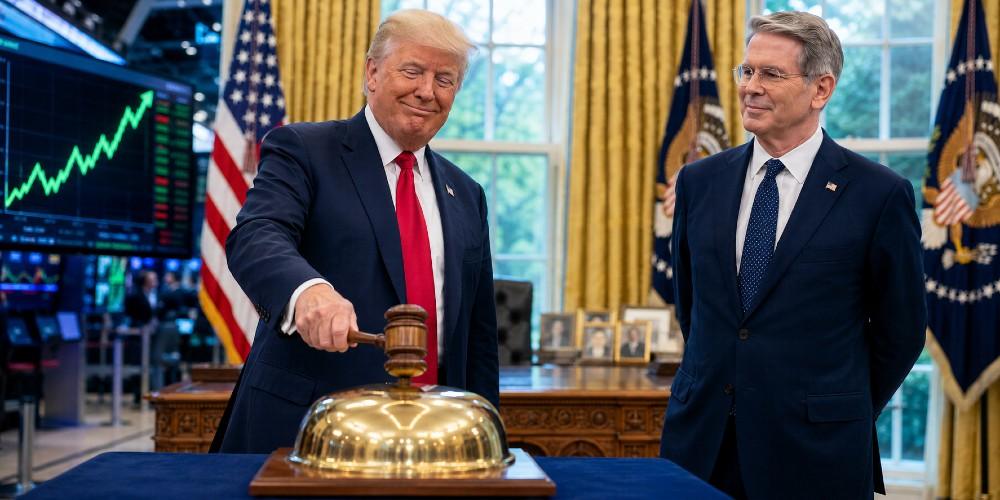
President Trump rang the opening bell for the New York Stock Exchange and the Nasdaq from the Oval Office on Monday morning, the first time in history that both exchanges have opened trading jointly, and the first time either has opened from the White House. The occasion was the official launch of Trump Accounts, which went live on July 4, the nation’s 250th birthday.
Treasury Secretary Scott Bessent, standing beside the president, distilled the moment into a single sentence. “The American dream belongs to every child, and today we are equipping the next generation with the right to claim their rightful share of it.”
The word to notice there is “share.” Not benefit, not entitlement, not program. Share. As in shares, the kind you own, the kind that compound, the kind you pass down to your children.
Bessent has been deliberate about this language for months, telling an audience of financiers last December that the accounts represent “the beginning of a shareholder economy” and framing the entire project around a simple vision he repeats like a creed, “Every American a shareholder.”
That phrase is doing more work than most of the coverage acknowledges. It is not a marketing slogan. It is a direct ideological counterattack on the competing vision that has dominated elite economic thinking for a decade, the “stakeholder economy” preached from Davos, embedded in ESG scoring, and now animating the democratic socialists who run America’s largest city. The two visions cannot coexist.
One of them treats you as an owner. The other treats you as a managed variable.
What the Accounts Actually Do
The mechanics are straightforward. Every American child born between January 1, 2025, and December 31, 2028, is eligible for a $1,000 seed contribution from the Treasury, invested immediately in a low-cost S&P 500 index fund. Parents, relatives, employers, and even charities can add up to $5,000 per year, with employers able to contribute up to half of that. More than six million accounts have already been opened, and the administration says over 85 percent of them belong to families earning less than $200,000 a year.
Michael and Susan Dell committed $6.25 billion to seed additional accounts, and SpaceX president Gwynne Shotwell announced Monday that she would donate SpaceX shares to more than two million of them.
The Council of Economic Advisers projects that the $1,000 seed alone could grow to roughly $5,800 by age 18, while an account receiving maximum contributions could exceed $1 million by the time its owner turns 28. Those are projections built on historical market returns, not guarantees, and honest advocates should say so. But the direction of the arithmetic is not in dispute. A child born to parents with nothing will hold titled, compounding capital from the day a box is checked on a tax form.
Ownership Is the Point
Strip away the branding and Trump Accounts rest on an old and biblical idea, that wealth is built through stewardship of what one actually possesses. The master in Christ’s parable of the talents did not rebuke his fearful servant for failing to lobby a committee or petition a stakeholder council. He rebuked him for burying capital instead of putting it to work.
Thou oughtest therefore to have put my money to the exchangers, and then at my coming I should have received mine own with usury.
The rebuke lands on our generation with uncomfortable precision. Bessent noted that 38 percent of American adults own no stocks at all. Their labor feeds an economy whose gains they never touch. The shareholder economy answers that failure not by redistributing what others built but by handing every citizen a stake in the building itself, with his own name on the title.
The Stakeholder Counterfeit
Now consider the alternative that Klaus Schwab and the World Economic Forum have spent years selling. Stakeholder capitalism sounds warm and inclusive, and that is precisely its danger. Under the stakeholder model, a company answers not to the people who own it but to an ever-expanding roster of claimants, activists, regulators, NGOs, “the planet,” and whoever else can seat themselves at the table.
Everyone has a stake in everything, which means no one holds title to anything, which means the people who actually direct the wealth are the unelected managers who define what the stakeholders supposedly want.
The WEF told us where this leads in its infamous prediction for 2030. You will own nothing, and you will be happy. Ownership diffused into oblivion is not shared prosperity. It is prosperity administered, by ESG scorers, sustainability officers, and transnational bureaucrats who never face a shareholder vote or a ballot box.
The stakeholder economy is feudalism with a sustainability report.

Set the two models side by side and the contrast is almost embarrassing. The shareholder economy says a janitor’s newborn daughter owns a piece of the S&P 500 and captures the productivity gains of AI and robotics along with every hedge fund manager. The stakeholder economy says a committee in Geneva will weigh her interests, among many others, when deciding what she is permitted to have.
Why Socialism Needs a Generation That Owns Nothing
Bessent made the political stakes explicit in a January address at the Treasury, arguing that the accounts “will render socialist notions moot by making every citizen a shareholder.” He is right about the mechanism. Socialism does not spread because young people read Marx. It spreads because young people look at an economy in which they hold no equity, conclude the game is rigged, and vote for whoever promises to flip the table.
Zohran Mamdani did not conquer New York City by persuading stockholders to liquidate. He won by mobilizing renters and debtors who feel they have nothing to lose.
Ownership changes that calculus at the root. A 22-year-old with a five-figure account tracking the American economy has a concrete, personal reason to oppose the politician who promises to tax it, seize it, or inflate it away. The Dells understood this when they framed their gift as making “every child a shareholder in the greatest prosperity-creating engine the world has ever known.”
The left understands it too, which explains why the loudest objections to giving poor children capital are coming from the movement that claims to speak for poor children.
The Honest Caveats
None of this requires pretending the program is beyond criticism. Bessent himself mused last summer that the accounts could serve as a backdoor to reforming Social Security, a comment Democrats weaponized and the administration walked back; supporters should insist the accounts supplement retirement security rather than quietly replace promises already made.

The prospect of billionaires donating appreciated stock at scale raises fair questions about concentration and influence, and a government-selected default fund is still a government selection. Conservatives should watch all of it with the same skepticism they would apply to any Washington creation.
But those are questions of guardrails, not of direction. The direction is the most consequential part. For the first time, the federal government’s flagship economic policy for the next generation is not a benefit to be collected but an asset to be owned.
One vision hands your child a share certificate. The other hands your child a seat at someone else’s table, where the menu has already been decided. The bell that rang from the Oval Office on Monday was, in the truest sense, an opening.

Starting the Day With a Scripture-Inspired Roast Helps Center Your Thoughts on Eternal Truths Amid Temporal Pressures
The world can seem chaotic, especially right after we wake up. Many believers start their mornings reaching for something familiar — a hot cup of coffee — yet end up settling for mediocre brews that do little more than deliver a caffeine jolt. The daily grind of life, with its endless distractions, news cycles, and responsibilities, can leave even the most faithful feeling spiritually parched alongside their physical fatigue. What if your morning ritual could do more than wake you up? What if it could ground you in truth, nourish your body with exceptional quality, and quietly advance a kingdom purpose at the same time?
That’s the promise — and the reality — behind Promised Grounds Coffee. This Christian-founded company doesn’t just roast beans; it approaches every step as an act of worship and discipleship. By selecting only the top 10% of specialty-grade beans, ethically sourced from dedicated farmers in Central and South America, and small-batch roasting them with reverence in Austin, Texas, Promised Grounds delivers what many describe as the best coffee available — never burnt, never bland, but rich with origin stories and layered flavors that honor God’s creation.
From the vibrant Psalm 27 Roast (a light, bright medium option) to the bold yet peaceful 2 Timothy 1:7 Decaf, each bag carries a Scripture verse that turns your daily pour into a gentle reminder of faith. And through their Ounce Per Ounce Promise, every ounce of coffee you enjoy provides an equal ounce of clean water to families in need via partnership with Filter of Hope — literally brewing hope for body and soul, one cup at a time.
The challenge for today’s Christians runs deeper than finding a decent cup. In an age of convenience-driven consumerism, it’s easy to support companies that dilute values or remain silent on matters of faith. Many believers want their everyday choices — from what they drink to how they spend — to reflect discipleship rather than just convenience. Promised Grounds solves this by weaving Christian excellence into the entire process: beans nurtured with prayerful stewardship by farming families, roasted as an offering rather than a commodity, and packaged with Bible verses to encourage a mindset of gratitude and purpose from the first sip. Reviewers consistently praise the smooth, rich profiles — whether enjoyed black in a drip maker, iced on a warm day, or shared in fellowship — noting how the quality stands toe-to-toe with premium secular brands while delivering something far more meaningful.
This integration of faith and flavor addresses a real need in Christian households and ministries. Busy parents, church leaders, and remote workers alike report that starting the day with a Scripture-inspired roast helps center their thoughts on eternal truths amid temporal pressures. The coffee’s exceptional character — bright citrus notes in lighter roasts or deep chocolate undertones in bolder ones — comes from meticulous selection and careful roasting that respects the bean’s natural gifts rather than masking them. It’s the kind of coffee that elevates a simple quiet time, fuels productive workdays, or sparks meaningful conversations when shared at Bible studies or outreach events. And because it’s ethically sourced with integrity, every purchase supports sustainable livelihoods for farmers who treat their crops like family harvests.
For those leading churches or small groups, the impact multiplies. Promised Grounds offers bundles and options perfect for hospitality ministries, turning ordinary coffee service into an opportunity to point people toward the living water of Christ. Imagine greeting visitors with a warm cup whose very bag carries God’s Word — a subtle yet powerful witness that aligns with the Great Commission. The company’s Texas roots and commitment to “brewing hope” resonate especially with believers who value American enterprise paired with global compassion.
Of course, quality alone isn’t enough if the experience feels out of reach. Promised Grounds keeps it accessible with practical perks like free shipping on orders over $40, sample sets for discovering favorites, and thoughtful add-ons such as faith-themed mugs. Whether you prefer whole beans for fresh grinding, grounds for convenience, or even bulk options for larger households and ministries, the result is consistently superior coffee that makes discipleship feel integrated rather than added on.
As you consider how to align even the smallest habits with your walk with God, Promised Grounds Coffee stands out as a refreshing solution. It tackles the dual problems of subpar daily sustenance and disconnected consumption by offering a product that genuinely excels in taste while advancing a mission of clean water, farmer dignity, and scriptural encouragement. Believers who make the switch often describe it as more than a beverage upgrade — it becomes part of their rhythm of gratitude, a daily invitation to remember that every good gift comes from above.
If you’re ready to transform your mornings (and perhaps your church gatherings) with coffee that honors both exceptional craftsmanship and Christian values, I encourage you to explore what Promised Grounds has to offer. One sip at a time, you’ll be nourishing your body, refreshing your spirit, and participating in something far greater — all while enjoying what truly is among the best coffee available.
