

The puns were flowing like wine, or rather, beer, on social media this week when Miller Lite went viral for an ad campaign that blasted its own brand for “sexism.”
“Hold my beer, Budweiser! Miller Lite’s new feminist spokeswoman is here to cuss at you and explain why men are evil,” wrote Not the Bee.
“Miller Lite apparently wants the Bud Light boycott treatment too,” said Rogan O’Handley, a Hollywood lawyer turned conservative commentator and supporter of former President Donald Trump. “Newsflash: After a hard day’s work, working-class beer drinkers don’t want to be lectured like they’re in a gender studies class at SUNY-Oswego.”
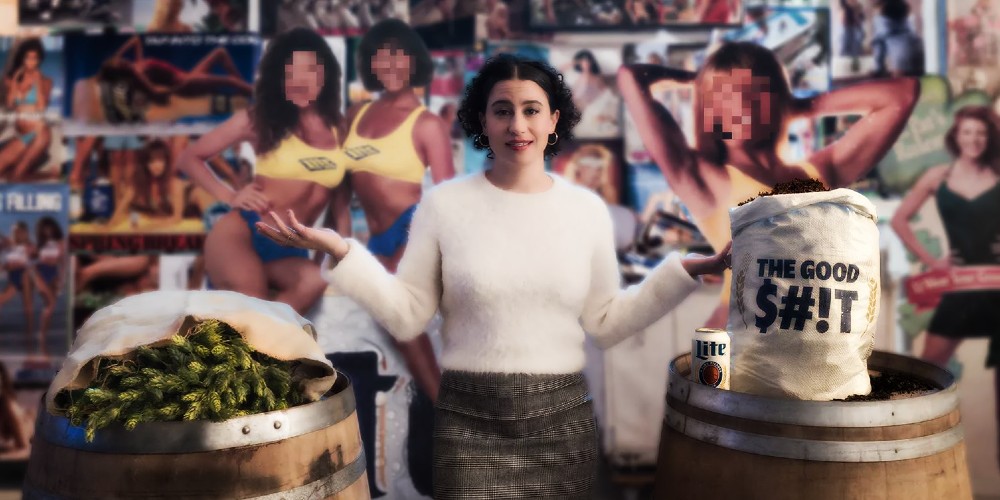
The ad features Ilana Glazer, a comedian who claimed women were the first brewers in history but were betrayed by corporate America.
“From Mesopotamia to the Middle Ages to colonial America, women were the ones doing the brewing,” Glazer said. “Centuries later, how did the industry pay homage to the founding mothers of beer? They put us in bikinis.”
To make amends, Miller Lite is buying up vintage ad art featuring women in swimwear, which it will turn into compost to support female brewers. “That good s*** helps farmers grow quality hops,” one woman explains.
Many accused Miller Lite of following the “woke” path of Bud Light, which witnessed a collapse in sales following a March Madness ad campaign featuring transgender influencer Dylan Mulvaney that prompted Anheuser-Busch to issue an apology .
“We never intended to be part of a discussion that divides people,” wrote CEO Brendan Whitworth.
What many on social media failed to realize is that Miller Lite’s ad was released before Bud Light’s implosion. It had just received little attention. It’s not clear if Miller Lite’s ad will have the same effect on beer sales as Bud Light’s. Some commentators on Twitter said they appreciated the ad.
“I actually think that Miller Lite got it a lot more right than Bud Lite in how it approached a female demo,” wrote Emily Zanotti of Fox News.
That’s the nature of commercials, of course. They are subjective. What might make one person feel uncomfortable might appeal to someone else.
I’m apparently a Neanderthal who likes the old-school Miller Lite commercials, whether they feature women in bikinis or Bob Uecker masquerading as Rodney Dangerfield at a costume party. I don’t like feeling lectured. That’s just me.
People naturally have different preferences and tastes in commercials, and that’s OK. The thing is, I’m actually Miller Lite’s target demo: a 40-something male beer drinker.
This invites questions. Why are Bud Light and Miller Lite making commercials that alienate their own consumer base? More importantly, why are they wading into controversial matters such as transgenderism, third-wave feminism, and nonbinary gender at all?
The primary answer is the rise of environmental, social, and corporate governance, a term coined during a 2004 United Nations initiative (“ Who Cares Wins ”) that grades companies on social performance.
ESG was born from the idea that traditional capitalism needs to be replaced with a more caring, socially conscious capitalism that serves other “stakeholders.” And what started as “guidelines and recommendations” have become explicit standards set by ESG rating agencies that impose steep costs on publicly traded companies, especially those that don’t comply.
The thing is, companies are not jazzed about having to dance to the tune of a small cabal of central bankers and asset managers. A 2022 CNBC survey showed that while executives support ESG publicly, privately, they harbor serious concerns. Yet not playing ball is not an option.
“If a company has to do disclosures, and it has some executives who are ‘not into ESG,’ it should be thinking about the cost of not becoming more concerned,” Eileen Murray, a former executive of Bridgewater Associates, the largest hedge fund in the world, told CNBC .
Miller Lite and Bud Light drinkers have every right to be annoyed by ads they don’t like. But they should understand these publicly traded companies are playing a balancing act on who they risk alienating, their consumers or ESG puppeteers.
This article was republished with permission from the Washington Examiner.


Jon Miltimore
Jonathan Miltimore is the Managing Editor of FEE.org. (Follow him on Substack.)
His writing/reporting has been the subject of articles in TIME magazine, The Wall Street Journal, CNN, Forbes, Fox News, and the Star Tribune.
Bylines: Newsweek, The Washington Times, MSN.com, The Washington Examiner, The Daily Caller, The Federalist, the Epoch Times.
This article was originally published on FEE.org. Read the original article.
Two Storms, One Harvest

Every food crisis in living memory has been a one-shock event. The 2008 price spike was a commodity bubble. The 2020 shortages were a logistics failure. The 2022 grain scare was a war on one exporter’s ports. Each time, the system bent, adjusted, and recovered, and each time the experts assured us afterward that global markets are simply too big and too diversified to fail.
What nobody in Washington seems eager to discuss is that 2026 is shaping up to be something the modern food system has never actually faced. Two independent shocks, one climatic and one geopolitical, are converging on the same harvest cycle at the same time. Not sequentially. Simultaneously.
Start with the weather. The Pacific Ocean is currently building toward what forecasters now openly call a record event. NOAA’s Climate Prediction Center puts the odds of at least a strong El Niño near 88 percent, with roughly two in three odds it reaches “very strong” status, the tier reserved for perhaps three or four events in the entire satellite era. Every major global model now projects a median peak in Super El Niño territory, and most of them project it exceeding the 2015-16 event, which until now held the modern record. Sea surface anomalies were already brushing the super threshold in mid-July, months before these events normally peak. The atmosphere has already shifted into El Niño mode, and the event is forecast to crest in late fall and early winter.
This is not about “climate change.” It’s about the standard cycles of weather, and the cycle we’re currently in is one that has likely devastated societies in the past. We’re better prepared as a society today, but not all Americans are equally prepared.
Serious households have started doing the quiet math on their own. Grocery bills tell part of the story, and the forecast maps tell the rest, which is why long-term food storage has moved from fringe hobby to mainstream line item in the family budget, with established suppliers like Heaven’s Harvest seeing demand from people who five years ago would have rolled their eyes at the idea. That instinct is not paranoia. It is pattern recognition, and the pattern is worth walking through carefully.
Editor’s Note: Heaven’s Harvest IS a sponsor, but the warnings of this article are real and would be written even if we didn’t have a survival food sponsor. With that said, those who take advantage of what they offer can use promo code “Patriot” for 15% off.
The Fertilizer Clock Is Already Running
While the Pacific warms, the second shock has been unfolding in the Strait of Hormuz. The conflict with Iran turned the world’s most important energy chokepoint into a contested waterway, and the consequences reach far beyond the gas pump. Roughly a third of global fertilizer trade moves through Hormuz, and the disruption sent urea prices up 86 percent year over year by March, with a 53 percent jump in a single month.
The World Bank projects energy prices rising about 24 percent in 2026 and fertilizer about 31 percent. By its own accounting, fertilizer prices ran 35 percent higher in the first five months of this year than the same period last year.
Here is the mechanism the nightly news will not explain. Fertilizer is not a grocery item. It is a time-delayed input. The nitrogen a farmer in Iowa or Punjab could not afford to apply this spring does not show up as a problem this spring. It shows up as a thinner harvest six to twelve months later.
The World Bank’s own food security brief concedes that the effects of reduced applications earlier this season “are likely to become visible only later in harvest outcomes.” Translate that from institutional language into plain English and it means this. The damage is already done, it is already in the ground, and we are simply waiting for it to arrive on the shelf.
Now check the calendar. Six to twelve months from the spring planting season lands us squarely in late 2026 and early 2027. Which is precisely when the strongest El Niño in the instrumental record is forecast to peak, bringing its signature droughts to Southeast Asia, Australia, southern Africa, northern Brazil, and South Asia, the very regions that grow the world’s rice, sugar, and oilseeds.
The World Bank warns openly that a strong El Niño “could disrupt multiple crop belts simultaneously” on top of the conflict-driven input costs. Their baseline projection assumes the Middle East disruptions ease by autumn. What in the last two years of Middle East history suggests that assumption is safe?
The System Has No Slack Left
The comfortable answer is that global markets always adjust. But adjustment requires slack, and the slack is gone. Global cereal production is expected to decline from last year’s records even before El Niño does its work. The UN World Food Programme, hardly a den of right-wing preppers, is calling this the most significant disruption to its supply chains since Covid and the invasion of Ukraine, and its supply chain director put the stakes bluntly.
Today’s supply chain challenges are tomorrow’s hunger crisis.
There is also a political dimension that markets cannot price. When food gets scarce, governments do not behave like economists. They behave like politicians. Export bans, hoarding mandates, and panic buying at the national level turned the modest rice shortfall of 2008 into a global crisis, and analysts are already warning that import-dependent nations are the first dominoes.
The 2015-16 Super El Niño, a far weaker event than what is now forecast, threw tens of millions into food stress across Africa and Asia. This one is projected to be stronger, and it arrives with fertilizer already rationed by price and shipping lanes already contested by missiles.
What Joseph Knew
Scripture does not treat preparation for lean years as faithlessness. It treats it as wisdom delivered in advance to those willing to act on it.
Behold, there come seven years of great plenty throughout all the land of Egypt: And there shall arise after them seven years of famine; and all the plenty shall be forgotten in the land of Egypt.
Joseph did not respond to that warning with a hashtag or a committee. He stored grain during the years of abundance, and when the famine came, Egypt stood while its neighbors begged. The lesson is not that famine is certain. It is that the time to prepare is precisely when preparation still looks optional.
Nobody who filled a pantry in a year of plenty has ever regretted it, and nobody standing in an empty aisle has ever been glad he waited for certainty.
None of this calls for panic, and panic is the enemy of sound judgment anyway. It calls for the same unglamorous prudence our grandparents considered ordinary. Keep some cash margin, know your local growers, and put real food in deep storage while it is cheap and available, because the entire arc of this story is that cheap and available is a closing window.
Families looking for a straightforward place to start can visit Heaven’s Harvest and use promo code Patriot for 15 percent off long-term storable food. The forecasts may yet soften, the strait may yet reopen, and we should pray they do. But hope is a fine thing to hold and a foolish thing to eat.

Meh. The real reason Big Beer teamed up with trannies is probably because beer grows man-boobs.
Moobs!
It’s the small hats.
There IS an option, Fight back and the people will support you.
Yes. But they can do more too. Budweiser who had a majority lock on beer drinkers before the disaster Mulvaney could have positioned themselves to go private and stick a thumb in ESG. Other companies should consider this move for ESG will destroy many brands before it is all over.
The real reason? Because the young, female ‘executives’ put in charge of the brands are leftist perverts who approve of fetishists, pedophiles, and groomers. And think (without actually being able to think) that their products are so popular with customers that customers will fall in line with whatever they do.
To put it simply: They’re woke idiots.
Most dangerous threat to what remains of The American Experiment; leftist woke liberal highly miss-educated women (and their neutered male counterparts).
I’m so sick of articles that should be 25 words or less droning on and on.
…and I thought it was satan releasing his demons on the world.
Hopefully the generations that follow the current “woke” generation realize what a mess the woke generation made of things and rejects them wholeheartedly.
The entire “Western World” is now Gomorrah. (there never was a “Sodom” – Sodomy is the ACT, not a town/city)
Everything happening today is a repeat of what happened 4000 years ago when God destroyed all the Evil on the Earth because “mankind” denied the existence of God, and worshiped Satan.
Beer corporations need to push back, you are the ones making the money. Don’t come to us crying because you’re weak and for us to just give in. Yeagling didn’t!
If you buy any of their products you are part of the problem.
Support your local craft brewer and tell all the conglomerates to go pound sand.
So how do we end ESG and CEI?
These globalist organizations who control this ESG bullshit are coming for the regular population next. They plan to have all humans backed into a corner to control their travels, spending and mind. Fortunately, they don’t realize that freedom loving Americans are going to revolt soon. We’re not China and we’re not going to be influenced by a social credit system.
Don’t try that “poor little corporations” crap on me. Big Corp is in a bind? So what? The reason Americans are fighting back is because these corporations didn’t! Instead, they are rolling over and showing their bellies to big government…exacerbating the problem. Give me a break…politicians get elected not by people but by big money and lobby kings. If the government is coercing big corp., then big corp should have played hardball and said NO…and no donations if you try that. Budweiser bellied up to the government and hopefully will fully belly up by good citizens making them pay the price for capitulating to tyranny. I fully hope for Budweiser’s total ruin!
Businesses and industry should do no (real) harm. They should conserve resources where they can, minimize pollution, follow the law (not bogus mandates), and treat their employees fairly. But their contribution to society is just that…commerce…work…economics. And they need to stay in their lane. Instead of perpetuating a tyrannical government, companies should have told politicians to pound sand. They cowered…now they’re paying for it. Good times!