

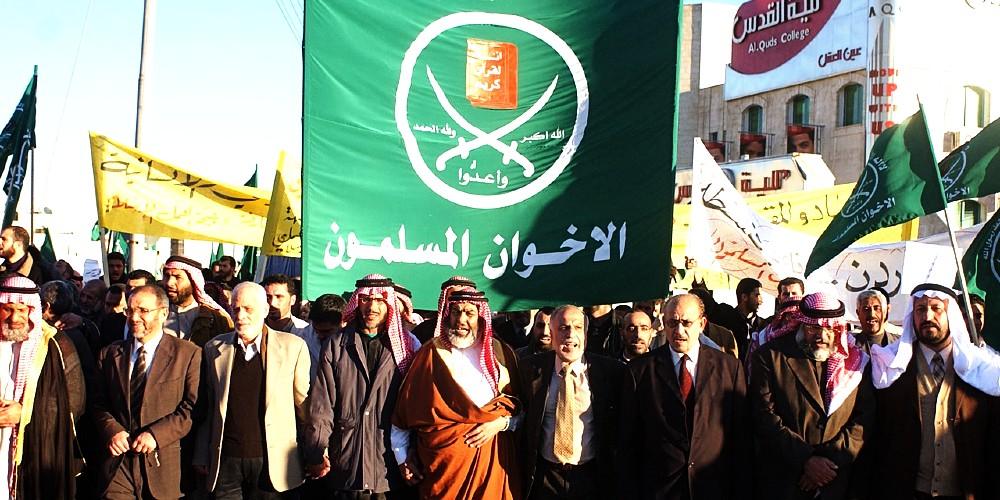
(Daily Signal)—The Muslim Brotherhood has engaged in a century-long project to “Islamify” modern countries through gradual, lawful, multisector action. Across Europe and now the United States, the Brotherhood builds institutions, exploits rights language, and forges “red-green” alliances. In this way, it prepares ground for jihadist violence while avoiding overt illegality.
This “Brotherism,” as I call it in a new special report, is an ideology coupled with a method. It advocates a political and social project organized around the primacy of the Islamic way of life in the public sphere.
Its method favors nonviolent, patient, generational transformation of the host society. Brotherists first build parallel institutions like mosques, community centers, and schools using the host country’s support to gain footholds. Then they enter established educational, media, associative, and political fields en route to capturing institutions.
The Brotherhood, founded in Egypt in 1928 by Hassan al-Banna, aims to convert a strict reading of Islam into an organized, patient, and transnational political project to make Islam the fundamental law of the land in modern countries.
Al-Banna set out successive stages for this project: forming the Muslim individual, building the Muslim family, constructing a Muslim society with an Islamic government, restoring the caliphate, and ultimately achieving what Muslims call ustādhiyyat al-‘ālam or “mastership of the world.” He aspired to establish an Islam in which the religious would order every sphere; a supremacist identity of a chosen community destined to prevail; and a gradual, adaptable plan would advance with the balance of power. Under this framework, nothing would be beyond Islam’s reach.
Everywhere in Europe—Belgium, Germany, the United Kingdom, Austria, the Netherlands, Italy—the same kinds of networks embed themselves at the national level. Germany’s domestic intelligence agency has called this “Islamization from below.” The Dutch conclude that the ultimate aim of its national association is “to create, then implant and expand, an ultra-orthodox Muslim bloc inside Western Europe.”
Chakib Benmakhlouf, a senior figure in a European organizational network that is linked with the Muslim Brotherhood, stated: “We do not want to draw attention to the fact that we are Islamizing the West.”
European governments have promoted Brotherhood goals, often unwittingly. Many began by backing organizations that they believed were moderate promoters of a peaceful form of Islam. These organizations often turned out to be Brotherhood front groups.
In Britain, according to a government report, the Brotherhood “shaped the new Islamic Society of Britain (ISB), dominated the Muslim Association of Britain,” and helped run the Muslim Council of Britain. In France, the Brotherhood-linked Union of Islamic Organizations of France (now “Muslims of France”) became an official partner.
The next step in the Brotherist approach is to accumulate property and build durable institutions, often with the approval of the state.
Groups and individual actors linked with or sympathetic to the Brotherhood have then entered and oriented schools, associations, and local governments from within, converting ordinary civic spaces into vehicles for its project.
They have made life difficult for law enforcement and investigators by turning scrutiny into litigation and public accusation. Groups have covered their methods with a shield of legal immunity, invoking freedom of religion and anti-discrimination rules to roll back neutrality and gain official status.
In these later stages, so-called red-green alliances with leftist parties develop, along with educational and media investment, institutional recognition, and a communal economy of halal certification and Islamic finance.
In France, there were about 100 Islamic places of worship around 1970. There are roughly 2,600 today.

Brotherism has anchored itself through mosques and cultural centers, alongside schools and media, which have diffused its norms. It has then captured institutions, gaining recognition in part through its influence on the French Council of the Muslim Faith and local bodies.
The same advance produced the red-green alliance with the radical Left, which supplies an electorate for both and exploits antiracist vocabulary that shields the project from criticism. Socialist presidential candidate François Hollande received 86% of the Muslim vote in the 2012 runoff, and the radical leftist La France Insoumise presidential candidate Jean-Luc Mélenchon got nearly 70% of the Muslim vote in the first round in 2022.
In Britain, groups linked with or sympathetic to the Brotherhood have put down roots and gained public respectability from Britain’s multicultural establishment.
British failures to handle Islamic issues are legion. Successive governments treated the Muslim Council of Britain as the de facto voice of British Muslims until 2009. The 2014 Trojan Horse affair revealed coordinated efforts to introduce an intolerant Islamic ethos into schools. Authorities in several cities gravely failed victims of grooming gangs, sometimes ignoring evidence for years.
What happens in Europe does not stay in Europe.
In the United States, the Brotherhood and its sympathizers have gradually built an institutional ecosystem of national groups. After the Muslim Student Association was founded in 1963, a network of legacy organizations emerged. The North American Islamic Trust held property. The International Institute of Islamic Thought focuses on institutional reform. The Islamic Society of North America builds youth coalitions. The Council on American-Islamic Relations is a public interest firm.

None of these are formal American affiliates of the Egyptian Brotherhood. Yet, as scholars show, they make for a durable ecosystem capable of shaping how Islam is organized and represented in the United States. Key figures such as Jamal Barzinji, Ahmad Totonji, and Hisham al-Talib helped build the infrastructure. Gulf donors at times supplied substantial funding.
The same pattern appeared in Britain and France. The global war on terrorism elevated “moderate” partners who condemned violence. These then gained access, credibility, and funding as seemingly dependable Islamic allies.
Whether formally connected with the Brotherhood or not, American Islamic groups use the same tactics as European advocates. In the United States, a red-green political alliance has grown around figures such as New York City Mayor Zohran Mamdani, whose support for the Palestinian cause and BDS drew backing from CAIR Action. One CAIR official described the New York mayor’s election as a “referendum” on Palestinian resistance.
Territorial implantation is seen in the proposed EPIC City project in Texas, which aims to combine housing, mosque, school, and commerce into a single community.
Islamic groups engage in strategic litigation under civil rights law. After Texas Gov. Greg Abbott designated CAIR and the Muslim Brotherhood as foreign terrorist and transnational criminal organizations under state law in November 2025 and ordered investigations, CAIR sued, framing the action as discriminatory.
Brotherism is a project with flexible but identifiable methods. It can survive the disappearance of its accidental structures and can exist without formal affiliation. If one federation is dissolved, another constitutes itself. If one source of funding closes, others open. The men, the funding, the doctrine, and the aim of Islamifying modernity remain.
Too many attempted remedies attack the visible forms rather than the matrix that produces them. This is the system that has been built in Europe and is coming to the United States. This is what we are up against.
We publish a variety of perspectives. Nothing written here is to be construed as representing the views of the Daily Signal.

Starting the Day With a Scripture-Inspired Roast Helps Center Your Thoughts on Eternal Truths Amid Temporal Pressures
The world can seem chaotic, especially right after we wake up. Many believers start their mornings reaching for something familiar — a hot cup of coffee — yet end up settling for mediocre brews that do little more than deliver a caffeine jolt. The daily grind of life, with its endless distractions, news cycles, and responsibilities, can leave even the most faithful feeling spiritually parched alongside their physical fatigue. What if your morning ritual could do more than wake you up? What if it could ground you in truth, nourish your body with exceptional quality, and quietly advance a kingdom purpose at the same time?
That’s the promise — and the reality — behind Promised Grounds Coffee. This Christian-founded company doesn’t just roast beans; it approaches every step as an act of worship and discipleship. By selecting only the top 10% of specialty-grade beans, ethically sourced from dedicated farmers in Central and South America, and small-batch roasting them with reverence in Austin, Texas, Promised Grounds delivers what many describe as the best coffee available — never burnt, never bland, but rich with origin stories and layered flavors that honor God’s creation.
From the vibrant Psalm 27 Roast (a light, bright medium option) to the bold yet peaceful 2 Timothy 1:7 Decaf, each bag carries a Scripture verse that turns your daily pour into a gentle reminder of faith. And through their Ounce Per Ounce Promise, every ounce of coffee you enjoy provides an equal ounce of clean water to families in need via partnership with Filter of Hope — literally brewing hope for body and soul, one cup at a time.
The challenge for today’s Christians runs deeper than finding a decent cup. In an age of convenience-driven consumerism, it’s easy to support companies that dilute values or remain silent on matters of faith. Many believers want their everyday choices — from what they drink to how they spend — to reflect discipleship rather than just convenience. Promised Grounds solves this by weaving Christian excellence into the entire process: beans nurtured with prayerful stewardship by farming families, roasted as an offering rather than a commodity, and packaged with Bible verses to encourage a mindset of gratitude and purpose from the first sip. Reviewers consistently praise the smooth, rich profiles — whether enjoyed black in a drip maker, iced on a warm day, or shared in fellowship — noting how the quality stands toe-to-toe with premium secular brands while delivering something far more meaningful.
This integration of faith and flavor addresses a real need in Christian households and ministries. Busy parents, church leaders, and remote workers alike report that starting the day with a Scripture-inspired roast helps center their thoughts on eternal truths amid temporal pressures. The coffee’s exceptional character — bright citrus notes in lighter roasts or deep chocolate undertones in bolder ones — comes from meticulous selection and careful roasting that respects the bean’s natural gifts rather than masking them. It’s the kind of coffee that elevates a simple quiet time, fuels productive workdays, or sparks meaningful conversations when shared at Bible studies or outreach events. And because it’s ethically sourced with integrity, every purchase supports sustainable livelihoods for farmers who treat their crops like family harvests.
For those leading churches or small groups, the impact multiplies. Promised Grounds offers bundles and options perfect for hospitality ministries, turning ordinary coffee service into an opportunity to point people toward the living water of Christ. Imagine greeting visitors with a warm cup whose very bag carries God’s Word — a subtle yet powerful witness that aligns with the Great Commission. The company’s Texas roots and commitment to “brewing hope” resonate especially with believers who value American enterprise paired with global compassion.
Of course, quality alone isn’t enough if the experience feels out of reach. Promised Grounds keeps it accessible with practical perks like free shipping on orders over $40, sample sets for discovering favorites, and thoughtful add-ons such as faith-themed mugs. Whether you prefer whole beans for fresh grinding, grounds for convenience, or even bulk options for larger households and ministries, the result is consistently superior coffee that makes discipleship feel integrated rather than added on.
As you consider how to align even the smallest habits with your walk with God, Promised Grounds Coffee stands out as a refreshing solution. It tackles the dual problems of subpar daily sustenance and disconnected consumption by offering a product that genuinely excels in taste while advancing a mission of clean water, farmer dignity, and scriptural encouragement. Believers who make the switch often describe it as more than a beverage upgrade — it becomes part of their rhythm of gratitude, a daily invitation to remember that every good gift comes from above.
If you’re ready to transform your mornings (and perhaps your church gatherings) with coffee that honors both exceptional craftsmanship and Christian values, I encourage you to explore what Promised Grounds has to offer. One sip at a time, you’ll be nourishing your body, refreshing your spirit, and participating in something far greater — all while enjoying what truly is among the best coffee available.
