

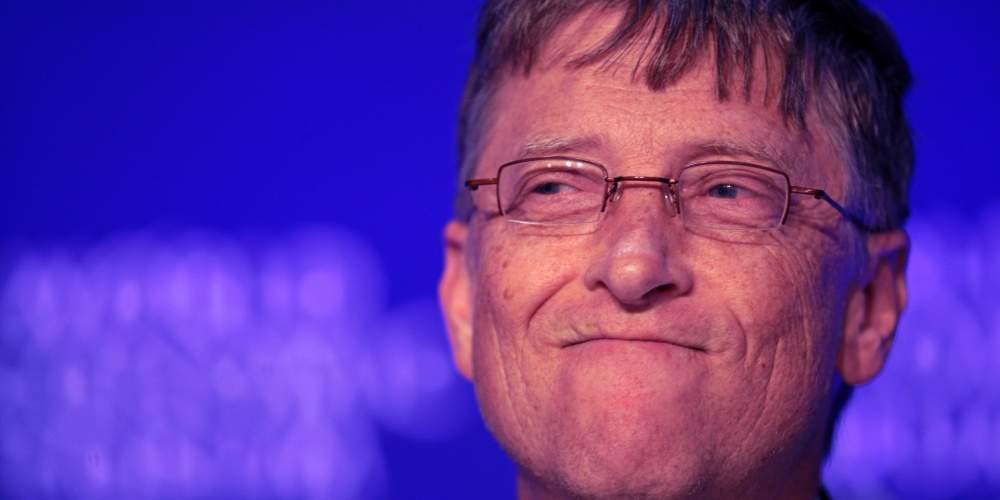
A few weeks back, at the World Economic Forum (WEF) meeting in Davos, Bill Gates said some surprising things. In the course of a 56-minute panel discussion the vaccine pusher extraordinaire admitted (starting at the 18:22 mark) that the Covid vaccines do not block infection and that the duration of whatever protection they bring to the table is extremely short.
He later talked (starting at 51:00 mark) of the absurdity of implementing any Covid passport program—and one can logically deduce any other measure to segregate the vaccinated from the unvaccinated—when the injections have shown no ability to do the least that one should expect from a vaccine: prevent infection and transmission.
These admissions violently kick the stool out from under the arguments made in favor of the more assaultive and damaging Covid “containment measures” taken in the past two years, many of which are still being pursued with pitiless vigor by public officials, CEOs, and educational “leaders” all around the world.
Are we to believe that Bill Gates had a sudden impulse to undermine all that he used his billions to mercilessly promote over the last two years? And that he was giving all those currently carrying out those plans permission to stand down?
It’s a nice thought. But I don’t believe it to be the case.
No. Bill was simply engaging in one of the more tried and true techniques of elite information management, the limited hangout, or what I prefer to call a drive to “save the frame” of an argument that is quickly taking on water.
Since Bill and many of the people he has paired up with to force the experimental and often harmful vaccines upon the world, effectively own or have donated untold amounts of money to many of the world’s more important media outlets, he knew beforehand that he did not have to worry much about his words being widely circulated.
And so it was. Only relatively small independent news gatherers took any note of what he said.
So who was he addressing his words to and why?
He was speaking to the fellow true believers and providing them with a rhetorical model for handling the loss of faith some among their ranks are having in the face of the vaccines’ abject failure.
The key to understanding the frame game here is the clause Gates uttered right before the “but” with which he introduced his truthful words about the “vaccines” pitiful infection-blocking capabilities and short duration of effectiveness: “The vaccines have saved millions of lives.”
Those familiar with the work of cognitive linguist George Lakoff, or the activities of pollster and so-called political wordsmith Frank Luntz will know what I’m talking about.
What these two men have in common—despite their divergent political allegiances—is their belief in the extraordinary power of rhetorical framing; that is, the tendency of the human brain to subordinate the careful analysis of empirically proven details to the embrace of an overarching cognitive metaphor that appeals to their deeper, if often unstated, cultural and emotional values.
It’s the difference between, for example: “The US invaded Iraq on false pretenses and destroyed it, killing hundreds of thousands of innocent people.” and “In its efforts to bring democracy to Iraq, the US made a number of tragic mistakes.”

The first states a bald empirical truth. The second obfuscates that crude reality and subordinates it to the noble vision, so cherished by Americans when contemplating their role in the world, of a country that is constantly helping people around the world to better their lives.
And with widespread imposition of mental frames like this through the media, “poof!” go all the gory, on-the-ground details, and with them more importantly, the need to actually interrogate what we did and how we might seek to repair the lives we broke.
Going back to Davos, Bill was effectively saying to his minions, “You are on a great moral crusade. We’ve had some small problems along the way, but don’t give up, because the world needs us to continue to be heroic and save more lives.”
And with that cognitive frame in place, any creeping doubts those in the audience might have about what they have done, and their future mission, disappear just like that.
We see the same gambit used when the US government inevitably links the apparent waning of the pandemic to the use of vaccines. Here, for example, is what the CDC said to CNN shortly after lifting requirement that US citizens be tested before returning home from foreign travels:
“The Covid-19 pandemic has now shifted to a new phase, due to the widespread uptake of highly effective Covid-19 vaccines, the availability of effective therapeutics, and the accrual of high rates of vaccine-and infection-induced immunity at the population level in the United States. Each of these measures has contributed to lower risk of severe disease and death across the United States.”
It’s no accident that the first factor adduced to explain the onset of happier days, the one that sets the frame for all that follows, is the “widespread uptake of highly effective Covid-19 vaccines.”
The goal here— as it was in the case of Gates at Davos—is to preserve, in the face of abundant empirical evidence to the contrary, the frame that presents the forced administration of vaccines as the great slayer of the pandemic and gifter of our vanquished freedoms, and to turn that suggestion into an established fact through constant repetition.
But, of course, neither Gates’s claim about the vaccines saving “millions of lives” nor the CDCs’ assertion that “widespread vaccine uptake” was the key reason for ending the pandemic are established facts. Far from it. Indeed, there are no scientific studies that l know of capable of authenticating either claim. But that’s just the point.
The elites that deign to rob us of our bodily sovereignty and so much more in the name of Covid, or whatever other “mortal health threat” that they choose to publicize next through their carpet-bomber control of most media, have all done their homework on the frame game and carefully tailor their communications to fit with its imperatives.
Unfortunately, most citizens are still not clued in to how it operates in their lives. Verbal details such as the ones cited above matter because they play an enormous role in establishing and maintaining what the now sadly tarnished Chomsky once brilliantly called the field of “thinkable thought” in our public discussions.
To open up that field we need to smash their frames. But to smash those frames we first need to admit they exist, and where we can go to find them.
About the Author
Thomas Harrington, Senior Scholar at the Brownstone Institute, is an essayist and Professor Emeritus of Hispanic Studies at Trinity College in Hartford (USA) where he taught for 24 years. He specializes in Iberian movements of national identity Contemporary Catalan culture. His writings are at Thomassharrington.com.
Image by World Economic Forum via Flickr, CC BY-NC-SA 2.0. Article cross-posted from Brownstone Institute.
Two Storms, One Harvest

Every food crisis in living memory has been a one-shock event. The 2008 price spike was a commodity bubble. The 2020 shortages were a logistics failure. The 2022 grain scare was a war on one exporter’s ports. Each time, the system bent, adjusted, and recovered, and each time the experts assured us afterward that global markets are simply too big and too diversified to fail.
What nobody in Washington seems eager to discuss is that 2026 is shaping up to be something the modern food system has never actually faced. Two independent shocks, one climatic and one geopolitical, are converging on the same harvest cycle at the same time. Not sequentially. Simultaneously.
Start with the weather. The Pacific Ocean is currently building toward what forecasters now openly call a record event. NOAA’s Climate Prediction Center puts the odds of at least a strong El Niño near 88 percent, with roughly two in three odds it reaches “very strong” status, the tier reserved for perhaps three or four events in the entire satellite era. Every major global model now projects a median peak in Super El Niño territory, and most of them project it exceeding the 2015-16 event, which until now held the modern record. Sea surface anomalies were already brushing the super threshold in mid-July, months before these events normally peak. The atmosphere has already shifted into El Niño mode, and the event is forecast to crest in late fall and early winter.
This is not about “climate change.” It’s about the standard cycles of weather, and the cycle we’re currently in is one that has likely devastated societies in the past. We’re better prepared as a society today, but not all Americans are equally prepared.
Serious households have started doing the quiet math on their own. Grocery bills tell part of the story, and the forecast maps tell the rest, which is why long-term food storage has moved from fringe hobby to mainstream line item in the family budget, with established suppliers like Heaven’s Harvest seeing demand from people who five years ago would have rolled their eyes at the idea. That instinct is not paranoia. It is pattern recognition, and the pattern is worth walking through carefully.
Editor’s Note: Heaven’s Harvest IS a sponsor, but the warnings of this article are real and would be written even if we didn’t have a survival food sponsor. With that said, those who take advantage of what they offer can use promo code “Patriot” for 15% off.
The Fertilizer Clock Is Already Running
While the Pacific warms, the second shock has been unfolding in the Strait of Hormuz. The conflict with Iran turned the world’s most important energy chokepoint into a contested waterway, and the consequences reach far beyond the gas pump. Roughly a third of global fertilizer trade moves through Hormuz, and the disruption sent urea prices up 86 percent year over year by March, with a 53 percent jump in a single month.
The World Bank projects energy prices rising about 24 percent in 2026 and fertilizer about 31 percent. By its own accounting, fertilizer prices ran 35 percent higher in the first five months of this year than the same period last year.
Here is the mechanism the nightly news will not explain. Fertilizer is not a grocery item. It is a time-delayed input. The nitrogen a farmer in Iowa or Punjab could not afford to apply this spring does not show up as a problem this spring. It shows up as a thinner harvest six to twelve months later.
The World Bank’s own food security brief concedes that the effects of reduced applications earlier this season “are likely to become visible only later in harvest outcomes.” Translate that from institutional language into plain English and it means this. The damage is already done, it is already in the ground, and we are simply waiting for it to arrive on the shelf.
Now check the calendar. Six to twelve months from the spring planting season lands us squarely in late 2026 and early 2027. Which is precisely when the strongest El Niño in the instrumental record is forecast to peak, bringing its signature droughts to Southeast Asia, Australia, southern Africa, northern Brazil, and South Asia, the very regions that grow the world’s rice, sugar, and oilseeds.
The World Bank warns openly that a strong El Niño “could disrupt multiple crop belts simultaneously” on top of the conflict-driven input costs. Their baseline projection assumes the Middle East disruptions ease by autumn. What in the last two years of Middle East history suggests that assumption is safe?
The System Has No Slack Left
The comfortable answer is that global markets always adjust. But adjustment requires slack, and the slack is gone. Global cereal production is expected to decline from last year’s records even before El Niño does its work. The UN World Food Programme, hardly a den of right-wing preppers, is calling this the most significant disruption to its supply chains since Covid and the invasion of Ukraine, and its supply chain director put the stakes bluntly.
Today’s supply chain challenges are tomorrow’s hunger crisis.
There is also a political dimension that markets cannot price. When food gets scarce, governments do not behave like economists. They behave like politicians. Export bans, hoarding mandates, and panic buying at the national level turned the modest rice shortfall of 2008 into a global crisis, and analysts are already warning that import-dependent nations are the first dominoes.
The 2015-16 Super El Niño, a far weaker event than what is now forecast, threw tens of millions into food stress across Africa and Asia. This one is projected to be stronger, and it arrives with fertilizer already rationed by price and shipping lanes already contested by missiles.
What Joseph Knew
Scripture does not treat preparation for lean years as faithlessness. It treats it as wisdom delivered in advance to those willing to act on it.
Behold, there come seven years of great plenty throughout all the land of Egypt: And there shall arise after them seven years of famine; and all the plenty shall be forgotten in the land of Egypt.
Joseph did not respond to that warning with a hashtag or a committee. He stored grain during the years of abundance, and when the famine came, Egypt stood while its neighbors begged. The lesson is not that famine is certain. It is that the time to prepare is precisely when preparation still looks optional.
Nobody who filled a pantry in a year of plenty has ever regretted it, and nobody standing in an empty aisle has ever been glad he waited for certainty.
None of this calls for panic, and panic is the enemy of sound judgment anyway. It calls for the same unglamorous prudence our grandparents considered ordinary. Keep some cash margin, know your local growers, and put real food in deep storage while it is cheap and available, because the entire arc of this story is that cheap and available is a closing window.
Families looking for a straightforward place to start can visit Heaven’s Harvest and use promo code Patriot for 15 percent off long-term storable food. The forecasts may yet soften, the strait may yet reopen, and we should pray they do. But hope is a fine thing to hold and a foolish thing to eat.
