

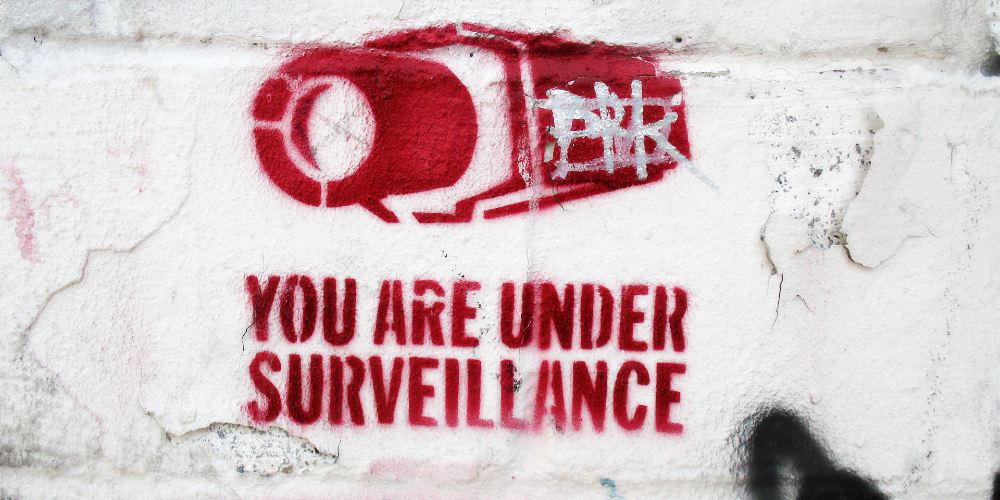
(Brownstone Institute)—The greatest trick the Devil ever pulled was convincing the world he didn’t exist” is a quote generally attributed to Charles Baudelaire – or possibly Keyser Söze depending on who you ask on the internet. Something similar can be said about Big Brother.
When you think about what our emerging surveillance state will look like, you think 1984. You imagine East Germany powered by Google and Amazon. You recall your favorite dystopian sci-fi film – or maybe horror stories of China’s social credit system. Thoughts of a frustrated middle-aged police chief from a mid-sized Midwestern town attempting to procure security cameras with innovative new features probably don’t come to mind. You definitely don’t think of a guy in a lawn chair jotting down the license plate numbers of passing vehicles in a notebook. And that’s partly how the surveillance state is going to emerge as it creeps its way into one small town at a time.
Whether a surveillance state is the end goal is hard to say. The police chief of Pawnee, Indiana probably isn’t plotting the development of his own mini-Oceania. But, 18,000-plus mini-Oceanias operating across multiple platforms with varying degrees of integration, both locally and nationally, is undoubtedly the direction in which we are heading as salespeople peddle shiny new surveillance gadgets to cities big and small, making often unverified but intuitively appealing claims of how their devices will decrease crime or prove to be useful investigative tools.
Facial recognition tends to be the surveillance gadget that receives the most attention these days. You’ve seen it in movies and maybe feel some unease over visions of government agents sitting in a penumbrous room illuminated only by the faint glow of countless monitors with little boxes tracking the faces of every person walking down a busy city street. Likely, by now, you’ve also probably heard of facial recognition being used for relatively petty purposes or leading to incidents in which innocent people were harassed or arrested because a program made a mistake. Maybe you’ve even been following the efforts to ban the technology.
Yet, other surveillance gadgets that aren’t quite as sexy or as prevalent in pop culture manage to remain under the radar of even the most privacy-conscious as they are promoted through law enforcement peer referral programs organized by surveillance gadget companies seeking to have their devices in every town in America.
Some, such as gunshot detection devices, may seem relatively benign, although there have been concerns they might pick up bits of conversation on quiet streets. Others, such as cell site simulators, are quite a bit more intrusive as they can be used by law enforcement to monitor the location of people through their cell phones, as well as collect metadata from their calls and a considerable amount of other information.
Automatic license plate readers, or ALPRs, can be used to log a person’s movements through the license plates of their vehicles. Given the exponential increase in their use over the past few years and the ease with which data from the cameras of some vendors are integrated, they also pose a threat to privacy on par with facial recognition and cell site simulators.
Often positioned on street lights, traffic lights, independent structures, or police vehicles, ALPRs are a type of camera that captures the license plate and other identifying information of passing vehicles before comparing the information in real time to “hot lists” of vehicles actively being sought by law enforcement and transmitting the information to a searchable database. ALPRs sold by some companies are even said to be able to assess a car’s driving patterns to determine whether the person behind the wheel is “driving like a criminal.”
Depending on the vendor and the particulars of their contract with a municipality or private entity leasing the cameras from them, the information the cameras collect is maintained usually for thirty days but sometimes for a period of months or even years.
Although on the surface this may sound relatively unintrusive, leading to places such as Nashville approving ALPRs while rejecting facial recognition, what this ultimately does is create a searchable database for the timestamped rough location of any individual who regularly travels using a single vehicle – in other words, most Americans especially those living outside of major cities.
Jay Stanley, a senior policy analyst with the ACLU’s national office, who has written extensively on matters pertaining to technology, privacy, and surveillance, stated in a 2023 phone interview, “There’s no question that if you get enough license plate readers and you got one on every block, that put together…can create a GPS-tracker-like-record of my movement and even if there’s, you know, only one every ten miles and [I’m] driving around the country, I’m driving from Texas to California or what have you, that can be very revealing as well.”
Subsequently, organizations such as the Electronic Frontier Foundation, a privacy advocacy group, and the Brennan Center for Justice, a self-described “non-partisan law and policy institute,” have expressed concerns that the devices could be used to track the activities of protesters and activists.
If ALPRs were as prevalent during lockdowns as they are now, it’s not difficult to imagine at least some governors or mayors using them to track and reprimand those who dared violate Corona law.
Furthermore, sometimes the devices do make mistakes, leading to claims by individuals and families that they were psychologically traumatized after they were pulled over, held at gunpoint, searched, and handcuffed by police essentially due to a computer error.

As for the benefits they provide in terms of making communities safer, quantitative data demonstrating their success tends to be lacking.
The University of Washington’s Center for Human Rights released a report in December 2022 indicating hit rates for ALPRs, or the percentage of license plates photographed by ALPRs within a municipality that are associated with a vehicle being sought by law enforcement, tend to fall below 0.1%, meaning a lot of data have to be collected on a lot of law-abiding citizens in order for the devices to be of any use. Moreover, even when they do aid law enforcement in finding a wanted vehicle, the end results still can be somewhat underwhelming.
The University of Illinois’ Community Data Clinic, for example, in a preliminary report dated Fall 2023, indicated that of 54 instances law enforcement in Champaign, one of the two cities U of I calls home, accessed data from their ALPRs within a particular period, only 31 of those instances likely involved felonies, most of which did not involve a firearm. The University of Illinois report went on to indicate only ten of those instances led to an arrest or an arrest warrant and only two of those arrests led to formal charges.
As demonstrated at an October 2021 town hall regarding ALPRs in Urbana, IL, Champaign’s sister city, even proponents of the devices struggle to produce a single study showing that the cameras deter or prevent gun violence, which is often one of the main reasons communities turn to ALPRs in the first place.
However, when vendor reps and local law enforcement are trying to gain approval from city councils and assuage the fears of wary citizens, the surveillance potential of the devices, along with their questionable effectiveness and the devastating consequences that can follow when one makes a mistake, tend not to be what they lead with.
Instead, proponents emphasize how common they are in surrounding cities, cite anecdotal evidence of their utility, and try to present ALPRs as non-threatening, normal, and perhaps even a little old-fashioned.

You have nothing to worry about, you’re told. The town down the road brought them in six months back. Chief Jones over there said they helped solve that murder from the news. And, by the way, they’re not really that much different from a concerned citizen just keeping an eye on things.
At the town hall in Urbana, for example, then-police chief, Bryant Seraphin, worked to dismiss the notion that ALPRs actually pose a threat to privacy or even constitute a surveillance tool.
“They [ALPRs] are not surveillance cameras,” stated Seraphin early in the event. “I cannot pan, tilt, [or] zoom them. There’s no live looking to see what’s happening at the corner…” he explained.
Repeatedly, he emphasized that ALPRs do not capture any information about the person driving a car or automatically link to information about the person to whom a vehicle is registered. Their ubiquity in the area was accentuated. Supposed success stories were shared.
To allay any remaining notion that there might be something scary about ALPRs, Seraphin described them with a folksy metaphor: “One of the things that I’ve talked about with these things is that if you pictured somebody sitting in a lawn chair writing down every plate that went by, the date, and the time when they wrote ‘red Toyota ABC123’, and then they would make a phone call and check the databases and then hang up and then go on to the next one – that’s what [an ALPR] does automatically and it can do it over and over again…with incredible speed.”
Yet, when Anita Chan, the director of the University of Illinois Community Data Clinic, proceeded to raise concerns regarding “the potential violation of civil liberties” and how a license plate alone is sufficient for the police to not just find out “where you live and where you work but also…who potentially your friends are, what religious affiliation you might have, essentially where you get medical services…[and] suss out essentially who’s traveling and where,” Seraphin acknowledged all this is possible. However, he assured her with a frustrated chuckle, ALPRs simply provide a notebook that would only be referenced when investigating serious crimes.
By the same logic, facial recognition simply provides a notebook as well. As do cell site simulators. As do any surveillance device. Yet, there is a fundamental question of whether such a notebook should exist. Does the chief of police in Urbana or the sheriff in Pawnee need a notebook containing your approximate location three Thursdays ago at 8:15pm, as well as a record of who attended last week’s political rally, in order to solve a murder? Should he be allowed to keep such a notebook if it might help solve an extra murder in his town each year? If the answer is yes, then what are the limits to the tools he and his department should be afforded?
Furthermore, there is also something a little off about the disarming metaphor of a guy who spends his days sitting around in a lawn chair jotting down the license plate numbers of passing vehicles. Something a little insidious. Something that perhaps Anita Chan was piking up on.
One guy in a lawn chair jotting down license plate numbers is a nosy neighbor, maybe even a neighborhood crank, but not someone to whom you would pay much attention. When he starts following you around though to the point of knowing who your friends are, where you worship, and when you go to the doctor, he kind of becomes a stalker. But, when he develops the ability to gather this kind of information on everyone, he starts to develop a level of omnipresence and omniscience with which no one should be comfortable – which may be why you’re told he’s just a guy in a lawn chair.
About the Author
Daniel Nuccio holds master’s degrees in both psychology and biology. Currently, he is pursuing a PhD in biology at Northern Illinois University studying host-microbe relationships. He is also a regular contributor to The College Fix where he writes about COVID, mental health, and other topics.

Two Storms, One Harvest

Every food crisis in living memory has been a one-shock event. The 2008 price spike was a commodity bubble. The 2020 shortages were a logistics failure. The 2022 grain scare was a war on one exporter’s ports. Each time, the system bent, adjusted, and recovered, and each time the experts assured us afterward that global markets are simply too big and too diversified to fail.
What nobody in Washington seems eager to discuss is that 2026 is shaping up to be something the modern food system has never actually faced. Two independent shocks, one climatic and one geopolitical, are converging on the same harvest cycle at the same time. Not sequentially. Simultaneously.
Start with the weather. The Pacific Ocean is currently building toward what forecasters now openly call a record event. NOAA’s Climate Prediction Center puts the odds of at least a strong El Niño near 88 percent, with roughly two in three odds it reaches “very strong” status, the tier reserved for perhaps three or four events in the entire satellite era. Every major global model now projects a median peak in Super El Niño territory, and most of them project it exceeding the 2015-16 event, which until now held the modern record. Sea surface anomalies were already brushing the super threshold in mid-July, months before these events normally peak. The atmosphere has already shifted into El Niño mode, and the event is forecast to crest in late fall and early winter.
This is not about “climate change.” It’s about the standard cycles of weather, and the cycle we’re currently in is one that has likely devastated societies in the past. We’re better prepared as a society today, but not all Americans are equally prepared.
Serious households have started doing the quiet math on their own. Grocery bills tell part of the story, and the forecast maps tell the rest, which is why long-term food storage has moved from fringe hobby to mainstream line item in the family budget, with established suppliers like Heaven’s Harvest seeing demand from people who five years ago would have rolled their eyes at the idea. That instinct is not paranoia. It is pattern recognition, and the pattern is worth walking through carefully.
Editor’s Note: Heaven’s Harvest IS a sponsor, but the warnings of this article are real and would be written even if we didn’t have a survival food sponsor. With that said, those who take advantage of what they offer can use promo code “Patriot” for 15% off.
The Fertilizer Clock Is Already Running
While the Pacific warms, the second shock has been unfolding in the Strait of Hormuz. The conflict with Iran turned the world’s most important energy chokepoint into a contested waterway, and the consequences reach far beyond the gas pump. Roughly a third of global fertilizer trade moves through Hormuz, and the disruption sent urea prices up 86 percent year over year by March, with a 53 percent jump in a single month.
The World Bank projects energy prices rising about 24 percent in 2026 and fertilizer about 31 percent. By its own accounting, fertilizer prices ran 35 percent higher in the first five months of this year than the same period last year.
Here is the mechanism the nightly news will not explain. Fertilizer is not a grocery item. It is a time-delayed input. The nitrogen a farmer in Iowa or Punjab could not afford to apply this spring does not show up as a problem this spring. It shows up as a thinner harvest six to twelve months later.
The World Bank’s own food security brief concedes that the effects of reduced applications earlier this season “are likely to become visible only later in harvest outcomes.” Translate that from institutional language into plain English and it means this. The damage is already done, it is already in the ground, and we are simply waiting for it to arrive on the shelf.
Now check the calendar. Six to twelve months from the spring planting season lands us squarely in late 2026 and early 2027. Which is precisely when the strongest El Niño in the instrumental record is forecast to peak, bringing its signature droughts to Southeast Asia, Australia, southern Africa, northern Brazil, and South Asia, the very regions that grow the world’s rice, sugar, and oilseeds.
The World Bank warns openly that a strong El Niño “could disrupt multiple crop belts simultaneously” on top of the conflict-driven input costs. Their baseline projection assumes the Middle East disruptions ease by autumn. What in the last two years of Middle East history suggests that assumption is safe?
The System Has No Slack Left
The comfortable answer is that global markets always adjust. But adjustment requires slack, and the slack is gone. Global cereal production is expected to decline from last year’s records even before El Niño does its work. The UN World Food Programme, hardly a den of right-wing preppers, is calling this the most significant disruption to its supply chains since Covid and the invasion of Ukraine, and its supply chain director put the stakes bluntly.
Today’s supply chain challenges are tomorrow’s hunger crisis.
There is also a political dimension that markets cannot price. When food gets scarce, governments do not behave like economists. They behave like politicians. Export bans, hoarding mandates, and panic buying at the national level turned the modest rice shortfall of 2008 into a global crisis, and analysts are already warning that import-dependent nations are the first dominoes.
The 2015-16 Super El Niño, a far weaker event than what is now forecast, threw tens of millions into food stress across Africa and Asia. This one is projected to be stronger, and it arrives with fertilizer already rationed by price and shipping lanes already contested by missiles.
What Joseph Knew
Scripture does not treat preparation for lean years as faithlessness. It treats it as wisdom delivered in advance to those willing to act on it.
Behold, there come seven years of great plenty throughout all the land of Egypt: And there shall arise after them seven years of famine; and all the plenty shall be forgotten in the land of Egypt.
Joseph did not respond to that warning with a hashtag or a committee. He stored grain during the years of abundance, and when the famine came, Egypt stood while its neighbors begged. The lesson is not that famine is certain. It is that the time to prepare is precisely when preparation still looks optional.
Nobody who filled a pantry in a year of plenty has ever regretted it, and nobody standing in an empty aisle has ever been glad he waited for certainty.
None of this calls for panic, and panic is the enemy of sound judgment anyway. It calls for the same unglamorous prudence our grandparents considered ordinary. Keep some cash margin, know your local growers, and put real food in deep storage while it is cheap and available, because the entire arc of this story is that cheap and available is a closing window.
Families looking for a straightforward place to start can visit Heaven’s Harvest and use promo code Patriot for 15 percent off long-term storable food. The forecasts may yet soften, the strait may yet reopen, and we should pray they do. But hope is a fine thing to hold and a foolish thing to eat.

Very imrpessive quoting and citjig these SOROS–funded organizations like the ACLU and UW’s Center for Human Rights — bot that outfit and UW enjoy an atrocious human rights record, supportive of CCP concentration camps in Xinjiang, and other severe human abuses —— what exactly is up with this site???
Some days it appears to be consuit for the CIA’s Open Source Works operation???
(Garbled in transmission —- resent)
Very impressive quoting and citing these SOROS–funded organizations like the ACLU and UW’s Center for Human Rights — both that outfit and UW enjoy an atrocious human rights record, supportive of CCP concentration camps in Xinjiang, and other severe human abuses —— what exactly is up with this site???
Some days it appears to be conduit for the CIA’s Open Source Works operation???
Brownstone claims to be a “conservative” organization, yet forever pumps out articles absent all important PUBLIC DOMAIN DATA: who are the entities and corporations behind this, etc.???
Brownstone has reported numerous times on the WHO, yet NEVER any mention of BILL GATES and the GATES FOUNDATION?!
Just one of countless examples: as if they follow the dictates of the NOAM CHOMSKY SCHHOOL of NEBULOUSNESS!?