

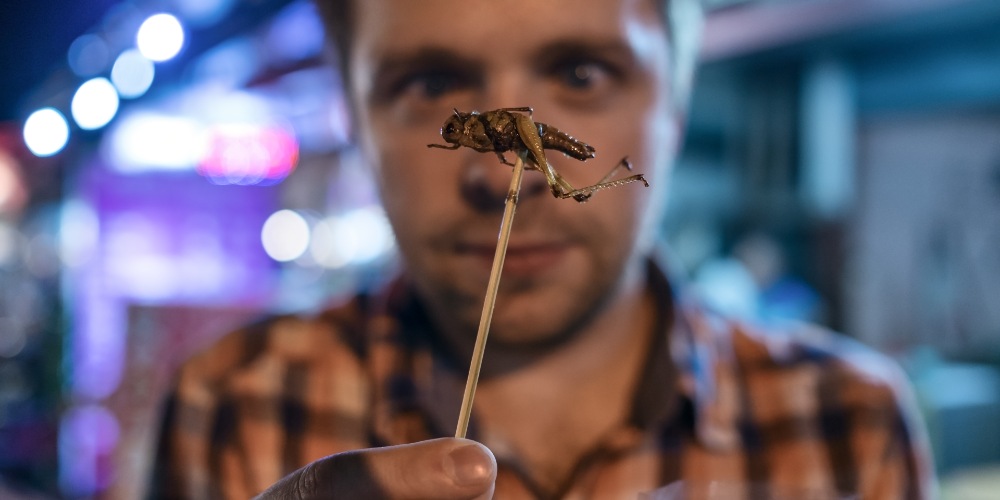
Editor’s Note: I will not be eating bugs. I will not stand in a breadline. I refuse to participate in the totalitarianism that appears to be spreading across the globe and that may be coming to America in the not-too-distant future. This is why we strongly recommend three different long-term storage food companies. These wonderful sponsors can help you avoid the crickets for protein and refrain from becoming beholden to government to survive. Here’s the article by Birsen Filip…
Coercive covid-19 lockdown measures, vaccine mandates, the transition to green energy, and poorly thought out Western sanctions against Russia have all played significant roles in disrupting global food markets and supply chains. In May 2022, data from the UN Food and Agriculture Organization indicated that, relative to twelve months ago, “international wheat prices have increased 56 percent,” “cereal prices are up nearly 30 percent,” and “vegetable oils are 45 percent higher.”

The World Bank expects many people to be pushed into extreme poverty and to experience food insecurity on account of higher prices for both food and farm inputs, particularly in nations that import most of their needs in these areas. More specifically, it notes that “the war in Ukraine has altered global patterns of trade, production, and consumption of commodities in ways that will keep prices at historically high levels through the end of 2024 exacerbating food insecurity and inflation.”
Meanwhile, Bayer, “an international chemicals, agricultural and healthcare group,” projects that “food insecurity will affect up to 1.9 billion people by November 2022—mainly caused by the war in Ukraine and further accelerated by climate change and COVID-19,” which could possibly lead to a “hurricane of hunger.”
In May, the World Economic Forum (WEF) issued a press release stating that “there is a risk that short-term efforts to combat food shortages could come at the expense of meeting climate and sustainability targets given the interconnection between agriculture and climate change. Global food production contributes more than a third of greenhouse gas emissions, and efforts to ramp up food supply could worsen emissions and reliance on fossil fuels.”
The WEF does not support efforts to find immediate solutions to the current food crisis; rather, it is focusing on making radical changes to food production and human beings’ consumption habits over the coming decades. In 2018, the WEF pointed out that
feeding the world in 2050 will require a 70 percent increase in overall food production because of population growth and changes in consumption driven by an expanding middle class, with demand for red meat and dairy products increasing by up to 80 percent. Every opportunity presented by the Fourth Industrial Revolution must be used to realize a global food production system that can address challenges with limited environmental impact.
That shows that transforming the food industry was already among the main items on the WEF’s agenda prior to the emergence of covid-19 and the outbreak of hostilities in Ukraine. This became further apparent in June 2020, only three months after the pandemic was declared and well before there were any indications of an impending food crisis: the WEF webpage already stated that “COVID-19 reveals a strong and urgent need for representatives of all sectors of the economy to come together and engage in a dialogue to plan what a post-pandemic food system will look like.”
The WEF has expressed its commitment to “helping define the agriculture industry agenda” and is calling for a transition to new alternatives to help “feed an expanding populace,” such as “Impossible Foods, Just and Beyond Meat,” all of which are “plant-based products” that attempt to imitate “the sensory profile of meat.” It is also promoting the greater utilization of “cultured meat” produced in laboratories.
More precisely, the WEF envisages “the use of biotechnologies to engineer tissues from cell culture for end-product application, such as meat, or the use of cells/microorganisms as a ‘factory’ to produce fats and/or proteins that make up an end food product, such as eggs and milk.” Additionally, it supports the use of “a technique that enables scientists to hack into genomes, make precise incisions, and insert desired traits into plants.”
The WEF is also promoting edible insects, including ants, bees, beetles, caterpillars, crickets, dragonflies, grasshoppers, earthworms, leafhoppers, termites, and locusts, as an alternative food source that would consume “fewer resources than traditional livestock” and emit “less harmful gas than more mainstream farm animals.” In 2018, the WEF stated that “from the farmer’s point of view, raising insects is going to be radically different from raising sheep, pigs, or cattle,” as there will be “no more coping with mud, muck and filth.” Meanwhile, the “consumption of insects can offset climate change” by reducing people’s “carbon footprint in food consumption.”
To encourage people to accept insects in their daily diets, the WEF has been promoting some of their nutritional benefits and other features. For example, it claims that eating “grasshoppers” will provide “nearly as much protein, more calcium and iron, and less fat than the equivalent amount of ground beef.” Furthermore, the WEF highlights “insects such as the Tenebrio Molitor” because its “high protein content makes it a highly digestible ingredient that can be used in senior nutrition.” Advocates of edible insects also claim that putting cockroaches on “fruits and vegetables” creates a very good “taste,” while blackflies, which are “rich in fatty acids to the same extent as in some fish oils,” can replace “blood sausage.”
The World Bank largely concurs with the WEF when it comes to the mass production and consumption of edible insects, arguing that insect farming, “for both human food and animal feed, ha[s] the potential to increase access to nutritious food, while creating millions of jobs, improving the climate and the environment, and strengthening national economies.”
The Food and Agriculture Organization of the United Nations also touts edible insects’ benefits, stating:

Edible insects contain high quality protein, vitamins and amino acids for humans. Insects have a high food conversion rate, e.g., crickets need six times less feed than cattle, four times less than sheep, and twice less than pigs and broiler chickens to produce the same amount of protein. Besides, they emit less greenhouse gases and ammonia than conventional livestock. Insects can be grown on organic waste. Therefore, insects are a potential source for conventional production (mini-livestock) of protein, either for direct human consumption, or indirectly in recomposed foods (with extracted protein from insects); and as a protein source into feedstock mixtures.
Moreover, the International Platform of Insects for Food and Feed (IPIFF), which currently has eighty-three members from twenty-three different countries, was established in 2012 to represent “the interests of the insect production sector towards EU policy makers, European stakeholders and citizens.” In particular, it promotes “the use of insects for human consumption and insect-derived products as a top tier source of nutrients for animal feed.”
The IPIFF pointed out that while “more than 2,000 insect species are consumed worldwide,” only seven species are “used in animal feed” and only about “a dozen are allowed in food” in “certain” members of the European Union. Accordingly, this organization is seeking to increase the variety and quantity of insects consumed in Europe and around the world.
Supporters of the mass production and consumption of alternative food products are fully aware that coercing the world population into accepting this dystopian transformation of the food industry will likely destroy the livelihoods of billions of people who are dependent on conventional farming, which will lead to unprecedented poverty, desperation, misery, and starvation, particularly among the lower and middle classes. Furthermore, they also realize that people are not going to voluntarily make such drastic changes to their food and eating habits, which are often tied to their heritage and traditions.
In 2019, the WEF acknowledged that there is a “unique emotional and cultural politics of food, particularly of meat,” which means that successfully transforming the food system will likely necessitate some degree of force, the censorship of dissenters, and the creation of a narrative that will be pushed by the corporate media, unelected experts, and corrupt politicians in order to make alternative food products appear more palatable.
Accordingly, it is calling for “coordinated public-private efforts and intergovernmental engagement” over the next decade to “develop and own” “a global narrative on the protein transition” so as to “overcome the critical cultural and emotional barriers that may stand in the way of a holistic transformation.” Clearly, the WEF does not have faith in individual or collective solutions when it comes to people feeding themselves, their families, and their communities going forward. It signaled this in 2019, when it stated that

a reliance on the market or a hope that individual technologies, unconnected projects, or even financing or policy innovations will cause a global breakthrough—even collectively—are perhaps optimistic. These will likely not be enough to create the scale or speed required to provide universally accessible and affordable, healthy and sustainable protein … by 2030.
If successful, the dystopian transformation of the food industry will interfere with or eliminate many different groups’ and societies’ distinct cultural and traditional practices by imposing abhorrent food alternatives. Throughout history, food, meals, and harvests have been important aspects of cultural heritage in virtually every society, bringing families and communities together. In fact, many meals and ingredients have historical, national, seasonal, and religious significance for different communities.
Traditional practices and activities, including rituals, ceremonies, festivals (e.g., springtime festival, harvest festival, winter carnival, Oktoberfest, Mardi Gras), holidays (e.g., Christmas, Eid, the Passover Seder, Hanukkah, New Year’s Eve, Diwali, Easter), and other special events (e.g., engagements, weddings, birthdays, anniversaries, potlucks), which often involve preparing and sharing meals with family, friends, and other members of the community, have also played significant roles in conveying culture, traditions, and distinct identities from one generation to the next.
People that truly care about concepts like diversity, inclusion, and equity, which are often used and abused by woke ideologues and globalist social engineers in order to advance their agendas, should not ignore the fact that food is an important aspect of cultural diversity. In fact, efforts to drastically change the entire food industry can be viewed as direct and violent attacks on the cultural, religious, and national practices of distinct groups across the globe.
Image via Shutterstock. Article cross-posted from Mises.

Two Storms, One Harvest

Every food crisis in living memory has been a one-shock event. The 2008 price spike was a commodity bubble. The 2020 shortages were a logistics failure. The 2022 grain scare was a war on one exporter’s ports. Each time, the system bent, adjusted, and recovered, and each time the experts assured us afterward that global markets are simply too big and too diversified to fail.
What nobody in Washington seems eager to discuss is that 2026 is shaping up to be something the modern food system has never actually faced. Two independent shocks, one climatic and one geopolitical, are converging on the same harvest cycle at the same time. Not sequentially. Simultaneously.
Start with the weather. The Pacific Ocean is currently building toward what forecasters now openly call a record event. NOAA’s Climate Prediction Center puts the odds of at least a strong El Niño near 88 percent, with roughly two in three odds it reaches “very strong” status, the tier reserved for perhaps three or four events in the entire satellite era. Every major global model now projects a median peak in Super El Niño territory, and most of them project it exceeding the 2015-16 event, which until now held the modern record. Sea surface anomalies were already brushing the super threshold in mid-July, months before these events normally peak. The atmosphere has already shifted into El Niño mode, and the event is forecast to crest in late fall and early winter.
This is not about “climate change.” It’s about the standard cycles of weather, and the cycle we’re currently in is one that has likely devastated societies in the past. We’re better prepared as a society today, but not all Americans are equally prepared.
Serious households have started doing the quiet math on their own. Grocery bills tell part of the story, and the forecast maps tell the rest, which is why long-term food storage has moved from fringe hobby to mainstream line item in the family budget, with established suppliers like Heaven’s Harvest seeing demand from people who five years ago would have rolled their eyes at the idea. That instinct is not paranoia. It is pattern recognition, and the pattern is worth walking through carefully.
Editor’s Note: Heaven’s Harvest IS a sponsor, but the warnings of this article are real and would be written even if we didn’t have a survival food sponsor. With that said, those who take advantage of what they offer can use promo code “Patriot” for 15% off.
The Fertilizer Clock Is Already Running
While the Pacific warms, the second shock has been unfolding in the Strait of Hormuz. The conflict with Iran turned the world’s most important energy chokepoint into a contested waterway, and the consequences reach far beyond the gas pump. Roughly a third of global fertilizer trade moves through Hormuz, and the disruption sent urea prices up 86 percent year over year by March, with a 53 percent jump in a single month.
The World Bank projects energy prices rising about 24 percent in 2026 and fertilizer about 31 percent. By its own accounting, fertilizer prices ran 35 percent higher in the first five months of this year than the same period last year.
Here is the mechanism the nightly news will not explain. Fertilizer is not a grocery item. It is a time-delayed input. The nitrogen a farmer in Iowa or Punjab could not afford to apply this spring does not show up as a problem this spring. It shows up as a thinner harvest six to twelve months later.
The World Bank’s own food security brief concedes that the effects of reduced applications earlier this season “are likely to become visible only later in harvest outcomes.” Translate that from institutional language into plain English and it means this. The damage is already done, it is already in the ground, and we are simply waiting for it to arrive on the shelf.
Now check the calendar. Six to twelve months from the spring planting season lands us squarely in late 2026 and early 2027. Which is precisely when the strongest El Niño in the instrumental record is forecast to peak, bringing its signature droughts to Southeast Asia, Australia, southern Africa, northern Brazil, and South Asia, the very regions that grow the world’s rice, sugar, and oilseeds.
The World Bank warns openly that a strong El Niño “could disrupt multiple crop belts simultaneously” on top of the conflict-driven input costs. Their baseline projection assumes the Middle East disruptions ease by autumn. What in the last two years of Middle East history suggests that assumption is safe?
The System Has No Slack Left
The comfortable answer is that global markets always adjust. But adjustment requires slack, and the slack is gone. Global cereal production is expected to decline from last year’s records even before El Niño does its work. The UN World Food Programme, hardly a den of right-wing preppers, is calling this the most significant disruption to its supply chains since Covid and the invasion of Ukraine, and its supply chain director put the stakes bluntly.
Today’s supply chain challenges are tomorrow’s hunger crisis.
There is also a political dimension that markets cannot price. When food gets scarce, governments do not behave like economists. They behave like politicians. Export bans, hoarding mandates, and panic buying at the national level turned the modest rice shortfall of 2008 into a global crisis, and analysts are already warning that import-dependent nations are the first dominoes.
The 2015-16 Super El Niño, a far weaker event than what is now forecast, threw tens of millions into food stress across Africa and Asia. This one is projected to be stronger, and it arrives with fertilizer already rationed by price and shipping lanes already contested by missiles.
What Joseph Knew
Scripture does not treat preparation for lean years as faithlessness. It treats it as wisdom delivered in advance to those willing to act on it.
Behold, there come seven years of great plenty throughout all the land of Egypt: And there shall arise after them seven years of famine; and all the plenty shall be forgotten in the land of Egypt.
Joseph did not respond to that warning with a hashtag or a committee. He stored grain during the years of abundance, and when the famine came, Egypt stood while its neighbors begged. The lesson is not that famine is certain. It is that the time to prepare is precisely when preparation still looks optional.
Nobody who filled a pantry in a year of plenty has ever regretted it, and nobody standing in an empty aisle has ever been glad he waited for certainty.
None of this calls for panic, and panic is the enemy of sound judgment anyway. It calls for the same unglamorous prudence our grandparents considered ordinary. Keep some cash margin, know your local growers, and put real food in deep storage while it is cheap and available, because the entire arc of this story is that cheap and available is a closing window.
Families looking for a straightforward place to start can visit Heaven’s Harvest and use promo code Patriot for 15 percent off long-term storable food. The forecasts may yet soften, the strait may yet reopen, and we should pray they do. But hope is a fine thing to hold and a foolish thing to eat.
