

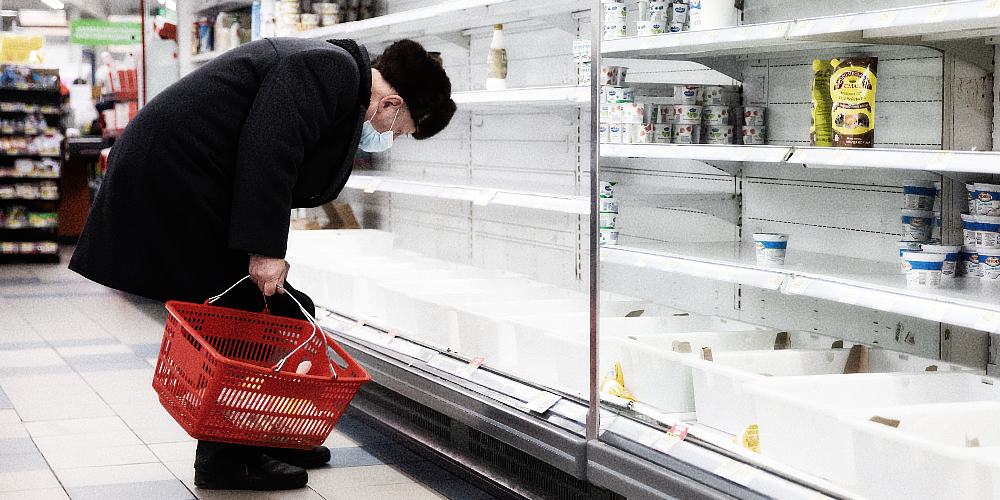
(WND)—Of all the crazy agendas hitting the news in the last few years, one of the most insane is the war on food. You’d think, since everyone needs to eat, this critical component of human existence would be exempt from bureaucratic oversight; but no. Instead, we’re being led to believe that food production is somehow evil and must be scaled back for the good of the planet. After all, control the food and you control the people.
The battle starts with how food is cooked. We’re all familiar with the government’s war on gas stoves, one of the most popular methods for cooking food. Knowing full well that outright bans won’t work, the Biden administration is rolling out increased “efficiency” standards for new models that are effectively impossible to achieve. The push is to electrify everything, despite the increased strain this agenda places on an already fragile grid.
Now it’s being hinted that cooking food itself is bad. According to the National Oceanic and Atmospheric Administration (NOAA), a quarter of all air pollution comes from cooking food. “If you can smell it, there’s a good chance it’s impacting air quality,” we’re told. At fault are “primarily oxygenated VOCs, or volatile organic compounds.” It’s not farfetched to conclude that if a government agency says something is impacting air quality, then soon it will be under tighter regulation. “[B]ased on the new findings, cooking emissions could be the single largest missing source of urban VOCs in current air quality models, which could have important ramifications for air quality management,” notes the article.
Let’s consider the plethora of mysterious disasters impacting food production facilities. The latest is a fire at one of the nation’s largest free-range egg facilities that killed millions of chickens. But this is just one of a long, long, long list of similar disasters that are destroying, one by one, the business of feeding humans.
Now, of course, we’re dealing with the whole avian flu panic, in which millions upon millions of chickens are being destroyed on the basis of questionable testing methodologies. Right now the news headlines focus on commercial facilities; what’s less well-known is that backyard flocks are also being tested. We all know where this will lead. Already in the U.K., all chicken owners will soon be forced to register with the government or face up to six months in prison or a £5,000 fine. The state of Maryland also requires poultry registration. And in Wisconsin, if you own poultry or other livestock, you must register your land.
Of course, the potential for bird flu leaping to cows is putting the dairy industry in the crosshairs at a time when America’s dairy cow replacement inventory is at a two-decade low.
Even home-grown food is not exempt. Most people are familiar with Pennsylvania’s vicious war against Amish farmer Amos Miller for the crime of selling fresh food to eager customers. Attorney Robert Barnes sums it up succinctly: “Let me explain what the #AmosMiller case is about after a court conference. The @PAAgriculture claims ALL food is ‘illegal’ – as illegal as illegal drugs – unless it was made by a government-approved facility, and they can destroy it at will.”
But don’t think your backyard gardens are immune. A Guardian piece entitled “Carbon footprint of homegrown food five times greater than those grown conventionally” strives to conclude that backyard gardens are bad for the planet, and suggests farming should be left to the professionals.
Additionally, a couple years ago, “experts” at the University Medical Center Mainz in Germany suddenly issued an “urgent” warning that gardening can cause heart disease by exposing people to harmful soil pollutants.
According to The Sun, “Gardeners have been warned that their habit could leave them at an increased risk of heart disease. Medics found that pollutants in the soil could have a ‘detrimental effect on the cardiovascular system.’ The results of the analysis pushed experts to recommend that people wear a face mask, if they are in close contact with the soil. Experts at the University Medical Center Mainz, Germany said pollution of air, water and soil is responsible for at least nine million deaths each year. They highlighted that more than 60 per cent of pollution-related deaths are due to heart issues such as strokes, heart attacks, heart rhythm disorders and chronic ischaemic heart disease.”
In fact, Europe has spent the last few years embroiled in violent protests against increased government regulations that were putting farmers out of business. The Netherlands planned to “compulsory purchase” and close up to 3,000 farms to comply with EU environmental rules. Ireland is set on cutting its dairy herds by 10%, meaning about 200,000 cows will be culled for no other reason that cow farts are bad for the environment.
And who can forget the disastrous collapse of Sri Lankan agriculture after the government forcibly scaled back the use of non-organic fertilizer?
To top it off, did you know the United Nations is working with banks to destroy the American farming industry? Their method is to impose ESG (environmental, social, and corporate governance) criteria to score and penalize farmers. The U.N.-organized Net-Zero Banking Alliance is demanding net-zero greenhouse gas emissions in agriculture. Farmers who can’t or won’t comply are being de-banked by having their accounts shut down without notice or explanation.
And on and on it goes: headline after headline after headline. Agriculture, in which humans have been engaged for thousands of years, is now being deemed dangerous and wrong in the eyes of well-fed bureaucratic idiots who are determined to make food unaffordable and/or unavailable for the huge majority of the global population who aren’t wealthy. Oh, and if the U.N. has its way, anyone who criticizes the anti-human agenda will be silenced.

But that’s OK. The vast majority of the global population is, in the eyes of the elites, useless eaters anyway. The sooner they are removed from the picture – by whatever means possible – the better they’ll like it. If this isn’t the epitome of evil, I don’t know what is.
Should the majority of useless eaters be phased out of existence, who will serve the elites after the planet is depopulated and returned to some mythical Eden? Who will grow the food, manufacture the goods and clean the toilets for the overlords? When I posed that hypothetical question to my husband, his answer was succinct and accurate: “These are the people who would rather rule in hell than serve in heaven.”
Hell on earth may be coming a lot sooner than most people realize, if the global war on food continues. The need for food is something even the elites cannot escape.
Sound off about this article on The Liberty Daily Substack.
Content created by the WND News Center is available for re-publication without charge to any eligible news publisher that can provide a large audience. For licensing opportunities of our original content, please contact [email protected].

Two Storms, One Harvest

Every food crisis in living memory has been a one-shock event. The 2008 price spike was a commodity bubble. The 2020 shortages were a logistics failure. The 2022 grain scare was a war on one exporter’s ports. Each time, the system bent, adjusted, and recovered, and each time the experts assured us afterward that global markets are simply too big and too diversified to fail.
What nobody in Washington seems eager to discuss is that 2026 is shaping up to be something the modern food system has never actually faced. Two independent shocks, one climatic and one geopolitical, are converging on the same harvest cycle at the same time. Not sequentially. Simultaneously.
Start with the weather. The Pacific Ocean is currently building toward what forecasters now openly call a record event. NOAA’s Climate Prediction Center puts the odds of at least a strong El Niño near 88 percent, with roughly two in three odds it reaches “very strong” status, the tier reserved for perhaps three or four events in the entire satellite era. Every major global model now projects a median peak in Super El Niño territory, and most of them project it exceeding the 2015-16 event, which until now held the modern record. Sea surface anomalies were already brushing the super threshold in mid-July, months before these events normally peak. The atmosphere has already shifted into El Niño mode, and the event is forecast to crest in late fall and early winter.
This is not about “climate change.” It’s about the standard cycles of weather, and the cycle we’re currently in is one that has likely devastated societies in the past. We’re better prepared as a society today, but not all Americans are equally prepared.
Serious households have started doing the quiet math on their own. Grocery bills tell part of the story, and the forecast maps tell the rest, which is why long-term food storage has moved from fringe hobby to mainstream line item in the family budget, with established suppliers like Heaven’s Harvest seeing demand from people who five years ago would have rolled their eyes at the idea. That instinct is not paranoia. It is pattern recognition, and the pattern is worth walking through carefully.
Editor’s Note: Heaven’s Harvest IS a sponsor, but the warnings of this article are real and would be written even if we didn’t have a survival food sponsor. With that said, those who take advantage of what they offer can use promo code “Patriot” for 15% off.
The Fertilizer Clock Is Already Running
While the Pacific warms, the second shock has been unfolding in the Strait of Hormuz. The conflict with Iran turned the world’s most important energy chokepoint into a contested waterway, and the consequences reach far beyond the gas pump. Roughly a third of global fertilizer trade moves through Hormuz, and the disruption sent urea prices up 86 percent year over year by March, with a 53 percent jump in a single month.
The World Bank projects energy prices rising about 24 percent in 2026 and fertilizer about 31 percent. By its own accounting, fertilizer prices ran 35 percent higher in the first five months of this year than the same period last year.
Here is the mechanism the nightly news will not explain. Fertilizer is not a grocery item. It is a time-delayed input. The nitrogen a farmer in Iowa or Punjab could not afford to apply this spring does not show up as a problem this spring. It shows up as a thinner harvest six to twelve months later.
The World Bank’s own food security brief concedes that the effects of reduced applications earlier this season “are likely to become visible only later in harvest outcomes.” Translate that from institutional language into plain English and it means this. The damage is already done, it is already in the ground, and we are simply waiting for it to arrive on the shelf.
Now check the calendar. Six to twelve months from the spring planting season lands us squarely in late 2026 and early 2027. Which is precisely when the strongest El Niño in the instrumental record is forecast to peak, bringing its signature droughts to Southeast Asia, Australia, southern Africa, northern Brazil, and South Asia, the very regions that grow the world’s rice, sugar, and oilseeds.
The World Bank warns openly that a strong El Niño “could disrupt multiple crop belts simultaneously” on top of the conflict-driven input costs. Their baseline projection assumes the Middle East disruptions ease by autumn. What in the last two years of Middle East history suggests that assumption is safe?
The System Has No Slack Left
The comfortable answer is that global markets always adjust. But adjustment requires slack, and the slack is gone. Global cereal production is expected to decline from last year’s records even before El Niño does its work. The UN World Food Programme, hardly a den of right-wing preppers, is calling this the most significant disruption to its supply chains since Covid and the invasion of Ukraine, and its supply chain director put the stakes bluntly.
Today’s supply chain challenges are tomorrow’s hunger crisis.
There is also a political dimension that markets cannot price. When food gets scarce, governments do not behave like economists. They behave like politicians. Export bans, hoarding mandates, and panic buying at the national level turned the modest rice shortfall of 2008 into a global crisis, and analysts are already warning that import-dependent nations are the first dominoes.
The 2015-16 Super El Niño, a far weaker event than what is now forecast, threw tens of millions into food stress across Africa and Asia. This one is projected to be stronger, and it arrives with fertilizer already rationed by price and shipping lanes already contested by missiles.
What Joseph Knew
Scripture does not treat preparation for lean years as faithlessness. It treats it as wisdom delivered in advance to those willing to act on it.
Behold, there come seven years of great plenty throughout all the land of Egypt: And there shall arise after them seven years of famine; and all the plenty shall be forgotten in the land of Egypt.
Joseph did not respond to that warning with a hashtag or a committee. He stored grain during the years of abundance, and when the famine came, Egypt stood while its neighbors begged. The lesson is not that famine is certain. It is that the time to prepare is precisely when preparation still looks optional.
Nobody who filled a pantry in a year of plenty has ever regretted it, and nobody standing in an empty aisle has ever been glad he waited for certainty.
None of this calls for panic, and panic is the enemy of sound judgment anyway. It calls for the same unglamorous prudence our grandparents considered ordinary. Keep some cash margin, know your local growers, and put real food in deep storage while it is cheap and available, because the entire arc of this story is that cheap and available is a closing window.
Families looking for a straightforward place to start can visit Heaven’s Harvest and use promo code Patriot for 15 percent off long-term storable food. The forecasts may yet soften, the strait may yet reopen, and we should pray they do. But hope is a fine thing to hold and a foolish thing to eat.

NOAA has always been a colossal politcal op and OBSCENE JOKE!!!
Their personnel are corrupt, dishonest and lazy!
Although slightly better than the Federal Reserve lowlifes!
Tried tofollow up on a NOAA study years back★ but they disavowed all their studies and had no record of the researchers?! UNBELIEVABLE!
★ It was study stating that the sea floor of Elliott Bay off the west coast of Seattle was rising several inches every year.
Pretty cool this is from the WND site —- was banned TEN YEARS ago by them for predicting EXACTLY this!