


(End of the American Dream)—I have been repeatedly telling my readers that we are living in apocalyptic times, and when I first started saying that I think that many people out there thought that I was exaggerating, but now what is happening to us is becoming a lot more obvious. The war in the Middle East has escalated dramatically over the past week, the “Super El Niño” is causing absolutely crazy heatwaves and storms all over the planet, the Ebola outbreak in Africa is totally out of control, and we have been witnessing some very large earthquakes in Venezuela and elsewhere. I have been warning that war, famine, pestilence and natural disasters are in our future, but the truth is that the future is now. Global events have started to spiral out of control, and the chaos that we are experiencing is not going to stop.
Just a little while ago, U.S. Central Command informed the world that for a third night in a row the U.S. has begun conducting an enormous round of airstrikes in Iranian territory…
Moments after President Trump told talk show host Hugh Hewitt the U.S. would be launching more strikes against Iran, U.S. Central Command announced the U.S. began its third consecutive night of strikes.
“At 4:45 p.m. ET today, U.S. Central Command began launching the third consecutive night of strikes against Iran, at the Commander in Chief’s direction,” U.S. Central Command announced on X. “These strikes will continue imposing a heavy cost on Iranian forces and degrade their ability to attack innocent civilians and commercial shipping in the Strait of Hormuz.”
Massive explosions are being reported in multiple locations even as I write this article.
And President Trump just told Hugh Hewitt that the U.S. is even going to attack “Pickaxe Mountain” at some point…
Speaking to conservative talk host Hugh Hewitt, President Trump said the U.S. will hit Iran hard Monday and Tuesday. The president said the U.S. will “take out” Pickaxe Mountain, a deeply buried site that analysts believe could be part of Iran’s nuclear program..
“We’re going to take out Pickaxe Mountain,” he said. “Tell the Iranians to be ready. Let them know we’re coming, okay? There’s not a damn thing they can do about it.”
I have mentioned Pickaxe Mountain multiple times in recent weeks.
Many believe that Iran’s most important nuclear work goes on in that underground facility, and so far the U.S. and Israel have not been able to damage it because it is considered to be “beyond the reach of the most powerful bunker buster bombs”…
Pickaxe Mountain, located near Iran’s heavily damaged Natanz uranium enrichment facility, is a heavily fortified site that hosts two deeply buried tunnel complexes that experts assess as beyond the reach of the most powerful bunker buster bombs in the U.S. arsenal.
President Trump is signaling that the U.S. is prepared to take things to a new level.
Of course the Iranians are not just going to sit there and absorb punishment.
They have been striking back every night, and Mohammad Bagher Qalibaf just issued a very ominous warning…
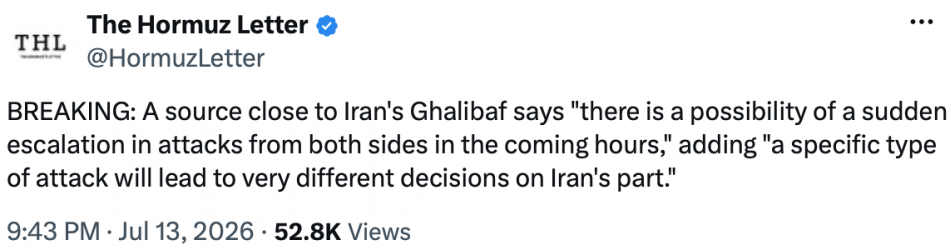
What did he mean by that?
We don’t know.
But what we do know is that the Iranians just hit two UAE tankers with cruise missiles…

The Iranians are simply not going to back down, and so things are going to get insane.
Earlier today, we learned that President Trump has notified Congress that the war with Iran is officially back on…

President Trump formally notified Congress that “military action” against Iran restarted last week, according to a letter obtained by CBS News on Monday, as a monthslong ceasefire comes to an end.
Military action “commenced on July 7,” the president said in a message dated July 10 and addressed to Republican Sen. Chuck Grassley of Iowa, the Senate’s president pro tempore.
The letter was sent after Mr. Trump declared the U.S.-Iran ceasefire “over” and ordered several rounds of strikes on Iranian targets, in response to Iranian attacks on commercial vessels in the Strait of Hormuz last week. Iranian authorities have insisted that ships seek permission and use an Iranian-approved route before transiting the strait, and responded to the U.S. strikes by launching missiles and drones at U.S.-allied Gulf states.
Iran War 3 is not going to be like Iran War 1 or Iran War 2.
In my opinion, the coming weeks will be full of shocks and surprises.
Meanwhile, yet another gigantic heat dome produced by the “Super El Niño” is frying large portions of the western half of the United States…
Roughly 100 million people across the United States are facing extreme temperatures this week as a heat dome scorching the western part of the country spreads to the Northeast.
In Billings, Montana, temperatures reached a record high of 111 degrees on Sunday as the dangerous heat was felt across the Great Basin, the Rockies and sections of the desert Southwest.
Temperatures are forecast to be 20 to 30 degrees above average for this time of year, according to CBS News meteorologist Nikki Nolan. Some locations will see record-breaking temperatures through the week.
It isn’t supposed to get up to 111 degrees in Montana.
But it just did.
This “Super El Niño” is going to do so much damage to crops all over the world, and the World Meteorological Organization is projecting that this could push global food prices higher for years…

Analysts are warning that a powerful El Niño developing in the Pacific Ocean could push up global food prices over the months and years ahead.
In early July, the World Meteorological Organization (WMO) forecast that current El Niño weather conditions would “strengthen rapidly over the coming months,” with a higher likelihood of “heatwaves, droughts, heavy rainfall and other extreme weather events in many parts of the world.” Meanwhile, the National Oceanographic and Atmospheric Administration (NOAA) last week said there was an 81 percent possibility of a “very strong” El Niño between October and December—one it said would rank “among the largest El Niño events in the historical record going back to 1950.”
Meteorologists and economists, including analysts at the World Bank, warn that such an event—dubbed by some a “super” or “Godzilla” El Niño—could disrupt global agriculture and food supply chains through next year while exacerbating the economic pressures facing countries worldwide.
Tens of millions died from starvation during the “Super El Niño” of 1877-1878.
How many will die from starvation this time around?
If health authorities are not able to get the Ebola outbreak in the Democratic Republic of the Congo under control, pestilence could claim a large number of lives during the months ahead as well.
Earlier today, we learned that another American has officially tested positive…
Another US citizen has tested positive for Ebola as part of an ongoing outbreak in the Democratic Republic of Congo (DRC).
The American was working for a humanitarian organization and was transferred to Frankfurt University Hospital in Germany on Monday, US officials said.
The CDC announced the positive test on Friday and said it is working with public health authorities and the person’s employer, which was not identified, to identify close contacts and prevent further transmission.
There is no cure for the Bundibugyo strain, and the official numbers that we are being given are going up quite rapidly…
Africa CDC Director-General Jean Kaseya, MD, MPH, said that, as of July 9, 112 healthcare workers have been infected with Ebola since the outbreak began, including 35 who died. The outbreak now stands at 1,947 cases, and 704 deaths, with the vast majority of those in the DRC.
As I noted on Friday, many experts are convinced that the official numbers are seriously understating the severity of this outbreak.
I have shared this before, but I am going to share it again. It is being reported that approximately four out of every five new Ebola cases in the DRC “have no known link to existing patients”…
Four out of every five new Ebola cases in parts of Democratic Republic of Congo have no known link to existing patients, a senior World Health Organization official said, warning that the true scale of the outbreak could be two to four times larger than official data suggest.
The figures underscore the challenges facing health workers as they battle to contain the outbreak in the country’s northeast, which has so far infected 1,792 people and killed 625, according to government data released on Thursday.
The vast majority of the new cases that are popping up have no connection to the existing cases that authorities already know about.
That is a major league red flag.
And once someone gets infected, there is a very good chance that they will die.
Lastly, I wanted to point out two very alarming earthquakes that we just witnessed in Southern California…
A second significant earthquake has struck Southern California in two days, along a dangerous fault line that one expert claims has now been ‘unlocked’ and could soon unleash ‘The Big One.’
A magnitude 4.3 quake struck less than 90 miles from Los Angeles at 12.40pm ET (9.40am local) on Monday, according to the US Geological Survey (USGS).
It struck less than 24 hours after a magnitude 4.1 tremor erupted along the same fault line that a California geophysicist says is long overdue for a massive and devastating quake – the Garlock Fault.
The ground is shaking.
But are local residents paying attention?
Sunday’s quake happened at a location where the Garlock Fault meets the San Andreas Fault.
According to geophysicist Stefan Burns, this was the largest earthquake at that particular junction in 26 years…
The Garlock is a major east-west fault in Southern California, while the San Andreas is an 800-mile-long fracture running from Southern California north through the Bay Area and into the Pacific Ocean.
Burns warned that the earthquake struck exactly where these two faults meet, in an area that has not seen a quake this strong in more than 26 years.
According to the scientist, this small event at the junction could be an early sign that underground stress is building and the Garlock may play a role in the next major California earthquake – which many call ‘The Big One.’
As I keep pointing out, scientists have repeatedly warned us that “the Big One” is way overdue.
It is just a matter of time before it strikes, and once that day arrives life in Southern California will never be the same again.
Sadly, many will ignore the warnings until it is too late.
Even though so many historic events are happening all around us, I am seeing so much apathy out there right now.
20 years ago we weren’t being hit by crisis after crisis, but that is considered to be “normal” in 2026.
We really are in the midst of a “perfect storm” in which we are being hammered by one problem after another, and this “perfect storm” is only going to intensify in the months ahead.
Michael’s new book entitled “10 Prophetic Events That Are Coming Next” is available in paperback and for the Kindle on Amazon.com, and you can subscribe to his Substack newsletter at michaeltsnyder.substack.com.

Starting the Day With a Scripture-Inspired Roast Helps Center Your Thoughts on Eternal Truths Amid Temporal Pressures
The world can seem chaotic, especially right after we wake up. Many believers start their mornings reaching for something familiar — a hot cup of coffee — yet end up settling for mediocre brews that do little more than deliver a caffeine jolt. The daily grind of life, with its endless distractions, news cycles, and responsibilities, can leave even the most faithful feeling spiritually parched alongside their physical fatigue. What if your morning ritual could do more than wake you up? What if it could ground you in truth, nourish your body with exceptional quality, and quietly advance a kingdom purpose at the same time?
That’s the promise — and the reality — behind Promised Grounds Coffee. This Christian-founded company doesn’t just roast beans; it approaches every step as an act of worship and discipleship. By selecting only the top 10% of specialty-grade beans, ethically sourced from dedicated farmers in Central and South America, and small-batch roasting them with reverence in Austin, Texas, Promised Grounds delivers what many describe as the best coffee available — never burnt, never bland, but rich with origin stories and layered flavors that honor God’s creation.
From the vibrant Psalm 27 Roast (a light, bright medium option) to the bold yet peaceful 2 Timothy 1:7 Decaf, each bag carries a Scripture verse that turns your daily pour into a gentle reminder of faith. And through their Ounce Per Ounce Promise, every ounce of coffee you enjoy provides an equal ounce of clean water to families in need via partnership with Filter of Hope — literally brewing hope for body and soul, one cup at a time.
The challenge for today’s Christians runs deeper than finding a decent cup. In an age of convenience-driven consumerism, it’s easy to support companies that dilute values or remain silent on matters of faith. Many believers want their everyday choices — from what they drink to how they spend — to reflect discipleship rather than just convenience. Promised Grounds solves this by weaving Christian excellence into the entire process: beans nurtured with prayerful stewardship by farming families, roasted as an offering rather than a commodity, and packaged with Bible verses to encourage a mindset of gratitude and purpose from the first sip. Reviewers consistently praise the smooth, rich profiles — whether enjoyed black in a drip maker, iced on a warm day, or shared in fellowship — noting how the quality stands toe-to-toe with premium secular brands while delivering something far more meaningful.
This integration of faith and flavor addresses a real need in Christian households and ministries. Busy parents, church leaders, and remote workers alike report that starting the day with a Scripture-inspired roast helps center their thoughts on eternal truths amid temporal pressures. The coffee’s exceptional character — bright citrus notes in lighter roasts or deep chocolate undertones in bolder ones — comes from meticulous selection and careful roasting that respects the bean’s natural gifts rather than masking them. It’s the kind of coffee that elevates a simple quiet time, fuels productive workdays, or sparks meaningful conversations when shared at Bible studies or outreach events. And because it’s ethically sourced with integrity, every purchase supports sustainable livelihoods for farmers who treat their crops like family harvests.
For those leading churches or small groups, the impact multiplies. Promised Grounds offers bundles and options perfect for hospitality ministries, turning ordinary coffee service into an opportunity to point people toward the living water of Christ. Imagine greeting visitors with a warm cup whose very bag carries God’s Word — a subtle yet powerful witness that aligns with the Great Commission. The company’s Texas roots and commitment to “brewing hope” resonate especially with believers who value American enterprise paired with global compassion.
Of course, quality alone isn’t enough if the experience feels out of reach. Promised Grounds keeps it accessible with practical perks like free shipping on orders over $40, sample sets for discovering favorites, and thoughtful add-ons such as faith-themed mugs. Whether you prefer whole beans for fresh grinding, grounds for convenience, or even bulk options for larger households and ministries, the result is consistently superior coffee that makes discipleship feel integrated rather than added on.
As you consider how to align even the smallest habits with your walk with God, Promised Grounds Coffee stands out as a refreshing solution. It tackles the dual problems of subpar daily sustenance and disconnected consumption by offering a product that genuinely excels in taste while advancing a mission of clean water, farmer dignity, and scriptural encouragement. Believers who make the switch often describe it as more than a beverage upgrade — it becomes part of their rhythm of gratitude, a daily invitation to remember that every good gift comes from above.
If you’re ready to transform your mornings (and perhaps your church gatherings) with coffee that honors both exceptional craftsmanship and Christian values, I encourage you to explore what Promised Grounds has to offer. One sip at a time, you’ll be nourishing your body, refreshing your spirit, and participating in something far greater — all while enjoying what truly is among the best coffee available.
