

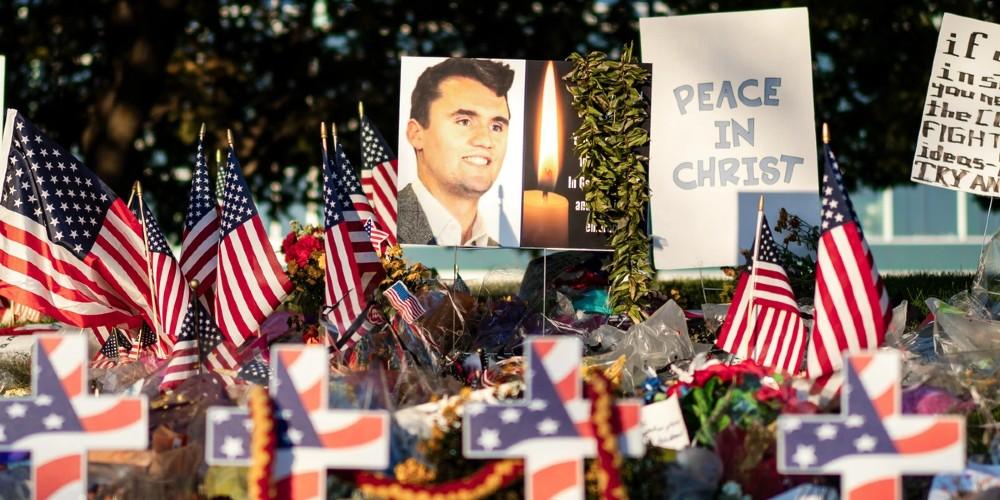
(The Epoch Times)—As he spoke in front of 3,000 people on a college campus, Charlie Kirk invited critics to challenge him face-to-face—something he had done countless times with his signature “prove-me-wrong” debates.
Then a fatal shot struck him in the neck. Graphic videos of that moment spread rapidly to millions of online viewers.
All of a sudden, people who had never heard the name “Charlie Kirk” were wondering who he was, why he became the target of a public assassination, and why his death sparked such intense reactions.
Hateful remarks celebrating Kirk’s violent end led to firings or disciplinary action against more than 600 people across America, including professors and others in public-facing positions.
In contrast, glowing tributes came from many world leaders, including U.S. President Donald Trump, and people familiar with the conservative youth movement that Kirk founded, Turning Point USA (TPUSA).
The organization, which burgeoned in the wake of Kirk’s death, will hold a “night of remembrance” at Utah Valley University on Sept. 10, the first anniversary of his slaying there.
The aftereffects of Kirk’s assassination continue to ripple beyond his organization.
His death forced political violence into the national conversation and inspired lawmakers to propose dozens of ways to honor him, ranging from bolstering free speech to establishing memorial highways.
It also touched off “a wave of Christian revival that spread far beyond the United States, igniting prayer gatherings, worship events, and renewed faith commitments,” a TPUSA tribute to Kirk states, commending him for “a life that emboldened young people, challenged cultural norms, and called a generation to courage.”
TPUSA spokesman Andrew Kolvet, who worked with Kirk at the organization for eight years, said, “I absolutely believe that Charlie’s legacy has probably not nearly been written yet.”
The ultimate impact might take decades to play out—longer than the 31 years Kirk lived, Kolvet and others told The Epoch Times.
Impact Reverberates
For many, Kirk’s death became the modern-day equivalent of the 1963 assassination of U.S. President John F. Kennedy—an unforgettable moment of intense personal and national significance.
“It was traumatic, I think, for the entire country—of all ages, but really for Gen Z and millennials,” Kolvet said. Those groups born after 1981 grew up watching Kirk’s videos on the internet, logging billions of views.
“After his death, it was almost like round two,” Kolvet said. “Everybody rediscovered all the videos again—and a wider audience did.”

Through debates and public speeches since early adulthood, Kirk became a driving force in U.S. politics. He was credited with lassoing young voters for Trump’s election wins in 2016 and 2024. He also had contact with foreign leaders, such as Israeli Prime Minister Benjamin Netanyahu.
His regular themes were faith in Jesus Christ, advocacy for traditional marriages and parenthood, and his belief that America is the greatest nation to ever exist.
But Kirk’s blunt declarations about race, gender, and politics also stoked controversy. Defenders say Kirk debated passionately but civilly, and they alleged that some critics misconstrued his remarks.
Challenges loom for those continuing Kirk’s crusade. High on their list is building TPUSA further and educating younger voters about the dangers of socialism.
At the same time, pursuing justice and the truth about Kirk’s assassination have become part of the organization’s mission, too, Kolvet said.
TPUSA tries to ignore the conspiracy theories that still swirl, he said, dismissing those as “distractions.” But questions, as well as wild speculation, continue to be raised with each stage of the criminal case against alleged gunman Tyler Robinson.

U.S. Vice President JD Vance, a friend of Kirk, said during an Aug. 20 podcast that it “enrages” him when people make accusations implicating people close to Kirk such as his widow, who now heads TPUSA.
Prosecutors allege that Robinson, 23, assassinated Kirk over political differences. Yet Kirk had once stated: “We heal our divides by talking to people we disagree with. … You heal the country when you allow disagreement.”
Turning Point Surges
Within weeks of Kirk’s slaying, 120,000 students inquired about starting a new Turning Point chapter, according to TPUSA.
Following that initial surge, growth has continued at a more manageable rate, Kolvet said, while still tallying large increases.
TPUSA reported a 300 percent jump in church partnerships, a 200 percent increase in Club America groups at high schools, and 64 percent more college chapters, he said.
More than 3,500 schools are represented, according to the group’s website.
A TPUSA women’s gathering drew 3,000 attendees to San Antonio in June.
The next month, a chapter leadership gathering in Washington attracted 2,500 young people. That was double the previous year’s total, Kolvet said, noting that two-thirds of those participants became involved with TPUSA after Kirk’s death.
More than 1,200 employees and 1 million donors—95 percent of whom gave $1,000 or less—support the group’s activities, he said.
Kolvet cited other indirect trends that could reflect Kirk’s influence: surges in church attendance, baptisms, and Bible sales.
And across the nation, young people emulating Kirk’s “happy warrior” style sometimes make headlines. In Indiana, an angry woman confronted a 17-year-old girl who was sitting at a TPUSA table and handing out plain red, white, and blue bracelets.
Despite the woman hurling profanity and insults, the teen didn’t back down.
“There’s story after story like that,” Kolvet said. “It’s really inspiring. … That’s an amazing legacy that just continues rolling on.”
‘Loudmouths’ Quieter on College Campus
Extreme political rhetoric against Kirk—such as advocating violence or cheering Kirk’s demise—has been trending down, two academics told The Epoch Times last month.
Jeff Bloodworth, an American political history professor at Pennsylvania’s Gannon University, said, “I call them ‘loudmouths,’ the people who were celebrating what happened.”
But over the past year, they’ve become quieter—likely because they feared for their jobs or were re-evaluating how they were behaving, he said.
“I think it made a lot of people kind of look in the mirror and kind of think, ‘Gosh, is this really who we want to be?’” he said.
America has a “very competitive and rambunctious” political history that sometimes has turned violent, the professor noted.
“And so, sadly, what happened to Charlie Kirk is not an aberration … and we see this regularly in American life,” in waves that ebb and flow, he said.
But one thing distinguishes the current political environment.
“We have social media, which gives millions of people the ability to comment about this instantaneously,” Bloodworth said, “and I think that’s what kind of added to the rancor.”
Social media can distort reality, but it also provides an unfiltered and sometimes ugly glimpse of people’s “thought bubbles,” he said.
Many people who once posted extreme comments have been subject to disciplinary actions that followed Kirk’s death.
“You don’t get to say your most intemperate thought and broadcast it to the world without there potentially being some sort of consequence,” he said.
Bloodworth also noticed another change on campus in the wake of Kirk’s death: “We now have a Turning Point chapter on campus.” A young conservative took steps to launch it right after Kirk was slain.
Concerns as Midterms Approach
Longtime Florida political analyst Susan MacManus, a retired professor, said the aftermath of Kirk’s death did seem to “turn down the temperature” in politics—at first.
However, the atmosphere seems to be getting uglier again, she said, as the crucial Nov. 3 midterm elections approach.
All 435 U.S. House districts and 33 of the 50 Senate seats are up for grabs. Republicans now hold a slim majority in both chambers. If they lose too many races to Democrats in November, Trump’s second-term agenda could be greatly hampered.
“I’m fearful that we’re moving away from people trying to get along—and back toward the nastiness,” she said.
On one side, MacManus said, she sees people who “glorify” political violence or vitriol; on the other, people in “Kirk mode” are calling for “a more peaceful environment and dialog.”
She senses a strong commitment in the people who want to follow Kirk’s example and his “life model,” as well as his views on what constitutes good governance.
Many fans of Kirk adopted the slogan “I am Charlie,” showing that they were stepping up to fill the void left by his death.
“[They seem dedicated to] making sure that our voice is heard and that our way of doing politics is heard,” MacManus said. “And we won’t back down.”
Opposition Still Obvious
Try as they might, people who try to spread positive messaging have their work cut out for them in an election year, when inflammatory language seems to be on the rise, she said.
And TPUSA still sometimes encounters violent or disruptive opposition at its events.
At the June women’s summit in San Antonio, TPUSA’s video journalists documented police clashing with protesters outside the venue. They also reported that one person dressed like Kirk was mimicking his assassination.
Meanwhile, legislative attempts to honor Kirk have at times become political hot potatoes.
Although lawmakers in 20 states—chiefly Republicans—proposed Kirk-inspired laws, a designated “Charlie Kirk Day,” or physical memorials, many of the measures hit snags. While Democrats often joined Republicans in condemning Kirk’s assassination, they typically opposed honoring him.
Some of the proposals did succeed, such as a Kansas law allowing students to sue schools over interfering with free speech and a Tennessee law urging “the positive impacts of religion” to be taught in American history courses.
Carolina Estevez, a New Jersey psychologist, explained why pro- and anti-Kirk factions could both become more entrenched in their views.
“His death changed him from a political communicator to a political symbol, and symbols frequently last longer than arguments,” she said.
A political assassination such as Kirk’s “may increase in-group solidarity,” she said, noting that the victim may be seen as a symbol of “perceived threats” to the whole group.
Wildaliz Caro, a licensed clinical psychologist in Cherry Hill, New Jersey, said, “The continued influence of Charlie Kirk may well rely on collective memory.”
“After a leader dies, movements tend to simplify their image,” she said. “Complex individuals are now simply symbols of something much bigger: grievance, identity, or cause … supporters respond not just to what he said, but to what he has come to mean.”
As a result, the opposing factions may have an even harder time relating to each other, Caro said.
Socratic Method
However, Kirk knew how to connect with different types of people.
“Charlie was a bridge-builder with the generations,” Kolvet said. “He could speak ‘Boomer,’ but he could speak Gen Z. … He understood how to speak to donors and to the political class, but he understood how to speak to kids, too.”
Kirk decided against going to college. Instead, he schooled himself in religion, history, politics, and philosophy—forming the foundation for the way he lived and the way he approached debates.
“He created a model, a way to think about things, the way to argue through things, a way to defend our values in America, unapologetically, courageously, full-throated,” Kolvet said.
Kirk explained his methods in podcasts, including during an episode of The Charlie Kirk Show on Aug. 18, 2025—less than a month before he was killed.
A listener wanted to know how conservatives can talk to liberals without devolving into name-calling.
Kirk advised: “Always make sure they’re the ones freaking out … and use the Socratic method.”
The method is named after the ancient Greek philosopher Socrates. After a person made an assertion, he would ask questions that eventually could reveal contradictions in the responder’s own logic.
Some people will refuse to change their minds no matter what. But others who seem to be staunch can be persuaded by using the Socratic method persistently “to get toward some approximation of truth,” Kirk said.
And, Kirk said, debaters ought to remember: “You’re not just debating a person. You’re performing for the audience of everyone else. And I try to do that at our prove-me-wrong events.”
Kirk seemed to have a special ability to inspire people who were open-minded and free thinkers, Kolvet said. Those people would walk away with “a fire in [their] belly that was just so contagious.”
Opposing Spread of Socialism
Through its Pick Up the Mic initiative, TPUSA is moving its founder’s legacy forward.
“Charlie Kirk built a movement from under a tent with one table, one mic, and a line of students stepping forward to debate. Now the tent is back, and a new generation of TPUSA chapters is bringing that presence to the center of campus,” the group’s website says, calling this “free speech in action.”
Kolvet predicted that 40 years from now, the “crop of young leaders that he inspired are going to go on and do great things, and they will be the firewall for freedom that this country needs.”
Before he died, Kirk made it clear to those leaders-in-training that they must stand firm against the spread of socialism.
“We’re doing our part to tell young people that free market capitalism is the most moral, proven, and effective system,” Kolvet said. “It’s lifted more people out of poverty across the world than any other economic system has.”
In contrast, socialism leads to stagnation, despair, and seizure of private property under communist rule—the antithesis of the American bedrock of “life, liberty, and the pursuit of happiness.”
“It’s tempting to go down this other path, but it doesn’t work, and that’s the problem,” Kolvet said. “And so, we are winning that debate with our people, but there’s a lot of people that still need to be reached and still need to hear that message.”
Justice for Kirk
Another important objective for TPUSA is fighting against “Charlie Kirk trutherism”—the rejection of officials’ accounts about what happened the day he was killed.
A “cottage industry” has sprung up around that skepticism, Kolvet said.
The antidote is for the justice system to handle the alleged gunman’s case properly and in the open, he said, noting, “Getting justice for Charlie is actually really, really important for the country.”
While it’s healthy to question government, “there has to be a foundation of rule of law, of justice, of facts, evidence, logic that undergirds all of our institutions,” he said.
Pursuing justice for Kirk “feels like a battle for truth itself,” Kolvet said.
“It’s part of a larger mission of fighting for the country. … We want to make sure that we don’t lose all faith in our institutions, right?” he said.
Balancing all those considerations is challenging, but Kolvet said he believes that “God is doing a work through Charlie’s life.”
“Charlie’s life will continue to be one of the most important and pivotal expressions of God’s providential hand on this country for years to come,” he said.
“And I believe, on some level, I’m comforted by the fact that, yes, we can choose to be a part of that.”

Two Storms, One Harvest

Every food crisis in living memory has been a one-shock event. The 2008 price spike was a commodity bubble. The 2020 shortages were a logistics failure. The 2022 grain scare was a war on one exporter’s ports. Each time, the system bent, adjusted, and recovered, and each time the experts assured us afterward that global markets are simply too big and too diversified to fail.
What nobody in Washington seems eager to discuss is that 2026 is shaping up to be something the modern food system has never actually faced. Two independent shocks, one climatic and one geopolitical, are converging on the same harvest cycle at the same time. Not sequentially. Simultaneously.
Start with the weather. The Pacific Ocean is currently building toward what forecasters now openly call a record event. NOAA’s Climate Prediction Center puts the odds of at least a strong El Niño near 88 percent, with roughly two in three odds it reaches “very strong” status, the tier reserved for perhaps three or four events in the entire satellite era. Every major global model now projects a median peak in Super El Niño territory, and most of them project it exceeding the 2015-16 event, which until now held the modern record. Sea surface anomalies were already brushing the super threshold in mid-July, months before these events normally peak. The atmosphere has already shifted into El Niño mode, and the event is forecast to crest in late fall and early winter.
This is not about “climate change.” It’s about the standard cycles of weather, and the cycle we’re currently in is one that has likely devastated societies in the past. We’re better prepared as a society today, but not all Americans are equally prepared.
Serious households have started doing the quiet math on their own. Grocery bills tell part of the story, and the forecast maps tell the rest, which is why long-term food storage has moved from fringe hobby to mainstream line item in the family budget, with established suppliers like Heaven’s Harvest seeing demand from people who five years ago would have rolled their eyes at the idea. That instinct is not paranoia. It is pattern recognition, and the pattern is worth walking through carefully.
Editor’s Note: Heaven’s Harvest IS a sponsor, but the warnings of this article are real and would be written even if we didn’t have a survival food sponsor. With that said, those who take advantage of what they offer can use promo code “Patriot” for 15% off.
The Fertilizer Clock Is Already Running
While the Pacific warms, the second shock has been unfolding in the Strait of Hormuz. The conflict with Iran turned the world’s most important energy chokepoint into a contested waterway, and the consequences reach far beyond the gas pump. Roughly a third of global fertilizer trade moves through Hormuz, and the disruption sent urea prices up 86 percent year over year by March, with a 53 percent jump in a single month.
The World Bank projects energy prices rising about 24 percent in 2026 and fertilizer about 31 percent. By its own accounting, fertilizer prices ran 35 percent higher in the first five months of this year than the same period last year.
Here is the mechanism the nightly news will not explain. Fertilizer is not a grocery item. It is a time-delayed input. The nitrogen a farmer in Iowa or Punjab could not afford to apply this spring does not show up as a problem this spring. It shows up as a thinner harvest six to twelve months later.
The World Bank’s own food security brief concedes that the effects of reduced applications earlier this season “are likely to become visible only later in harvest outcomes.” Translate that from institutional language into plain English and it means this. The damage is already done, it is already in the ground, and we are simply waiting for it to arrive on the shelf.
Now check the calendar. Six to twelve months from the spring planting season lands us squarely in late 2026 and early 2027. Which is precisely when the strongest El Niño in the instrumental record is forecast to peak, bringing its signature droughts to Southeast Asia, Australia, southern Africa, northern Brazil, and South Asia, the very regions that grow the world’s rice, sugar, and oilseeds.
The World Bank warns openly that a strong El Niño “could disrupt multiple crop belts simultaneously” on top of the conflict-driven input costs. Their baseline projection assumes the Middle East disruptions ease by autumn. What in the last two years of Middle East history suggests that assumption is safe?
The System Has No Slack Left
The comfortable answer is that global markets always adjust. But adjustment requires slack, and the slack is gone. Global cereal production is expected to decline from last year’s records even before El Niño does its work. The UN World Food Programme, hardly a den of right-wing preppers, is calling this the most significant disruption to its supply chains since Covid and the invasion of Ukraine, and its supply chain director put the stakes bluntly.
Today’s supply chain challenges are tomorrow’s hunger crisis.
There is also a political dimension that markets cannot price. When food gets scarce, governments do not behave like economists. They behave like politicians. Export bans, hoarding mandates, and panic buying at the national level turned the modest rice shortfall of 2008 into a global crisis, and analysts are already warning that import-dependent nations are the first dominoes.
The 2015-16 Super El Niño, a far weaker event than what is now forecast, threw tens of millions into food stress across Africa and Asia. This one is projected to be stronger, and it arrives with fertilizer already rationed by price and shipping lanes already contested by missiles.
What Joseph Knew
Scripture does not treat preparation for lean years as faithlessness. It treats it as wisdom delivered in advance to those willing to act on it.
Behold, there come seven years of great plenty throughout all the land of Egypt: And there shall arise after them seven years of famine; and all the plenty shall be forgotten in the land of Egypt.
Joseph did not respond to that warning with a hashtag or a committee. He stored grain during the years of abundance, and when the famine came, Egypt stood while its neighbors begged. The lesson is not that famine is certain. It is that the time to prepare is precisely when preparation still looks optional.
Nobody who filled a pantry in a year of plenty has ever regretted it, and nobody standing in an empty aisle has ever been glad he waited for certainty.
None of this calls for panic, and panic is the enemy of sound judgment anyway. It calls for the same unglamorous prudence our grandparents considered ordinary. Keep some cash margin, know your local growers, and put real food in deep storage while it is cheap and available, because the entire arc of this story is that cheap and available is a closing window.
Families looking for a straightforward place to start can visit Heaven’s Harvest and use promo code Patriot for 15 percent off long-term storable food. The forecasts may yet soften, the strait may yet reopen, and we should pray they do. But hope is a fine thing to hold and a foolish thing to eat.
