

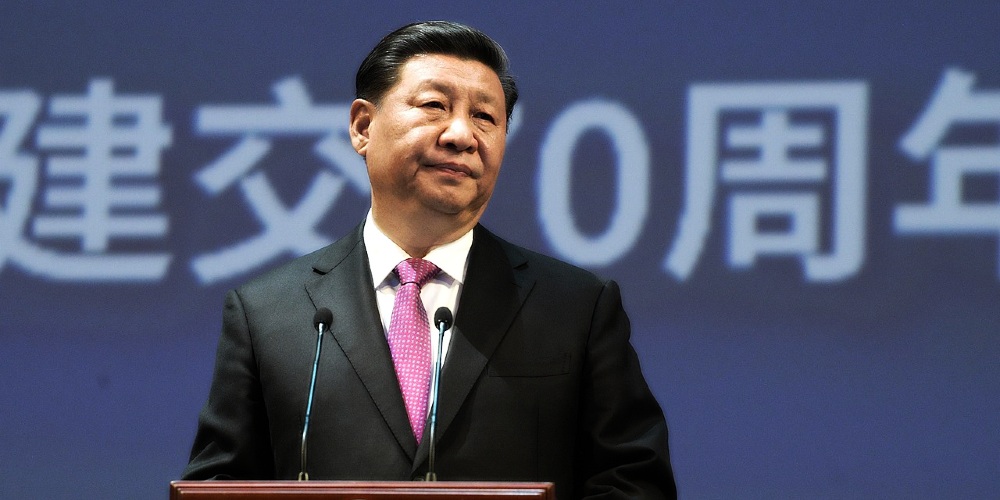
War requires deception, and nation states often project misleading signals in order to keep their adversaries off-balance. That said, the growing number of indicators suggesting that China is preparing for imminent conflict should not be ignored. China is working rapidly both to decrease its dependence on the rest of the world and to increase the rest of the world’s dependence on it. Simultaneously, China has expanded its influence in and around the United States in what appears to be a calculated campaign to disrupt any future American response to Chinese aggression across the Taiwan Strait.
Taken together, these actions should be understood as part of a sword-and-shield strategy designed to deter foreign nations from interfering with its intended conquest and capture of Taiwan.
1. Grain
Professor Edward Luttwak, a military historian and international relations strategist, says there is a dead giveaway that China is preparing for war: it is rapidly clearing forests to maximize arable land suitable for growing grains. He says the rate of clearing far exceeds the pace of the Amazon’s deforestation, even though Western environmentalists are saying nothing.
The likely reason for China’s quiet reclamation of woodland space is its current dependence upon a massive supply of imported soybeans, corn, and wheat from the United States, Canada, and elsewhere to feed its animal livestock. In order to reduce dependence on foreign adversaries during any potential conflict, local Communist Party officials have ordered peasants to use every available square yard of soil to plant cereals.
The word has even gone out to cull backyard ducks and pigs in order to minimize their consumption of grains while maximizing the available soil for crops. In an eerie reversal of Mao Zedong’s “Great Leap Forward” pivot toward rapid industrialization, Xi Jinping has issued an “all hands on deck” ultimatum to citizens demanding that they ensure China’s agrarian self-sufficiency.
2. Military Expansion
China is rapidly expanding the size and capabilities of its military. It already has the largest navy in the world and is expected to increase the total number of its naval vessels by roughly 40% over the next two decades. China is quickly growing its aircraft carrier and logistics forces and is projecting its “naval influence further from shore.”
The People’s Liberation Army has the world’s largest standing ground force with around one million active-duty personnel. China’s military spending has grown faster than its economy for over a decade and is considerably higher than every other country, aside from the United States. The U.S. Department of Defense predicts that China will quadruple its nuclear stockpile by 2030, and military observers believe China is making significant progress toward the development of hypersonic missiles — achievements that would help level the playing field in any confrontation with the United States.
According to the Pentagon’s China Military Power Report, “China is already ahead of the United States in certain areas” of military development. Playing out in the background of China’s steady advances, both the U.S. and China are engaged in an intense “arms race” to produce the world’s most advanced artificial intelligence system — the realization of which Russian President Vladimir Putin has warned will determine which nation controls global power for the next century.
3. “Green” Energy
While President Joe Biden insists that China will not invade Taiwan and his “climate czar” John Kerry praises China’s “commitments” to combatting “climate change,” some analysts warn that the Chinese Communist Party is using the West’s ideological obsession with “global warming” to discreetly prepare for war.
How so? Because China relies on foreign imports for nearly three-quarters of its oil usage, it is rapidly weaning itself from oil and natural gas. While it publicly talks about wind turbines and solar panels, though, its main alternative is coal-generated electricity. Chuck DeVore, a public policy analyst and retired U.S. Army lieutenant colonel, notes that China “now generates more than 5.3 times the amount of coal power as does the U.S. And China isn’t stopping — it’s now building or has plans to build the equivalent of the entire American coal power-plant fleet, even as we decommission our plants.”
While it is true that almost half of the world’s electric vehicles operate in China, it is also true that all those supposedly “green” EV’s are really coal-powered. Even more alarming, Chinese industry is rapidly shifting to technologies that convert coal into gasoline and lubricants, giving China an enormous advantage in withstanding any future oil blockades during a time of war. While Biden and Kerry praise China’s environmentalism, the Chinese Communist Party is increasing its energy independence and economic resilience through coal-to-liquids innovation.
4. Transport Exercises
Bradley Thayer, the Director of China Policy for the Center for Security Policy, argues that the People’s Liberation Army has already “completed two of three major military dress rehearsals required for a Chinese invasion of Taiwan.” In August 2022, Chinese armed forces simulated a joint air-missile-maritime strike campaign against Taiwan; in April 2023, China rehearsed large-scale anti-air raid drills designed to establish air supremacy over the island. Thayer expects a final dress rehearsal that includes broad amphibious landing exercises to occur over the next few months. Once completed, the PLA will have demonstrated its capacity to take Taiwan by force.
5. Russia Partnership
Ties between Russia and China have become much closer in recent years. As China seeks workarounds to importing oil from Western nations and Russia seeks workarounds to U.S.-led sanctions following its invasion of Ukraine, the two nations have partnered to increase the flow of oil and natural gas piped from Russia into China.
Their economic partnership has geopolitical strategic value. Ming Jinwei, a senior editor for China’s state press agency Xinhua, posted on his WeChat blog just after Russia’s invasion of Ukraine: “Simply put, China has to back Russia up with emotional and moral support” because “China will also need Russia’s understanding and support when wrestling with America to solve the Taiwan issue once and for all.” Russian President Vladimir Putin has said a military alliance between China and Russia is “quite possible to imagine.”

Jonathan D.T. Ward, a consultant on U.S.-China relations, concludes that “China is preparing for war with the United States and Asia, and if and when that happens, they want Russia as their partner on that date.” From Ward’s point of view, Russia and China are now united in “a joint idea of taking down the U.S.-led order.”
6. Gold Stockpiling
Over the last decade — and particularly over the last year — the People’s Bank of China has been steadily stockpiling gold, while decreasing its foreign currency reserves. While central banks around the world have been buying up gold during this period of global inflation and instability, China’s surge in holdings still stands out. The financial news site Zero Hedge has put together a revealing graph that combines Russia and China’s gold reserves and holdings of U.S. Treasuries over the last two decades.
The representation of the underlying data is stunning. Right around the time when President Barack Obama began using the international financial system as a means to sanction Russia for its military occupation of Crimea, an unmistakable split occurred. Before those imposed sanctions, China and Russia maintained relatively steady supplies of gold and U.S. Treasuries; afterwards, China and Russia began stockpiling gold and offloading U.S. securities. It seems clear that both countries have used the last decade to limit the extent that U.S.-led financial institutions can be used to constrain their future actions.
7. BRICS and SCO
The Shanghai Cooperation Organization — the largest political, economic, and security organization in the world — links China not only to Russia but also to roughly 60% of Eurasia and nearly half of the global population. BRICS (Brazil, Russia, India, China, and South Africa) — a collection of fast-growing economies that rivals the West’s G7 bloc — covers nearly 30% of global territory and half of the world’s population.
Together with Russia, China is linking both its economy and geopolitical security with the vast majority of nations comprising the Global South. One of the key concerns connecting nation states involved with both organizations is their interest in avoiding the West’s “rules-based international order.” Right now BRICS is working on a common payment system that would allow members to trade without having to rely on the U.S. dollar as a reserve currency.
China is constructing a BRICS-SCO trade bloc that will increase the pace of de-dollarization and reduce the pain of any future Western financial sanctions. Such economic integration will naturally encourage further military and intelligence cooperation, as well. Ultimately, China and Russia have set their sights on expanding BRICS+ membership across Africa, Latin America, and the Middle East. China’s own Belt and Road Initiative now encircles Latin America and the Caribbean — ensuring the Chinese Community Party’s influence right up to America’s front door. This formidable alliance poses significant challenges to the West’s post-WWII global order.

8. Youth Unemployment and Public Jingoism
China’s youth unemployment rates continue to reach new record highs. The numbers are so bad, in fact, that the Chinese Communist Party has announced that it will simply stop releasing youth unemployment figures altogether. Some analysts see this deception as evidence that China’s economy is on the “verge of collapse.” If history is any guide, when a nation is faced with increasing numbers of young males with nothing to do, unstable political regimes tend to redirect their energies away from domestic concerns and toward saber-rattling military campaigns abroad.
As Jeffrey Landsberg at Commodore Research has soberly noted: “War creates a lot of employment for a country’s youth.” It seems no coincidence, then, that “concerns of a coming war in Taiwan are intensifying at the very same time that China’s youth unemployment is surging.” When President Xi Jinping opened the Chinese Communist Party congress last year, he asserted that “complete reunification” with Taiwan “must be realized” and that China would “never promise to renounce the use of force.” His battle cries were met with boisterous applause. Through a steady diet of State propaganda, the Chinese people believe that they must fight in order to “liberate Taiwan.”
9. Hybrid Warfare against the United States
While the United States and China are not technically at war, they are engaged in a perpetual state of quiet provocations and not-so-quiet hostilities. Ever since President William Jefferson Clinton and a bipartisan U.S. Congress approved Permanent Normal Trade Relations status for China in 2000 and paved the way for its entrance into the World Trade Organization a year later, China has been engaged in a relentless campaign to plunder U.S. intellectual property, trade secrets, and innovative tech.
Through either overt control over American companies operating in China or covert espionage of American companies at home, China has systematically infiltrated America’s corporate structure in ways that the Cold War Soviet Union could have only dreamed. Combined with its placement of spies in U.S. business and government positions, China simultaneously operates an exceedingly effective cyber-hacking force dedicated to penetrating private U.S. records systems both inside and outside of government. The end result is that China has amalgamated a treasure-trove of personal information on nearly every U.S. citizen.
At the same time, China is steadily infiltrating the American homeland through both quasi-legal and illegal methods. Using shell companies as fronts, the Chinese Communist Party is in the business of “legally” acquiring precious U.S. farmland, private property near U.S. military bases and other sites with strategic value, and businesses that can be utilized to hide malicious Chinese operations on American soil. In addition to its efforts to use America’s loose property rules for its own advantage, China is also using America’s relatively open border to sneak in both Chinese men of military age and a nearly endless supply of lethal fentanyl. Whereas the latter has had the direct effect of killing tens of thousands of Americans each year from drug overdoses, the former seemingly pose a dormant threat of sabotage to America’s vulnerable infrastructure, power grid, and other utilities that can be attacked at any time.
10. Expansion into the Western Hemisphere and Appeals to Overseas Expats
In recent years, China has greatly expanded its intelligence footprint and economic influence into the Caribbean, Central America, and throughout South America. Concurrently, it has pursued a carrot-or-stick strategy against expats living inside the United States and Canada whereby secret Chinese police forces induce the cooperation of Western residents of Chinese descent by either offering financial incentives or threatening violence.
Recently, two U.S. Navy sailors were arrested for having spied on China’s behalf. One was even encouraged to assist Chinese intelligence officers because his mother believed her son’s espionage would help him secure a good job with the Chinese government in the future. These “sugar-coated bullets,” as Mao described them, have become one of China’s most effective methods for inviting subversion. Using a mixture of patriotic nostalgia for the Chinese homeland, information warfare, and outright intimidation, the Chinese Communist Party is aggressively courting and coercing Westerners to act as Chinese spies.
It is not difficult to see where all this is heading. If and when China decides to take Taiwan by force, it intends to use agents both inside the United States and within the U.S.’s larger sphere of influence to cause as much mayhem and distraction as possible. Should Xi Jinping execute a strike across the Taiwan Strait, Americans should expect concomitant civil disruptions.
Image by Kremlin.ru, CC BY 4.0, via Wikimedia Commons.

Two Storms, One Harvest

Every food crisis in living memory has been a one-shock event. The 2008 price spike was a commodity bubble. The 2020 shortages were a logistics failure. The 2022 grain scare was a war on one exporter’s ports. Each time, the system bent, adjusted, and recovered, and each time the experts assured us afterward that global markets are simply too big and too diversified to fail.
What nobody in Washington seems eager to discuss is that 2026 is shaping up to be something the modern food system has never actually faced. Two independent shocks, one climatic and one geopolitical, are converging on the same harvest cycle at the same time. Not sequentially. Simultaneously.
Start with the weather. The Pacific Ocean is currently building toward what forecasters now openly call a record event. NOAA’s Climate Prediction Center puts the odds of at least a strong El Niño near 88 percent, with roughly two in three odds it reaches “very strong” status, the tier reserved for perhaps three or four events in the entire satellite era. Every major global model now projects a median peak in Super El Niño territory, and most of them project it exceeding the 2015-16 event, which until now held the modern record. Sea surface anomalies were already brushing the super threshold in mid-July, months before these events normally peak. The atmosphere has already shifted into El Niño mode, and the event is forecast to crest in late fall and early winter.
This is not about “climate change.” It’s about the standard cycles of weather, and the cycle we’re currently in is one that has likely devastated societies in the past. We’re better prepared as a society today, but not all Americans are equally prepared.
Serious households have started doing the quiet math on their own. Grocery bills tell part of the story, and the forecast maps tell the rest, which is why long-term food storage has moved from fringe hobby to mainstream line item in the family budget, with established suppliers like Heaven’s Harvest seeing demand from people who five years ago would have rolled their eyes at the idea. That instinct is not paranoia. It is pattern recognition, and the pattern is worth walking through carefully.
Editor’s Note: Heaven’s Harvest IS a sponsor, but the warnings of this article are real and would be written even if we didn’t have a survival food sponsor. With that said, those who take advantage of what they offer can use promo code “Patriot” for 15% off.
The Fertilizer Clock Is Already Running
While the Pacific warms, the second shock has been unfolding in the Strait of Hormuz. The conflict with Iran turned the world’s most important energy chokepoint into a contested waterway, and the consequences reach far beyond the gas pump. Roughly a third of global fertilizer trade moves through Hormuz, and the disruption sent urea prices up 86 percent year over year by March, with a 53 percent jump in a single month.
The World Bank projects energy prices rising about 24 percent in 2026 and fertilizer about 31 percent. By its own accounting, fertilizer prices ran 35 percent higher in the first five months of this year than the same period last year.
Here is the mechanism the nightly news will not explain. Fertilizer is not a grocery item. It is a time-delayed input. The nitrogen a farmer in Iowa or Punjab could not afford to apply this spring does not show up as a problem this spring. It shows up as a thinner harvest six to twelve months later.
The World Bank’s own food security brief concedes that the effects of reduced applications earlier this season “are likely to become visible only later in harvest outcomes.” Translate that from institutional language into plain English and it means this. The damage is already done, it is already in the ground, and we are simply waiting for it to arrive on the shelf.
Now check the calendar. Six to twelve months from the spring planting season lands us squarely in late 2026 and early 2027. Which is precisely when the strongest El Niño in the instrumental record is forecast to peak, bringing its signature droughts to Southeast Asia, Australia, southern Africa, northern Brazil, and South Asia, the very regions that grow the world’s rice, sugar, and oilseeds.
The World Bank warns openly that a strong El Niño “could disrupt multiple crop belts simultaneously” on top of the conflict-driven input costs. Their baseline projection assumes the Middle East disruptions ease by autumn. What in the last two years of Middle East history suggests that assumption is safe?
The System Has No Slack Left
The comfortable answer is that global markets always adjust. But adjustment requires slack, and the slack is gone. Global cereal production is expected to decline from last year’s records even before El Niño does its work. The UN World Food Programme, hardly a den of right-wing preppers, is calling this the most significant disruption to its supply chains since Covid and the invasion of Ukraine, and its supply chain director put the stakes bluntly.
Today’s supply chain challenges are tomorrow’s hunger crisis.
There is also a political dimension that markets cannot price. When food gets scarce, governments do not behave like economists. They behave like politicians. Export bans, hoarding mandates, and panic buying at the national level turned the modest rice shortfall of 2008 into a global crisis, and analysts are already warning that import-dependent nations are the first dominoes.
The 2015-16 Super El Niño, a far weaker event than what is now forecast, threw tens of millions into food stress across Africa and Asia. This one is projected to be stronger, and it arrives with fertilizer already rationed by price and shipping lanes already contested by missiles.
What Joseph Knew
Scripture does not treat preparation for lean years as faithlessness. It treats it as wisdom delivered in advance to those willing to act on it.
Behold, there come seven years of great plenty throughout all the land of Egypt: And there shall arise after them seven years of famine; and all the plenty shall be forgotten in the land of Egypt.
Joseph did not respond to that warning with a hashtag or a committee. He stored grain during the years of abundance, and when the famine came, Egypt stood while its neighbors begged. The lesson is not that famine is certain. It is that the time to prepare is precisely when preparation still looks optional.
Nobody who filled a pantry in a year of plenty has ever regretted it, and nobody standing in an empty aisle has ever been glad he waited for certainty.
None of this calls for panic, and panic is the enemy of sound judgment anyway. It calls for the same unglamorous prudence our grandparents considered ordinary. Keep some cash margin, know your local growers, and put real food in deep storage while it is cheap and available, because the entire arc of this story is that cheap and available is a closing window.
Families looking for a straightforward place to start can visit Heaven’s Harvest and use promo code Patriot for 15 percent off long-term storable food. The forecasts may yet soften, the strait may yet reopen, and we should pray they do. But hope is a fine thing to hold and a foolish thing to eat.

_63.jpg)
Clearing woodlands to grow grain? Right, the Germans did it (twice) …NO MORE TREES IN DEUTSCHLAND !!
Little hint here for you sales people: Communists never gave a damn about their own people. If 100’s of millions die – so be it.
Little tip here for free:
YOU NEED TO READ UP ON THE HISTORY OF COMMUNISM BEFORE POSTING YOUR BS.
Not True! I counted SEVEN or more trees on my last visit to Munich!
China has been at war with us for 30 years.
No one wants to accept that.
The END GAME of that effort is at hand.
You are right. And the fact that Biden received millions for selling out to the Chinese to the detriment of U.S. security spells out treason.
The grifting of these sites are becoming annoying…
10 reason the
DRAGON is prepping for war
Let me give you a history lesson
VICHY FRANCE
Surrender Monkeys
Both are where the democracy of these states is at right now
A human being call FJB
Would surrender to
THE DRAGON as soon as the
LIGHTS GO OUT and very few would known it
All the rest of your top ten reason all follow
The GUNS IN THE SKY
Turned on
ONE PEOPLE if they don’t accept
FJB SIGNED INTO LAW
ENDORSED BY BOTH
POO-LITACAL BANDS
ONE sign China is preparing for war… Xi.
“While President Joe Biden insists that China will not invade Taiwan…”
Biden also emphatically stated that Russia would not invade Ukraine.
So much stupid in one article.
Most of what you say is actually what Western Leaders stereotype anyone that does not kowtow to them.
Each of your points is a projection of Western Foreign Policy of piracy, regime change with zero dialog.
If anyone wants to learn about the stuff goingg on in China go to you tube Channels : China Observer and China Truths, they just need a finger shove and its all gone. People are 50% unemployed , Realestate collpsed, Each province billions in debt thew recent and continuing hurtricane and daily storms have ruined vast swaths of crops towns homes gone. The poor are now homeless the govt is doing nothing . GDP is toast.
WE are screwed unless Trump wins.
Excellent article!!!
Other signs: biowarfare lab stumbled upon by accident in Reedley, California! War will be multi–pronged!
Those two sailors arrested involved banal data, but focused on war prep!
The Chicom surveillance balloon’s air route was the exact flight plan over North America for precision terrain mapping, RADAR center identification plus the sighting of the Naval Global Operations Center as it entered over the Atlantic! A preemptive strike against CONUS may be part of the invasion of Taiwan —— destruction of command–and–control facilities!
Xi’s recent political shakeup to replace the “pro–business doves” with the “war hawks”!
NUKE CHINA NOW!