

The U.S. Supreme Court on Friday slapped down the latest attack by leftists in the state of Colorado on Christianity.
It ruled that the state, under the guise of a “non-discrimination” law, cannot force a graphic designer to violate her Christian faith and promote same-sex marriages.
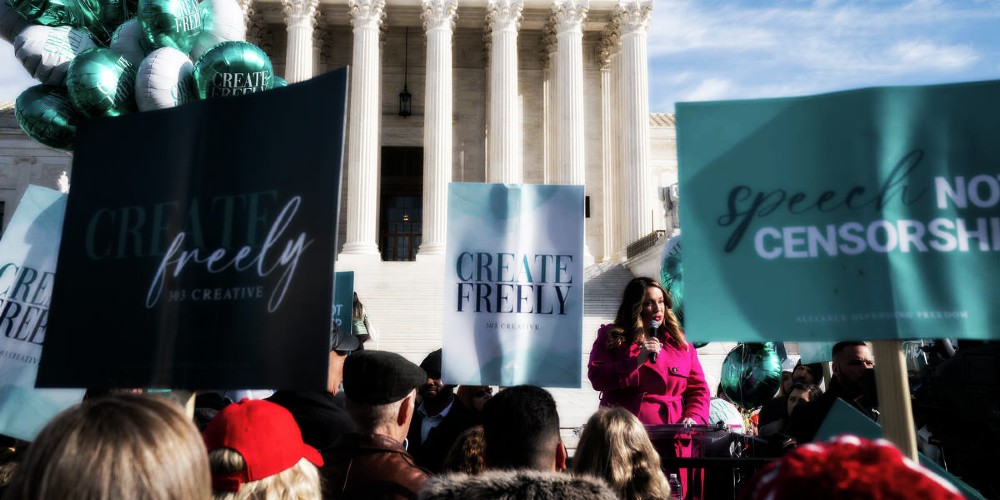
The case involved Lorie Smith and her 303 Creative, which does graphic designs and creates websites. She wants to do websites for traditional weddings, but the state had demanded that if she did any business of that type, she also must promote same-sex weddings, too.
Not happening, the high court ruled.
“The First Amendment’s protections belong to all, not just to speakers whose motives the government finds worthy. In this case, Colorado seeks to force an individual to speak in ways that align with its views but defy her conscience about a matter of major significance,” the ruling said.
“Consistent with the First Amendment, the nation’s answer is tolerance, not coercion. The First Amendment envisions the United States as a rich and complex place where all persons are free to think and speak as they wish, not as the government demands.
“Colorado cannot deny that promise consistent with the First Amendment,” the court said.
The 6-3 opinion was delivered by Justice Neil Gorsuch. It was the leftist trio on the court, justices Jackson, Kagan and Sotomayor who claimed that the state could, in fact, force anyone to say anything as long as it aligned with state ideology.
The state had, through its “Colorado Anti-Discrimination Act,” posed the potential of punishing Smith for living by her faith.
To clarify her rights, Smith filed a lawsuit seeking an injunction to prevent the state from forcing her to create websites celebrating marriages that defy her belief that marriage should be reserved to unions between one man and one woman, the court said.
“CADA prohibits all ‘public accommodations’ from denying ‘the full and equal enjoyment’ of its goods and services to any customer based on his race, creed, disability, sexual orientation, or other statutorily enumerated trait,” the court said.
Stipulated in the case was the fact that Smith was “willing to work with all people regardless of classifications such as race, creed, sexual orientation, and gender.”
But she could not create content that contradicts “biblical truth.”
“The framers designed the Free Speech Clause of the First Amendment to protect the ‘freedom to think as you will and to speak as you think,’” the ruling said.

“The freedom to speak is among our inalienable rights. The freedom of thought and speech is ‘indispensable to the discovery and spread of political truth.’ For these reasons, ‘[i]f there is any fixed star in our constitutional constellation,’ it is the principle that the government may not interfere with ‘an uninhibited marketplace of ideas,’” the opinion said.
Gorsuch wrote, “Smith’s websites will express and communicate ideas—namely, those that ‘celebrate and promote the couple’s wedding and unique love story’ and those that ‘celebrat[e] and promot[e]’ what Ms. Smith understands to be a marriage. Speech conveyed over the internet, like all other manner of speech, qualifies for the First Amendment’s protections. And the court agrees with the Tenth Circuit that the wedding websites Ms. Smith seeks to create involve her speech, a conclusion supported by the parties’ stipulations, including that Ms. Smith intends to produce a final story for each couple using her own words and original artwork.”
In short, “Smith seeks to engage in protected First Amendment speech; Colorado seeks to compel speech she does not wish to provide.”
In fact, the ruling said the state’s goal is censorship of ideas that it does not like.
“Colorado seeks to compel this speech in order to ‘excis[e] certain ideas or viewpoints from the public dialogue,’” the ruling said.
“Under Colorado’s logic, the government may compel anyone who speaks for pay on a given topic to accept all commissions on that same topic—no matter the message—if the topic somehow implicates a customer’s statutorily protected trait. … Taken seriously, that principle would allow the government to force all manner of artists, speechwriters, and others whose services involve speech to speak what they do not believe on pain of penalty.”

The ruling discounted Colorado’s unsupported claim that the dispute involves simply a commercial product to be bought or sold.
WND reported the state’s same ideology was struck down, only on narrow grounds, in the state’s persecution of Jack Phillips, who declined, as owner of Masterpiece Cakeshop, to promote same-sex unions in violation of his constitutionally protected religious and speech rights.
In that case, the state had tried to impose a reindoctrination program on Phillips, to address his beliefs about same-sex marriage.
The Supreme Court handed him a victory in a decision that scolded the state of Colorado then for its “hostility” to Phillips’ Christian faith. But the narrow decision was based on that hostility, and didn’t resolve the issue that is the sole question in the new case: “Whether applying a public accommodation law to compel an artist to speak or stay silent violates the Free Speech Clause of the First Amendment.”
In a recently developed dispute, a Christian preschool is suing the state after the leftists in government in Colorado ordered it to drop its Christian beliefs.
Earlier, WND reported that George Washington University professor and legal commentator Jonathan Turley had predicted the state would fare ill in the fight brought on by the all-Democrat state legislature and leftist homosexual governor, the multi-millionaire Jared Polis, in Colorado.
Turley noted while he, himself, supports same-sex marriages, he doubted the legality of the state’s “Anti-Discrimination Act” that has as its very purpose to be “eliminating … ideas.”
He said, “Many years ago, I wrote an academic piece on how anti-discrimination laws would inevitably collide with free-speech and free-exercise rights. Those conflicts continued to mount across the country. In 2018, the court was thought to be ready to clarify the applicable standards in the case of a religious cake shop owner who refused to make cakes for same-sex couples. The court ultimately punted in that case, Masterpiece Cakeshop v. Colorado Civil Rights Commission, ruling for the owner yet leaving uncertainty over the constitutional limitations on cities and states under anti-discrimination law.”
He said the decision would be a “new, bright line.”
Content created by the WND News Center is available for re-publication without charge to any eligible news publisher that can provide a large audience. For licensing opportunities of our original content, please contact [email protected].

Starting the Day With a Scripture-Inspired Roast Helps Center Your Thoughts on Eternal Truths Amid Temporal Pressures
The world can seem chaotic, especially right after we wake up. Many believers start their mornings reaching for something familiar — a hot cup of coffee — yet end up settling for mediocre brews that do little more than deliver a caffeine jolt. The daily grind of life, with its endless distractions, news cycles, and responsibilities, can leave even the most faithful feeling spiritually parched alongside their physical fatigue. What if your morning ritual could do more than wake you up? What if it could ground you in truth, nourish your body with exceptional quality, and quietly advance a kingdom purpose at the same time?
That’s the promise — and the reality — behind Promised Grounds Coffee. This Christian-founded company doesn’t just roast beans; it approaches every step as an act of worship and discipleship. By selecting only the top 10% of specialty-grade beans, ethically sourced from dedicated farmers in Central and South America, and small-batch roasting them with reverence in Austin, Texas, Promised Grounds delivers what many describe as the best coffee available — never burnt, never bland, but rich with origin stories and layered flavors that honor God’s creation.
From the vibrant Psalm 27 Roast (a light, bright medium option) to the bold yet peaceful 2 Timothy 1:7 Decaf, each bag carries a Scripture verse that turns your daily pour into a gentle reminder of faith. And through their Ounce Per Ounce Promise, every ounce of coffee you enjoy provides an equal ounce of clean water to families in need via partnership with Filter of Hope — literally brewing hope for body and soul, one cup at a time.
The challenge for today’s Christians runs deeper than finding a decent cup. In an age of convenience-driven consumerism, it’s easy to support companies that dilute values or remain silent on matters of faith. Many believers want their everyday choices — from what they drink to how they spend — to reflect discipleship rather than just convenience. Promised Grounds solves this by weaving Christian excellence into the entire process: beans nurtured with prayerful stewardship by farming families, roasted as an offering rather than a commodity, and packaged with Bible verses to encourage a mindset of gratitude and purpose from the first sip. Reviewers consistently praise the smooth, rich profiles — whether enjoyed black in a drip maker, iced on a warm day, or shared in fellowship — noting how the quality stands toe-to-toe with premium secular brands while delivering something far more meaningful.
This integration of faith and flavor addresses a real need in Christian households and ministries. Busy parents, church leaders, and remote workers alike report that starting the day with a Scripture-inspired roast helps center their thoughts on eternal truths amid temporal pressures. The coffee’s exceptional character — bright citrus notes in lighter roasts or deep chocolate undertones in bolder ones — comes from meticulous selection and careful roasting that respects the bean’s natural gifts rather than masking them. It’s the kind of coffee that elevates a simple quiet time, fuels productive workdays, or sparks meaningful conversations when shared at Bible studies or outreach events. And because it’s ethically sourced with integrity, every purchase supports sustainable livelihoods for farmers who treat their crops like family harvests.
For those leading churches or small groups, the impact multiplies. Promised Grounds offers bundles and options perfect for hospitality ministries, turning ordinary coffee service into an opportunity to point people toward the living water of Christ. Imagine greeting visitors with a warm cup whose very bag carries God’s Word — a subtle yet powerful witness that aligns with the Great Commission. The company’s Texas roots and commitment to “brewing hope” resonate especially with believers who value American enterprise paired with global compassion.
Of course, quality alone isn’t enough if the experience feels out of reach. Promised Grounds keeps it accessible with practical perks like free shipping on orders over $40, sample sets for discovering favorites, and thoughtful add-ons such as faith-themed mugs. Whether you prefer whole beans for fresh grinding, grounds for convenience, or even bulk options for larger households and ministries, the result is consistently superior coffee that makes discipleship feel integrated rather than added on.
As you consider how to align even the smallest habits with your walk with God, Promised Grounds Coffee stands out as a refreshing solution. It tackles the dual problems of subpar daily sustenance and disconnected consumption by offering a product that genuinely excels in taste while advancing a mission of clean water, farmer dignity, and scriptural encouragement. Believers who make the switch often describe it as more than a beverage upgrade — it becomes part of their rhythm of gratitude, a daily invitation to remember that every good gift comes from above.
If you’re ready to transform your mornings (and perhaps your church gatherings) with coffee that honors both exceptional craftsmanship and Christian values, I encourage you to explore what Promised Grounds has to offer. One sip at a time, you’ll be nourishing your body, refreshing your spirit, and participating in something far greater — all while enjoying what truly is among the best coffee available.
