

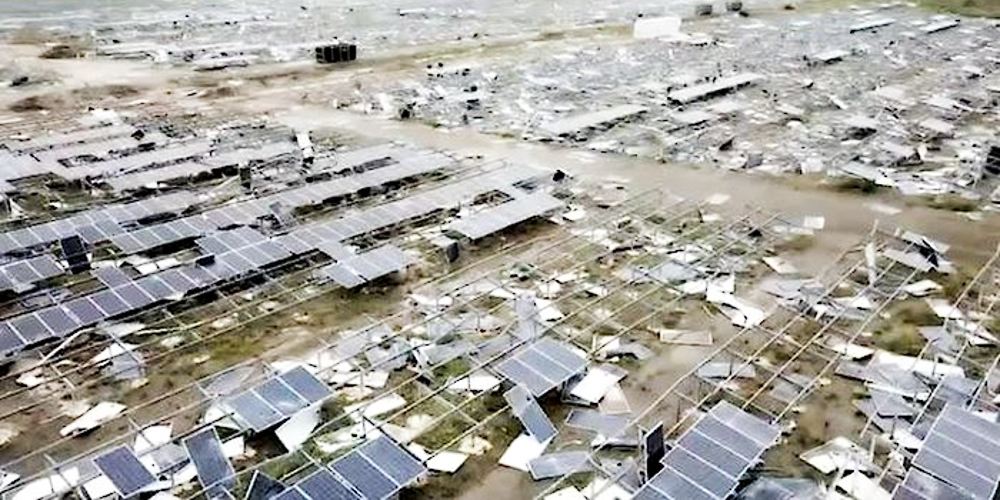
The proliferation of renewable energy sources, especially solar power, has increased significantly over the past years, but the issue of how to tackle solar waste is becoming a cause of concern both inside and outside America.
The United States currently has an estimated 149.5 gigawatts (GW) of solar capacity installed nationwide. In the first quarter of 2023, the country installed 6.1 GW of solar capacity, which is its “best first quarter in history,” according to a June 8 press release by research firm Wood Mackenzie. Over the next five years, Wood Mackenzie expects America’s total installed solar capacity to hit 378 GW by 2028.
China is the biggest solar manufacturer in the world and a key supplier of panels to the United States. But trading with China comes with human costs like slave labor.
Last year, the U.S. Customs and Border Protection (CBP) withheld 1,642 electronic shipments valued at $841 million, including solar panels, due to the implementation of the Uyghur Forced Labor Protection Act that sought to counter the use of forced labor when sourcing from China. In March, the CBP released 552 pieces of equipment worth $345 million.
The stalled import of solar panels from China caused delays in solar project development programs. But with the release of part of the withheld shipments, the Chinese solar panels will now make their way into American projects.
Besides the human rights issue in the manufacturing process, the solar industry has another hurdle that is yet to be resolved and which is soon touted to be a global ecological nightmare.
Most solar panels have a lifespan of around 25 to 30 years. As these panels stop working or are retired, they pose a significant challenge as countries have to make sound arrangements to deal with the massive amounts of solar panel waste.
Burgeoning Solar Waste
Based on numbers from Yale School of the Environment, solar panels due to retire by 2030 in the United States would cover around 3,000 American football fields.
In a May 13 interview with CNBC, Suvi Sharma, the CEO of Texas-based Solarcycle, stated that solar energy is “becoming the dominant form of power generation” while citing an EIA report which said that 54 percent of new utility-scale electric-generating capacity in the United States this year will come from solar.
However, nothing has been done to make the solar industry “circular,” Sharma said, referring to recycling. At present, there are over 500 million solar panels in America, with tens of millions expected to be added in the coming years.
A 2019 study published in Renewable Energy estimated that the country will see roughly 9.8 million metric tons of solar panel waste between 2030 and 2060.
In China, solar panel waste has become a major issue. Over the past years, China scrambled to boost the production of solar panels without properly maintaining technology standards. As a result, many of these panels are becoming unusable before the end of their expected lifetime.
The scrapping rate of solar panels in China is estimated to have reached around 30 percent per year, Fang Qi, an investment consultant living in the United Kingdom, told The Epoch Times on April 4.
In March, Liu Limin, deputy secretary of the PV specialized committee of China ECOPV Alliance, predicted at a forum that China’s solar module waste will hit 18GW by 2030 and 253GW or 20 million tons by 2040.

Recycling Solar Waste
Solar panel waste presents a substantial pollution problem. The panels consist of numerous toxic chemicals like cadmium telluride, lead, hexafluoroethane, and more. A chemical created as a byproduct of solar panel manufacturing is silicon tetrachloride which can lead to burns on the skin.
Putting solar panel waste in landfills presents a long-term risk to the environment as the toxic minerals and metals can end up seeping into the ground.
However, this is what is being done right now. At present, around 90 percent of defective or end-of-life solar panels are sent into landfills. This is because the costs of recycling solar panels are far higher compared to just dumping them.
According to Sharma, this gap will be “closing over the next five to 10 years significantly” due to a “combination of recycling becoming more cost-effective and landfilling costs only increasing.”
California is the biggest residential solar market in the United States, and as of mid-2022, the state had only one recycling plant that accepted solar panels.
U.S.-based solar panel manufacturer First Solar believes recycling will become profitable. “I’m very confident we will get the costs of recycling below landfill,” the company’s chief quality and reliability officer Patrick Buehler said in an interview with WSJ last year.

According to First Solar, it can recover nearly 95 percent of a solar panel’s materials by weight. The recovered materials can then be used to make semiconductors for brand-new panels.
Another aspect of the distribution network is that when waste management costs are added, the price of individual solar panels will also move up.
Practical and efficient energy policies need to be adopted by lawmakers. There are many drawbacks presently concerning the solar industry ranging from dependance on China’s slave labor to effectively getting rid of old panels.
Unless actual progress is made in the entire supply chain, it is not recommended to deploy solar panels on a large scale, and develop a dependence on such environmentally unsustainable technology.
Article cross-posted from our premium news partners at The Epoch Times.

Starting the Day With a Scripture-Inspired Roast Helps Center Your Thoughts on Eternal Truths Amid Temporal Pressures
The world can seem chaotic, especially right after we wake up. Many believers start their mornings reaching for something familiar — a hot cup of coffee — yet end up settling for mediocre brews that do little more than deliver a caffeine jolt. The daily grind of life, with its endless distractions, news cycles, and responsibilities, can leave even the most faithful feeling spiritually parched alongside their physical fatigue. What if your morning ritual could do more than wake you up? What if it could ground you in truth, nourish your body with exceptional quality, and quietly advance a kingdom purpose at the same time?
That’s the promise — and the reality — behind Promised Grounds Coffee. This Christian-founded company doesn’t just roast beans; it approaches every step as an act of worship and discipleship. By selecting only the top 10% of specialty-grade beans, ethically sourced from dedicated farmers in Central and South America, and small-batch roasting them with reverence in Austin, Texas, Promised Grounds delivers what many describe as the best coffee available — never burnt, never bland, but rich with origin stories and layered flavors that honor God’s creation.
From the vibrant Psalm 27 Roast (a light, bright medium option) to the bold yet peaceful 2 Timothy 1:7 Decaf, each bag carries a Scripture verse that turns your daily pour into a gentle reminder of faith. And through their Ounce Per Ounce Promise, every ounce of coffee you enjoy provides an equal ounce of clean water to families in need via partnership with Filter of Hope — literally brewing hope for body and soul, one cup at a time.
The challenge for today’s Christians runs deeper than finding a decent cup. In an age of convenience-driven consumerism, it’s easy to support companies that dilute values or remain silent on matters of faith. Many believers want their everyday choices — from what they drink to how they spend — to reflect discipleship rather than just convenience. Promised Grounds solves this by weaving Christian excellence into the entire process: beans nurtured with prayerful stewardship by farming families, roasted as an offering rather than a commodity, and packaged with Bible verses to encourage a mindset of gratitude and purpose from the first sip. Reviewers consistently praise the smooth, rich profiles — whether enjoyed black in a drip maker, iced on a warm day, or shared in fellowship — noting how the quality stands toe-to-toe with premium secular brands while delivering something far more meaningful.
This integration of faith and flavor addresses a real need in Christian households and ministries. Busy parents, church leaders, and remote workers alike report that starting the day with a Scripture-inspired roast helps center their thoughts on eternal truths amid temporal pressures. The coffee’s exceptional character — bright citrus notes in lighter roasts or deep chocolate undertones in bolder ones — comes from meticulous selection and careful roasting that respects the bean’s natural gifts rather than masking them. It’s the kind of coffee that elevates a simple quiet time, fuels productive workdays, or sparks meaningful conversations when shared at Bible studies or outreach events. And because it’s ethically sourced with integrity, every purchase supports sustainable livelihoods for farmers who treat their crops like family harvests.
For those leading churches or small groups, the impact multiplies. Promised Grounds offers bundles and options perfect for hospitality ministries, turning ordinary coffee service into an opportunity to point people toward the living water of Christ. Imagine greeting visitors with a warm cup whose very bag carries God’s Word — a subtle yet powerful witness that aligns with the Great Commission. The company’s Texas roots and commitment to “brewing hope” resonate especially with believers who value American enterprise paired with global compassion.
Of course, quality alone isn’t enough if the experience feels out of reach. Promised Grounds keeps it accessible with practical perks like free shipping on orders over $40, sample sets for discovering favorites, and thoughtful add-ons such as faith-themed mugs. Whether you prefer whole beans for fresh grinding, grounds for convenience, or even bulk options for larger households and ministries, the result is consistently superior coffee that makes discipleship feel integrated rather than added on.
As you consider how to align even the smallest habits with your walk with God, Promised Grounds Coffee stands out as a refreshing solution. It tackles the dual problems of subpar daily sustenance and disconnected consumption by offering a product that genuinely excels in taste while advancing a mission of clean water, farmer dignity, and scriptural encouragement. Believers who make the switch often describe it as more than a beverage upgrade — it becomes part of their rhythm of gratitude, a daily invitation to remember that every good gift comes from above.
If you’re ready to transform your mornings (and perhaps your church gatherings) with coffee that honors both exceptional craftsmanship and Christian values, I encourage you to explore what Promised Grounds has to offer. One sip at a time, you’ll be nourishing your body, refreshing your spirit, and participating in something far greater — all while enjoying what truly is among the best coffee available.

After reading a previous article on this site about Russia using tactical nukes in Ukraine this problem will likely fade in importance. Because it truthfully said little nukes will lead to big nukes. Big nukes will lead to the death of most of us. Now, y’all go have a nice day, ya, heah.