

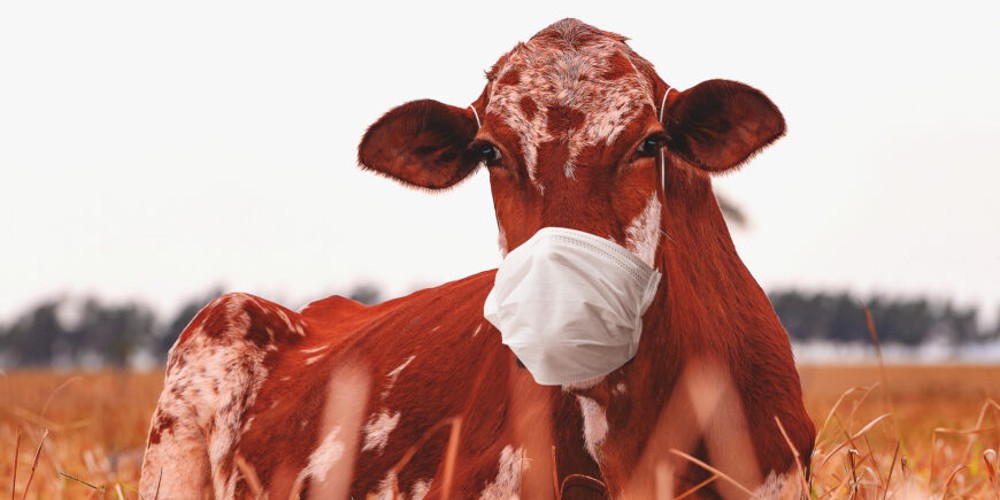
The Bill & Melinda Gates Foundation this month awarded a $4.8 million grant to ZELP, which claims its artificial intelligence mask technology for livestock will reduce methane emissions and curb climate change.
This article was originally published by The Defender —Children’s Health Defense’s News & Views Website
The Bill & Melinda Gates Foundation this month awarded a $4.8 million grant to a company that sells “smart” face masks for cows.
ZELP, which stands for Zero Emissions Livestock Project, claims its artificial intelligence (AI) mask technology for livestock will reduce methane emissions—considered to be a main greenhouse gas—and curb climate change. Cows and other ruminant animals emit methane in the process of digesting their food.
The mask goes around the cow’s head and captures the methane gas exhaled by the animal, oxidizing it and then releasing it into the air as carbon dioxide and water vapor, according to ZELP. It also has sensors that continuously collect millions of data points on the animals that are processed by machine learning algorithms.
“Our AI is trained to detect heat, flag welfare conditions, and identify the most efficient animals with a high-level of accuracy,” ZELP said.
But critics, including third-generation farmer Howard Vlieger, said the Gates-funded venture is illogical and driven by greed.
Vlieger, who advises crop and livestock farmers across the United States, said, “This is what you would get when you combine greed and stupidity.”
Commenting on the news, Will Harris—a fourth-generation regenerative farmer who runs his family’s farm White Oak Pastures, told The Defender all he could say was, “Surely this is a hoax.”
Critical Sway, a researcher and investigator, tweeted, “You couldn’t make this stuff up. … We’re living in ridiculous times my friends.”
The Bill & Melinda Gates Foundation just announced a $4.7 million grant for a company that sells face masks for cows.
You couldn't make this stuff up. pic.twitter.com/U8vkorBKwr
— Critical Sway (@CriticalSway) March 11, 2023
ZELP—which collaborates with the agricultural giant Cargill—makes its money by leasing the smart masks out to farmers and by selling carbon offset credits, Critical Sway said.
“History will show that the vast majority of so-called environmentally beneficial projects like this are going to make Bernie Madoff look like an altar boy,” Vlieger said.
Madoff, whose name became synonymous with financial fraud, was behind the $20 billion Ponzi scheme that CNN called the largest financial fraud in history.
Gates’ Love Affair With Techno-Fixes
Smart masks for cows aren’t the first money-making tech fix Gates has attempted to apply to a natural problem. Last year, the billionaire partnered with Samsung in an attempt to make a toilet that would turn human feces into ash.
And Gates recently claimed his genetically altered seeds were necessary for solving world hunger because climate change alters growing conditions.

He also promotes AI-driven digital agriculture that relies on large-scale monocultures and is “basically a surveillance agriculture,” according to environmental activist Vandana Shiva, Ph.D.
The technology forces farmers “to get addicted to chemicals and chemical fertilizers” that harm the planet and people while reducing natural biodiversity, Shiva said.
Shiva said Gates’ solutions ignore obvious natural remedies for environmental problems, such as the regenerative agriculture practices of managed grazing and natural soil enrichment.
Industrial Farming Practices–Not Cows–Are the Problem
ZELP’s design was one of four winners last year in the Terra Carta Design Lab, an environmental sustainability competition for cutting methane emissions.
Prince Charles—who launched the competition as part of his Sustainable Markets Initiative—praised the mask design as “fascinating,” reported Business Insider in April 2022. But according to Vlieger, ruminant animals in their natural habitat are not the key drivers of environmental problems.
“When the settlers worked their way across the plains, there were millions of buffalo,” Vlieger said. “If ruminant animals were the problem, why didn’t we have climate change problems then?”

Techno-fixes like ZELP’s smart masks ignore the issue of where and how the animals graze, Vlieger and others said.
Conventional livestock production—which includes confining large numbers of animals in concentrated animal feeding operations, more commonly known as factory farms—“manipulates pieces of the ecosystem in an effort to maximize production and profits, thereby leading to the complication and expense of dealing with unintended consequences,” according to a 2015 report by the Savory Institute, a regenerative agriculture organization that promotes wholistic management of livestock.
An intact ecosystem effectively balances ruminant methane production and breakdown, the report authors said.
Indeed, researchers—including W. Richard Teague, Ph.D., professor emeritus and grazing ecologist at Texas A&M AgriLife Research & Extension Center—found that with appropriate regenerative crop and grazing management, ruminant animals not only reduce overall greenhouse gas emissions but also provide essential ecosystem services that increase soil carbon sequestration and reduce environmental damage.
Teague and his colleagues said in a 2016 article published in the Journal of Soil and Water Conservation that “to ensure long-term sustainability and ecological resilience of agroecosystems, agricultural production should be guided by policies and regenerative management protocols that include ruminant grazing.”
Allowing cows to open graze “under appropriate management results in more carbon sequestration than emissions,” Teague told Successful Farming.
Grazing systems that are regenerative cause soil microorganisms to increase, which helps drive carbon sequestration and methane oxidization, Teague added.
‘This Is Wrong in so Many Ways’
Vlieger said ZELP’s smart mask would generate electromagnetic radiation that could harm the animals.
“Many years ago when the USDA [U.S. Department of Agriculture] was talking about the electronic ID ear tags for cattle, I wrote an article about the dangers of the electromagnetic frequencies—and that was way before we had a fraction of the information that we have today,” he said.
“The potential for tumors and other ill health effects are significant,” Vlieger added.
Blogger Tessa Lena also criticized the cow smart mask because it is a step in normalizing “smart” facewear for both animals and humans—something that is “a win-win for all fascists,” she said in a March 14 Substack post.
Lena said:
“It’s a very lucrative ‘product adoption curve for Big Tech—and extremely consistent with how they’ve been going about their ‘product adoption curves’ since day one of the industry’s existence.”
Smart faceware is also “useful to the totalitarian types in the government” and a “treasure trove of yummy ‘new oil’ biometric data for the delight of all fascists,” Lena added.
Her solution? People must wake up and refuse to do this, she said.
This article was originally published by The Defender—Children’s Health Defense’s News & Views Website under Creative Commons license CC BY-NC-ND 4.0. Please consider subscribing to The Defender or donating to Children’s Health Defense.

Two Storms, One Harvest

Every food crisis in living memory has been a one-shock event. The 2008 price spike was a commodity bubble. The 2020 shortages were a logistics failure. The 2022 grain scare was a war on one exporter’s ports. Each time, the system bent, adjusted, and recovered, and each time the experts assured us afterward that global markets are simply too big and too diversified to fail.
What nobody in Washington seems eager to discuss is that 2026 is shaping up to be something the modern food system has never actually faced. Two independent shocks, one climatic and one geopolitical, are converging on the same harvest cycle at the same time. Not sequentially. Simultaneously.
Start with the weather. The Pacific Ocean is currently building toward what forecasters now openly call a record event. NOAA’s Climate Prediction Center puts the odds of at least a strong El Niño near 88 percent, with roughly two in three odds it reaches “very strong” status, the tier reserved for perhaps three or four events in the entire satellite era. Every major global model now projects a median peak in Super El Niño territory, and most of them project it exceeding the 2015-16 event, which until now held the modern record. Sea surface anomalies were already brushing the super threshold in mid-July, months before these events normally peak. The atmosphere has already shifted into El Niño mode, and the event is forecast to crest in late fall and early winter.
This is not about “climate change.” It’s about the standard cycles of weather, and the cycle we’re currently in is one that has likely devastated societies in the past. We’re better prepared as a society today, but not all Americans are equally prepared.
Serious households have started doing the quiet math on their own. Grocery bills tell part of the story, and the forecast maps tell the rest, which is why long-term food storage has moved from fringe hobby to mainstream line item in the family budget, with established suppliers like Heaven’s Harvest seeing demand from people who five years ago would have rolled their eyes at the idea. That instinct is not paranoia. It is pattern recognition, and the pattern is worth walking through carefully.
Editor’s Note: Heaven’s Harvest IS a sponsor, but the warnings of this article are real and would be written even if we didn’t have a survival food sponsor. With that said, those who take advantage of what they offer can use promo code “Patriot” for 15% off.
The Fertilizer Clock Is Already Running
While the Pacific warms, the second shock has been unfolding in the Strait of Hormuz. The conflict with Iran turned the world’s most important energy chokepoint into a contested waterway, and the consequences reach far beyond the gas pump. Roughly a third of global fertilizer trade moves through Hormuz, and the disruption sent urea prices up 86 percent year over year by March, with a 53 percent jump in a single month.
The World Bank projects energy prices rising about 24 percent in 2026 and fertilizer about 31 percent. By its own accounting, fertilizer prices ran 35 percent higher in the first five months of this year than the same period last year.
Here is the mechanism the nightly news will not explain. Fertilizer is not a grocery item. It is a time-delayed input. The nitrogen a farmer in Iowa or Punjab could not afford to apply this spring does not show up as a problem this spring. It shows up as a thinner harvest six to twelve months later.
The World Bank’s own food security brief concedes that the effects of reduced applications earlier this season “are likely to become visible only later in harvest outcomes.” Translate that from institutional language into plain English and it means this. The damage is already done, it is already in the ground, and we are simply waiting for it to arrive on the shelf.
Now check the calendar. Six to twelve months from the spring planting season lands us squarely in late 2026 and early 2027. Which is precisely when the strongest El Niño in the instrumental record is forecast to peak, bringing its signature droughts to Southeast Asia, Australia, southern Africa, northern Brazil, and South Asia, the very regions that grow the world’s rice, sugar, and oilseeds.
The World Bank warns openly that a strong El Niño “could disrupt multiple crop belts simultaneously” on top of the conflict-driven input costs. Their baseline projection assumes the Middle East disruptions ease by autumn. What in the last two years of Middle East history suggests that assumption is safe?
The System Has No Slack Left
The comfortable answer is that global markets always adjust. But adjustment requires slack, and the slack is gone. Global cereal production is expected to decline from last year’s records even before El Niño does its work. The UN World Food Programme, hardly a den of right-wing preppers, is calling this the most significant disruption to its supply chains since Covid and the invasion of Ukraine, and its supply chain director put the stakes bluntly.
Today’s supply chain challenges are tomorrow’s hunger crisis.
There is also a political dimension that markets cannot price. When food gets scarce, governments do not behave like economists. They behave like politicians. Export bans, hoarding mandates, and panic buying at the national level turned the modest rice shortfall of 2008 into a global crisis, and analysts are already warning that import-dependent nations are the first dominoes.
The 2015-16 Super El Niño, a far weaker event than what is now forecast, threw tens of millions into food stress across Africa and Asia. This one is projected to be stronger, and it arrives with fertilizer already rationed by price and shipping lanes already contested by missiles.
What Joseph Knew
Scripture does not treat preparation for lean years as faithlessness. It treats it as wisdom delivered in advance to those willing to act on it.
Behold, there come seven years of great plenty throughout all the land of Egypt: And there shall arise after them seven years of famine; and all the plenty shall be forgotten in the land of Egypt.
Joseph did not respond to that warning with a hashtag or a committee. He stored grain during the years of abundance, and when the famine came, Egypt stood while its neighbors begged. The lesson is not that famine is certain. It is that the time to prepare is precisely when preparation still looks optional.
Nobody who filled a pantry in a year of plenty has ever regretted it, and nobody standing in an empty aisle has ever been glad he waited for certainty.
None of this calls for panic, and panic is the enemy of sound judgment anyway. It calls for the same unglamorous prudence our grandparents considered ordinary. Keep some cash margin, know your local growers, and put real food in deep storage while it is cheap and available, because the entire arc of this story is that cheap and available is a closing window.
Families looking for a straightforward place to start can visit Heaven’s Harvest and use promo code Patriot for 15 percent off long-term storable food. The forecasts may yet soften, the strait may yet reopen, and we should pray they do. But hope is a fine thing to hold and a foolish thing to eat.
