

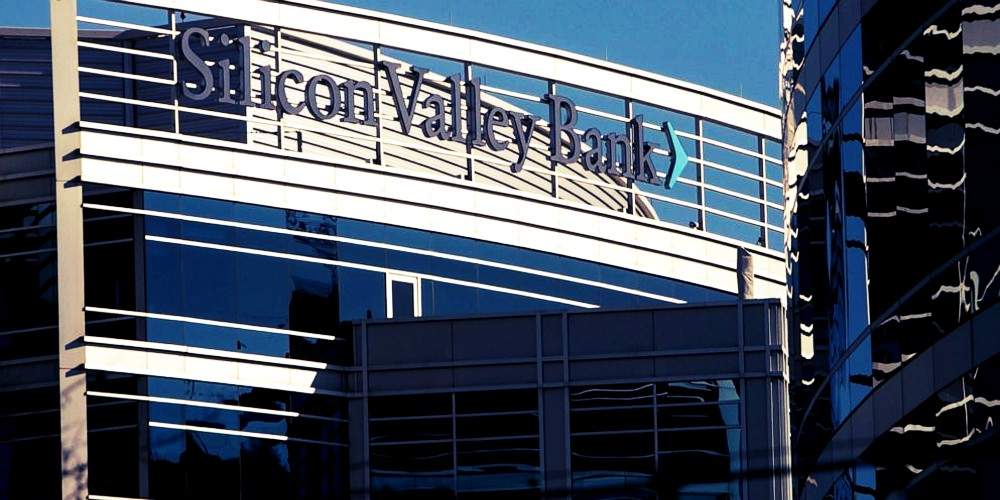
Silicon Valley Bank’s shares have tanked, causing panic in the financial sector to spread from Wall Street to Europe and Asia. This comes after the lender announced it would sell shares at a loss in order to cover rapidly declining customer deposits.
Silicon Valley Bank (SVB) Financial Group, a bank which lends primarily to tech companies, told investors on Mar. 9 that it was forced to sell almost $2 billions in shares to raise additional capital to help offset bond sale losses.
The news quickly triggered massive losses across the banking sector and raised concerns that the Federal Reserve’s interest-rate hikes were preventing banks from raising capital.
Before last year, when interest rates were near zero, large banks were buying up U.S. Treasurys and bonds, but the rise in the federal fund rate has since weakened their value, while banks sit on increasing losses.
Since banks tend to hold large portfolios of bonds, their decline is normally not a problem unless they are forced to sell them.
U.S. government bonds surged after the California lender sold off shares to cover bond losses, leading to more worries over the banking sector’s debt holdings.
Bank Stock Values Plunge Across the Board
The news from the tech industry lender quickly caused a knock-on effect on Thursday, as banking stocks fell at their fastest pace since the first months of the pandemic, taking Wall Street’s major indexes down with them.
SVB shares tumbled more than 60 percent and lost another 20 percent in after-hours trading, in the worst decline in the sector, after CEO Greg Becker admitted the bank could be dealing with problems for the foreseeable future.
Meanwhile, America’s four largest banks lost more than $50 billion in market value at the end of trading on Mar. 9.
Shares of JPMorgan Chase fell 5.4 percent, while Bank of America took a 6.2 percent hit, Wells Fargo was down 6.2 percent, and Citigroup tumbled 4.1 percent.
Bank stocks in Europe and Asia sold off sharply the following day, as news surrounding SVB Financial spread to markets across the world.
The Euro Stoxx Banks Index witnessed its worst day since June 2022, led by Deutsche Bank, which saw an 8 percent loss, followed by Société Générale, HSBC, ING Groep, and Commerzbank, which all fell more than 5 percent.
“Lots of chatter today about the possibility of generalized U.S. banking system stress due to SVB troubles. Three summary things on this: While the U.S. banking system as a whole is solid, and it is, that does not mean that every bank is,” stated economist Mohamed A. El-Erian in a tweet.
“Due to the volatility in yields after the prior protracted period of leverage-enabling policy, the most vulnerable currently are those vulnerable to both interest rate and credit risk. Contagion risk and the systemic threat can be easily contained by careful balance sheet management and avoiding more policy mistakes,” he continued.

Meanwhile, U.S. and European bond yields fell to their lowest level in weeks, after investors bet that turmoil in the bank sector could reduce the ability of the Fed to keep hiking interest rates.
Silicon Valley Lender’s Bonds Lose Value to Rising Interest Rates
The interest-rate hikes over the past year have also caused value of its bonds to fall, particularly those that took many years to mature, forcing the bank to reinvest the proceeds from its sales into shorter-term assets.
SVB has suffered significant losses on its portfolio, which was heavily invested in U.S. Treasurys and mortgage-backed securities, which have all taken a beating.
The 40-year-old bank was forced into a fire sale of its securities on Thursday, dumping $21 billion worth of holdings at a $1.75 billion loss while raising $500 million from venture firm General Atlantic, according to a financial mid-quarter report on Mar. 8.
SVB additionally reported more than $90 billion in held-to-maturity securities.
Its recent losses have caused American startup firms, particularly venture-backed tech and life sciences companies, to feel the pinch, as the bank caters heavily to these new firms.

Higher interest rates, fears of a recession, and a tepid market for initial public offerings have made it harder for new startups to raise additional capital in the past year.
The lender’s 2022 third quarter report stated it was partnered with nearly half of all venture-backed tech and health care companies based in the United States.
“The failure of @SVB_Financial could destroy an important long-term driver of the economy as VC-backed companies rely on SVB for loans and holding their operating cash. If private capital can’t provide a solution, a highly dilutive gov’t preferred bailout should be considered,” warned Pershing Square CEO Bill Ackman in a tweet.
“After what the Feds did to @jpmorgan after it bailed out Bear Stearns, I don’t see another bank stepping in to help @SVB_Financial,” he added.
Investors were worried ahead of today’s employment report from the Department of Labor, which they hope will provide some hint on the Fed’s next policy moves.
SVB Reassures Investors That Things Are Fine
The collapse of SVB’s stock value comes shortly after a key lender for the cryptocurrency industry, Silvergate Capital, announced liquidation plans on Mar. 8, following the implosion of FTX, which used the bank to transfer customer funds.
However, the bank said in its letter to investors that it had minimal exposure to crypto, but analysts are still concerned that not all is well at SVB.
Becker reassured investors that their assets were safe and that the stock sale was only an attempt to increase financial flexibility, strength, and profitability at the bank, but the current market situation has caused pressure to its “balance of fund flows.”
The bank cited higher interest rates and “elevated cash burn from our clients” at a historically elevated level and less investments from venture capital, are the primary reasons for raising new capital.
Becker said the bank has “ample liquidity” to support its clients “with one exception: If everybody is telling each other that SVB is in trouble, that will be a challenge.”
He asked clients to “stay calm. That’s my ask. We’ve been there for 40 years, supporting you, supporting the portfolio companies, supporting venture capitalists.”
SVB’s mid-quarter update reported a low ratio of loans to deposits, at 43 percent, which leaves little protection in the wake of a share-price selloff over the coming days.
If startups panic and begin pulling funds from SVB due to concern about its financial health, this could exacerbate the mismatch in deposits and withdrawals, increasing pressure on the bank.
Still, one expert believes the problem goes deeper than just investors getting spooked by SVB and that it is more systemic.
“Why this sudden meltdown in bank stocks? Small banks face a double whammy: Less ”financial liquidity” (reserves) in the system, disproportionately affecting them, a tougher funding landscape, with plenty of safer and higher-yielding alternatives for depositors. This is the real issue, [in my honest opinion],” said Alfonso Peccatiello, founder and CEO of TheMacroCompass, in a tweet.
Article cross-posted from our premium news partners at The Epoch Times.

Starting the Day With a Scripture-Inspired Roast Helps Center Your Thoughts on Eternal Truths Amid Temporal Pressures
The world can seem chaotic, especially right after we wake up. Many believers start their mornings reaching for something familiar — a hot cup of coffee — yet end up settling for mediocre brews that do little more than deliver a caffeine jolt. The daily grind of life, with its endless distractions, news cycles, and responsibilities, can leave even the most faithful feeling spiritually parched alongside their physical fatigue. What if your morning ritual could do more than wake you up? What if it could ground you in truth, nourish your body with exceptional quality, and quietly advance a kingdom purpose at the same time?
That’s the promise — and the reality — behind Promised Grounds Coffee. This Christian-founded company doesn’t just roast beans; it approaches every step as an act of worship and discipleship. By selecting only the top 10% of specialty-grade beans, ethically sourced from dedicated farmers in Central and South America, and small-batch roasting them with reverence in Austin, Texas, Promised Grounds delivers what many describe as the best coffee available — never burnt, never bland, but rich with origin stories and layered flavors that honor God’s creation.
From the vibrant Psalm 27 Roast (a light, bright medium option) to the bold yet peaceful 2 Timothy 1:7 Decaf, each bag carries a Scripture verse that turns your daily pour into a gentle reminder of faith. And through their Ounce Per Ounce Promise, every ounce of coffee you enjoy provides an equal ounce of clean water to families in need via partnership with Filter of Hope — literally brewing hope for body and soul, one cup at a time.
The challenge for today’s Christians runs deeper than finding a decent cup. In an age of convenience-driven consumerism, it’s easy to support companies that dilute values or remain silent on matters of faith. Many believers want their everyday choices — from what they drink to how they spend — to reflect discipleship rather than just convenience. Promised Grounds solves this by weaving Christian excellence into the entire process: beans nurtured with prayerful stewardship by farming families, roasted as an offering rather than a commodity, and packaged with Bible verses to encourage a mindset of gratitude and purpose from the first sip. Reviewers consistently praise the smooth, rich profiles — whether enjoyed black in a drip maker, iced on a warm day, or shared in fellowship — noting how the quality stands toe-to-toe with premium secular brands while delivering something far more meaningful.
This integration of faith and flavor addresses a real need in Christian households and ministries. Busy parents, church leaders, and remote workers alike report that starting the day with a Scripture-inspired roast helps center their thoughts on eternal truths amid temporal pressures. The coffee’s exceptional character — bright citrus notes in lighter roasts or deep chocolate undertones in bolder ones — comes from meticulous selection and careful roasting that respects the bean’s natural gifts rather than masking them. It’s the kind of coffee that elevates a simple quiet time, fuels productive workdays, or sparks meaningful conversations when shared at Bible studies or outreach events. And because it’s ethically sourced with integrity, every purchase supports sustainable livelihoods for farmers who treat their crops like family harvests.
For those leading churches or small groups, the impact multiplies. Promised Grounds offers bundles and options perfect for hospitality ministries, turning ordinary coffee service into an opportunity to point people toward the living water of Christ. Imagine greeting visitors with a warm cup whose very bag carries God’s Word — a subtle yet powerful witness that aligns with the Great Commission. The company’s Texas roots and commitment to “brewing hope” resonate especially with believers who value American enterprise paired with global compassion.
Of course, quality alone isn’t enough if the experience feels out of reach. Promised Grounds keeps it accessible with practical perks like free shipping on orders over $40, sample sets for discovering favorites, and thoughtful add-ons such as faith-themed mugs. Whether you prefer whole beans for fresh grinding, grounds for convenience, or even bulk options for larger households and ministries, the result is consistently superior coffee that makes discipleship feel integrated rather than added on.
As you consider how to align even the smallest habits with your walk with God, Promised Grounds Coffee stands out as a refreshing solution. It tackles the dual problems of subpar daily sustenance and disconnected consumption by offering a product that genuinely excels in taste while advancing a mission of clean water, farmer dignity, and scriptural encouragement. Believers who make the switch often describe it as more than a beverage upgrade — it becomes part of their rhythm of gratitude, a daily invitation to remember that every good gift comes from above.
If you’re ready to transform your mornings (and perhaps your church gatherings) with coffee that honors both exceptional craftsmanship and Christian values, I encourage you to explore what Promised Grounds has to offer. One sip at a time, you’ll be nourishing your body, refreshing your spirit, and participating in something far greater — all while enjoying what truly is among the best coffee available.
