

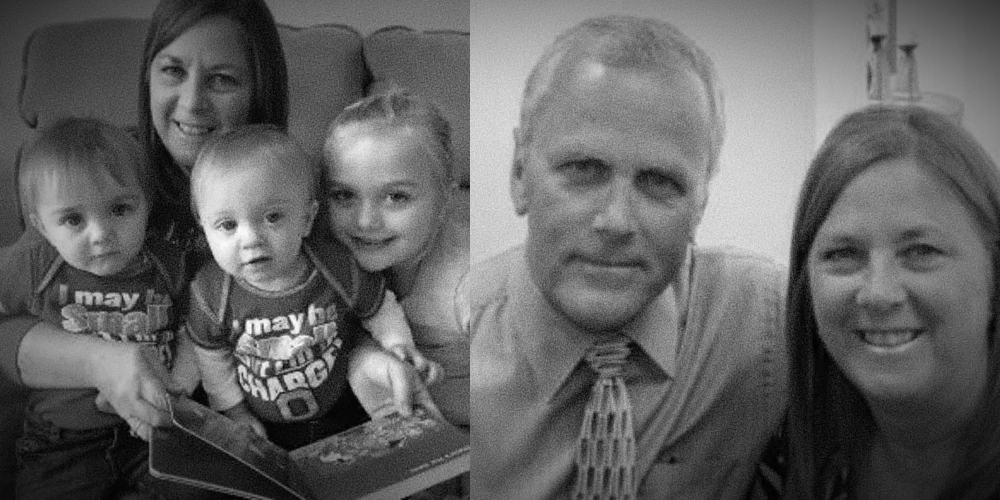
(The Epoch Times)—Brenda Downs was dying.
Mrs. Downs, 64, contracted COVID-19 while on vacation. She went to the local emergency room after returning home for treatment. She was transferred to a bigger facility in Ohio when her condition worsened.
Mrs. Downs, though, kept getting worse, despite a federally recommended treatment course including remdesivir.
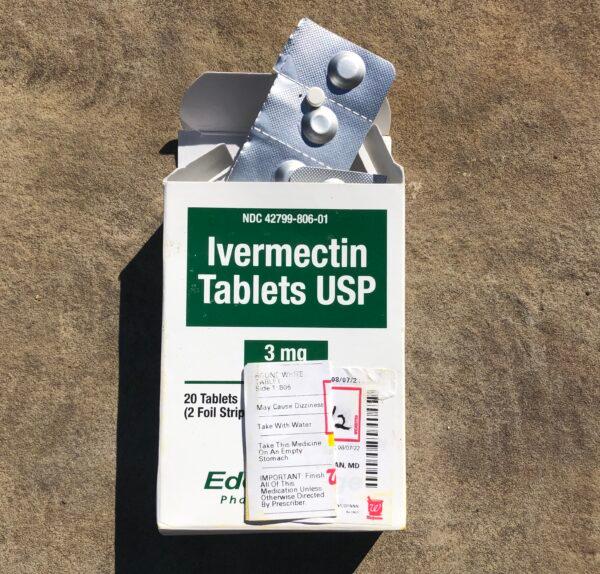
On the same day Mrs. Downs was placed on a ventilator, her family asked doctors to try ivermectin, an anti-malarial that has had some success against COVID-19. Because the treatment course was not working, relatives felt it was time to try something new.
The hospital refused. A clinical ethicist there cited how the U.S. Food and Drug Administration (FDA) warned people against using ivermectin against COVID-19. The ethicist claimed there could be “great harms” if Mrs. Downs was given ivermectin.
“This may make the family upset,” he wrote in notes reviewed by The Epoch Times.
But Mrs. Downs’s husband and daughters weren’t giving up. They sued the hospital to try to force the facility to either administer ivermectin or allow an outside doctor in to administer it.
A local doctor who reviewed Mrs. Downs’s case said she should be able to receive the drug. Based on his research into ivermectin, he said there was “very little downside” in trying the drug, whether it worked or not.
A settlement was reached on Aug. 19, 2021. The settlement said that the hospital would administer ivermectin, but that the administration was conditional on “the treating physician(s) professional judgement and discretion, and the applicable standard of care.”
Mrs. Downs never received ivermectin. She died at the hospital on Sept. 2, 2021.
If she had received the drug, “I believe it would have set some kind of precedent, so they did everything they could to make sure she was never going to get it,” Donald Downs, Mrs. Downs’s husband, told The Epoch Times. “If we could’ve gotten it to her sooner, maybe things would’ve been different.”
Possible Fine Looms Over Family
The family experienced pressure from the court system and OhioHealth, which runs the facility to which Mrs. Downs was admitted, to agree to a fine of $100,000 for each person who disclosed the existence of the settlement.
They still signed the confidential settlement because they felt there was limited time for Mrs. Downs to receive ivermectin.
“We were under severe pressure and in desperation to save my wife and my daughter’s mother,” Mr. Downs said. “We would do anything to try to save her.”

Ralph Lorigo, a lawyer who was representing the family, said that the judge in the case wanted him to sign the settlement, which would open him up to being fined as well if he violated the agreement.
“I’ve never in my at that point 47 or 48 years in my career had a judge ever tell the lawyer that they had to be part of that settlement,” Mr. Lorigo told The Epoch Times.
Mr. Lorigo said a confidential agreement was fine but that the parameters of this one were “so broad.”
“If you named the hospital, for Christ’s sake, you could be responsible for $100,000,” Mr. Lorigo said.
Franklin County Court of Common Pleas Judge Mark Serrott, who was overseeing the case, told the Downs family that Mr. Lorigo was blocking the settlement by refusing to sign, according to the family. The family fired Mr. Lorigo to make sure the settlement went through.
Judge Serrott “tells us that we will be able to get my wife the medicine as soon as we sign the agreement,” Mr. Downs said. Judge Serrott and Jeffrey Perry, a local attorney who helped secure the settlement, did not respond to requests for comment.

Judge Serrott, the family says, told them they were forbidden to discuss the case. “When someone asks you about this case, you are going to say, ‘the judge says I’m not allowed to talk about it,'” he said, the family recalls. The judge made them repeat the sentence.
The threat of a fine loomed over the family for years, preventing them from talking about how their mother and wife died.
On Oct. 27, 2022, the Downs family asked the Franklin County court to declare the settlement void on the grounds it was illegal, procured fraudulently because OhioHealth never intended to administer ivermectin or allow it to be administered, and was procured under duress. OhioHealth countersued, asking the court to sanction the family for a frivolous filing.
Judge Carl Aveni ruled on Oct. 6, 2023, that the settlement agreement was never enforceable because Mr. Downs voluntarily dismissed the suit after his wife died. He said he would rule on the countersuit at a later time.
Initially Alert
Mr. and Mrs. Downs were enjoying summer vacation in Baton Rouge, Louisiana when Mr. Downs became ill. His wife began experiencing symptoms several days later. They returned home early. Mrs. Downs then went to a local hospital with symptoms including cough, headache, and sore throat.
A doctor who on July 28, 2021, saw Mrs. Downs said she was “not ill-appearing or toxic-appearing,” nor “in acute distress. Mrs. Downs did test positive for COVID-19, he wrote in notes reviewed by The Epoch Times. The doctor sent her home with an inhaler in stable condition.
Five days later, Mrs. Downs went back to the same hospital, Hocking Valley Community Hospital, reporting diarrhea, nausea, cough, fever, and loss of taste and smell.
Dr. John Ireton, the doctor at Hocking Valley, described plans to start Mrs. Downs on the anti-inflammatory dexamethasone. He did not plan to administer remdesivir due to “recent poor efficacy data,” he wrote in notes from the Aug. 2, 2021, encounter.
Even a day later, Mrs. Downs was in relatively good condition despite experiencing some symptoms, according to additional notes. The patient was “pleasant and cooperative” while appearing “moderately ill,” Dr. Ireton wrote.
But the patient’s inflammatory markers started trending upward, and she soon required oxygen.
Mrs. Downs was transferred to Doctors Hospital, the bigger facility, on Aug. 5, 2021, in part because the facility had “remdesivir and other COVID-19 treatments unavailable at this facility,” Dr. Ireton wrote in discharge notes.
Remdesivir is an antiviral cleared by the FDA for treating COVID-19.
Placed on Ventilator
Mrs. Downs was admitted to the intensive care unit at Doctors Hospital the same day, with conditions including acute respiratory failure and a slow heartbeat, the doctors there said.
Other symptoms were later noted, including acute kidney injury. It was “unknown” whether those conditions were present at admission, the doctors said in notes reviewed by The Epoch Times.
Doctors after admission started Mrs. Downs on a course of remdesivir, which some researchers have said is linked to kidney injury. The doctors also continued the dexamethasone and added various vitamins and other drugs, including the monoclonal antibody tocilizumab and vitamin C. Family members say they asked if remdesivir was being administered and were told no.
Doctors used a bilevel positive airway pressure machine to assist Mrs. Downs with breathing. They ended up placing her on a ventilator on Aug. 11, 2021, due to worsening symptoms, despite her telling them she did not want to be intubated. Fentanyl and other drugs were administered.
On the same day as the intubation, the family asked that ivermectin be administered, under the Right to Try Act, as the treatments applied by the hospital weren’t working.
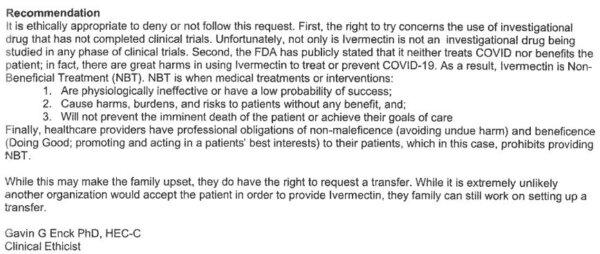
Gavin Enck, a clinical ethicist at OhioHealth, said that the request would have to be rejected because it did not meet the conditions of the act, such as being an investigational drug studied in clinical trials. “Second, the FDA has publicly stated that it neither treats COVID nor benefits the patients; in fact, there are great harms in using ivermectin to treat or prevent COVID-19. As a result, ivermectin is non-beneficial treatment,” Mr. Enck wrote in an analysis dated Aug. 11, 2021, that was reviewed by The Epoch Times.
Ivermectin is an FDA-approved drug, but not for COVID-19. Doctors in the United States commonly prescribe drugs for non-approved uses. The FDA said in a warning earlier in 2021 that ivermectin was not approved to treat COVID-19 and that “taking large doses of this drug is dangerous and can cause serious harm.” The FDA has since acknowledged doctors can prescribe ivermectin for COVID-19, while an appeals court said the FDA likely overstepped its authority with the warning and similar statements.
Mr. Enck said that if the family didn’t like the decision, they could take action.
“While this may make the family upset, they do have the right to request a transfer,” he wrote. “While it is extremely unlikely another organization would accept the patient in order to provide ivermectin, they family [sic] can still work on setting up a transfer.”
Mr. Enck did not pick up his phone or return a voicemail. OhioHealth did not respond to a request for comment.
The family asked to speak to hospital administrators and offered to sign waivers. They said their attempts were turned down.
Family members also spoke to Dr. Brian Still, Mrs. Downs’ primary care doctor. He agreed to prescribe Mrs. Downs ivermectin and wrote a letter saying he felt there was little downside to trying it.
Suit Filed
Desperate to give their loved one a better chance at surviving, the family took OhioHealth to court.
They chose Mr. Lorigo, who had won multiple similar cases for patients that wanted ivermectin, to represent them.
“Every time he won a case in court, the person that got it lived,” Cara Bookman, Mrs. Downs’s daughter, told The Epoch Times.
The family through their lawyers filed an emergency request for relief in the Franklin County court on Aug. 16, 2021. Attorneys asked for an emergency sealed hearing.
The hearing was held on Aug. 18, 2021. The family was not present. Judge Serrott, the family said, called them and said that the parties were nearing an agreement on a confidential settlement that would bar the family from discussing the settlement and include a fine if they did.
OhioHealth wanted a $1 million fine but Judge Serrott changed the amount to $100,000, according to the family.
The judge also said that Mr. Lorigo was holding up the settlement by refusing to sign it. The family offered to fire him in a bid to finalize the settlement and get Mrs. Downs the ivermectin.
That’s when the family says the judge told them Mrs. Downs would be able to receive the drug as soon as they signed the settlement.
The agreement indemnified OhioHealth for administering ivermectin and stated that OhioHealth “shall prescribe and administer a 12 (twelve) mg daily oral dose of ivermectin for 4 (four) days” to the patient.
It also said, however, that the prescription and administration were “subject to the [sic] treating physician(s)’ professional judgment and discretion, and the applicable standard of care.”
No Ivermectin
The family went to the hospital after signing the agreement and learned Mrs. Downs had not received ivermectin. A nurse said that Mrs. Downs was experiencing cognitive issues and doctors felt ivermectin could harm her. Several doctors then met with the family and said that they didn’t want to administer the drug. The family agreed to a one-day delay.
According to the Downs family, Dr. Joseph Gastaldo told them during the meeting that ivermectin may have helped Mrs. Downs if it had been administered at an earlier date. But Dr. Gastaldo later told a local broadcaster that there was “no proven benefit” for using ivermectin against COVID-19 and “potentially has toxicities if you take it at a higher dose.”
Additional attempts to secure the drug for Mrs. Downs were not successful, prompting the family to ask Mr. Perry, the local attorney, about dismissing the case.
“We did not want to be held liable for the $100,000 each [in the] confidentiality agreement knowing that they were still not going to give her the medicine,” Mr. Downs said.
Mrs. Downs died on Sept. 2, 2021.
Judge Serrott, about a week later, dismissed the case.
The family said they later found they were still held to the confidentiality agreement. They filed the fresh action in October 2022 to ensure they could speak about their ordeal.
The complaint was straightforward, Warner Mendenhall, who is now representing the family, told The Epoch Times. Without a ruling from the court, the family “would be under the threat” of the fines, he said.

OhioHealth countersued, alleging that the family was launching a frivolous action. Hospital lawyers asked for sanctions.
Judge Aveni finally ruled on the matter nearly one year later. While confirming the confidentiality agreement was not in effect, he rejected the family’s attempt to dismiss the countersuit, saying the case would be decided in the future.
The family wants people to know about their experience with a major hospital and the court system.
“If I hadn’t went through this, I don’t know if I could believe it,” Mr. Downs, a pastor, told The Epoch Times. “It’s that horrendous.”
They are hoping that OhioHealth, the doctors there, and Judge Serrott are in some way held accountable for what transpired.
“We are seeking justice,” Mr. Downs said, “so that no other family has to go through what we did.”
Starting the Day With a Scripture-Inspired Roast Helps Center Your Thoughts on Eternal Truths Amid Temporal Pressures
The world can seem chaotic, especially right after we wake up. Many believers start their mornings reaching for something familiar — a hot cup of coffee — yet end up settling for mediocre brews that do little more than deliver a caffeine jolt. The daily grind of life, with its endless distractions, news cycles, and responsibilities, can leave even the most faithful feeling spiritually parched alongside their physical fatigue. What if your morning ritual could do more than wake you up? What if it could ground you in truth, nourish your body with exceptional quality, and quietly advance a kingdom purpose at the same time?
That’s the promise — and the reality — behind Promised Grounds Coffee. This Christian-founded company doesn’t just roast beans; it approaches every step as an act of worship and discipleship. By selecting only the top 10% of specialty-grade beans, ethically sourced from dedicated farmers in Central and South America, and small-batch roasting them with reverence in Austin, Texas, Promised Grounds delivers what many describe as the best coffee available — never burnt, never bland, but rich with origin stories and layered flavors that honor God’s creation.
From the vibrant Psalm 27 Roast (a light, bright medium option) to the bold yet peaceful 2 Timothy 1:7 Decaf, each bag carries a Scripture verse that turns your daily pour into a gentle reminder of faith. And through their Ounce Per Ounce Promise, every ounce of coffee you enjoy provides an equal ounce of clean water to families in need via partnership with Filter of Hope — literally brewing hope for body and soul, one cup at a time.
The challenge for today’s Christians runs deeper than finding a decent cup. In an age of convenience-driven consumerism, it’s easy to support companies that dilute values or remain silent on matters of faith. Many believers want their everyday choices — from what they drink to how they spend — to reflect discipleship rather than just convenience. Promised Grounds solves this by weaving Christian excellence into the entire process: beans nurtured with prayerful stewardship by farming families, roasted as an offering rather than a commodity, and packaged with Bible verses to encourage a mindset of gratitude and purpose from the first sip. Reviewers consistently praise the smooth, rich profiles — whether enjoyed black in a drip maker, iced on a warm day, or shared in fellowship — noting how the quality stands toe-to-toe with premium secular brands while delivering something far more meaningful.
This integration of faith and flavor addresses a real need in Christian households and ministries. Busy parents, church leaders, and remote workers alike report that starting the day with a Scripture-inspired roast helps center their thoughts on eternal truths amid temporal pressures. The coffee’s exceptional character — bright citrus notes in lighter roasts or deep chocolate undertones in bolder ones — comes from meticulous selection and careful roasting that respects the bean’s natural gifts rather than masking them. It’s the kind of coffee that elevates a simple quiet time, fuels productive workdays, or sparks meaningful conversations when shared at Bible studies or outreach events. And because it’s ethically sourced with integrity, every purchase supports sustainable livelihoods for farmers who treat their crops like family harvests.
For those leading churches or small groups, the impact multiplies. Promised Grounds offers bundles and options perfect for hospitality ministries, turning ordinary coffee service into an opportunity to point people toward the living water of Christ. Imagine greeting visitors with a warm cup whose very bag carries God’s Word — a subtle yet powerful witness that aligns with the Great Commission. The company’s Texas roots and commitment to “brewing hope” resonate especially with believers who value American enterprise paired with global compassion.
Of course, quality alone isn’t enough if the experience feels out of reach. Promised Grounds keeps it accessible with practical perks like free shipping on orders over $40, sample sets for discovering favorites, and thoughtful add-ons such as faith-themed mugs. Whether you prefer whole beans for fresh grinding, grounds for convenience, or even bulk options for larger households and ministries, the result is consistently superior coffee that makes discipleship feel integrated rather than added on.
As you consider how to align even the smallest habits with your walk with God, Promised Grounds Coffee stands out as a refreshing solution. It tackles the dual problems of subpar daily sustenance and disconnected consumption by offering a product that genuinely excels in taste while advancing a mission of clean water, farmer dignity, and scriptural encouragement. Believers who make the switch often describe it as more than a beverage upgrade — it becomes part of their rhythm of gratitude, a daily invitation to remember that every good gift comes from above.
If you’re ready to transform your mornings (and perhaps your church gatherings) with coffee that honors both exceptional craftsmanship and Christian values, I encourage you to explore what Promised Grounds has to offer. One sip at a time, you’ll be nourishing your body, refreshing your spirit, and participating in something far greater — all while enjoying what truly is among the best coffee available.
