

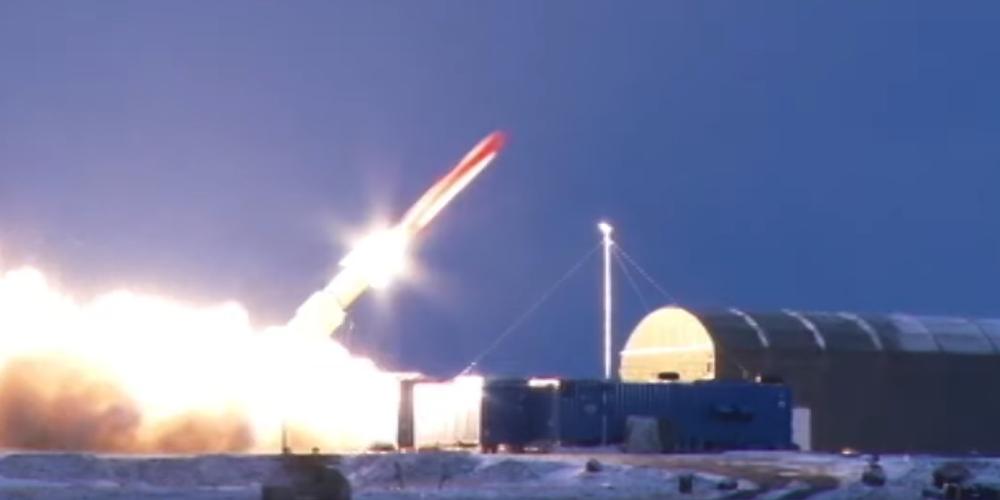
(End of the American Dream)—For a moment, I would like you to imagine what the perfect cruise missile would look like. It would have to be so evasive that no missile defense system on Earth could intercept it. It would also have to possess unlimited range so that it could hit any potential target on the entire planet. In addition, it would also have to be capable of carrying a nuclear warhead so that it could serve as the ideal nuclear deterrent. What I have just described may sound like a fantasy, but now it actually exists.
Needless to say, the United States does not have such a weapon.
But the Russians do.
According to Russian President Vladimir Putin, his military has just successfully tested a new nuclear-powered missile called “the Flying Chernobyl”…
VLADIMIR Putin claims Russia has test-launched a new nuclear-powered missile dubbed the “Flying Chernobyl” – and has vowed it will soon be ready for war.
The Russian president said his menacing 9M730 Burevestnik missile – assigned the codename “Skyfall” by Nato – was a “weapon of unlimited range powered by a nuclear engine”.
This isn’t just another missile.
Once you understand what it is capable of, you quickly realize that it has the potential to change everything.
The 9M730 Burevestnik looks like a normal cruise missile, but inside it has a compact nuclear reactor which could allow it to remain in the air “for weeks or even months without refueling”…
Visually, the Burevestnik resembles a traditional cruise missile, with folding wings for compact launch storage. It launches from a ground platform using a solid-fuel booster, then switches to an air-breathing nuclear-powered jet engine once it reaches cruising speed. In theory, this engine heats incoming air via a compact nuclear reactor, allowing the missile to stay airborne for weeks or even months without refueling.
Sources estimate the missile’s operational range at 22,000km, though in practice it may be virtually unlimited. Such a missile could patrol potential conflict zones indefinitely, awaiting launch commands. Upon receiving orders, it could maneuver toward targets from unpredictable vectors, making interception extraordinarily difficult.
You can’t destroy a missile before it is fired if it is never on the ground.
And a missile that can stay in the air “for weeks or even months” could theoretically attack from any direction. That is a nightmare for military planners.
And it would be exceedingly difficult to perform a successful surprise first strike on an adversary that already has “a guaranteed retaliatory strike” already in the air…
During the October 21 test, according to Russia’s top brass, the missile remained airborne for several hours, covered 14,000km, and executed vertical and horizontal maneuvers associated with defense evasion profiles.
Effectively, the Burevestnik is designed to serve as a ‘doomsday weapon’ – a guaranteed retaliatory strike platform in the event of nuclear war.
The 9M730 Burevestnik flies so fast and it is so evasive that it would be almost impossible to shoot it down.
So we are talking about a weapon with unlimited range that can hit us from any direction and that we have no realistic hope of intercepting.
One Russian official was certainly not exaggerating when he called it an “absolutely new class” of weapon…
The Russian leader also claimed it was invulnerable to current and future missile defenses, due to its almost unlimited range and unpredictable flight path.
Kirill Dmitriev, a top Putin aide who was in the U.S. as the video surfaced, said his delegation informed U.S. colleagues of the “successful testing” of the Burevestnik, which he said was an “absolutely new class” of weapon.
Of course this is not the only thing that the Russians have been working on.

Less than a year ago, we saw what the new Oreshnik missile is capable of doing.
And according to leaked documents, the Russians have recently placed large production orders for a number of other highly advanced missile systems…
The report lists the following procurement data:
303 Iskander-K (9M728) cruise missiles.
1,202 Iskander-M (9M723) ballistic missiles in multiple variants.
18 new 9M723-2 missiles, possibly the “Iskander-1000”, with a range of 500–1,000 km.
95 9M729 missiles, featuring an extended range of over 2,000 km.
690 Kalibr (3M14) missiles ordered between 2022–2026, including 56 special 3M14S nuclear variants.
1,225 Kh-101 air-launched cruise missiles.
188 Kinzhal hypersonic missiles.
Up to 240 Zircon (3M22) hypersonic missiles scheduled for 2024–2026.
32 “Product 506” (Kh-BD) next-generation cruise missiles.
In total, the leaked records indicate that Russia plans to field around 2,500 new missiles by the end of 2025, confirming a sustained and methodical expansion of its strategic and tactical strike capacity.
The Russians are clearly preparing for the kinetic phase of World War III.
Are we?
On Russian television, pundits are constantly talking about conducting missile strikes on western targets. Here is just one example…
Russia has issued an urgent warning to the UK over the potential of an “overwhelming” nuclear strike if NATO countries supply Ukraine with long-range weapons. A journalist made the stark warning on Russian state media, explaining that the attack would involve air and sea-launched cruise missiles on a “massive scale”.
A video posted on the Russian Media Monitor YouTube page, which supplies clips broadcast by Russian state media, shows military expert Mikhail Khodaryonok outlining the potential Russian response if Western European nations supported Kyiv with long-range weapons. He claimed that the West is “forcing” the Kremlin into taking extreme measures.
We would be wise to settle the war in Ukraine peacefully while we still can.

Unfortunately, President Trump has accused Vladimir Putin of “wasting his time” and is refusing to even meet with him until the Russians are willing to make the sort of compromises that western leaders want…
DONALD Trump is “disappointed” in Vladimir Putin and has ruled out meeting the tyrant until he stops “wasting his time”.
The US president says there will be no in-person summit unless the Russian despot can prove he is serious about wanting peace in Ukraine.
Of course the Russians are not inclined to make major concessions because they are winning the war.
In fact, there are reports that thousands of Ukraine’s best troops have just been encircled, but the Ukrainian government is disputing this…
Ukrainian President Volodymyr Zelenskyy refuted Russia’s information about the encirclement of 5,000 Ukrainian servicemen in the Kupyansk and Pokrovsk directions, calling it a lie aimed at the United States. He noted that enemy activity in these directions this week was lower, and Ukrainian troops are in control of the situation.
If this war continues to drag on, it is just a matter of time before Russia and NATO are directly fighting one another.
Once we reach that stage, we will literally be on the verge of nuclear war.
President Trump must not allow that to happen.
Speaking of nuclear war, three citizens of China have just been arrested for trying to illegally purchase 4.4 pounds of uranium…
Three Chinese citizens have been arrested in Georgia’s capital, Tbilisi, while attempting to illegally purchase 2 kilograms (4.4 pounds) of uranium, the country’s State Security Service said Saturday.
The suspects planned to transport the nuclear material to China through Russia, the security service said in a statement, while also releasing video footage of the detention operation.
“Three Chinese citizens have been detained in Tbilisi while attempting to illegally purchase 2 kilograms of nuclear material — uranium,” the agency said, adding that members of the criminal group planned to pay $400,000 (344,000 euros) for the radioactive material.
Wow.
Were these three individuals working for the Chinese government? And why were they planning to transport this uranium to China?
Even more importantly, what did they plan to do with it?
For decades, we have been warned about the dangers of nuclear weapons. Sadly, I believe that we live at a time when they will actually be used.
The clock is ticking my friends, but for the moment ignorance is still bliss for the vast majority of the population.
Michael’s new book entitled “10 Prophetic Events That Are Coming Next” is available in paperback and for the Kindle on Amazon.com, and you can subscribe to his Substack newsletter at michaeltsnyder.substack.com.

Two Storms, One Harvest

Every food crisis in living memory has been a one-shock event. The 2008 price spike was a commodity bubble. The 2020 shortages were a logistics failure. The 2022 grain scare was a war on one exporter’s ports. Each time, the system bent, adjusted, and recovered, and each time the experts assured us afterward that global markets are simply too big and too diversified to fail.
What nobody in Washington seems eager to discuss is that 2026 is shaping up to be something the modern food system has never actually faced. Two independent shocks, one climatic and one geopolitical, are converging on the same harvest cycle at the same time. Not sequentially. Simultaneously.
Start with the weather. The Pacific Ocean is currently building toward what forecasters now openly call a record event. NOAA’s Climate Prediction Center puts the odds of at least a strong El Niño near 88 percent, with roughly two in three odds it reaches “very strong” status, the tier reserved for perhaps three or four events in the entire satellite era. Every major global model now projects a median peak in Super El Niño territory, and most of them project it exceeding the 2015-16 event, which until now held the modern record. Sea surface anomalies were already brushing the super threshold in mid-July, months before these events normally peak. The atmosphere has already shifted into El Niño mode, and the event is forecast to crest in late fall and early winter.
This is not about “climate change.” It’s about the standard cycles of weather, and the cycle we’re currently in is one that has likely devastated societies in the past. We’re better prepared as a society today, but not all Americans are equally prepared.
Serious households have started doing the quiet math on their own. Grocery bills tell part of the story, and the forecast maps tell the rest, which is why long-term food storage has moved from fringe hobby to mainstream line item in the family budget, with established suppliers like Heaven’s Harvest seeing demand from people who five years ago would have rolled their eyes at the idea. That instinct is not paranoia. It is pattern recognition, and the pattern is worth walking through carefully.
Editor’s Note: Heaven’s Harvest IS a sponsor, but the warnings of this article are real and would be written even if we didn’t have a survival food sponsor. With that said, those who take advantage of what they offer can use promo code “Patriot” for 15% off.
The Fertilizer Clock Is Already Running
While the Pacific warms, the second shock has been unfolding in the Strait of Hormuz. The conflict with Iran turned the world’s most important energy chokepoint into a contested waterway, and the consequences reach far beyond the gas pump. Roughly a third of global fertilizer trade moves through Hormuz, and the disruption sent urea prices up 86 percent year over year by March, with a 53 percent jump in a single month.
The World Bank projects energy prices rising about 24 percent in 2026 and fertilizer about 31 percent. By its own accounting, fertilizer prices ran 35 percent higher in the first five months of this year than the same period last year.
Here is the mechanism the nightly news will not explain. Fertilizer is not a grocery item. It is a time-delayed input. The nitrogen a farmer in Iowa or Punjab could not afford to apply this spring does not show up as a problem this spring. It shows up as a thinner harvest six to twelve months later.
The World Bank’s own food security brief concedes that the effects of reduced applications earlier this season “are likely to become visible only later in harvest outcomes.” Translate that from institutional language into plain English and it means this. The damage is already done, it is already in the ground, and we are simply waiting for it to arrive on the shelf.
Now check the calendar. Six to twelve months from the spring planting season lands us squarely in late 2026 and early 2027. Which is precisely when the strongest El Niño in the instrumental record is forecast to peak, bringing its signature droughts to Southeast Asia, Australia, southern Africa, northern Brazil, and South Asia, the very regions that grow the world’s rice, sugar, and oilseeds.
The World Bank warns openly that a strong El Niño “could disrupt multiple crop belts simultaneously” on top of the conflict-driven input costs. Their baseline projection assumes the Middle East disruptions ease by autumn. What in the last two years of Middle East history suggests that assumption is safe?
The System Has No Slack Left
The comfortable answer is that global markets always adjust. But adjustment requires slack, and the slack is gone. Global cereal production is expected to decline from last year’s records even before El Niño does its work. The UN World Food Programme, hardly a den of right-wing preppers, is calling this the most significant disruption to its supply chains since Covid and the invasion of Ukraine, and its supply chain director put the stakes bluntly.
Today’s supply chain challenges are tomorrow’s hunger crisis.
There is also a political dimension that markets cannot price. When food gets scarce, governments do not behave like economists. They behave like politicians. Export bans, hoarding mandates, and panic buying at the national level turned the modest rice shortfall of 2008 into a global crisis, and analysts are already warning that import-dependent nations are the first dominoes.
The 2015-16 Super El Niño, a far weaker event than what is now forecast, threw tens of millions into food stress across Africa and Asia. This one is projected to be stronger, and it arrives with fertilizer already rationed by price and shipping lanes already contested by missiles.
What Joseph Knew
Scripture does not treat preparation for lean years as faithlessness. It treats it as wisdom delivered in advance to those willing to act on it.
Behold, there come seven years of great plenty throughout all the land of Egypt: And there shall arise after them seven years of famine; and all the plenty shall be forgotten in the land of Egypt.
Joseph did not respond to that warning with a hashtag or a committee. He stored grain during the years of abundance, and when the famine came, Egypt stood while its neighbors begged. The lesson is not that famine is certain. It is that the time to prepare is precisely when preparation still looks optional.
Nobody who filled a pantry in a year of plenty has ever regretted it, and nobody standing in an empty aisle has ever been glad he waited for certainty.
None of this calls for panic, and panic is the enemy of sound judgment anyway. It calls for the same unglamorous prudence our grandparents considered ordinary. Keep some cash margin, know your local growers, and put real food in deep storage while it is cheap and available, because the entire arc of this story is that cheap and available is a closing window.
Families looking for a straightforward place to start can visit Heaven’s Harvest and use promo code Patriot for 15 percent off long-term storable food. The forecasts may yet soften, the strait may yet reopen, and we should pray they do. But hope is a fine thing to hold and a foolish thing to eat.
