

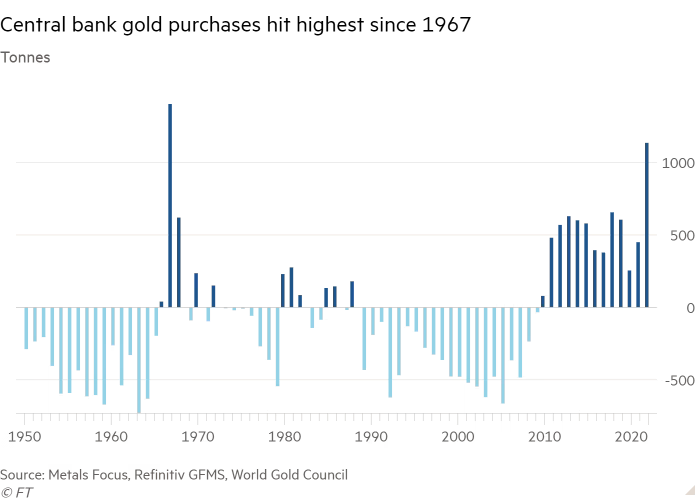
Did you know that central banks bought more gold last year than any year in the past 55 years—since 1967? Though most don’t realize it, 1967 was a significant year in financial history, mainly due to the events at the London Gold Pool.
The London Gold Pool was an agreement among central banks of the United States and Western European countries to stabilize the price of gold. The goal was to maintain the price of gold at $35 per ounce by collectively buying or selling gold as needed.
However, in 1967 the London Gold Pool collapsed due to a shortage of gold and increased demand for the metal. That’s because European central banks bought massive amounts of gold as they began to doubt the US government’s promise to back the dollar to gold at $35/ounce. The buying depleted the London Gold Pool’s reserves and pushed the price of gold higher.
In short, 1967 was the beginning of the end of the Bretton Woods international monetary system that had been in place since the end of World War 2. It ultimately led to severing the US dollar’s last link to gold in 1971. The dollar has been unbacked fiat confetti ever since—though the petrodollar system and coercion have propped it up.
The point is large global gold flows can be a sign that a paradigm shift in the international monetary system is imminent.
Central banks are the biggest players in the gold market. And now that we have just experienced the largest year for central bank gold purchases since 1967, it’s clear to me something big is coming soon.
And those are just the official numbers that governments report. The actual gold purchases could be much higher because governments are often opaque about their gold holdings, which they consider a crucial part of their economic security.
Today, I think we are on the cusp of a radical change in the international monetary system with profound implications. Yet, few are aware of what is happening and its enormous significance.
I suspect most people will be taken by surprise—and it won’t be a pleasant one. They’ll be the ones holding the bag for a failing monetary system.
But it doesn’t have to be a disaster for everyone… Those who get positioned properly ahead of this paradigm shift could make fortunes.
The Real Reason for China’s Massive Gold Stash
According to the Financial Times, the big buyers of gold in 2022 were China and Middle East oil producers. That’s not a coincidence, as these countries will be at the center of the changes to the international monetary system.
It’s no secret that China has been stashing away as much gold as possible for many years. China is the world’s largest producer and buyer of gold. Most of that gold finds its way into the Chinese government’s treasury.
Nobody knows the exact amount of gold China has, but most observers believe it is many multiples of what the government declares. Today it’s clear why China has had an insatiable demand for gold.
Beijing has been waiting for the right moment to pull the rug from beneath the US dollar. And now is that moment…
The key to understanding it all is Chinese President Xi’s recent historic visit to Saudi Arabia and other Gulf Cooperation Council (GCC) states to launch, in his words, “a new paradigm of all-dimensional energy cooperation.”
The GCC includes Saudi Arabia, Kuwait, Qatar, Bahrain, Oman, and the United Arab Emirates. These countries account for more than 25% of the world’s oil exports, with Saudi Arabia alone contributing around 17%. In addition, more than 25% of China’s oil imports come from Saudi Arabia. China is the GCC’s largest trading partner.
The meetings reflect a natural—and growing—trade relationship between China, the world’s largest oil importer, and the GCC, the world’s largest oil exporters. During Xi’s visit, he made the following crucial remarks (emphasis mine):
“China will continue to import large quantities of crude oil from GCC countries, expand imports of liquefied natural gas, strengthen cooperation in upstream oil and gas development, engineering services, storage, transportation and refining, and make full use of the Shanghai Petroleum and National Gas Exchange as a platform to carry out yuan settlement of oil and gas trade.”
After years of preparation, the Shanghai International Energy Exchange (INE) launched a crude oil futures contract denominated in Chinese yuan in March 2018. It’s the first oil futures contract to be traded in China. The contract is based on Brent crude oil, the global benchmark for oil prices, and is settled in cash.
Since then, any oil producer can sell its oil for something besides US dollars… in this case, the Chinese yuan. The INE yuan oil futures contract provides a new pricing benchmark for the global oil market, which the US dollar has traditionally dominated. By trading in yuan, the contract is expected to increase the use of the Chinese currency in global trade and reduce the reliance on the US dollar.
Its significance lies in its potential to shift the balance of power in the oil market away from the US and towards China and to increase the use of the Chinese yuan in global trade. There’s one big issue, though. Most oil producers don’t want to accumulate a large yuan reserve, and China knows this.

That’s why China has explicitly linked the crude futures contract with the ability to convert yuan into physical gold—without touching China’s official reserves—through gold exchanges in Shanghai (the world’s largest physical gold market) and Hong Kong.
PetroChina and Sinopec, two Chinese oil companies, provide liquidity to the yuan crude futures by being big buyers. So, if any oil producer wants to sell their oil in yuan (and gold indirectly), there will always be a bid.
After years of growth and working out the kinks, the INE yuan oil future contract is now ready for prime time. Xi wouldn’t promise the GCC large and consistent oil purchases if it wasn’t ready. Why is China purchasing oil and gas from the GCC in yuan important?
Because it undercuts the petrodollar system, which has been the bedrock of the US and international financial system since the Bretton Woods system broke down in 1971.
The Saudis Acquiesce and What Happens Next
For nearly 50 years, the Saudis had always insisted anyone wanting their oil would need to pay with US dollars, upholding their end of the petrodollar system.
But that all changed recently.
After Xi’s historic visit and bombshell announcement, the Saudi government isn’t hiding its intention to sell oil in yuan. According to a recent Bloomberg report:
“Saudi Arabia is open to discussions about trade in currencies other than the US dollar, according to the kingdom’s finance minister.”
In short, the Saudis don’t think the US is holding up its end of the petrodollar deal. So they don’t feel like they should hold up their part.
The Saudis are angry at the US for not supporting it enough in its war against Yemen. They were further dismayed by the US withdrawal from Afghanistan and the nuclear negotiations with Iran.
In this context, China swooped in and, after many years, finally compelled the Saudis to accept yuan as payment. It was bound to happen.
China is already the world’s largest oil importer. Moreover, the amount of oil it imports continues to grow as it fuels an economy of over 1.4 billion people (more than 4x larger than the US).
The sheer size of the Chinese market made it impossible for Saudi Arabia—and other oil exporters—to ignore China’s demands to pay in yuan indefinitely. The Shanghai International Energy Exchange further sweetens the deal for oil exporters.
Here’s the bottom line. Saudi Arabia—the linchpin of the petrodollar system—is openly agreeing not to sell its oil exclusively in US dollars.
It signals an imminent and enormous change for anyone holding US dollars. It would be incredibly foolish to ignore this giant red warning sign.
Even the WSJ admits such a move would be disastrous for the US dollar.
“The Saudi move could chip away at the supremacy of the US dollar in the international financial system, which Washington has relied on for decades to print Treasury bills it uses to finance its budget deficit.”
Ron Paul is an American politician and physician who has been a vocal critic of the current international monetary system for decades. Nixon’s move to end the dollar’s link to gold in 1971 initially motivated him to get into politics. He is known for his views on monetary policy, central banking, and the Federal Reserve. Ron Paul has written several books on these topics and advocated for a return to sound money and a gold-backed monetary system.
In short, Ron Paul knows more about the international monetary system than almost anyone alive.
He once gave a speech called “The End of Dollar Hegemony,” where he pointed out the one thing that would precipitate the US dollar’s collapse.
Here’s the relevant part:
“The economic law that honest exchange demands only things of real value as currency cannot be repealed.
The chaos that one day will ensue from our experiment with worldwide fiat money will require a return to money of real value.
We will know that day is approaching when oil-producing countries demand gold, or its equivalent, for their oil rather than dollars or euros.
The sooner the better.”
Here’s the bottom line. The end of the petrodollar system is imminent.
For over 50 years, this arrangement has allowed the US government and many Americans to live way beyond their means.
The US takes this unique position for granted. But it will soon disappear. There will be a lot of extra dollars floating around suddenly looking for a home now that they are not needed to purchase oil.
As a result, a lot of oil money—hundreds of billions of dollars and perhaps trillions—that would typically flow through banks in New York in US dollars into US Treasuries will instead flow through Shanghai into yuan and gold.
The end of the petrodollar system is bad news for Americans. Unfortunately, there’s little any individual can practically do to change the course of these trends in motion. The best you can and should do is to stay informed so that you can protect yourself in the best way possible, and even profit from the situation.
That’s precisely why I just released an urgent report on where this is all headed and what you can do about it… including three strategies everyone needs today.
- Click here to download the PDF now.
- Article cross-posted from International Man.

Two Storms, One Harvest

Every food crisis in living memory has been a one-shock event. The 2008 price spike was a commodity bubble. The 2020 shortages were a logistics failure. The 2022 grain scare was a war on one exporter’s ports. Each time, the system bent, adjusted, and recovered, and each time the experts assured us afterward that global markets are simply too big and too diversified to fail.
What nobody in Washington seems eager to discuss is that 2026 is shaping up to be something the modern food system has never actually faced. Two independent shocks, one climatic and one geopolitical, are converging on the same harvest cycle at the same time. Not sequentially. Simultaneously.
Start with the weather. The Pacific Ocean is currently building toward what forecasters now openly call a record event. NOAA’s Climate Prediction Center puts the odds of at least a strong El Niño near 88 percent, with roughly two in three odds it reaches “very strong” status, the tier reserved for perhaps three or four events in the entire satellite era. Every major global model now projects a median peak in Super El Niño territory, and most of them project it exceeding the 2015-16 event, which until now held the modern record. Sea surface anomalies were already brushing the super threshold in mid-July, months before these events normally peak. The atmosphere has already shifted into El Niño mode, and the event is forecast to crest in late fall and early winter.
This is not about “climate change.” It’s about the standard cycles of weather, and the cycle we’re currently in is one that has likely devastated societies in the past. We’re better prepared as a society today, but not all Americans are equally prepared.
Serious households have started doing the quiet math on their own. Grocery bills tell part of the story, and the forecast maps tell the rest, which is why long-term food storage has moved from fringe hobby to mainstream line item in the family budget, with established suppliers like Heaven’s Harvest seeing demand from people who five years ago would have rolled their eyes at the idea. That instinct is not paranoia. It is pattern recognition, and the pattern is worth walking through carefully.
Editor’s Note: Heaven’s Harvest IS a sponsor, but the warnings of this article are real and would be written even if we didn’t have a survival food sponsor. With that said, those who take advantage of what they offer can use promo code “Patriot” for 15% off.
The Fertilizer Clock Is Already Running
While the Pacific warms, the second shock has been unfolding in the Strait of Hormuz. The conflict with Iran turned the world’s most important energy chokepoint into a contested waterway, and the consequences reach far beyond the gas pump. Roughly a third of global fertilizer trade moves through Hormuz, and the disruption sent urea prices up 86 percent year over year by March, with a 53 percent jump in a single month.
The World Bank projects energy prices rising about 24 percent in 2026 and fertilizer about 31 percent. By its own accounting, fertilizer prices ran 35 percent higher in the first five months of this year than the same period last year.
Here is the mechanism the nightly news will not explain. Fertilizer is not a grocery item. It is a time-delayed input. The nitrogen a farmer in Iowa or Punjab could not afford to apply this spring does not show up as a problem this spring. It shows up as a thinner harvest six to twelve months later.
The World Bank’s own food security brief concedes that the effects of reduced applications earlier this season “are likely to become visible only later in harvest outcomes.” Translate that from institutional language into plain English and it means this. The damage is already done, it is already in the ground, and we are simply waiting for it to arrive on the shelf.
Now check the calendar. Six to twelve months from the spring planting season lands us squarely in late 2026 and early 2027. Which is precisely when the strongest El Niño in the instrumental record is forecast to peak, bringing its signature droughts to Southeast Asia, Australia, southern Africa, northern Brazil, and South Asia, the very regions that grow the world’s rice, sugar, and oilseeds.
The World Bank warns openly that a strong El Niño “could disrupt multiple crop belts simultaneously” on top of the conflict-driven input costs. Their baseline projection assumes the Middle East disruptions ease by autumn. What in the last two years of Middle East history suggests that assumption is safe?
The System Has No Slack Left
The comfortable answer is that global markets always adjust. But adjustment requires slack, and the slack is gone. Global cereal production is expected to decline from last year’s records even before El Niño does its work. The UN World Food Programme, hardly a den of right-wing preppers, is calling this the most significant disruption to its supply chains since Covid and the invasion of Ukraine, and its supply chain director put the stakes bluntly.
Today’s supply chain challenges are tomorrow’s hunger crisis.
There is also a political dimension that markets cannot price. When food gets scarce, governments do not behave like economists. They behave like politicians. Export bans, hoarding mandates, and panic buying at the national level turned the modest rice shortfall of 2008 into a global crisis, and analysts are already warning that import-dependent nations are the first dominoes.
The 2015-16 Super El Niño, a far weaker event than what is now forecast, threw tens of millions into food stress across Africa and Asia. This one is projected to be stronger, and it arrives with fertilizer already rationed by price and shipping lanes already contested by missiles.
What Joseph Knew
Scripture does not treat preparation for lean years as faithlessness. It treats it as wisdom delivered in advance to those willing to act on it.
Behold, there come seven years of great plenty throughout all the land of Egypt: And there shall arise after them seven years of famine; and all the plenty shall be forgotten in the land of Egypt.
Joseph did not respond to that warning with a hashtag or a committee. He stored grain during the years of abundance, and when the famine came, Egypt stood while its neighbors begged. The lesson is not that famine is certain. It is that the time to prepare is precisely when preparation still looks optional.
Nobody who filled a pantry in a year of plenty has ever regretted it, and nobody standing in an empty aisle has ever been glad he waited for certainty.
None of this calls for panic, and panic is the enemy of sound judgment anyway. It calls for the same unglamorous prudence our grandparents considered ordinary. Keep some cash margin, know your local growers, and put real food in deep storage while it is cheap and available, because the entire arc of this story is that cheap and available is a closing window.
Families looking for a straightforward place to start can visit Heaven’s Harvest and use promo code Patriot for 15 percent off long-term storable food. The forecasts may yet soften, the strait may yet reopen, and we should pray they do. But hope is a fine thing to hold and a foolish thing to eat.
