

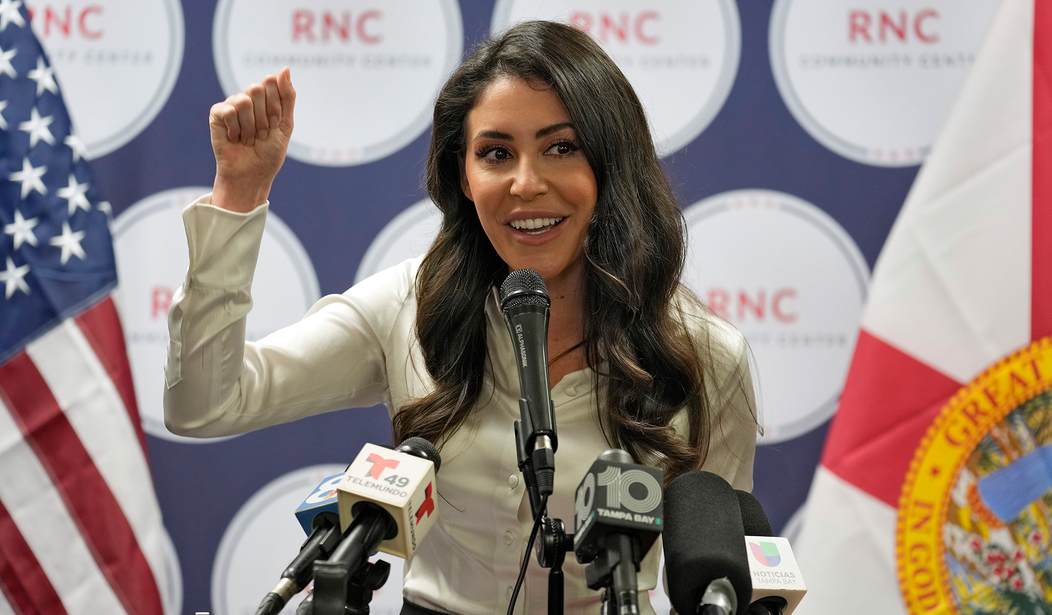
 (DCNF)—Republican Florida Rep. Anna Paulina Luna is sounding the alarm about corporate interests threatening to tank Robert F. Kennedy Jr.’s nomination to serve as President Donald Trump’s Health and Human Services (HHS) secretary.
With Kennedy facing two confirmation hearings next week, the prospective HHS secretary’s confirmation is uncertain due to a number of GOP holdouts who are thus far noncommittal. Luna, who supports Kennedy’s nomination and has been a driving force behind Make America Healthy Again (MAHA) priorities in Congress, is warning that senators will face immense pressure from large corporations profiting off the country’s chronic disease crises to oppose Kennedy’s nomination.
“I do believe that there are nefarious actors within the agriculture and food industries that are going to start putting financial top-down pressure on some of these senators in an effort to block his confirmation because they’re making a lot of money on making people sick, Luna, a member of the House Freedom Caucus, told the DCNF. “[Opposing Kennedy’s nomination] would signify that they’re corporate shills that have no invested interest in keeping our people healthy but sick for their own personal gain and interest.”
“There’s a lot of good people here in Washington, but there’s also a lot of bad people that I think are more controlled by corporations,” Luna added.
Luna, who served as a surrogate for Trump’s 2024 Presidential campaign, believes that GOP senators would be rejecting the president’s mandate and core campaign promise to “Make America Healthy Again” if they were to oppose Kennedy’s nomination to serve as HHS secretary. Senators that vote “no” on Kennedy’s nomination would also invite backlash from millions of Trump-Vance voters across the country, including self-described “MAHA moms” that want to feed their families healthy foods free of toxins and harmful additives, according to Luna, who counts herself in that cohort.
“A lot of people have no idea the underground force that they’re playing with: the amount of moms especially that just do not want this sh*t in their food,” Luna, who described herself as label-conscious when she goes grocery shopping, said during the interview.
Kennedy’s GOP Holdouts
Kennedy is scheduled to appear before the Senate Finance and Health, Education, Labor and Pensions (HELP) committees on Wednesday and Thursday.
The finance committee will likely vote the following week to advance Kennedy’s nomination to the Senate floor. Due to Senate Republicans’ one-seat majority on the committee, a single GOP senator could block Kennedy’s nomination in the event all Democratic lawmakers on the committee oppose Kennedy.
Three Republican senators who sit on the finance committee — Bill Cassidy of Louisiana, Todd Young of Indiana and Thom Tillis of North Carolina — have yet to take a firm position on Kennedy’s nomination.
Young’s staff told the DCNF that the Indiana Republican’s meeting with Kennedy was “very positive.”
Tillis has committed to voting for any Trump nominee that advances out of committee, but has not commented on whether he plans to support Kennedy during the Finance committee vote. A spokesperson for Tillis did not respond to the DCNF’s requests for comment.
Cassidy, a former gastroenterologist, has complimented parts of Kennedy’s advocacy around ultra-processed foods and chronic disease, but suggested the HHS secretary nominee is “wrong” about vaccines, during an interview on “Fox News Sunday” on Jan 5.
Had a frank conversation with HHS nominee @RobertKennedyJr. We spoke about vaccines at length. Looking forward to the hearings in HELP and Finance. pic.twitter.com/FIcNYLNlr0
— U.S. Senator Bill Cassidy, M.D. (@SenBillCassidy) January 8, 2025
GOP Sens. Susan Collins of Maine, Lisa Murkowski of Alaska and Mitch McConnell of Kentucky, seen as more willing to oppose some of Trump’s nominees, could also pose problems for Kennedy. Just four GOP senators could tank Kennedy’s nomination on the Senate floor assuming all Senate Democrats vote against Kennedy to lead HHS.
MAHA’s Momentum Heading Into Kennedy’s Confirmation Fight
Luna told the DCNF that more of her Republican colleagues are adopting Kennedy’s positions on various food and health issues that the presumptive HHS secretary pushed to the forefront of the national political conversation during the 2024 presidential campaign.

“There’s also conversations on the floor from other members that are also now becoming educated on it [harmful ingredients in the food supply] and just are horrified because they have young kids, grandchildren,” Luna told the DCNF. “A lot of people were just too trusting and unaware of what was happening with the food industry and just big corporate production … and how much stuff they were adding in just basically as filler instead of actual quality content, food products,” Luna told the DCNF.
But the Florida lawmaker has faced resistance from her own party in attempting to regulate harmful chemicals in the food supply.
Bills that Luna introduced last Congress to ban artificial food dyes linked to cancer and high-fructose corn syrup, associated with increased risk of obesity and diabetes, did not advance out of the Republican-controlled Energy and Commerce committee.
Our food affects every part of our lives, including our hormones, immune system, microbiome, brain chemistry, and more. What we fuel our bodies with matters.
That’s why I’ve introduced legislation to BAN harmful additives and toxic seed oils from everyday foods! #MAHA
— Rep. Anna Paulina Luna (@RepLuna) January 22, 2025
She is considering introducing legislation this Congress to place warning labels on artificial and harmful food ingredients, which could garner more support from GOP colleagues than implementing outright bans.
Luna’s spokesperson sent the DCNF a list of 15 food additives she would like to regulate by requiring their packaging comes with warning labels, similar to the ones seen on cigarette boxes. Many of these ingredients, including Red Dye 40, Green Dye 3, Yellow Dyes 5 and 6, either require warning labels or are banned in the European Union.
Luna is optimistic that the Biden Food and Drug Administration’s (FDA) decision to ban Red Dye 3 in the last weeks of the administration, a long-time goal of Kennedy’s, spurs momentum at the federal level to further crackdown on harmful additives in the food supply.

The FDA banned Red Dye 3 for use in cosmetics and topical drugs in 1990 after scientific studies linked the synthetic dye to cancer in laboratory animals, but allowed the color additive to remain in the food supply.
“It’s not going to just be him [Kennedy],” Luna told the DCNF. “It’s going to be me pushing from the House side. I’m going to get a sponsor in the Senate, and then you’ll have top down pressure so we can hit it from all angles.”
All content created by the Daily Caller News Foundation, an independent and nonpartisan newswire service, is available without charge to any legitimate news publisher that can provide a large audience. All republished articles must include our logo, our reporter’s byline and their DCNF affiliation. For any questions about our guidelines or partnering with us, please contact [email protected].

Two Storms, One Harvest

Every food crisis in living memory has been a one-shock event. The 2008 price spike was a commodity bubble. The 2020 shortages were a logistics failure. The 2022 grain scare was a war on one exporter’s ports. Each time, the system bent, adjusted, and recovered, and each time the experts assured us afterward that global markets are simply too big and too diversified to fail.
What nobody in Washington seems eager to discuss is that 2026 is shaping up to be something the modern food system has never actually faced. Two independent shocks, one climatic and one geopolitical, are converging on the same harvest cycle at the same time. Not sequentially. Simultaneously.
Start with the weather. The Pacific Ocean is currently building toward what forecasters now openly call a record event. NOAA’s Climate Prediction Center puts the odds of at least a strong El Niño near 88 percent, with roughly two in three odds it reaches “very strong” status, the tier reserved for perhaps three or four events in the entire satellite era. Every major global model now projects a median peak in Super El Niño territory, and most of them project it exceeding the 2015-16 event, which until now held the modern record. Sea surface anomalies were already brushing the super threshold in mid-July, months before these events normally peak. The atmosphere has already shifted into El Niño mode, and the event is forecast to crest in late fall and early winter.
This is not about “climate change.” It’s about the standard cycles of weather, and the cycle we’re currently in is one that has likely devastated societies in the past. We’re better prepared as a society today, but not all Americans are equally prepared.
Serious households have started doing the quiet math on their own. Grocery bills tell part of the story, and the forecast maps tell the rest, which is why long-term food storage has moved from fringe hobby to mainstream line item in the family budget, with established suppliers like Heaven’s Harvest seeing demand from people who five years ago would have rolled their eyes at the idea. That instinct is not paranoia. It is pattern recognition, and the pattern is worth walking through carefully.
Editor’s Note: Heaven’s Harvest IS a sponsor, but the warnings of this article are real and would be written even if we didn’t have a survival food sponsor. With that said, those who take advantage of what they offer can use promo code “Patriot” for 15% off.
The Fertilizer Clock Is Already Running
While the Pacific warms, the second shock has been unfolding in the Strait of Hormuz. The conflict with Iran turned the world’s most important energy chokepoint into a contested waterway, and the consequences reach far beyond the gas pump. Roughly a third of global fertilizer trade moves through Hormuz, and the disruption sent urea prices up 86 percent year over year by March, with a 53 percent jump in a single month.
The World Bank projects energy prices rising about 24 percent in 2026 and fertilizer about 31 percent. By its own accounting, fertilizer prices ran 35 percent higher in the first five months of this year than the same period last year.
Here is the mechanism the nightly news will not explain. Fertilizer is not a grocery item. It is a time-delayed input. The nitrogen a farmer in Iowa or Punjab could not afford to apply this spring does not show up as a problem this spring. It shows up as a thinner harvest six to twelve months later.
The World Bank’s own food security brief concedes that the effects of reduced applications earlier this season “are likely to become visible only later in harvest outcomes.” Translate that from institutional language into plain English and it means this. The damage is already done, it is already in the ground, and we are simply waiting for it to arrive on the shelf.
Now check the calendar. Six to twelve months from the spring planting season lands us squarely in late 2026 and early 2027. Which is precisely when the strongest El Niño in the instrumental record is forecast to peak, bringing its signature droughts to Southeast Asia, Australia, southern Africa, northern Brazil, and South Asia, the very regions that grow the world’s rice, sugar, and oilseeds.
The World Bank warns openly that a strong El Niño “could disrupt multiple crop belts simultaneously” on top of the conflict-driven input costs. Their baseline projection assumes the Middle East disruptions ease by autumn. What in the last two years of Middle East history suggests that assumption is safe?
The System Has No Slack Left
The comfortable answer is that global markets always adjust. But adjustment requires slack, and the slack is gone. Global cereal production is expected to decline from last year’s records even before El Niño does its work. The UN World Food Programme, hardly a den of right-wing preppers, is calling this the most significant disruption to its supply chains since Covid and the invasion of Ukraine, and its supply chain director put the stakes bluntly.
Today’s supply chain challenges are tomorrow’s hunger crisis.
There is also a political dimension that markets cannot price. When food gets scarce, governments do not behave like economists. They behave like politicians. Export bans, hoarding mandates, and panic buying at the national level turned the modest rice shortfall of 2008 into a global crisis, and analysts are already warning that import-dependent nations are the first dominoes.
The 2015-16 Super El Niño, a far weaker event than what is now forecast, threw tens of millions into food stress across Africa and Asia. This one is projected to be stronger, and it arrives with fertilizer already rationed by price and shipping lanes already contested by missiles.
What Joseph Knew
Scripture does not treat preparation for lean years as faithlessness. It treats it as wisdom delivered in advance to those willing to act on it.
Behold, there come seven years of great plenty throughout all the land of Egypt: And there shall arise after them seven years of famine; and all the plenty shall be forgotten in the land of Egypt.
Joseph did not respond to that warning with a hashtag or a committee. He stored grain during the years of abundance, and when the famine came, Egypt stood while its neighbors begged. The lesson is not that famine is certain. It is that the time to prepare is precisely when preparation still looks optional.
Nobody who filled a pantry in a year of plenty has ever regretted it, and nobody standing in an empty aisle has ever been glad he waited for certainty.
None of this calls for panic, and panic is the enemy of sound judgment anyway. It calls for the same unglamorous prudence our grandparents considered ordinary. Keep some cash margin, know your local growers, and put real food in deep storage while it is cheap and available, because the entire arc of this story is that cheap and available is a closing window.
Families looking for a straightforward place to start can visit Heaven’s Harvest and use promo code Patriot for 15 percent off long-term storable food. The forecasts may yet soften, the strait may yet reopen, and we should pray they do. But hope is a fine thing to hold and a foolish thing to eat.
