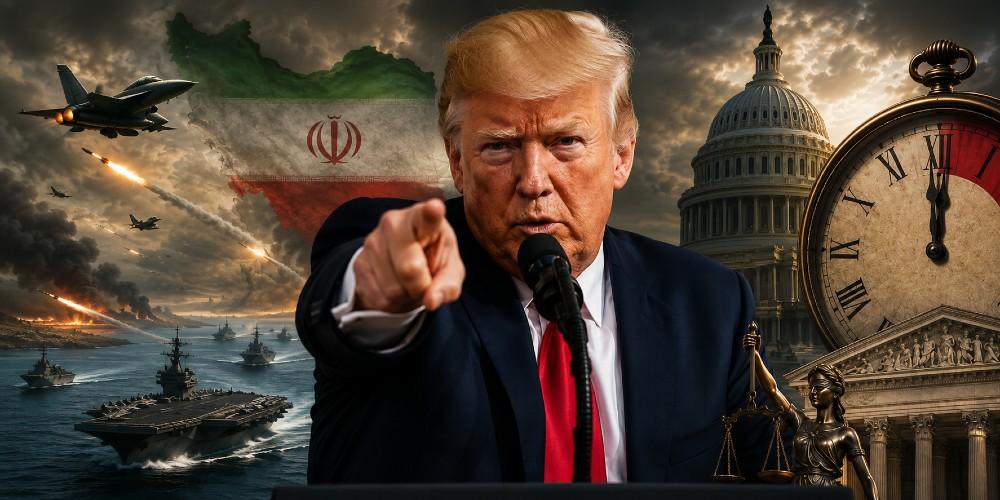
President Trump has restarted the war clock on Iran, and in doing so he has handed Congress a constitutional riddle it has spent 53 years refusing to solve. In a two-page letter dated July 10 and addressed to Senate President Pro Tempore Chuck Grassley, the president formally notified lawmakers that military action against the Islamic Republic recommenced on July 7 — and with that notification, the administration claims a fresh 60-day window to prosecute the fight without congressional authorization.
Democrats say he cannot do that. The White House says he just did. And the 1973 War Powers Act, the statute both sides are waving at each other, may not survive the argument intact.
What the Letter Says
The letter, reviewed Monday by multiple outlets, describes the renewed strikes as military action consistent with the president’s responsibility to protect Americans and American interests. It emphasizes that no ground forces are involved and characterizes the operations as limited, measured, and designed to minimize civilian casualties.
The stated targets are Iranian military capabilities threatening U.S. forces in the region, the American homeland, and commercial shipping transiting the Strait of Hormuz.
The letter also makes clear the campaign is open-ended. American forces, Trump wrote, “remain postured to take further action, as necessary and appropriate, to address further threats and attacks upon the United States or its allies and partners and to ensure the Government of the Islamic Republic of Iran ceases being a threat to the United States and to our allies and partners.”
That is not the language of a punitive one-off. That is the language of a war being fought until the other side quits.
How We Got Here, Again
The United States and Israel began striking Iran on February 28 under Operation Epic Fury. Trump ordered a ceasefire on April 7, which held long enough for the two governments to hash out a Memorandum of Understanding, signed June 17. The Islamic Revolutionary Guard Corps then did what the IRGC does — it kept attacking commercial vessels in the Strait of Hormuz, through which roughly a fifth of the world’s oil passes.
Trump’s patience ran out last week. “To me, I think it’s over. I don’t want to deal with them anymore, but they’re scum,” he said. “They’re scum, they’re sick people, they’re led by sick people, and they’re vicious, violent people.”
U.S. Central Command struck dozens of targets on July 7, and the strikes have continued nightly since. On Monday, Trump escalated further, announcing the naval blockade of Iranian ports is back in force, declaring the Strait under American control, and — in a twist that will delight taxpayers and horrify the foreign policy establishment — announcing a 20 percent fee on cargo shipped through the waterway.
“We guarded the Strait for 50 years, more, and we never got paid for it,” he said. “And now we’re guarding it and we’re going to get paid for guarding it; a lot of money.”
The Clock Fight
Here is where the lawyers earn their retainers. The War Powers Act requires the president to notify Congress within 48 hours of initiating hostilities and to terminate unauthorized military action within 60 days, with a possible 30-day withdrawal extension.
Democrats argue the real clock started February 28 and expired May 1, meaning the president has been waging an unauthorized war for months. A senior House Democratic aide, speaking anonymously to Reuters, argued the president cannot simply erase months of a war he once promised would last four to six weeks.
The administration’s position is that the April ceasefire terminated hostilities, the MOU formalized the peace, and Iran’s violations opened a new conflict — hence a new notification and a new 60 days. Whatever one thinks of the bookkeeping, the underlying logic is not frivolous. If a ceasefire and a signed agreement do not end hostilities for statutory purposes, what does?
Congress has already registered its objection, for whatever that was worth. The House passed a war powers resolution 215-208 on June 3, and the Senate followed 50-48 on June 23, with four Republicans crossing over. But lawmakers chose a concurrent resolution — a vehicle that never reaches the president’s desk and carries no force of law.

The very next day, the Senate declined to advance a binding measure. Congress, in other words, voted to express displeasure while carefully avoiding a vote that would actually require anyone to do anything. It is the legislative equivalent of a strongly worded letter, answered now by a presidential letter with aircraft carriers behind it.
The Question Nobody Wants Answered
Looming over all of this is the constitutional dispute that has festered since 1973. Trump has said plainly that he considers the War Powers Act unconstitutional, an infringement on the Commander in Chief’s Article II authority. He is in respectable company — Richard Nixon vetoed the law on precisely those grounds before Congress overrode him, and every president since has treated compliance as a courtesy rather than a command.
The statute has never been tested in court, largely because neither branch wants to risk losing.
Which is why Trump’s letter is more shrewd than his critics allow. By notifying Congress at all, he preserves the appearance of compliance while asserting an interpretation that renders the 60-day limit infinitely renewable.
If Democrats want to stop him, they will need to pass a binding measure through both chambers with veto-proof majorities, or persuade a federal court to referee a fight between the political branches that the judiciary has ducked for half a century. Neither is likely before September 8, when this clock runs out.
Where the word of a king is, there is power: and who may say unto him, What doest thou?
The Founders answered that question by giving Congress the power to declare war and the power of the purse. Congress has spent decades declining to use either, preferring resolutions that resolve nothing. Until it rediscovers its own authority, the clock belongs to the man willing to wind it.

Sixty days. The countdown has begun — again.