

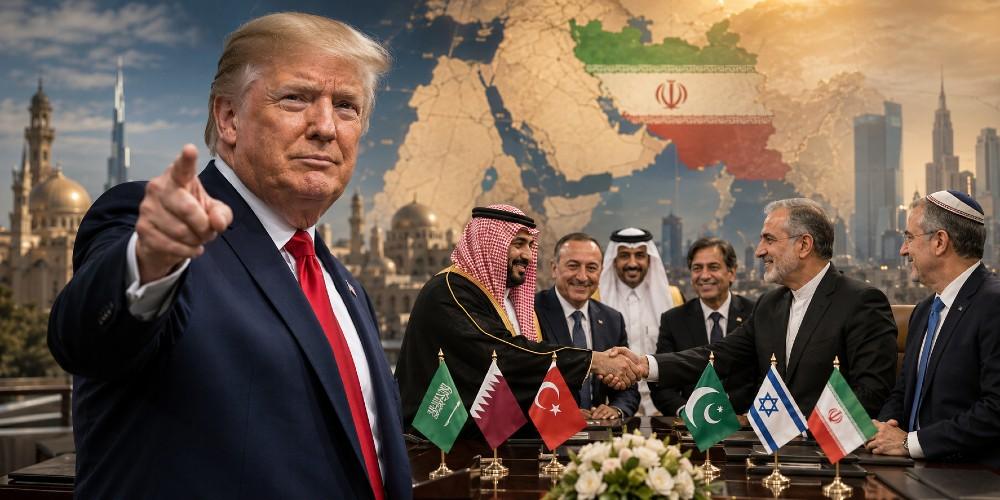
President Trump does not sound like a guy who’s desperate for peace with Iran. In fact, he’s making demands, and not just of the IRGC.
Here’s his Truth Social post from Memorial Day, edited only with line breaks:
Negotiations with the Islamic Republic of Iran are proceeding nicely! It will only be a Great Deal for all or, no Deal at all — Back to the Battlefront and shooting, but bigger and stronger than ever before — And nobody wants that!
During my discussions on Saturday with President Mohammed bin Salman Al Saud, of Saudi Arabia, Mohammed bin Zayed Al Nahyan, of The United Arab Emirates, Emir Tamim bin Hamad bin Khalifa Al Thani, Prime Minister Mohammed bin Abdulrahman bin Jassim bin Jaber Al Thani, and Minister Ali al-Thawadi, of Qatar, Field Marshal Syed Asim Munir Ahmed Shah, of Pakistan, President Recep Tayyip Erdoğan, of Türkiye, President Abdel Fattah El-Sisi, of Egypt, King Abdullah II, of Jordan, and King Hamad bin Isa Al Khalifa, of Bahrain, I stated that, after all the work done by the United States to try and pull this very complex puzzle together, it should be mandatory that all of these Countries, at a minimum, simultaneously, sign onto the Abraham Accords.
Those Countries discussed are Saudi Arabia, The United Arab Emirates (already a Member!), Qatar, Pakistan, Türkiye, Egypt, Jordan, and Bahrain (already a Member!). It may be possible that one or two have a reason for not doing so, and that will be accepted, but most should be ready, willing, and able to make this Settlement with Iran a far more Historic Event than it would, otherwise, be. The Abraham Accords have proven to be, for the Countries involved (The United Arab Emirates, Bahrain, Morocco, Sudan, and Kazakhstan), a Financial, Economic, and Social BOOM, even during this time of Conflict and War, with the current Members never even suggesting leaving, or taking so much as even a pause.
The reason for this is that the Abraham Accords have been great for them, and will be even better for everybody, and bring true Power, Strength, and Peace to the Middle East for the first time in 5,000 years. It will be a Document respected like no other that has ever been signed, anywhere in the World. Its level of Importance and Prestige will be unparalleled!
It should start with the immediate signing by Saudi Arabia and Qatar, and everybody else should follow suit. If they don’t, they should not be part of this Deal in that it shows bad intention. In speaking to numerous of the Great Leaders mentioned above, they would be honored, as soon as our Document is signed, to have the Islamic Republic of Iran as part of the Abraham Accords.
Wow, now that would be something special! This will be the most important Deal that any of these Great, but always in Conflict Countries, will ever sign. Nothing in the past, or in the future, will surpass it. Therefore, I am mandatorily requesting that all Countries immediately sign the Abraham Accords, and that, if Iran signs its Agreement with me, as President of the United States of America, it would be an Honor to have them also be part of this unparalleled World Coalition.
The Middle East would be United, Powerful, and Economically Strong, like perhaps no other area, anywhere in the World! By copy of this TRUTH, I am asking my Representatives to begin, and successfully complete, the process of signing these Countries into the already Historic Abraham Accords. Thank you for your attention to this matter!
DONALD J. TRUMP
PRESIDENT OF THE UNITED STATES OF AMERICA
President Donald Trump has called on key nations—including Saudi Arabia, Qatar, and Pakistan—to join the historic Abraham Accords as part of ongoing negotiations with Iran.
Far from the weak-kneed diplomacy that characterized previous administrations, this demand underscores a clear-eyed recognition that true regional stability requires more than paper agreements with hostile regimes; it demands integration into a framework proven to foster normalization and deter aggression.
The president’s statement on Truth Social leaves no room for ambiguity. The Abraham Accords, brokered during Trump’s first term, stand as one of the most significant diplomatic achievements in modern Middle East history. By bringing Israel together with nations like the United Arab Emirates, Bahrain, Morocco, and Sudan, these agreements bypassed the stale Palestinian veto on progress and focused on shared economic and security interests. Now, Trump seeks to build upon that foundation, challenging holdout nations to align with a coalition that rejects terror sponsorship and embraces mutual prosperity.
Critics on the left will no doubt decry this as provocative, ignoring how their own preferred policies of sanctions relief and nuclear ambiguity only emboldened the mullahs in Tehran. The irony is thick: those who once celebrated the disastrous JCPOA as “diplomacy” now face a president unwilling to repeat the mistakes of funding terror while pretending at restraint. Trump’s insistence on expanding the circle of peace exposes the contradiction at the heart of progressive foreign policy—endless concessions to adversaries paired with suspicion toward proven allies.

Turkey and Pakistan present particular challenges, given their complex relationships with Islamist elements and, in Pakistan’s case, its nuclear arsenal. Yet Trump’s approach recognizes that bringing these nations into the fold could isolate Iran further, forcing a choice between prosperity and pariah status. Saudi Arabia, already engaged in quiet normalization talks with Israel, stands to gain immensely from formal participation, especially as it confronts its own threats from Houthi proxies and Iranian-backed militias.
Qatar’s inclusion would be equally transformative. Long a hub for Hamas financiers and a complicated player in regional dynamics, its commitment to the Accords could mark a genuine shift away from hedging bets with jihadist groups toward genuine stability. The president’s message is unmistakable: participation is not optional if these nations seek the benefits of American partnership and protection.
This strategy reflects a deeper understanding of human nature and geopolitical reality. Evil regimes do not moderate through flattery or financial incentives; they respond to strength and unified opposition. The original Abraham Accords succeeded precisely because they sidelined the failed paradigms of the past, focusing instead on forward-looking partnerships.
As negotiations with Iran proceed, Trump’s vision offers a path that could fundamentally reshape the Middle East. Whether Tehran joins or faces renewed pressure matters less than the solidification of a pro-peace bloc that refuses to tolerate nuclear blackmail or proxy warfare. The left’s predictable outrage will only highlight their discomfort with outcomes that actually deliver security rather than perpetual crisis.
In the end, true peace comes not from wishful thinking but from moral clarity and resolute action. As the prophet Isaiah declared, “And the work of righteousness shall be peace; and the effect of righteousness quietness and assurance for ever” (Isaiah 32:17). Trump’s demand for broader participation in the Abraham Accords embodies this ancient wisdom applied to our modern challenges—pursuing righteousness through strength to secure lasting quietness in a troubled region.
Starting the Day With a Scripture-Inspired Roast Helps Center Your Thoughts on Eternal Truths Amid Temporal Pressures
The world can seem chaotic, especially right after we wake up. Many believers start their mornings reaching for something familiar — a hot cup of coffee — yet end up settling for mediocre brews that do little more than deliver a caffeine jolt. The daily grind of life, with its endless distractions, news cycles, and responsibilities, can leave even the most faithful feeling spiritually parched alongside their physical fatigue. What if your morning ritual could do more than wake you up? What if it could ground you in truth, nourish your body with exceptional quality, and quietly advance a kingdom purpose at the same time?
That’s the promise — and the reality — behind Promised Grounds Coffee. This Christian-founded company doesn’t just roast beans; it approaches every step as an act of worship and discipleship. By selecting only the top 10% of specialty-grade beans, ethically sourced from dedicated farmers in Central and South America, and small-batch roasting them with reverence in Austin, Texas, Promised Grounds delivers what many describe as the best coffee available — never burnt, never bland, but rich with origin stories and layered flavors that honor God’s creation.
From the vibrant Psalm 27 Roast (a light, bright medium option) to the bold yet peaceful 2 Timothy 1:7 Decaf, each bag carries a Scripture verse that turns your daily pour into a gentle reminder of faith. And through their Ounce Per Ounce Promise, every ounce of coffee you enjoy provides an equal ounce of clean water to families in need via partnership with Filter of Hope — literally brewing hope for body and soul, one cup at a time.
The challenge for today’s Christians runs deeper than finding a decent cup. In an age of convenience-driven consumerism, it’s easy to support companies that dilute values or remain silent on matters of faith. Many believers want their everyday choices — from what they drink to how they spend — to reflect discipleship rather than just convenience. Promised Grounds solves this by weaving Christian excellence into the entire process: beans nurtured with prayerful stewardship by farming families, roasted as an offering rather than a commodity, and packaged with Bible verses to encourage a mindset of gratitude and purpose from the first sip. Reviewers consistently praise the smooth, rich profiles — whether enjoyed black in a drip maker, iced on a warm day, or shared in fellowship — noting how the quality stands toe-to-toe with premium secular brands while delivering something far more meaningful.
This integration of faith and flavor addresses a real need in Christian households and ministries. Busy parents, church leaders, and remote workers alike report that starting the day with a Scripture-inspired roast helps center their thoughts on eternal truths amid temporal pressures. The coffee’s exceptional character — bright citrus notes in lighter roasts or deep chocolate undertones in bolder ones — comes from meticulous selection and careful roasting that respects the bean’s natural gifts rather than masking them. It’s the kind of coffee that elevates a simple quiet time, fuels productive workdays, or sparks meaningful conversations when shared at Bible studies or outreach events. And because it’s ethically sourced with integrity, every purchase supports sustainable livelihoods for farmers who treat their crops like family harvests.
For those leading churches or small groups, the impact multiplies. Promised Grounds offers bundles and options perfect for hospitality ministries, turning ordinary coffee service into an opportunity to point people toward the living water of Christ. Imagine greeting visitors with a warm cup whose very bag carries God’s Word — a subtle yet powerful witness that aligns with the Great Commission. The company’s Texas roots and commitment to “brewing hope” resonate especially with believers who value American enterprise paired with global compassion.
Of course, quality alone isn’t enough if the experience feels out of reach. Promised Grounds keeps it accessible with practical perks like free shipping on orders over $40, sample sets for discovering favorites, and thoughtful add-ons such as faith-themed mugs. Whether you prefer whole beans for fresh grinding, grounds for convenience, or even bulk options for larger households and ministries, the result is consistently superior coffee that makes discipleship feel integrated rather than added on.
As you consider how to align even the smallest habits with your walk with God, Promised Grounds Coffee stands out as a refreshing solution. It tackles the dual problems of subpar daily sustenance and disconnected consumption by offering a product that genuinely excels in taste while advancing a mission of clean water, farmer dignity, and scriptural encouragement. Believers who make the switch often describe it as more than a beverage upgrade — it becomes part of their rhythm of gratitude, a daily invitation to remember that every good gift comes from above.
If you’re ready to transform your mornings (and perhaps your church gatherings) with coffee that honors both exceptional craftsmanship and Christian values, I encourage you to explore what Promised Grounds has to offer. One sip at a time, you’ll be nourishing your body, refreshing your spirit, and participating in something far greater — all while enjoying what truly is among the best coffee available.
