

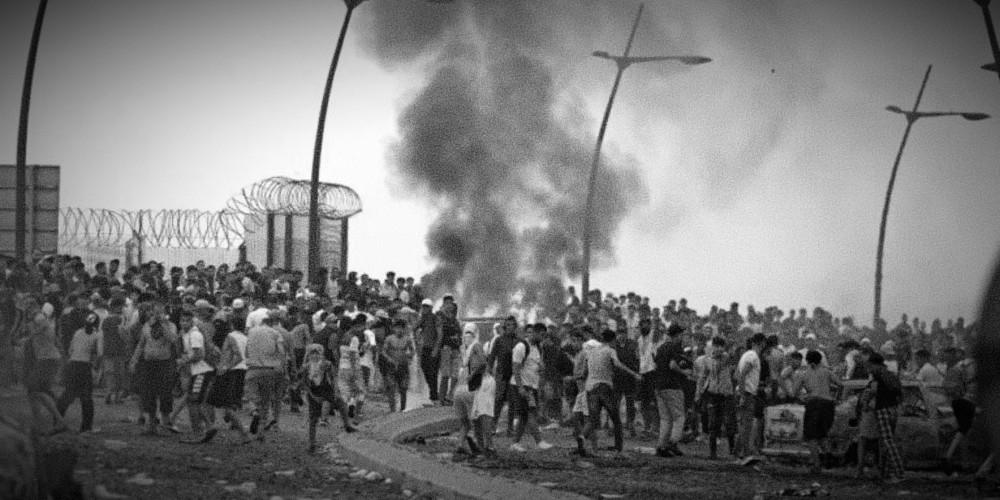
(Alt-Market)—For the past couple of weeks I have been closely tracking the migrant surge in the Spanish enclave of Ceuta and taking notes on the behavior of the extremely liberal Spanish government. One of the most important things to note about the event is that European officials quickly took to the media to admonish the OPTICS of the crisis, but not the migrants.
In other words, left-wing politicians didn’t like that the situation made them look bad, but they never spoke out against the basic premise of mass immigration from the third world. In fact, Spain’s Prime Minister, Pedro Sanchez, has been enthusiastically promoting open border policies since 2018. The main reason the migrants all flooded into Ceuta at the same time was because Spain’s supreme court ruled only days before that migrants arriving by sea could not be immediately deported.
It’s a scene we have witnessed over and over again in the past several years. The multiculturalists set the wheels in motion for a migrant rush into Europe then pretend to be shocked when it happens.
They engineer these events by breaking the cardinal rule of western civilization – Never leave the gates open, because the barbarians will see this as an invitation to pillage. Like hyenas circling a wounded animal, they will be uncontrollably drawn to the smell of an easy meal.
The only reason European elites took any opposition to the incident in Ceuta was because the migrants immediately started looting, burning and attacking locals the second they set foot on the beaches. If the barbarian horde had behaved themselves for a couple weeks, journalists and politicians would have called it a humanitarian crisis and lavished the migrants with praise for their “bravery.”
And yes, I have heard all the conspiracy theories about the US and Israel supposedly pulling the strings to facilitate the invasion and I have found those theories to be complete tripe based on zero tangible evidence. If the Trump Administration, for example, actually wanted migrants to invade Spain, all they would have to do is sit back and let the Spanish government continue to do what they’ve already been doing for years.
The fall of the western world is being aided by progressives, but these elitists are only tapping into the forces of an eternal conflict that has been raging for millennia.
Meaning, even if globalists were not a thing, the west would still be threatened with the constant danger of third world plunder. The elites are merely exploiting a problem that already exists naturally. The root of this conflict is the prominence of two distinct groups of human beings that are incapable of coexistence…
Pillager Culture vs Producer Culture
I was recently watching Sargon of Akkad’s latest expose on a small town in South Africa called Orania. It’s an all white town built by Afrikanns in the middle of nowhere in order to protect themselves from the exceedingly violent black population; a population organized around the ideology of race communism. The video is a great overview of the town and the controversy that surrounds it and I highly recommend watching it in full.
The details of Orania remind me of an article I published last year titled “The Third World Is Forever Chasing The White Man”. The concept of cultural separation is, I believe, the key to almost every problem we are facing in modern times. It may very well be the key to understanding every conflict since human history began.
At bottom, I argue that there are two kinds of people in the world: There are people who produce, create and maintain a functioning civilization. Then, there are parasites and pirates; people whose only survival trait is to pillage the wealth and resources of producer societies.
A community like Orania would not be controversial at all if it was made up of black isolationists, or Asians, or Hispanics, etc. In fact, it would be celebrated. It is treated as radioactive by the media specifically because the town was created by white people FOR white people. Their goal? To preserve their western principles and heritage and, most of all, to protect themselves from pillaging tribes and communists.
Orania looks much like any smaller rural town in America, with clean streets, quiet parks, well maintained infrastructure, self sufficient utilities and farms, safe neighborhoods and kids playing outside without fear.
The interesting thing is the reactions to the town by the YouTubers who visit with the expectation of discovering a virulent, racist, hate-fest. What they find instead is a community that functions far better than any other place in South Africa, run by white western people who just want to be left alone to enjoy the fruits of their labor.

There are two common reactions to Orania:
- Black influencers, surprised by the peace and relative tranquility of the town, ask “why can’t black people have something like this…?”
- South African politicians and thought leaders ask “How can we take away what these people have built and keep it for ourselves…?”
The answer to both questions is uncomfortable for most westerners in the US and Europe to think about, but it is a fact we desperately need to consider and embrace. They can’t copy Orania because they are socially and in some cases genetically incapable (the average IQ of Africans is 70). They can’t steal it for themselves because as soon as they take it over, the town will turn to shit and collapse.
In Ceuta, over 60,000 migrants overran the local infrastructure and demanded access to provisions, jobs, housing and the ability to travel deeper into Europe. When asked why they came to Spanish territory, they all tended to say the same thing: “We want more money and a better life.” They came to Europe because they can’t build a prosperous society on their own. Their pillager mentality drives them to latch onto the west, but as they do this they turn the west into the third world.
Western Civilization Has Two Choices: Separation Or Colonization
In recent articles I have explained the differences that separate the west from the third world, including the absence of the concept of “maintenance” in third world societies. In Africa, for example, there is no terminology for the idea of “maintenance”. They simply don’t have a word for it. They have words for “repair” or “replace”, but not a word for “maintain.” Learning this fact was a revelation for me.
It explains everything about the conflict between the third world and the west. It explains why third worlders are “forever chasing the white man.” It explains why these cultures never seem to progress without direct western investment, intervention or colonization. It explains why these people flood into western countries by the millions the second the gates are left open.
If you cannot maintain, then you can’t keep a system alive for future generations. From basics like water, sewer, sanitation, electricity, food, security, etc. – There can be no generational infrastructure and no generational wealth. Your tribe will be perpetually resource-poor and scratching in the dirt for bugs, UNLESS, that is, you turn to pillaging. You can steal the wealth created by producer tribes, but you can’t copy their success.

If we come to terms with the undeniable existence of the parasite or pillager class, everything becomes clear. The third world as we know it today is rooted in pillager culture, but this ideal is not limited to brown people. Within the west we also have white socialists and communists, useless people who have devised an entire philosophy to justify stealing from producers.
As far as the third world is concerned, the west has been dealing with such people for centuries. We were almost destroyed by them during the Muslim invasions into the Holy Roman Empire from the 7th Century to the 10th Century, and we had to continue to hold them back for several centuries after.
We’ve tried a variety of methods to solve this issue. We tried the Crusades to beat them into submission (effective). We tried colonization and importing western infrastructure so they don’t come to the west to steal what we have (also effective).
However, these solutions are no longer considered political correct by progressive ideology. It’s not a coincidence that liberalism has worked tirelessly to demonize colonization as one of the “great evils” of history. They hate it because it works; it made the west far more safe.
So, we tried global subsidization instead. In other words, western governments paid out billions of dollars (perhaps trillions) in subsidies to third world countries in order to keep them happy enough that they would stop trying to invade us. This has not worked for a number of reasons.
Most of all, migrants cannot help themselves. They will never be self reliant and independent producers, so they are compelled by their survival imperatives and their tribal instincts to plunder whenever an opportunity arises. The political left understands this dynamic and they stage opportunities so they can use migrants as biological weapons to tear down the west.
The reason third worlders and leftists seem to be joining forces (through Democratic Socialists and other organizations) is because they ARE joining forces. Conservatives will often point out the hypocrisy of progressives who claim to be champions of individual rights for women and “marginalized” groups. Meanwhile they aggressively defend the invasion of people who oppress those same groups.
I’ve made the point many times myself, but its not as profound as conservatives think it is. Leftists know exactly what they’re doing, because Marxists/Socialists/Communists and third worlders are the same. Both tribes are pillager tribes; both tribes are parasitic. They all want the same thing, which is to feed like vampires on the resources of producers. They are joining forces because parasites tend to work together.
One parasite infection can weaken a host’s immune system, which indirectly helps other parasites move in and thrive. At least, until the host is dead.
I have heard it argued that conservatives need to come to an understanding on why younger generations are turning to socialism as a solution. People claim that we don’t have enough empathy for their plight.
My position is, these people were ALWAYS going to turn to socialism because they are born pillagers. They are incapable of functioning in any merit based system, even one that is highly prosperous, because they are predisposed to feel as if they’re entitled to more. They are always going to be jealous of people who have more.
The idea of earning what we have never plays into it. They are barbarians. They are pillagers. There is no reasoning with them. There is no bargaining or compromise that will satisfy them. The only solution is for producers to separate completely, or, conquer the pillagers and force them to stop pillaging. Anything else would be a pointless half-measure.
If you would like to support the work that Alt-Market does while also receiving content on advanced tactics for defeating the globalist agenda, subscribe to our exclusive newsletter The Wild Bunch Dispatch. Learn more about it HERE.

Two Storms, One Harvest

Every food crisis in living memory has been a one-shock event. The 2008 price spike was a commodity bubble. The 2020 shortages were a logistics failure. The 2022 grain scare was a war on one exporter’s ports. Each time, the system bent, adjusted, and recovered, and each time the experts assured us afterward that global markets are simply too big and too diversified to fail.
What nobody in Washington seems eager to discuss is that 2026 is shaping up to be something the modern food system has never actually faced. Two independent shocks, one climatic and one geopolitical, are converging on the same harvest cycle at the same time. Not sequentially. Simultaneously.
Start with the weather. The Pacific Ocean is currently building toward what forecasters now openly call a record event. NOAA’s Climate Prediction Center puts the odds of at least a strong El Niño near 88 percent, with roughly two in three odds it reaches “very strong” status, the tier reserved for perhaps three or four events in the entire satellite era. Every major global model now projects a median peak in Super El Niño territory, and most of them project it exceeding the 2015-16 event, which until now held the modern record. Sea surface anomalies were already brushing the super threshold in mid-July, months before these events normally peak. The atmosphere has already shifted into El Niño mode, and the event is forecast to crest in late fall and early winter.
This is not about “climate change.” It’s about the standard cycles of weather, and the cycle we’re currently in is one that has likely devastated societies in the past. We’re better prepared as a society today, but not all Americans are equally prepared.
Serious households have started doing the quiet math on their own. Grocery bills tell part of the story, and the forecast maps tell the rest, which is why long-term food storage has moved from fringe hobby to mainstream line item in the family budget, with established suppliers like Heaven’s Harvest seeing demand from people who five years ago would have rolled their eyes at the idea. That instinct is not paranoia. It is pattern recognition, and the pattern is worth walking through carefully.
Editor’s Note: Heaven’s Harvest IS a sponsor, but the warnings of this article are real and would be written even if we didn’t have a survival food sponsor. With that said, those who take advantage of what they offer can use promo code “Patriot” for 15% off.
The Fertilizer Clock Is Already Running
While the Pacific warms, the second shock has been unfolding in the Strait of Hormuz. The conflict with Iran turned the world’s most important energy chokepoint into a contested waterway, and the consequences reach far beyond the gas pump. Roughly a third of global fertilizer trade moves through Hormuz, and the disruption sent urea prices up 86 percent year over year by March, with a 53 percent jump in a single month.
The World Bank projects energy prices rising about 24 percent in 2026 and fertilizer about 31 percent. By its own accounting, fertilizer prices ran 35 percent higher in the first five months of this year than the same period last year.
Here is the mechanism the nightly news will not explain. Fertilizer is not a grocery item. It is a time-delayed input. The nitrogen a farmer in Iowa or Punjab could not afford to apply this spring does not show up as a problem this spring. It shows up as a thinner harvest six to twelve months later.
The World Bank’s own food security brief concedes that the effects of reduced applications earlier this season “are likely to become visible only later in harvest outcomes.” Translate that from institutional language into plain English and it means this. The damage is already done, it is already in the ground, and we are simply waiting for it to arrive on the shelf.
Now check the calendar. Six to twelve months from the spring planting season lands us squarely in late 2026 and early 2027. Which is precisely when the strongest El Niño in the instrumental record is forecast to peak, bringing its signature droughts to Southeast Asia, Australia, southern Africa, northern Brazil, and South Asia, the very regions that grow the world’s rice, sugar, and oilseeds.
The World Bank warns openly that a strong El Niño “could disrupt multiple crop belts simultaneously” on top of the conflict-driven input costs. Their baseline projection assumes the Middle East disruptions ease by autumn. What in the last two years of Middle East history suggests that assumption is safe?
The System Has No Slack Left
The comfortable answer is that global markets always adjust. But adjustment requires slack, and the slack is gone. Global cereal production is expected to decline from last year’s records even before El Niño does its work. The UN World Food Programme, hardly a den of right-wing preppers, is calling this the most significant disruption to its supply chains since Covid and the invasion of Ukraine, and its supply chain director put the stakes bluntly.
Today’s supply chain challenges are tomorrow’s hunger crisis.
There is also a political dimension that markets cannot price. When food gets scarce, governments do not behave like economists. They behave like politicians. Export bans, hoarding mandates, and panic buying at the national level turned the modest rice shortfall of 2008 into a global crisis, and analysts are already warning that import-dependent nations are the first dominoes.
The 2015-16 Super El Niño, a far weaker event than what is now forecast, threw tens of millions into food stress across Africa and Asia. This one is projected to be stronger, and it arrives with fertilizer already rationed by price and shipping lanes already contested by missiles.
What Joseph Knew
Scripture does not treat preparation for lean years as faithlessness. It treats it as wisdom delivered in advance to those willing to act on it.
Behold, there come seven years of great plenty throughout all the land of Egypt: And there shall arise after them seven years of famine; and all the plenty shall be forgotten in the land of Egypt.
Joseph did not respond to that warning with a hashtag or a committee. He stored grain during the years of abundance, and when the famine came, Egypt stood while its neighbors begged. The lesson is not that famine is certain. It is that the time to prepare is precisely when preparation still looks optional.
Nobody who filled a pantry in a year of plenty has ever regretted it, and nobody standing in an empty aisle has ever been glad he waited for certainty.
None of this calls for panic, and panic is the enemy of sound judgment anyway. It calls for the same unglamorous prudence our grandparents considered ordinary. Keep some cash margin, know your local growers, and put real food in deep storage while it is cheap and available, because the entire arc of this story is that cheap and available is a closing window.
Families looking for a straightforward place to start can visit Heaven’s Harvest and use promo code Patriot for 15 percent off long-term storable food. The forecasts may yet soften, the strait may yet reopen, and we should pray they do. But hope is a fine thing to hold and a foolish thing to eat.
